

The truck is loaded, the crew is waiting, and the battery that turned over yesterday is dead this morning. In Sacramento and the Central Valley, a battery and charger may already be dealing with 100°F-plus summer heat, so clipping on the first bargain unit you find isn't a reliable repair plan. A 10 amp battery charger is usually a controlled choice for overnight recovery of common 12 V lead-acid batteries, but it isn't a jump starter, a fast shop charger, or a universal solution for every battery chemistry.
The label only tells you the maximum charging current. The useful questions are whether that output is continuous, whether the charger follows the correct absorption and float profile, and whether its chemistry setting matches the battery. Those details decide whether the charger earns space in the service truck.
What a 10 Amp Battery Charger Actually Does on the Truck
A 10 amp charger sits between a small maintainer and a high-output shop charger. A 2 amp unit is gentler for long-term maintenance and small batteries, while a 40 amp charger is better suited to rapid recovery when equipment must return to work quickly. A 10 amp model makes sense when the battery can charge overnight and you want more recovery current than a basic trickle maintainer provides.
The important distinction is continuous-duty output versus peak output. A charger that briefly reaches 10 amps isn't equivalent to one rated to supply 10 amps through most of the bulk phase. On a 12 V lead-acid system, a representative 10 A charger delivers roughly 120 W to the battery and draws about 141 W from the wall at approximately 85% efficiency during bulk charging, according to the Truecharge technical specifications.
Practical rule: Buy the charging profile and duty rating, not the largest number printed on the front panel.
A 10 amp charger works well for a homeowner maintaining a daily driver, a contractor keeping a trailer battery ready, or an RV owner preparing for a trip. For RV setups, a separate guide on RV battery chargers for trip prep can help you think through battery maintenance before equipment is packed.
It can be the wrong tool for both extremes. A deeply discharged large battery bank may take too long for same-day fleet work, while a small powersports battery may need a lower current setting unless the manufacturer specifically allows 10 amps. The charger also won't compensate for a battery with a shorted cell, severe sulfation, swelling, or a failed connection. Chemistry match and real charge time matter more than the headline amperage.
How the Charging Stages Actually Work
A properly controlled charger doesn't push 10 amps into a battery indefinitely. It normally moves through bulk, absorption, and float, and each stage has a different job.
Bulk brings the battery back efficiently
During bulk, the charger supplies close to its available current while the battery can accept it. A continuous-duty 10 A unit may provide approximately 10 amps through most of this phase. The battery voltage rises as stored capacity returns, but the current rating still doesn't tell you how long the entire charge will take.
Absorption is where the clock slows down
Once the battery approaches full charge, the charger holds approximately 14.2 to 14.4 V while current tapers. That taper is why capacity divided by 10 is only a first estimate. The charger is maintaining voltage while the battery accepts progressively less current, so the final portion takes much longer than the early bulk portion.
Setpoints vary between products. One documented 10 A unit uses approximately 14.3 V absorption and 13.3 V float, while another uses approximately 14.2 to 14.4 V absorption and 13.5 to 13.8 V float. Those differences are operationally important because flooded, AGM, gel, and sealed lead-acid batteries don't share identical voltage limits, as shown in this charger manual.
Float protects a charged battery
When the battery reaches the maintenance stage, the charger reduces voltage to approximately 13.5 to 13.8 V and supplies only the current needed to offset self-discharge. A genuine float mode is valuable when a battery stays connected for days.
Holding a fully charged lead-acid battery at bulk voltage can accelerate water loss, grid corrosion, and overheating. That risk deserves more attention in a hot Central Valley garage, where ambient heat adds to the heat generated during charging. A staged charger limits overcharge while keeping the battery ready for the next start.
Matching the Charger to Your Battery Chemistry
A 10 amp charger isn't automatically safe for every 12 V battery. Start with the chemistry label, then compare the charger's supported modes and voltage limits with the battery manufacturer's specifications. A conventional lead-acid setting shouldn't be used on lithium just because both batteries are labeled 12 V.
| Chemistry | Absorption Voltage | Float Voltage | Key Caution |
|---|---|---|---|
| Flooded lead-acid | Approximately 14.2 to 14.4 V | Approximately 13.5 to 13.8 V | Ventilation is required because charging can produce hydrogen |
| AGM | Manufacturer-specific, often within the charger's lead-acid range | Manufacturer-specific | Excessive absorption voltage can dry the battery |
| Gel | Manufacturer-specific, with tight overvoltage limits | Manufacturer-specific | Gel is particularly intolerant of excessive voltage |
| Sealed lead-acid | Manufacturer-specific | Manufacturer-specific | Use the sealed-battery setting when provided |
| LiFePO4 | Lithium-specific profile | Lithium-specific profile | Requires compatible charging control and battery-management-system support |
The table uses the documented ranges for representative 10 A lead-acid chargers, not universal settings for every battery. One unit may use 14.3 V absorption and 13.3 V float, while another may use 14.2 to 14.4 V absorption and 13.5 to 13.8 V float. Verify the exact limits in the battery manual before connecting a charger.
Flooded batteries generally tolerate a broader charging range than gel batteries, but they vent gas and need an appropriate charging area. AGM batteries can accept charge efficiently, yet excessive absorption voltage can dry them out. Gel batteries are less forgiving of overvoltage because gas created inside the battery may not recombine safely.
For a practical explanation of battery selection and maintenance, use this guide to the 12 V lead-acid battery. Before charging, identify the chemistry, inspect the case, confirm the battery voltage, select the correct mode, and verify that the charger will enter float automatically. If the battery is lithium, choose a lithium-specific charger with compatible BMS requirements. Don't rely on a lead-acid mode.
Real Charge Times and the Ah Divided by A Trap
The simple calculation is easy: battery capacity divided by charger output. A fully discharged 100 Ah battery charged at a constant 10 amps gives a theoretical result of 10 hours, but that assumes the charger supplies 10 amps without tapering and loses no energy.
A more useful field estimate applies a 1.25 multiplier for charging losses and tapering. That puts the same 100 Ah example at roughly 12.5 hours, according to this 10 amp charging-time calculation. The estimate still depends on battery age, temperature, starting state of charge, and charger behavior.
Use amp-hours that actually need replacement
If a 100 Ah battery is at 50% depth of discharge, roughly 50 Ah needs replacement. The theoretical calculation is therefore 50 Ah divided by 10 amps, or 5 hours, before losses and absorption tapering. Real time will be longer.
For a 50 Ah battery at approximately 50% state of charge, about 25 Ah needs replacement. The theoretical time is 2.5 hours, then you add allowance for losses and the final taper. That battery may be ready to start before it reaches a true full charge, which is an important distinction for trucks and standby equipment.
A battery below approximately 15% state of charge can take 16 to 24 hours or more in some conditions because absorption current falls sharply near full charge, as discussed in this 10 amp battery charger comparison. A battery discharged far below that may also be damaged or unable to hold the recovered charge, so a long charging time isn't proof that the charger is weak.
Check whether 10 amps is too much
A commonly cited lead-acid guideline is the C/10 rate, approximately 10% of the battery's amp-hour capacity. Under that guideline, a 100 Ah battery pairs naturally with 10 amps, while a 20 Ah battery may need a lower setting unless its manufacturer permits 10 amps. A charger with selectable 2, 6, and 10 amp modes is more useful for mixed automotive and powersports work than a fixed-output unit, as explained in this car battery charging guide.
The number on the charger is only the starting point. The final absorption phase, battery condition, and temperature control the schedule that matters on the jobsite.
Smart Chargers Versus Manual Units and Who Should Pick Each
A manual 10 amp charger can work well in a controlled shop with an experienced operator. You set the output, monitor the battery, and disconnect it when the charging process is complete. That simplicity can be useful, but it creates a poor fit for a truck battery left unattended overnight or a property-management shop handling unfamiliar chemistries.
A smart multistage charger is the better default for most mobile work. It can regulate bulk charging, transition into absorption, and reduce output in float mode without relying on someone to watch the meter. That matters when the charger is connected after the crew leaves and the battery needs to remain ready until morning.
Features that matter more than a bright display
Look for these protections and specifications:
- Reverse-polarity protection: Prevents a wrong clamp connection from becoming an immediate equipment failure.
- Short-circuit protection: Limits damage if the clamps touch or a cable is compromised.
- Thermal protection: Helps the charger respond to heat buildup during long charging periods.
- Automatic multistage control: Moves through the charging profile rather than applying a fixed output.
- Genuine float mode: Maintains the battery after charging instead of continuing at the bulk voltage.
- Continuous-duty rating: Confirms that the charger can sustain its advertised current rather than only reaching it briefly.
A charger can have a 10 amp label and still be a weak choice if it overheats, lacks a chemistry selector, or drops out when the battery voltage is low. Cable length, clamp quality, charge-status indicators, and a readable manual also matter when you're working in a dark service bay.
For a contractor, a smart charger with selectable current is usually the most practical compromise. It covers small batteries at a lower setting, common automotive batteries at a moderate setting, and larger lead-acid batteries when overnight time is available. A manual unit is best reserved for users who understand the battery's voltage limits and won't leave the charger unattended.
Safety, Ventilation, and a Pre-Charge Checklist
Lead-acid charging can release hydrogen. Hydrogen's lower flammability limit is approximately 4% by volume in air, while university safety guidance recommends keeping charging-room concentration below about 1% and placing detectors at ceiling level where vented batteries are charged, as described in this lead-acid battery gassing and ventilation guidance.
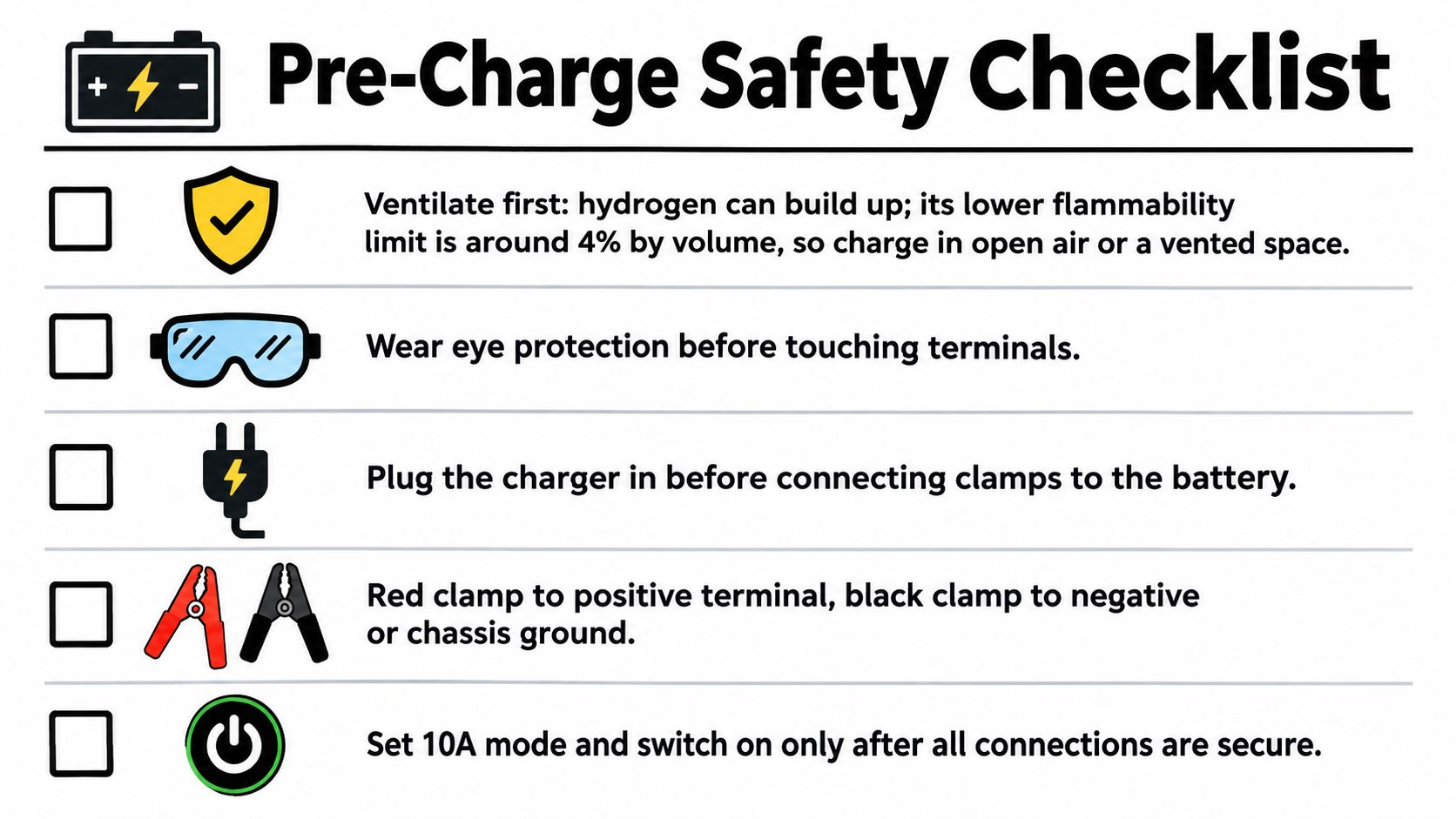
That doesn't mean a garage door cracked open is a universal safety plan. Charge flooded batteries in open air or a properly vented area, keep sparks, flames, cigarettes, and other ignition sources away, and leave vent caps in place. Stop charging if you notice an unusual odor, excessive heat, or visible gassing.
Run this checklist before applying power
- Identify chemistry: Confirm flooded, AGM, gel, sealed lead-acid, or lithium.
- Inspect the case: Don't charge a swollen, cracked, leaking, or visibly damaged battery.
- Confirm voltage: Check that the battery and charger are both intended for the same nominal system.
- Select the mode: Choose the exact chemistry and current setting before starting.
- Control heat: Keep the charger and battery out of direct Central Valley sun and allow air movement around both units.
- Connect securely: Red goes to positive, black goes to negative or an approved chassis ground.
- Define the stop condition: Disconnect if the battery becomes unusually hot, vents excessively, or behaves abnormally.
A Sacramento service truck may move from a shaded morning setup to a hot asphalt lot by afternoon. That temperature change can make an already marginal battery and charger combination less forgiving, so don't hide the charger under a tarp or inside a sealed toolbox while it operates.
For maintenance habits that reduce avoidable battery failures, see this guide on how to extend battery life. A 30-Day Peace of Mind Guarantee can help if a tested and inspected charger misbehaves out of the box, but no return policy replaces ventilation, correct connections, or stopping a dangerous charge.
The following video demonstrates connection and charging precautions:
Who This Charger Is For and Where Value Fits In
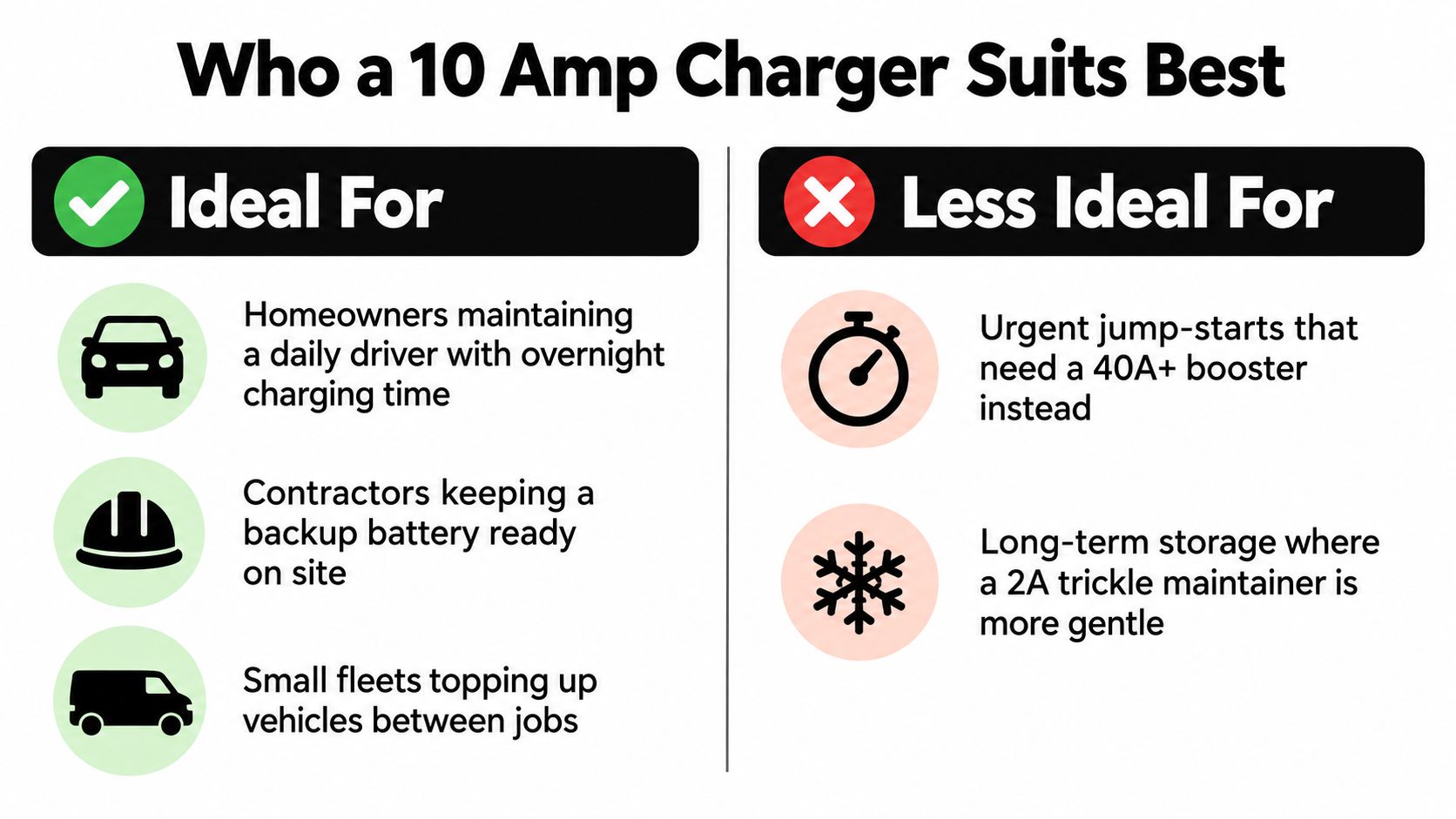
A 10 amp charger earns its place when charging time is available and the battery is large enough to accept the current under the manufacturer's guidance. It's a practical tool for several working situations.
- Homeowners: A daily driver can be charged overnight instead of relying on repeated jump starts.
- Contractors: A backup trailer or standby battery can be restored between shifts.
- Boat and RV owners: Deep-cycle batteries can be serviced when the vehicle isn't moving.
- Small fleets: Vehicles and equipment can rotate through charging when same-day turnaround isn't required.
It isn't the right choice for every operator. Owners of very large battery banks may need a higher continuous output, crews facing an urgent same-day recovery may need a shop charger or booster, and a single small powersports battery may be better served by a 2 amp setting. A 10 amp charger also won't solve a battery that has failed internally.
What to inspect before buying open-box equipment
Open-box equipment can make sense when the seller tests the unit instead of treating the box condition as the product's only issue. Inspect the housing for impact damage, check that the cables aren't brittle, confirm the clamps open and hold firmly, and look for a readable model label. Ask whether the charger was tested under load and whether the chemistry modes and float function were verified.
That standard applies to more than chargers. A bare tool, or herramienta sola, makes sense when you already own compatible batteries, just as an impact driver, or atornillador de impacto, may be a better purchase than another full kit. Brushless, or sin escobillas, tools still need inspection of the battery interface, trigger, and housing before they go into daily service.
Value-focused inventory is useful when it includes tested and inspected open-box or bare tools, savings of up to 55% off typical retail pricing, and a 30-Day Peace of Mind Guarantee with returns by mail or in-store and free return shipping on defective items. For Northern California crews, fast 1-day delivery and same-day Elk Grove warehouse pickup can matter when a dead battery has already delayed a shift. Compare the charger's actual specifications, not just the discount.
A discharged 100 Ah battery may require roughly 12.5 hours in real conditions, so a 10 amp model is generally suited to overnight recovery rather than same-day fleet turnaround, as outlined in this 20 amp battery charger comparison.
Buying Recommendation and Common Questions
Buy a 10 amp battery charger if you maintain common 12 V lead-acid batteries, can allow overnight charging, and want controlled recovery rather than emergency starting power. Choose a smart, continuous-duty model with the correct flooded, AGM, gel, sealed lead-acid, or lithium setting, plus reverse-polarity, short-circuit, and thermal protection. If you're preparing golf-cart equipment, separate Solana EV golf cart charging tips can help you distinguish charger requirements by vehicle and battery system.
Can a 10 amp charger safely charge a lithium battery?
Only when the charger has a lithium-specific profile and is compatible with the battery-management system. A conventional lead-acid charging mode shouldn't be assumed safe for LiFePO4 batteries.
How long does a 10 amp charger take to charge a car battery?
It depends on capacity, starting state of charge, battery condition, and absorption tapering. Theoretical amp-hour division is only a first estimate, and a partially discharged battery will take less time than a fully discharged battery of the same capacity.
Can I leave a 10 amp charger connected overnight?
You can leave it connected overnight when the charger is designed for automatic multistage charging and genuine float maintenance, the battery is compatible, and the charging area is safe and ventilated. Don't leave a manual unit unattended unless its instructions and your operating procedure explicitly support that use.
How does a 10 amp charger compare with a 2 amp maintainer?
A 10 amp charger restores capacity faster for suitable batteries, while a 2 amp maintainer is gentler for small batteries and long-term storage. Choose based on battery size, manufacturer limits, and whether you need recovery or maintenance.
Value Tools Co offers tested and inspected open-box and lightly used equipment, including chargers and trade tools, with savings up to 55% off typical retail pricing and a 30-Day Peace of Mind Guarantee. Visit Value Tools Co to find a chemistry-matched charger online or arrange same-day Elk Grove pickup before the next shift.


