

You're standing there with a grinder in one hand and a pile of discs in the truck, and the question isn't which one is cheapest. It's which one won't grab, shatter, or burn up the job before lunch. With angle grinder discs, the right pick is a matched system, disc shape, RPM rating, arbor size, and guard all have to line up, or you're gambling with the tool and your hands.
The mistake I see most often is simple. A guy reaches for whatever disc is nearby, drops it on a grinder that spins faster than the wheel was meant to see, and trusts the label because the package looks professional. That's how you end up with broken wheels, damaged work, and a trip to urgent care that costs more than the whole box of discs. If you buy open-box or bare-tool grinders, the same rule still holds, the savings only matter when the disc-tool match is right.
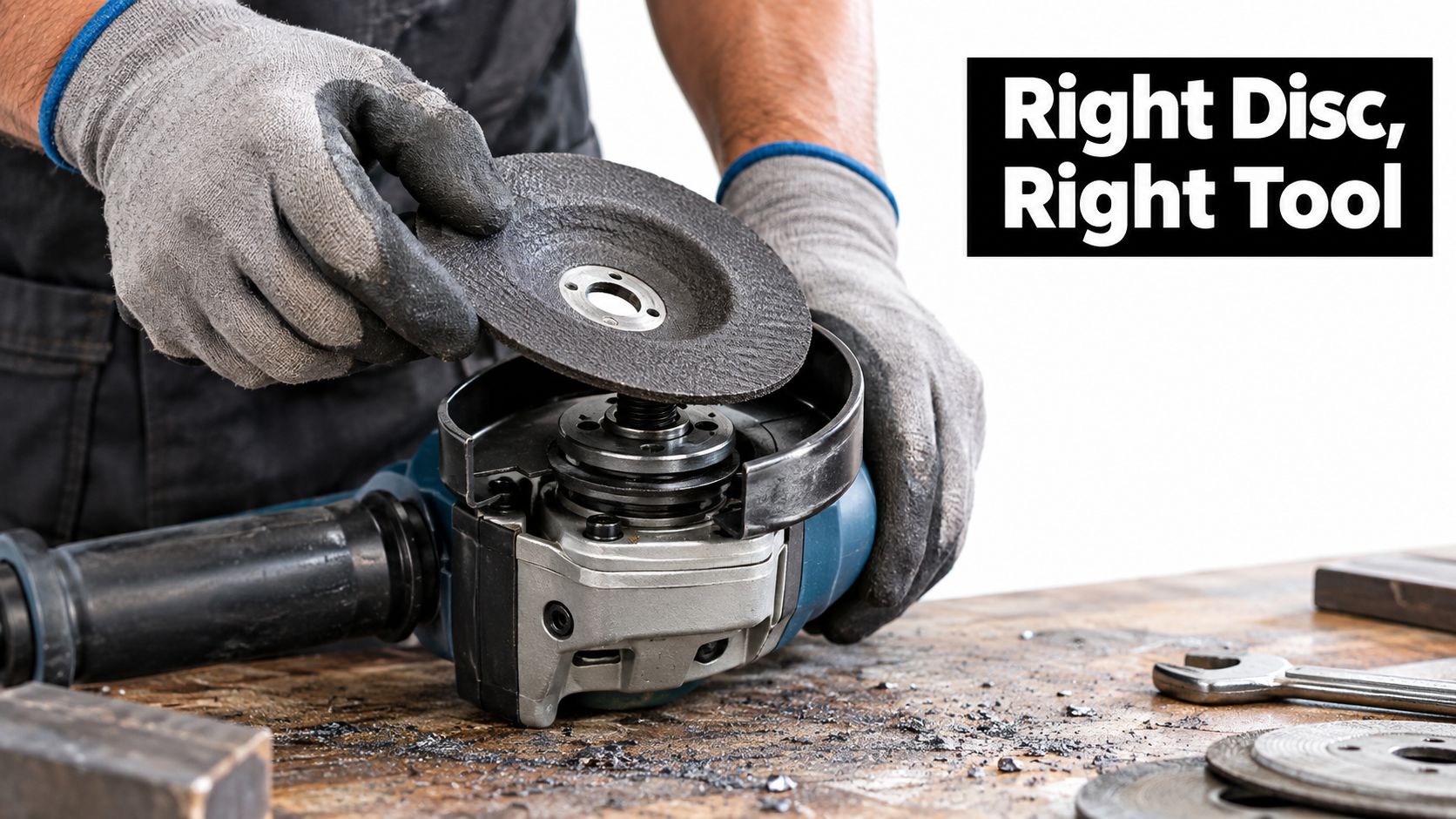
Why Most Angle Grinder Disasters Start with the Wrong Disc
A Sacramento welder on a fab crew swaps a 4-1/2-inch cut-off wheel onto a grinder rated for 11,000 RPM. The wheel is marked for 8,500 RPM. Before it touches the steel, that setup is already outside the wheel's design envelope. The label may look professional, but the rating mismatch is still there.
The same problem shows up when a depressed-center grinding wheel gets used like a cut-off disc, or when someone leans on a thin wheel as if it were a flap disc. The wheel loads unevenly, the cut wanders, and a small handling mistake can turn into broken abrasive, damaged material, or a trip to urgent care. The mechanics behind those failures are covered in this angle grinder accidents guide.
Practical rule: choose the disc for the job geometry, then verify the grinder speed, guard fit, and arbor size before comparing prices.
Disc diameter, type, and RPM rating are a matched system. OSHA's abrasive-wheel safety requirements require the grinder's spindle speed to stay at or below the disc's marked maximum operating speed. Do not round the numbers up because the job is behind schedule. The same check applies to a premium wheel, a bargain pack, or an open-box grinder from Value Tools Co.
For Sacramento and Central Valley crews, a same-day Elk Grove pickup can keep work moving after a wheel splits or a grinder gets replaced. It does not make an incompatible disc safe. With an open-box unit, inspect the guard, flange, and spindle before installing anything. In Spanish-speaking crews, the same check may be called the disco de corte setup, but the hardware still has to match.
A disc is not a universal accessory. Its shape controls contact with the work, while its speed rating determines whether it can survive the rotation. If either specification is wrong, the wheel is fighting its own design.
Angle Grinder Disc Types and When Each One Actually Works
Cutting, grinding, and shaping are not the same job
A cut-off wheel is built to slice with its edge, not to grind on its face. Push it sideways, twist it in the cut, or try to use it like a sanding disc, and you're loading a thin wheel in a way it wasn't built to handle. That's why a disc that looks “strong enough” can still fail fast in real work.
Type 27 grinding wheels, sometimes listed as Type 42 in some catalogs, are for flat grinding or shallow angle work. Type 28 wheels have a depressed center and a shape that helps with aggressive surface removal at shallow angles. They're not interchangeable with thin cut-off wheels, and they're not meant to be used the same way. A Type 27 wheel fits weld blending and cleanup well, while a Type 28 makes more sense when you want broader contact and better control on shallow stock removal.
Match the disc to the task
- Cut-off wheel: best for pipe cutoff, rebar, threaded rod, and other straight cuts, with the limitation that it hates side pressure.
- Grinding wheel: best for weld blending, beveling, and steel cleanup, with the limitation that it's not a cutting disc.
- Flap disc: best for smoothing, deburring, and light blend work, with the limitation that it removes material more slowly than a hard wheel.
- Wire wheel: best for paint, rust, and coating removal, with the limitation that it's not for shaping edges.
- Diamond disc: best for masonry, tile, and concrete edge trimming, with the limitation that it's a different animal from metal-cutting abrasives.
| Angle Grinder Disc Types by Job | Best For | Key Limitation |
|---|---|---|
| Cut-off wheel | Straight cuts in metal | Side loading breaks wheels fast |
| Type 27 grinding wheel | Weld blending, beveling, cleanup | Not for cutting through stock |
| Type 28 wheel | Aggressive shallow-angle grinding | Less versatile than a flat wheel |
| Flap disc | Finishing and smoothing | Slower for heavy stock removal |
| Wire wheel | Rust, paint, scale removal | Poor choice for shaping |
| Diamond disc | Masonry and tile | Wrong choice for most metal work |
If you're working with a framing nailer / clavadora de marcos, an impact driver / atornillador de impacto, or a brushless / sin escobillas kit on the same crew, the grinder disc choice still stands on its own. A cutting wheel is not a grinding wheel, even if the arbor fits and the package color looks similar. That's where cheap mistakes turn into stalled jobs.
If you want to dig deeper into wheel safety and fit, the angle grinder saw blade discussion is useful context for crews that switch between cutting accessories. A lot of the same logic applies, the tool doesn't care what the box says if the geometry is wrong.
Abrasive Grain Choices and Real Cost Per Cut
Cheap upfront doesn't always mean cheap to run
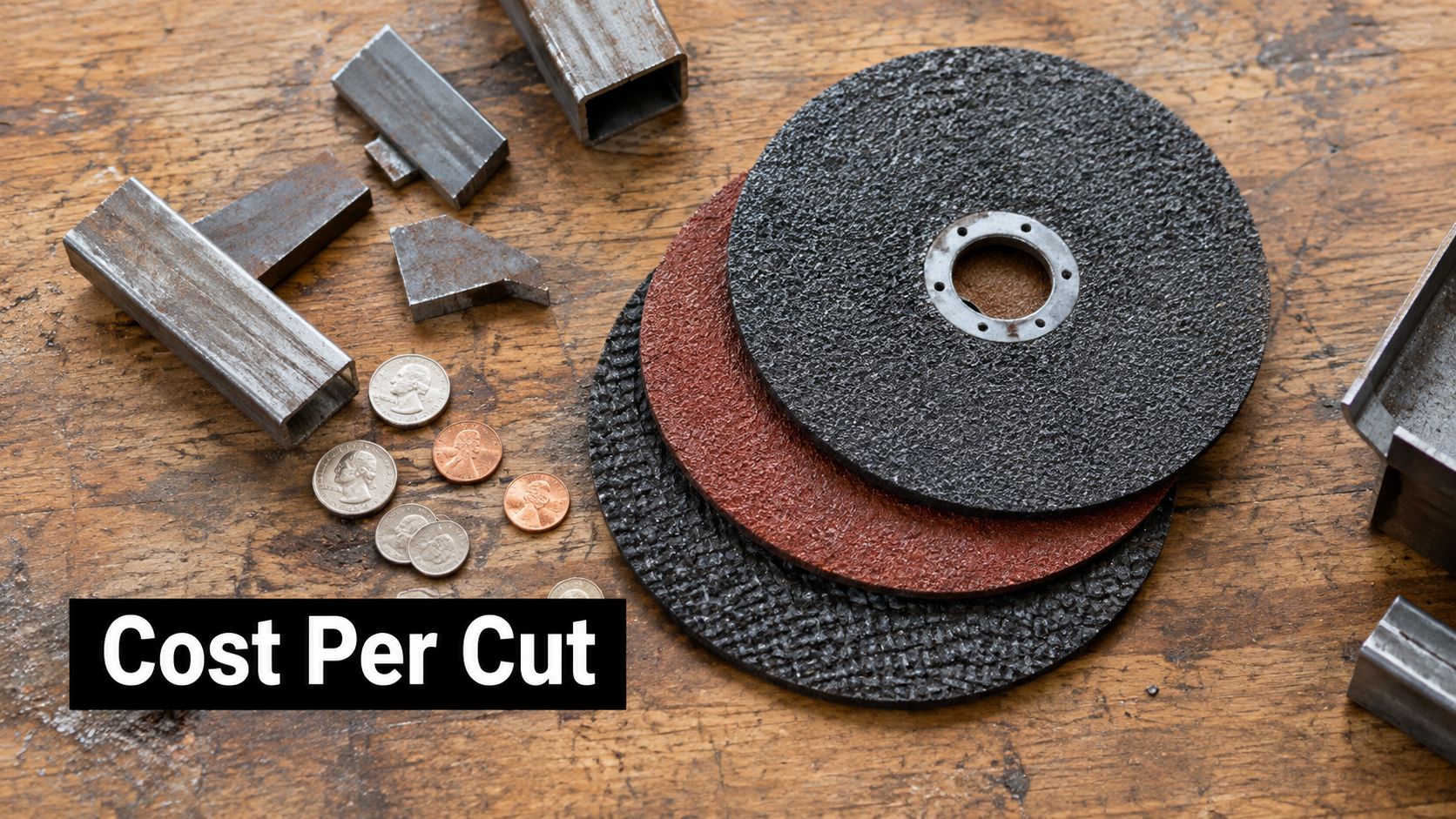
Aluminum oxide is the old standby for a reason. It's a solid, lower-cost abrasive for routine carbon-steel cutting and grinding, and for a homeowner or occasional maintenance user, that's often enough. The grain wears in a predictable way, so you know what you're getting.
Zirconia alumina is where the math changes for heavier users. Norton's comparison reports about a 50% increase in cut rate and up to three times the life versus aluminum oxide in the cited applications, which is a big deal when labor matters more than the price on the shelf. Norton's abrasive comparison makes the trade-off plain, better cutting and longer life can justify the higher buy-in if you're doing weld cleanup, structural steel work, or frequent grinding.
Grit size changes the finish and the pace
Coarser grits remove stock faster, but they leave a rougher surface. Finer grits slow the cut down and leave a cleaner finish, which is why they fit blend-and-polish work better. That's not a branding issue, it's basic trade-off math.
A disc that cuts faster but dies sooner isn't always more expensive, it depends on how often you stop to change wheels.
The right call depends on the job and who's paying for the downtime. A DIYer doing occasional steel repair can stick with aluminum oxide and do fine. A contractor in the field all week usually gets more value from zirconia or a blended abrasive because fewer wheel changes mean fewer interruptions, less frustration, and less lost time on the clock.
RPM Ratings, OSHA Speed Rules, and Guard Compatibility
A disc can fit the arbor and still be wrong for the grinder. Before mounting any wheel, compare the disc's printed RPM rating with the tool's maximum spindle speed. The grinder must run at or below the disc's rated speed. OSHA's general-industry standard, 29 CFR 1910.215, connects wheel speed, spindle speed, and guarding requirements. The OSHA 1910.215 rule is the baseline I use in a Sacramento-area shop or on a Northern California jobsite. Check the velocidad máxima, or maximum speed, before the wheel touches the flange.
What the guard has to do
Guard selection depends on peripheral speed, not just grinder size. Certain guards are permitted when operating speed stays at or below 8,000 surface feet per minute. Above that point and up to 16,000 surface feet per minute, the rule calls for stronger cast-steel or structural-steel guards. Oregon OSHA warns that a shattered wheel assembly can send fragments traveling at more than 300 miles per hour. Its Oregon OSHA abrasive-wheel guidance puts the hazard in practical terms: the guard, or guardia, has to stay in place and do its job.
| OSHA Guard and Speed Requirements at a Glance | Threshold / Rule |
|---|---|
| Maximum wheel speed | Wheel rating must meet or exceed grinder spindle speed |
| Guard type below threshold | Certain guards allowed up to 8,000 surface feet per minute |
| Guard type above threshold | Stronger cast-steel or structural-steel guards required above 8,000 and up to 16,000 surface feet per minute |
| Grinder contact angle | About 5 to 15 degrees for grinding |
| Wheel shatter hazard | Fragments can exceed 300 miles per hour |
For a wider machine-safety reference, find guarding requirements covers guarding across different tool types. On an angle grinder, keep the manufacturer's guard installed and set it between you and the exposed portion of the wheel. Our right-angle grinder guide explains how guard style and tool class affect setup. Inspect the disc before mounting, seat the flanges cleanly, and let the grinder reach full speed before contacting the work. Stand out of the wheel's rotation plane during startup.
The pre-mount checks that prevent failures
- Inspect the wheel: Reject cracks, chips, warping, or heavy wear.
- Check the speed rating: The grinder's maximum speed must not exceed the disc's marked limit.
- Keep the guard on: Position it to direct fragments and sparks away from your body.
- Use the right contact angle: Grind at about 5 to 15 degrees instead of laying the wheel flat.
- Start at speed: Let the tool reach operating speed before touching the workpiece.
The RPM check and guard setup take less time than an injury shutdown. If the disc, flange, and spindle do not match cleanly, stop and choose compatible hardware. Never force the fit.
Real Jobsite Applications and Choosing the Right Combo
Metal cutting, stainless work, masonry, and cleanup jobs each reward a different disc setup. A carbon-steel cut-off wheel on stainless steel is a bad call because you can contaminate the work, and a thin wheel leaned on like a grinder wheel is asking for side-load failure. The right choice usually comes down to what the disc is allowed to touch, not just what it can physically spin on.
For weld blending, a Type 27 grinding wheel or a flap disc usually makes more sense than a cut-off wheel. For pipe cutting, a thin cut-off wheel gets the job done faster and cleaner, but only if you keep the disc square and avoid twisting it in the kerf. For masonry edge trimming and tile work, a diamond disc belongs in the grinder, not a metal abrasive wheel. If you want a broader practical comparison for concrete jobs, the guide for facility managers on concrete polishing is a useful companion piece for teams handling floors and prep work.
What changes on a real crew
Sacramento summer heat changes tool behavior, especially with battery grinders. Batteries run hotter, cooling is slower, and a crew that leaves packs baking in the truck loses performance before the first cut of the afternoon. That's where same-day Elk Grove pickup and fast Northern California delivery can matter, because a dead wheel or overheated battery shouldn't stop a finish pass, a demo task, or a punch-list repair.
If you're buying an open-box grinder, inspect more than the motor label. Check the guard, flange, and spindle condition before trusting a new disc, because worn hardware changes how the wheel sits and how the grinder behaves under load. That's true whether you're using a bare tool, a refurbished unit, or a fresh box off the shelf.
The failure modes are different, but the buying rule stays the same. Use a disc that matches the material, the contact direction, and the speed rating. If those three don't line up, the disc choice is wrong even if the box says it fits.
Who Should Use This Guide and How to Buy Confidently
Who This Is For
This guide is for contractors who wear through discs on steel, remodelers who need one grinder for cleanup and finish work, property managers who want fewer tool surprises, and DIY users who prefer buying once over buying twice. It also helps buyers control costs without giving up dependable hardware. Open-box and bare-tool grinders can be practical choices when the unit works properly and the disc, guard, arbor, and speed rating all match.
Value Tools Co suits that buying approach with tested and inspected tools, a 2-Day Exchange Guarantee, a 2-day return window for fast exchanges, and free return shipping on defective items. Value Tools Co lists open-box and bare tools at up to 55% off typical retail pricing on its site. The savings only help when the grinder and disc belong together. A low price on the wrong wheel still leaves you with the wrong wheel.
Who Should Avoid This
Avoid bargain shopping if you expect one disc to cut, grind, and polish interchangeably. Do not remove the guard to reach a tight spot, and do not ignore the disc's RPM limit because the grinder appears to run normally. The tool requires the correct fit, speed rating, and loading behavior, regardless of how experienced the operator feels.
| Disc Selection Decision Matrix | What to Verify |
|---|---|
| Diameter | Matches the grinder and the job space |
| Arbor size | Fits the spindle without forcing |
| RPM rating | Higher than the grinder's maximum spindle speed |
| Disc thickness | Appropriate for cut-off or grinding use |
| Bond type | Suits the material and loading style |
| Contact direction | Edge for cutting, face or shallow angle for grinding |
Quick buying logic that holds up on the job
Begin with the grinder. Confirm its spindle speed, guard style, and arbor size before choosing a disc. Then match the wheel to the material and the job geometry. Select abrasive grain and grit according to the amount of stock you need to remove and the finish you need to leave.
A Sacramento-area buyer should also check replacement availability before committing to an unusual size or disc type. Northern California crews lose more time waiting on a replacement than comparing a few options at the counter. Match the tool, match the wheel, and use price as the final filter.
For inspected, affordable jobsite tools, visit Value Tools Co and compare open-box and bare-tool options with the task at hand. Northern California crews can keep a suitable grinder available without paying full retail when that premium is unnecessary.


