

You're halfway through a Sacramento remodel, the grinder is screaming, and the disc you grabbed looks close enough to a circular saw blade. It may fit the spindle, but that doesn't make it safe. An angle grinder saw blade must match the grinder's speed, guard, arbor, and material, and a standard toothed circular saw blade is generally the wrong accessory.
For most jobs, use a grinder-rated abrasive cutoff wheel for steel, a diamond blade for masonry, or a purpose-built carbide accessory that specifically states it's approved for grinder use. The decision is less about finding a blade that mounts and more about choosing an accessory designed to survive the grinder's speed and kickback behavior.
What an Angle Grinder Saw Blade Actually Is
On a hot Central Valley afternoon, a framer may reach for a 4.5-inch grinder to trim EMT conduit, cut a stubborn bolt, or clean up a piece of angle iron. The tool is compact and convenient, but its cutting accessory determines whether the pass feels controlled or turns into a wrestling match. An angle grinder saw blade is any rotary cutting accessory designed for the spindle of an angle grinder, including abrasive cutoff discs, diamond blades, carbide-grit wheels, and limited-purpose wood-cutting accessories.
The phrase creates confusion because many shoppers use “saw blade” to mean any round cutting disc. A circular saw blade belongs to a saw platform with a fixed base, controlled feed direction, and a guard designed around toothed cutting. An angle grinder uses a threaded spindle, a backing flange, a clamping nut, and a guard positioned to contain debris from a high-speed wheel. The two accessory systems aren't interchangeable just because the center hole appears to fit.
The grinder's no-load RPM drives the selection. Angle grinders as a tool class were first industrialized in 1954, when Ackermann + Schmitt, now FLEX, launched the first high-speed angle grinder, as documented in the history of the angle grinder. Portable grinders can operate around 10,000 RPM, with the wheel edge traveling up to about 180 mph, which explains why a disc's speed rating and guard coverage matter so much.
Practical rule: A disc that fits the spindle but lacks a grinder-compatible speed rating, guard arrangement, or accessory designation doesn't belong on the tool.
Before buying, confirm the grinder class, spindle thread, disc diameter, bore, and guard size. Value Tools Co's guide to the right angle grinder is useful for checking the grinder itself before you start comparing accessories. The main shelf categories are abrasive cutoff wheels, grinding wheels, diamond blades, carbide accessories, flap discs, and wire wheels.
Main Blade and Disc Types You Will See on the Shelf
A hardware-store peg wall can make every round disc look interchangeable. It isn't. The abrasive type, construction, thickness, and intended cutting direction all change how the grinder behaves.
Abrasive cutoff wheels for metal
Type 1, also called Type 41, cutoff wheels are the normal choice for steel, rebar, EMT, Unistrut, bolts, and stainless. Thin metal discs commonly range from 1.0 to 1.6 mm, while general-purpose metal discs are often 2.5 to 3.2 mm, according to Norton abrasive disc specifications. Thinner wheels make a narrower kerf and require less push force, but they don't tolerate twisting, prying, or side loading.
A depressed-center Type 27 wheel is made for grinding and stock removal, not ordinary straight cutting. It can remove weld bead and shape steel, but using a grinding wheel as a thin cutoff disc changes the load on the wheel and the guard.
Diamond blades for masonry and tile
Segmented diamond blades clear dust effectively and suit concrete, block, brick, and pavers. Turbo-rim blades generally offer a useful balance between cutting speed and edge control. Continuous-rim diamond blades produce cleaner tile cuts, though they're less appropriate for aggressive concrete work.
Dry-cut diamond blades are sold specifically for angle grinders and masonry saws. Because dry cutting has no water cooling, periodically lifting the blade from the cut allows it to spin freely and cool, as described in this dry-cut diamond blade guide.
Carbide accessories and surface-preparation wheels
Carbide-grit or purpose-built carbide-tipped wheels can handle selected wood, plastic, demolition material, and nail-embedded lumber. They're the only toothed-style category worth considering, and only when the product is explicitly rated and sold for angle grinders. Flap discs and wire wheels also appear nearby, but they're surface-preparation accessories rather than saw blades.
| Disc Type | Best For | Typical Thickness | Best Use Case |
|---|---|---|---|
| Type 1 cutoff wheel | Steel, stainless, rebar, EMT | 1.0–1.6 mm for thin discs, 2.5–3.2 mm for general-purpose discs | Straight metal cuts |
| Type 27 grinding wheel | Welds, heavy stock removal | Thicker grinding construction | Grinding and shaping |
| Segmented diamond | Concrete, brick, block, pavers | Product-specific | Fast dry masonry cuts |
| Turbo diamond | Masonry and general concrete | Product-specific | Controlled, moderately aggressive cuts |
| Continuous-rim diamond | Tile and porcelain | Product-specific | Cleaner tile edges |
| Grinder-rated carbide accessory | Wood, plastic, mixed demolition | Product-specific | Specialized carving or cutting |
For broader renovation planning, it's also useful to browse essential renovation equipment and separate cutting tools from grinding and fastening tools before loading the truck.
Sizing, Arbor, and RPM Rules That Keep You Safe
Three markings decide whether a disc is compatible: diameter, arbor, and maximum RPM. Check all three before mounting. Diameter controls guard fit and cutting depth, arbor controls the mechanical connection, and RPM controls whether the disc can withstand centrifugal force.
Common handheld grinder sizes include 4.5, 5, 7, and 9 inches. The 4.5-inch grinder is the jobsite workhorse because it's easy to control and handles common metal cutoff work. Larger 7-inch and 9-inch grinders require the correct larger guard and a disc rated for that tool class.
Arbor conventions vary by accessory and tool. Handheld grinder wheels commonly use a 22.23 mm bore, while other setups may use 5/8-inch, 7/8-inch, or 20 mm bores. A step-down ring may allow a larger spindle opening to accept a smaller arbor, but a ring never makes an unsuitable disc safe. It only addresses fit.
The maximum operating speed must be printed on the wheel and must exceed the grinder's no-load speed. Common gathered ratings include 12,200 to 12,250 RPM for 125 mm wheels, 8,500 RPM for 180 mm wheels, and 6,600 RPM for 230 mm wheels. Many abrasive discs also carry an 80 m/s peripheral-speed rating, as explained in this abrasive-wheel speed glossary.
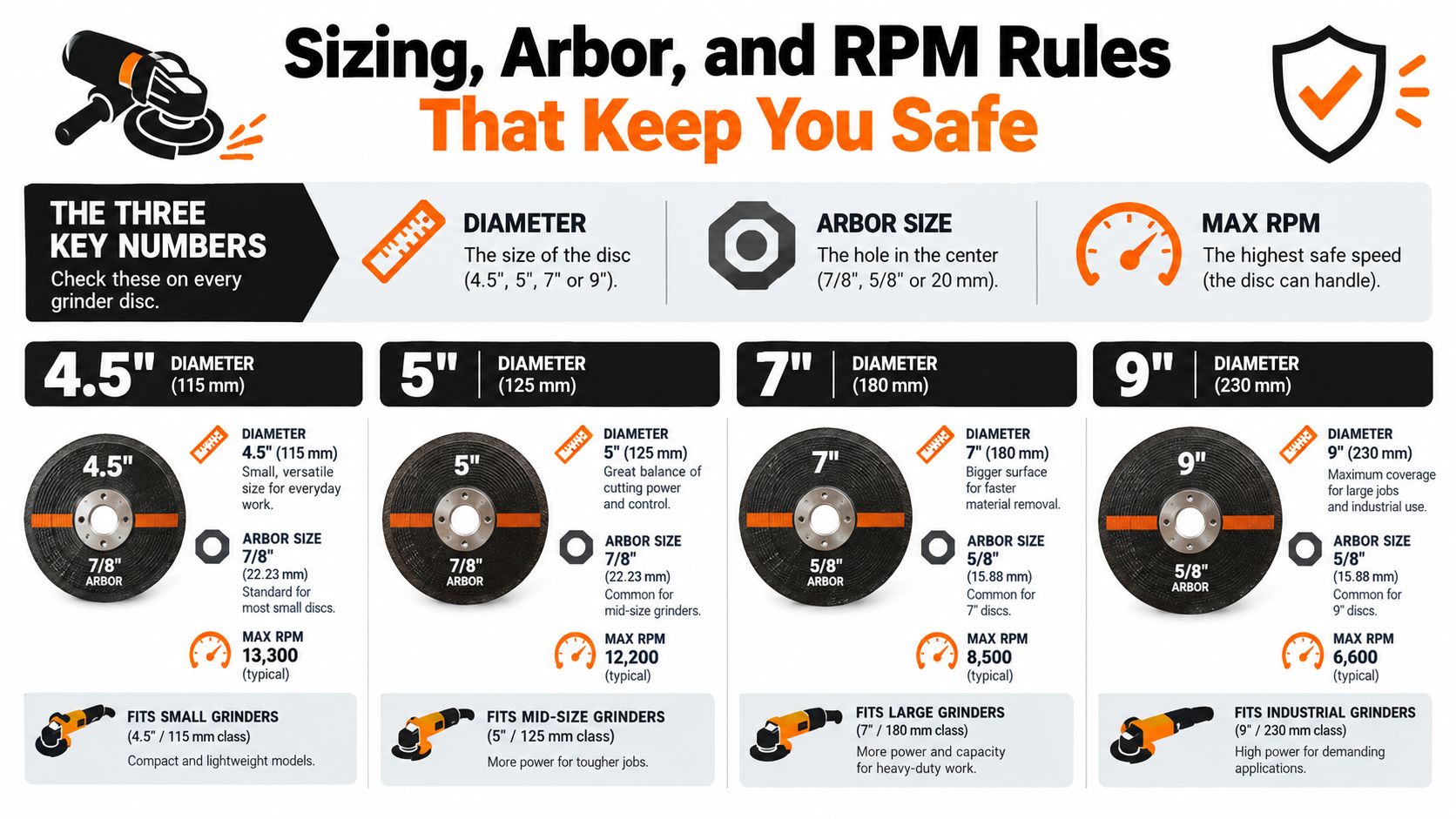
Use this pre-mount check:
- Diameter: Confirm the disc matches the grinder's guard.
- Arbor: Verify the bore sits correctly on the flange without forcing.
- RPM: Confirm the disc's maximum operating speed is at least the grinder's rated no-load speed.
- Condition: Reject cracks, chips, moisture damage, or a wheel that was dropped.
- Guard: Make sure the disc stays behind the guard and the guard deflects debris away from you.
Why a Toothed Saw Blade Does Not Belong on a Grinder
Bolting a wood-cutting circular saw blade onto an angle grinder isn't a clever shortcut. It combines a high-speed handheld motor with a blade designed for a different arbor, guard, feed direction, and cutting platform.
Industry safety commentary places typical grinder speeds around 9,000 to 11,000 RPM, while toothed saw blades are commonly intended for much lower speeds, according to angle grinder safety guidance from The Fabricator. The exact mismatch depends on the tool and blade, but the mechanism is consistent. A grinder keeps driving through a sudden tooth catch, while a circular saw's base and guard help manage that event.
Three failures concern me most on a real jobsite:
- Kickback: A tooth catches, the blade stalls, and the grinder rotates toward the operator before the tool can be controlled.
- Tooth or blade failure: A tooth can break loose, or the blade can fracture under a load it wasn't designed to absorb.
- Climb-out: The blade can rise out of the kerf and travel into the operator's leg or torso.
Safety alerts from UK and Australian regulators specifically warn that toothed saw attachments increase kickback and loss-of-control risk. A 2026 UK product-safety report again identified an angle grinder sold with a toothed saw blade attachment, showing that this remains a current market problem, not an old workshop myth, as documented in the Heimerdinger angle grinder safety report.
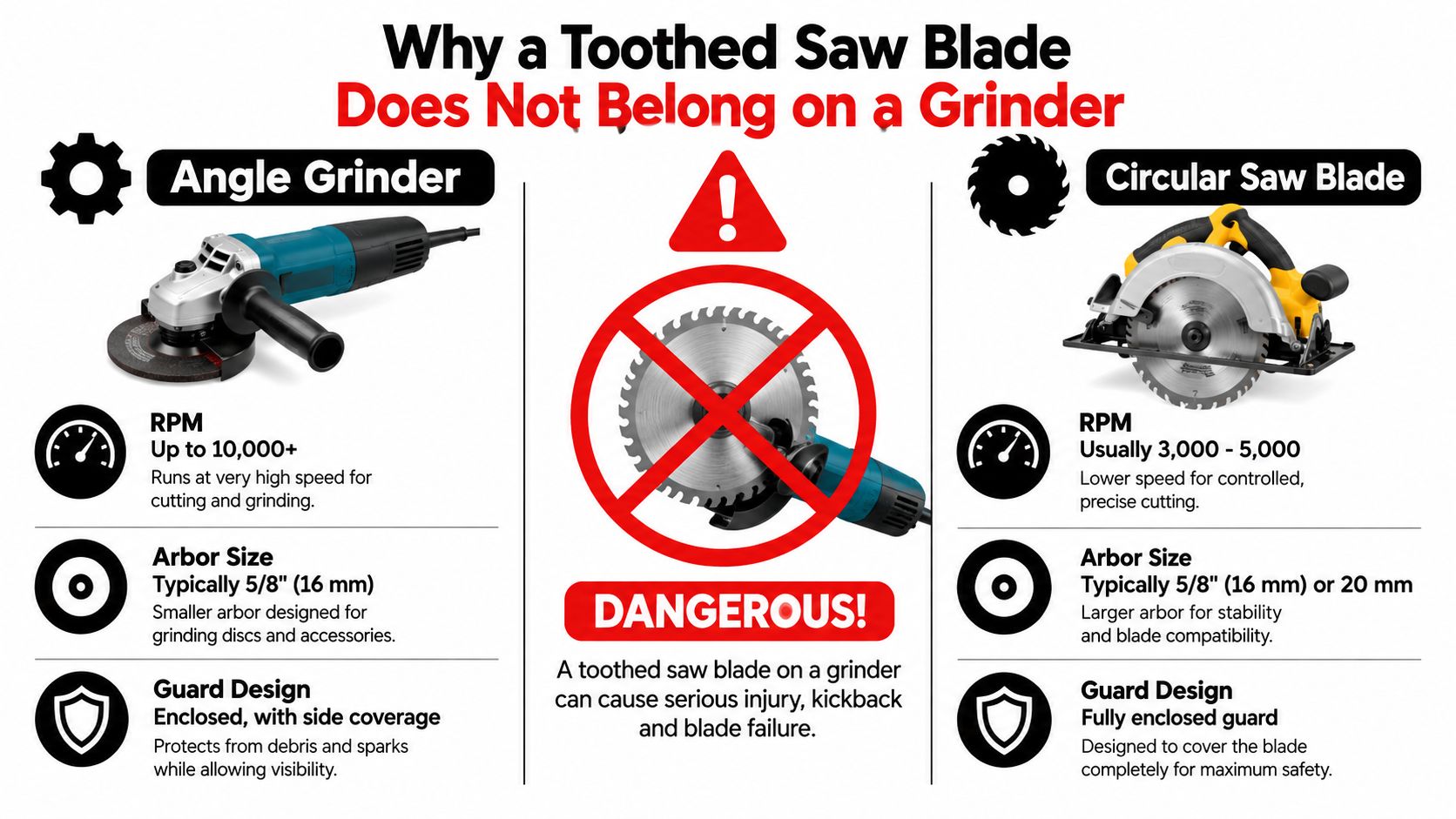
Safer substitutes include grinder-rated abrasive cutoff wheels, diamond tuck-point blades, masonry diamonds, and purpose-built wood-carving accessories that explicitly state grinder compatibility. If it has teeth and wasn't sold for your grinder, leave it on the shelf.
Matching the Disc to the Material You Are Cutting
The material should decide the disc, not the shape of the accessory. On a Sacramento-area framing or remodeling job, the most common mistake is carrying one general wheel from steel to concrete to wood and expecting predictable control.
| Material | Recommended Disc | Typical Thickness | RPM / Arbor Notes |
|---|---|---|---|
| Rebar, angle iron, EMT, Unistrut | Type 1 thin metal cutoff wheel | 1.0–1.6 mm | Match printed RPM to grinder, confirm 22.23 mm bore where applicable |
| Heavy plate and rusty bolts | Thicker metal cutoff wheel | 2.5–3.2 mm | Use only for straight cuts, never pry with the disc |
| Concrete, brick, block, pavers | Segmented or turbo diamond | Product-specific | Dry-cut rating and grinder RPM must match |
| Tile and porcelain | Continuous-rim diamond | Product-specific | Prioritize controlled feed and edge quality |
| Cast iron and masonry block | Silicon carbide abrasive or suitable diamond | Product-specific | Confirm material and speed rating |
| Wood, plastic, mixed demolition | Grinder-rated carbide or carving accessory | Product-specific | Use only if the manufacturer approves grinder use |
For steel rebar, angle iron, and EMT, a thin cutoff wheel usually gives the cleanest control with the least material loss. Thin wheels reduce kerf width, heat input, and push force, but they're vulnerable to binding, so keep the cut straight and don't twist the grinder.
For masonry, a segmented or turbo diamond blade is the practical choice. Dry cutting demands heat management, especially during long passes in concrete or block. Tile work calls for a continuous rim when edge quality matters more than aggressive stock removal.
Wood is the category where shoppers get into trouble. If the task involves timber framing or outdoor timber structures, use a circular saw, reciprocating saw, or a grinder-rated carving accessory rather than adapting a circular saw blade. The right platform is often safer and faster than forcing the grinder to do a saw's job.
Jobsite Safety Habits That Actually Prevent Injuries
A grinder injury usually starts before the wheel touches the material. The operator installs the wrong disc, removes the guard for visibility, or holds loose stock in one hand while cutting with the other. OSHA guidance for abrasive-wheel machinery, including OSHA 1910.215, and ANSI B7.1 safety principles both place strong emphasis on guarding, wheel condition, and correct operating practice.
The risk isn't theoretical. One safety reference cites nearly 25,000 U.S. angle-grinder injuries in 2008, while UK surveillance cited by the HSE points to roughly 5,000 injuries per year. The same reference says nearly half of abrasive-wheel accidents were linked to unsafe systems of work or operator error, and a 3M safety summary lists cuts and similar wounds at 41% and eye injuries at 37%. These figures are reported in the HSE abrasive-wheel safety reference.
Wear the PPE you'll need:
- Eye protection: Use Z87.1-rated safety glasses and add a full face shield for cutting.
- Head and hand protection: Wear an ANSI Z89.1 hard hat on active sites and suitable leather work gloves.
- Hearing protection: Use it when the grinder and material produce hazardous noise.
- Respiratory protection: Use appropriate respiratory protection for masonry dust or treated wood.
Inspect the wheel before mounting. Check the printed speed rating, bore, guard fit, visible cracks, moisture staining, and any expiration or shelf-life marking. A ring test may identify a damaged vitrified wheel, but it doesn't replace visual inspection or the manufacturer's instructions.
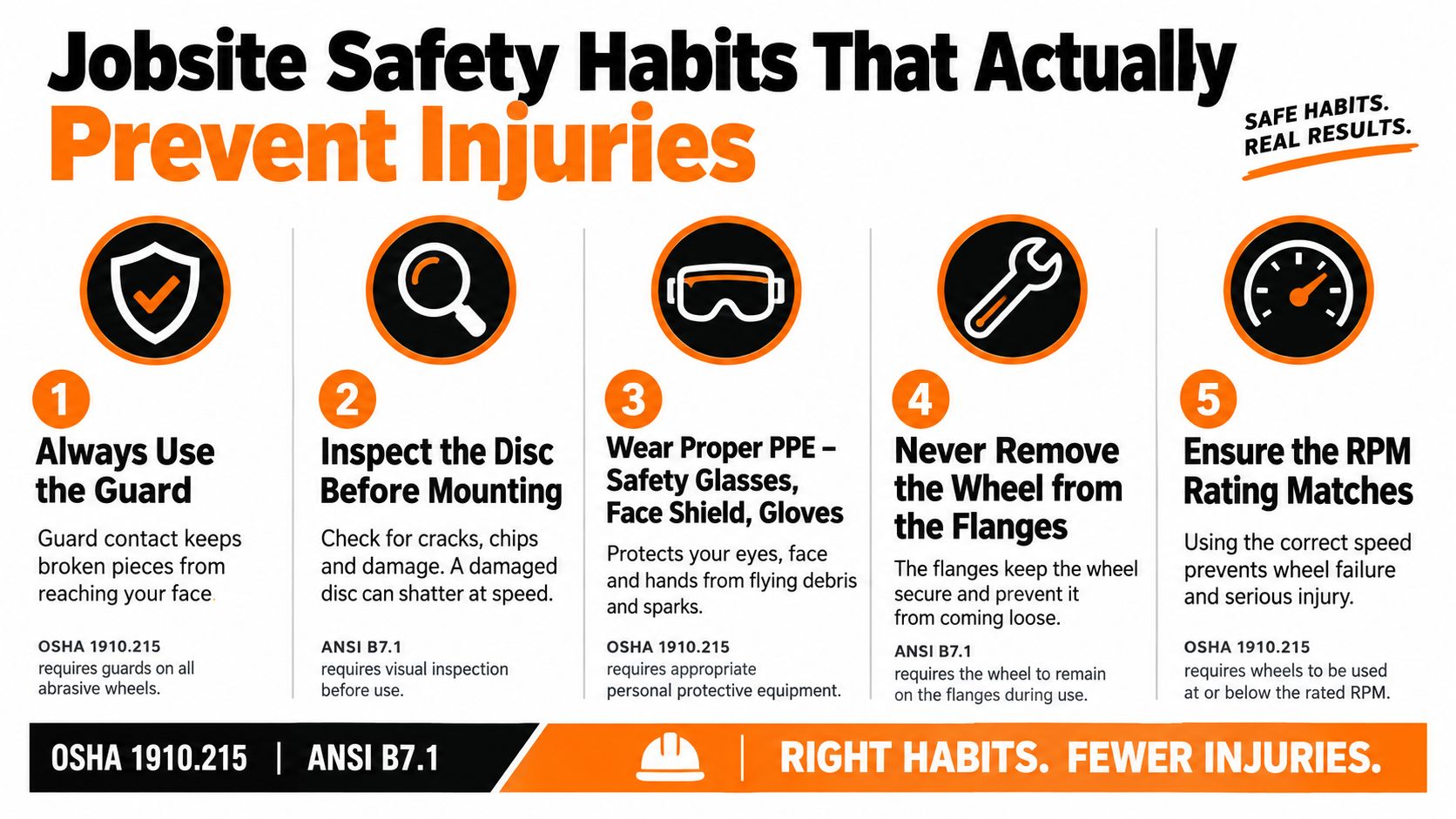
Clamp the work so the kerf won't close on the wheel. Keep the cord or battery away from the cutting path, stand out of the wheel's rotation plane, and let the wheel stop before setting the tool down. Use the side handle and both hands whenever the material could bind.
For a practical look at common failure modes, review Value Tools Co's guide to angle grinder accidents before putting a new accessory into service.
Smart Buying Tips and How to Get More for Less
Buying the cheapest disc on the peg wall can cost more when it burns through quickly, wanders in the cut, or contaminates a stainless weld zone. Thin abrasive wheels make sense for repetitive EMT, rebar, and light steel work, while diamond blades earn their price when you're cutting masonry or need consistent diameter retention.
For a busy crew, buying abrasive wheels in bulk can reduce interruptions, but only when the mix matches the work. Keep a substantial supply of thin metal cutoff wheels for daily steel work, then carry a smaller selection of turbo or segmented diamond blades for tile, brick, and concrete. Don't use a general-purpose aluminum-oxide wheel on stainless if contamination matters.
Name-brand diamond and carbide accessories are easier to evaluate because the product normally provides clear material, bore, guard, and speed information. Avoid any wheel without a readable maximum RPM, visible manufacturer markings, or a usable shelf-life indication. Replace a disc that has been dropped, soaked, stored near solvents, or exposed to rough trailer conditions.
Buying Strategy by User Type
| User Type | Recommended Mix | Buying Tip |
|---|---|---|
| Professional metalworker | Thin metal cutoff wheels, thicker stock-removal wheels, flap discs | Buy the consumables used every day in larger quantities |
| Masonry contractor | Segmented and turbo diamond blades | Keep separate blades for concrete, brick, and finish-sensitive work |
| DIY homeowner | One quality metal cutoff wheel and one suitable diamond blade | Buy by project material, not by the largest multipack |
| Remodeler or handyman | Metal, masonry, and grinder-rated multi-material accessories | Choose versatility only when the rating clearly covers the work |
| Budget-focused buyer | Open-box or lightly used tools, new rated consumables | Save on the grinder, not on an unmarked wheel |
Value Tools Co offers tested and inspected tools, including open-box and bare tools, with savings of up to 55% on qualifying Open-Box or Bare Tools, as described by the retailer. Its 30-Day Peace of Mind Guarantee includes returns by mail or in store and free return shipping on defective items. For Sacramento and Elk Grove buyers, local support and same-day Elk Grove warehouse pickup can matter when a job can't wait for a replacement tool.
Store discs flat in a dry place and rotate stock so older wheels leave the trailer first. Keep the accessories organized by material, and review saw blade sharpening guidance before assuming a worn cutting accessory should be sharpened rather than replaced.
Final Verdict and Common Buyer Questions
The right angle grinder saw blade is the thinnest grinder-rated wheel that matches the material, guard, arbor, and maximum RPM. Pros cutting steel should reach for a thin metal cutoff wheel, masonry crews should use a suitable turbo or segmented diamond, and wood or plastic work should use a purpose-built grinder-rated carbide accessory or a different saw platform.
DIY users can cover common repairs with one quality metal cutoff wheel and one appropriate diamond blade. Bargain hunters should save money on a tested open-box grinder or bare tool, then buy clearly marked, reputable consumables. Cheap, unmarked abrasives aren't a value if they fail before the cut is complete.
Who This Is For
This setup suits contractors, maintenance crews, remodelers, metalworkers, and DIYers who already have a compatible grinder and need to cut a specific material. It's particularly useful for compact metal work, masonry repairs, tile adjustments, bolt removal, and surface preparation.
Who Should Avoid This
Avoid using an angle grinder as a substitute for a circular saw, reciprocating saw, tile saw, or dedicated masonry saw when the job requires controlled depth, a stable base, or repeated long cuts. Never mount a circular saw blade or generic toothed blade on a grinder.
FAQ
Can you put a saw blade on an angle grinder?
You can physically mount some saw blades, but that doesn't make the setup safe. A conventional toothed circular saw blade has different speed, guard, arbor, and kickback requirements, so use a grinder-rated accessory instead.
What blade is best for cutting metal with an angle grinder?
A thin Type 1 metal cutoff wheel is the normal choice for steel, stainless, rebar, EMT, and angle iron. Confirm the wheel's maximum RPM exceeds the grinder's no-load speed and verify the bore and guard fit.
Can an angle grinder cut concrete?
Yes. Use a grinder-rated segmented or turbo diamond blade for concrete, brick, block, or pavers. Dry cutting requires heat and dust control, and the blade must be rated for the grinder's speed.
Does a 4.5-inch wheel fit every small grinder?
Not automatically. The diameter may be common, but you still need to confirm the spindle, bore, guard, and maximum RPM. A 4.5-inch disc must remain properly covered by the grinder's guard.
What should I check before installing a disc?
Check the disc diameter, arbor, printed maximum RPM, condition, direction markings where applicable, and guard compatibility. Don't force the bore onto the flange, and don't use a damaged or unmarked wheel.
If you're replacing a grinder or building a dependable cutting setup, visit Value Tools Co for tested and inspected open-box tools, bare tools, and grinder accessories. Use the 30-Day Peace of Mind Guarantee to buy with a practical return option, and check Elk Grove pickup availability when the next Sacramento-area job can't wait.


