

Torx socket bits drive a six-lobed star recess, and the number is a size designation rather than a millimeter reading. Match the bit's stamped size exactly to the fastener specification before applying torque.
You're standing over an equipment panel with a bit that almost fits, and the screw won't move. Don't squeeze the trigger harder. Check the recess, the size stamp, and the bit's condition before turning a straightforward repair into an extraction job.
Torx Socket Bit Sizes at a Glance
A Torx bit socket pairs a male star-shaped tip with a socket body that fits a ratchet or compatible powered tool. The tip size matches the fastener, while the socket's drive size matches the tool connection. Check both before buying; they solve different fit problems.
Camcar Textron developed Torx in 1967 to improve engagement under torque and reduce cam-out, according to the Torx history and technical overview. The generic technical name is hexalobular internal drive, a useful label when replacement bits aren't marked with the Torx trademark.
The ISO 10664 standard specifies the geometry, basic dimensions, and inspection method for the internal driving feature. It does not establish a bit's steel quality, heat treatment, impact suitability, or torque capacity. Matching the profile is a fit check, not a durability guarantee.
Torx Sizes and Recess Dimensions
Use dimensions as a cross-check, not as a substitute for the fastener specification. The CalcEngines Torx dimensional reference gives approximate recess and driver dimensions of 4.50/4.43 mm for T25 and 5.60/5.52 mm for T30. The T20 recess figure below is about 3.95 mm, as listed in the MLC Torx size guide.
| Size | Recess across lobes (mm) | Matching bit driver (mm) |
|---|---|---|
| T20 | About 3.95 | Not listed |
| T25 | About 4.50 | About 4.39 to 4.43 |
| T30 | About 5.60 | About 5.52 |
These are reference dimensions, not permission to substitute a neighboring size. Published driver measurements can differ slightly, so rely on the fastener specification and confirm that the stamped bit seats cleanly.
For the tool connection, the socket and ratchet guide explains the difference between fastener size and square-drive size. A compact manual option for a bicycle toolkit is to shop Cyclo's three-way Torx wrench, provided its listed sizes match the bicycle hardware.
On-site rule: The correct bit seats fully, reaches its intended engagement depth, and doesn't rock noticeably under light hand pressure.
Judge fit at the lobes, not by whether the socket shoulder touches the screw head. Tip length and recess depth vary; the bit must engage fully without bottoming against surrounding hardware.
Confirm Torx Fit and Diagnose Stripped Recesses
Check fit before using power. A recess packed with paint, corrosion, or metal shavings can make the correct bit feel wrong, while an undersized bit can seem acceptable until the joint resists turning.
Use this workflow before committing to removal.
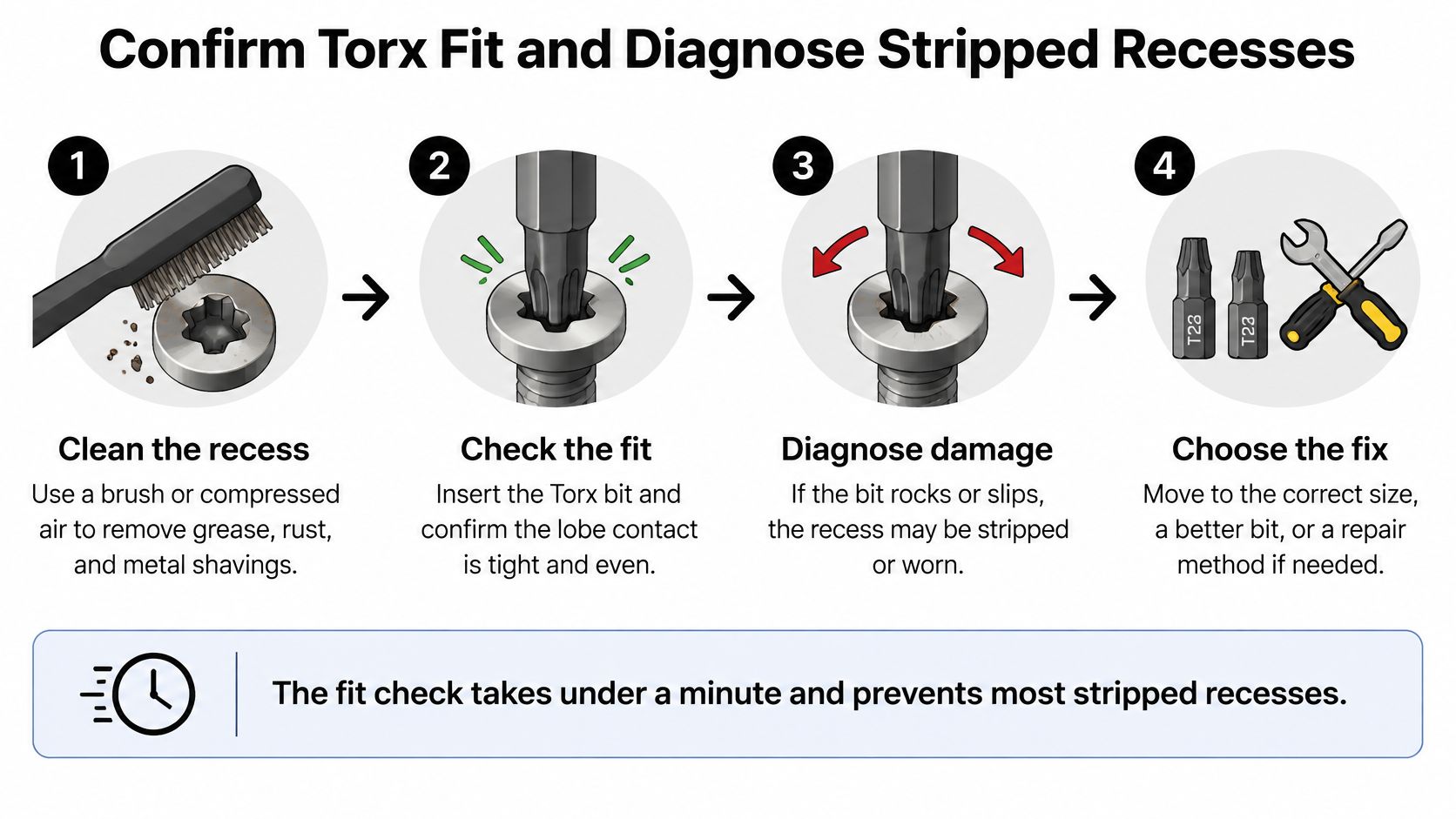
Seat the Bit Before Loading It
- Clean the recess. Use a brush and pick to loosen packed debris. If using compressed air, wear eye protection and direct the discharge away from yourself and nearby workers.
- Read the size stamp. Match it to the fastener specification rather than choosing whichever bit enters the opening.
- Insert by hand. Confirm the tip reaches the bottom of its intended engagement area and contacts the lobes evenly. Don't hammer a near-match into place.
- Keep the tool square. Reposition your body or remove an obstruction instead of leaning the bit against one side of the recess.
- Begin gently. Start with controlled hand pressure or the powered tool's lowest suitable setting. Stop if the bit moves independently of the screw.
- Finish to specification. Stop driving when the fastener seats, then use the specified tightening procedure and a suitable torque wrench where required.
The MLC Torx size guide lists a T20 recess at about 3.95 mm, a T25 driver at approximately 4.39 mm, and explains why visually similar T25 and T27 tools aren't interchangeable. The driver needs insertion clearance, but excess rotational play concentrates force on too little of the lobe.
The technical drive-system document hosted by Thomasnet describes an approximately 15-degree drive angle, which directs force more nearly perpendicular to the recess walls. That geometry reduces the tendency to push the bit upward, but it can't compensate for poor seating.
Separate Cam-Out From Rounded Lobes
Cam-out means the driver climbs out under load. Recess deformation means the fastener's contact surfaces have changed shape, so even a correctly sized bit may no longer hold.
A Prince Fastener drive comparison reports approximately 15–19 N·m before cam-out for a T25 recess, versus 3.0–4.5 N·m for an equivalent Phillips recess, under controlled conditions. These aren't tightening specifications: material, alignment, bit quality, and loading affect the result.
| Symptom | Likely cause | Fix |
|---|---|---|
| Bit spins in the recess | Undersized or worn bit | Match the specified size and replace bits with rounded or heavily polished lobes |
| Recess lobes look rounded | Wrong T-size or impact shock | Stop, assess remaining engagement, and plan extraction if a correct bit won't hold |
| Bit climbs out under load | Angled drive or debris | Clean the recess and keep the driver square |
| Fastener twists or snaps | Torque above joint specification | Stop and check the fastener specification before proceeding |
| Bit tip breaks | Non-impact accessory exposed to impact shock | Remove fragments safely and use a clearly impact-rated replacement for powered work |
Changing to an impact-rated bit won't restore an already rounded recess. If sound engagement is gone, use a suitable extraction method rather than repeatedly hammering the damaged head.
For motorcycle work, a model-specific reference such as Sixrace's Scrambler tightening specifications can help identify the required joint setting. Confirm applicability to the exact model and component before tightening.
After work in Central Valley summer heat, inspect the storage case for warping and let hot tools cool before handling. During cleanup, check for newly polished contact areas, rounded lobes, or a twisted tip before putting the bit back into service.
Standard Versus Security Torx Bits
A center post changes the tool you need. A solid standard Torx bit can't seat over that post, even when its size marking matches the screw.
The Teng Tools security Torx guide explains that tamper-resistant fasteners retain the Torx size numbering but require a hollow security bit. It also notes that security bits can generally drive ordinary Torx recesses, making them useful for mixed maintenance work.
Identify the Post Before Ordering
- Look inside the recess first. Use a light to check for a raised center pin, especially when dirt hides the bottom.
- Read the tool markings. Security products may use TR, T, or S designations. Confirm the product description explicitly says security or tamper-resistant.
- Match the specified size. A hole in the bit solves the center-post problem, not a size mismatch.
| Feature | Standard Torx | Security Torx |
|---|---|---|
| Recess shape | Six-lobe star | Six-lobe star with center post |
| Bit needed | Solid bit | Hollow bit of the matching size |
| Solid bit seats in recess? | Yes | No, the center post blocks it |
| Drives an ordinary Torx recess? | Yes | Generally yes |
| Common markings | T | TR, T or S |
| Common sizes | T10 to T50 | T10, T15, T20, T25, T27, T30, T40 |
For a general service kit, the security sizes in the table are a practical starting assortment, not a guarantee that every appliance or vehicle is covered. Check the equipment you maintain before buying.
Standard bits suit routine known fasteners. Their advantage is straightforward selection when the equipment uses ordinary recesses; their limitation is that they won't handle center-post hardware. Security bits suit appliance technicians, property maintenance staff, and mixed repair kits, although their hollow tips still need careful inspection for cracking and deformation.
Say you're opening an appliance panel or servicing a public fixture. Identifying the post before leaving for the job is more useful than carrying a large standard set that can't engage the fastener.
Security Torx discourages casual access. It doesn't make a panel theft-proof or remove the need for electrical isolation and authorized service procedures.
Don't drill out the post merely because the correct driver isn't in the case. Obtain the matching tool and preserve the hardware unless the repair procedure calls for replacement.
Impact-Rated Versus Standard Torx Sockets
Choose the impact rating by the tool you'll use, not by socket color alone. Black oxide is common on impact accessories, but a dark finish isn't proof that a particular bit socket is approved for repeated hammering.
This comparison separates powered-tool suitability from ordinary hand-tool use.
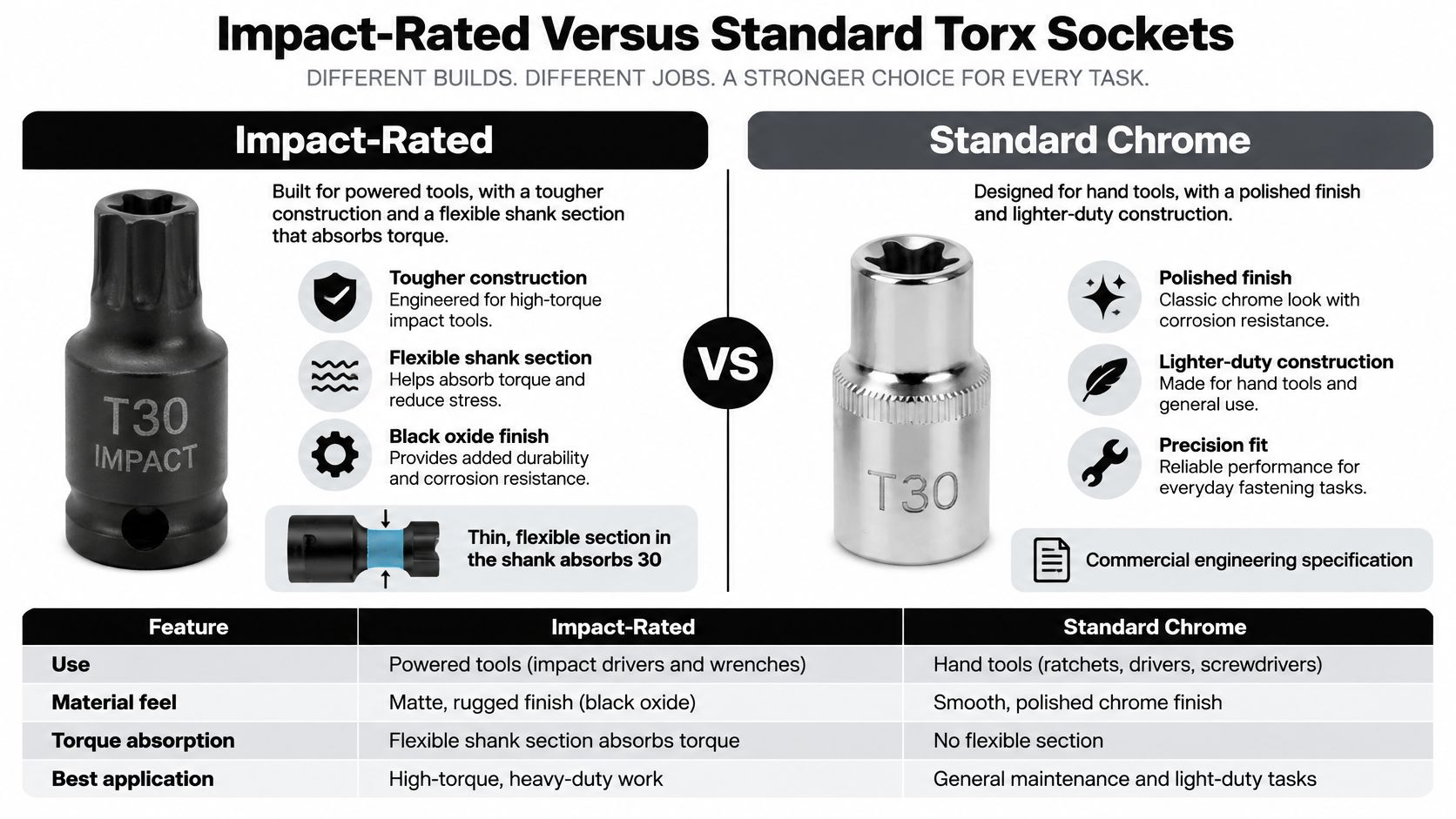
A McMaster-Carr impact Torx bit socket specification describes a thin, flexible shank section that absorbs 30 times the impact force. That's a commercial specification for the described construction, not a universal performance rating for every impact Torx socket.
| Feature | Impact-rated (black oxide) | Standard chrome |
|---|---|---|
| Construction | Impact-tolerant construction; some designs include a flexible shank section | Rigid hand-tool construction |
| Tool to use | Compatible impact driver or impact wrench | Hand ratchet or controlled manual work |
| Impact shock handling | Built for repeated hammering | Can fracture under impact |
| Cost | Generally higher | Generally lower |
| Best user | Contractors, automotive technicians, maintenance crews | DIY owners who use hand tools |
Pay for the Rating You Need
Impact-rated sockets make sense for equipment repairs and stubborn automotive hardware. Their benefit is resistance to repeated shock; their trade-offs can include higher cost and a bulkier body that restricts access.
Standard chrome Torx bit sockets remain useful for controlled manual work. A ratchet gives direct feedback as resistance rises, and a suitable torque wrench handles final tightening, but neither makes the bit safe for impact use.
A bare-tool purchase means you're buying the tool without the usual battery-and-charger package; a replacement socket is an accessory, not a bare tool. Confirm the connection and any adapter before buying a bit socket for a driver you already own, using our impact driver versus impact wrench guide if the interfaces are unclear.
Watch the tool setup as well as the bit selection.
Wear eye protection, inspect adapters, and keep your free hand clear of the rotating assembly. Never run an ordinary chrome hand-tool bit socket in an impact driver or wrench unless the manufacturer explicitly rates it for that use.
Who This Is For and Who Should Avoid This
A full Torx socket set earns its space when your work regularly crosses equipment types. It's harder to justify when the same known fastener is the only star-drive hardware you encounter.
Who This Is For
- Contractors and maintenance crews: Choose a job-matched impact-rated assortment when powered removal is part of routine equipment service. Add reach only where access demands it.
- Sacramento and Elk Grove property managers: Carry the sizes used across your appliances, fixtures, and maintenance equipment, plus the appropriate security profiles. Missing the right profile can stop an otherwise simple visit.
- DIY homeowners: Start with a compact, readable set that matches your projects. Organized storage and replacement availability matter more than unused oversized bits.
- Open-box buyers: Buy on condition, completeness, and return terms. A clean, complete working assortment can be better value than a larger set with damaged high-use tips.
If you already own a compatible driver, buy the required accessory rather than another cordless kit. Check the whole connection path, including the holder or adapter, before assuming a socket will attach directly.
Who Should Avoid This
Skip a full-range set if you only need a specific replacement bit for an occasional repair. A quality individual bit or compact manual tool may solve the job with less expense and less clutter.
Hand-ratchet-only users don't automatically need impact-rated sockets. Buy for actual use rather than paying for a rating that won't be used.
Anyone expecting Torx geometry to replace torque control should change the plan, not upgrade the piece count. A strong drive connection can let you overload the joint without an obvious slip, and specified assemblies still require the correct tightening procedure.
Buying Open-Box and Used Torx Sets and Final Pre-Order Check
A set's value depends first on fit: confirm the stamped sizes you need and inspect the recesses for wear before weighing piece count or price. A full case is poor value if its commonly used bits are twisted, their markings are unreadable, or they rock in the fastener.
Use the visual checklist alongside a close inspection of the actual listing.
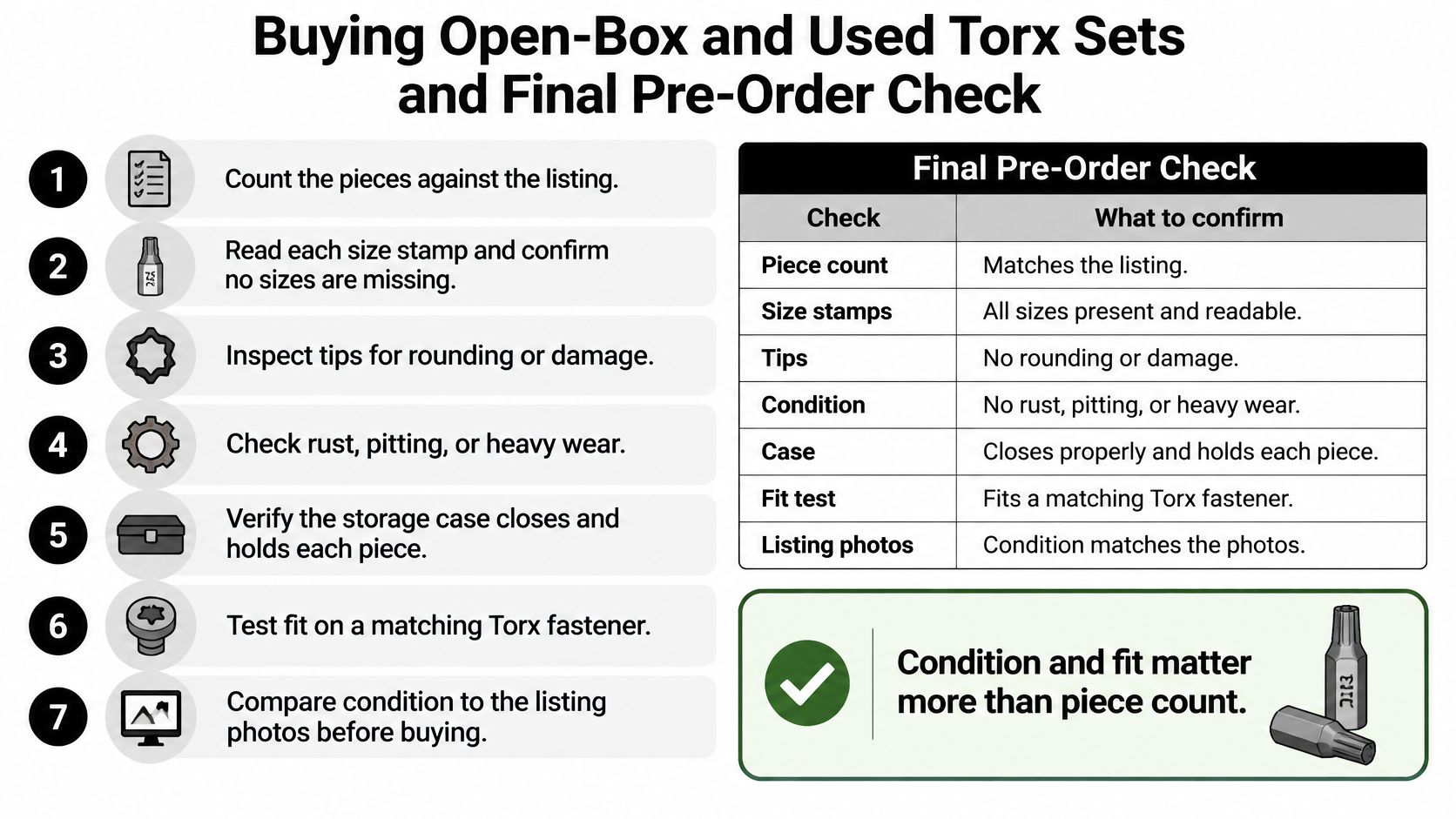
Inspect the Working Ends, Not Just the Case
- Count the pieces against the listing. Check whether adapters or holders are included in the advertised total.
- Read every size stamp and compare the contents with the sizes required for your work. Empty case positions and duplicate sizes deserve clarification.
- Look for chipped tips and twisted lobes. Rotate each bit under a light so damage isn't hidden on the far side.
- Inspect polished wear marks. Light finish wear isn't automatically a failure, but rounded contact surfaces or uneven lobe wear are reasons to reject the bit.
- Check for rust and pitting. Inspect the tip, socket drive recess, and bit-to-body connection. Deep corrosion can affect the connection, not just the appearance.
- Confirm the impact rating on the tool or in a traceable manufacturer specification. Don't accept color as the only evidence.
- Test each required size in a known good fastener. Confirm that the tip seats fully without noticeable rocking. Do this before the job, not while equipment is already dismantled.
For comparison, Harbor Freight's professional Torx bit socket set is listed as 12 pieces covering T8 through T55, with 1/4-inch and 3/8-inch drives. That example shows why checking the drive connection matters: a single case can include sockets that require different ratchets or compatible adapters. Compare the listed contents with the sizes and drive connections your work requires rather than treating the total piece count as proof of coverage.
Value Tools Co is an online tool shop based in Elk Grove, California, and many of its products are inspected open-box and overstock items. Before use, compare the delivered set with the listing photos and stated condition. Check that the required sizes are present, stamps are legible, tips are sound, and the drive connections match the tools you plan to use.
The used-tool buying guide covers broader checks for condition and completeness. For a set that has been stored in a vehicle or tool case, inspect the case hinges, latches, and retaining inserts as well as the bits. A damaged insert can let sockets shift or fall out, making it harder to keep the set complete.
Settle Compatibility and Return Terms Before Paying
| Check | What to confirm |
|---|---|
| Fastener coverage | Every required size appears in the contents list |
| Recess type | Standard or center-post security |
| Tool connection | Socket drive matches the ratchet, wrench, or approved adapter |
| Powered use | Manufacturer explicitly identifies impact suitability |
| Access | Socket body and bit length clear nearby components |
| Condition | Actual working ends match the advertised condition |
| Returns and warranty | Current seller terms and any applicable manufacturer coverage |
A seller's return policy and a manufacturer warranty are separate. Confirm each one independently, especially if original packaging or purchase documentation is missing. Check the written terms before paying, and make sure they apply to the item's stated condition.
Value Tools Co offers savings of up to 55% off retail, but a lower price does not make a damaged working tip usable. Value Tools Co has a concise 2-day return window, so check the current written return terms, including how defective items are handled, before you order. Keep the listing details available so you can compare the item's condition and contents with what was described.
Call 916 201 4365 with the fastener sizes and your tool's drive connection before buying. If pickup or delivery timing matters, confirm availability and timing for the actual order rather than assuming same-day pickup or next-day delivery.
Torx Socket Bits FAQ
- What size Torx do I need? Match the stamped bit size to the fastener specification, then confirm full seating without noticeable rocking. Use Torx Socket Bit Sizes at a Glance for reference dimensions, not as a substitute for the equipment manual.
- How do I tell security Torx from standard Torx? Look for a center post inside the star-shaped recess. Security Torx needs a hollow matching bit; Standard Versus Security Torx Bits explains the markings and compatibility.
- Can I use a chrome Torx socket with an impact driver? Don't use an ordinary chrome hand-tool socket with an impact driver. Use an accessory explicitly rated by its manufacturer for impact service, with a compatible holder or adapter.
- Why does my Torx bit keep slipping? Check for debris, an incorrect size, worn lobes, or an angled approach before applying more force. Follow Confirm Torx Fit and Diagnose Stripped Recesses, and stop if the recess no longer provides sound engagement.
- Are open-box Torx sets worth buying? Yes, if the required sizes are present, the working tips are undamaged, and the return terms are clear. Use Buying Open-Box and Used Torx Sets and Final Pre-Order Check to assess the actual set rather than its advertised piece count.
Visit Value Tools Co to browse tools and accessories, including inspected open-box and overstock options for your repair kit. Bring your Torx size list, security-profile requirements, and drive connection details so we can help you check available options before you buy.


