

You're halfway into a remodel, a long structural screw stops two inches proud, and your only drill starts twisting in your hand instead of turning the fastener. That's the exact moment a Cordless Drill Impact Driver Set earns its keep, because you can drill a clean pilot hole with one tool and drive the screw home with the other, on the same batteries. Buy the set when your work mixes controlled holes with high-resistance fastening. Skip it if you're only hanging a few indoor shelves.
When a Cordless Drill Impact Driver Set Pays Off
A Cordless Drill Impact Driver Set pays off when the same job needs a clutched drill for control and an impact driver for screws that would stall that drill. Match tomorrow's fasteners to the table before you compare brands, prices, or headline torque. If most of your work lands in one column only, you may not need both tools.
| Job | Better tool | Why | Watch-out |
|---|---|---|---|
| Cabinet hinges, pilot holes, small finish screws | Drill/driver | Adjustable clutch limits depth and spin-out | An impact can overdrive finish work |
| Deck boards and long structural screws | Impact driver | Hammer-anvil keeps rotating near stall | Predrill hardwood so boards do not split |
| Lag screws into ledgers | Drill first, then impact | Pilot with the chuck, drive with the hex collet | Do not compare inch-pounds with stall torque |
| Repetitive assembly and jigs | Drill/driver | A repeatable clutch setting is faster to control | High impact torque is a poor finish tool |
| Concrete anchors | Hammer drill, often not in a basic set | Masonry needs a hammer function | An impact driver is not a rotary hammer |
What the Two Tools Actually Do Differently
The drill/driver applies smooth, continuous torque through a chuck and an adjustable clutch. That's why it's the right tool for pilot holes, cabinet hinges, and small fasteners where sinking a screw too deep ruins the work. Set the clutch low, let it click, and every hinge screw seats at roughly the same depth.
The impact driver, or atornillador de impacto, works another way entirely. According to Build Construct's guide to cordless drill specs, an impact driver uses a 1/4-inch hex collet and an internal hammer-and-anvil mechanism that delivers short rotational impacts, letting it maintain rotation when long screws or lag fasteners approach a drill's stall limit. Published specifications commonly place compact impact drivers around 1,000 to 1,800 inch-pounds, while drill ratings are often stated as continuous or peak stall torque, so those numbers aren't interchangeable.
Practical rule: A bigger impact rating doesn't make ordinary holes faster. Drills win on clean holes, impacts win when resistance stalls the drill.
Say you're setting a ledger with lag screws. You drill the pilot with the chuck, swap to the impact, and drive without swapping bits back and forth in one tool all afternoon. That two-step rhythm, plus fewer cam-outs under load, is the gain here.
The trade-off is honest. You carry two tools, two batteries, and a charger instead of one drill, and on light indoor work the impact sits in the case. The gain is one shared 18-volt or 20V Max platform, one charger on the bench, and no bit swapping between drilling and driving. List your next job's fasteners first, find them in the table, then shop.
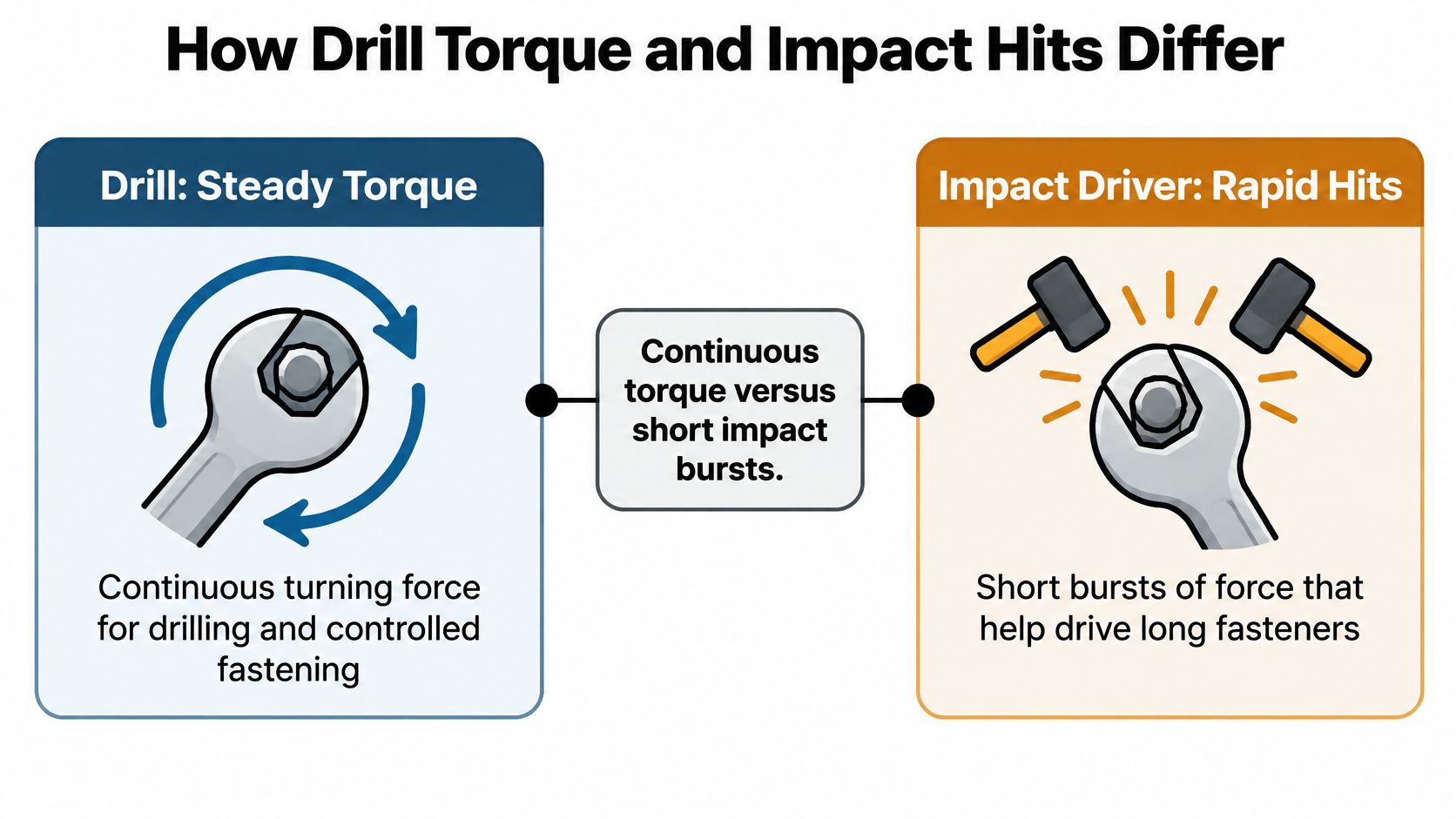
How Drill Torque and Impact Hits Differ
Think of a drill as a steady hand on a wrench, pushing with constant force until the bolt moves or your wrist gives out. An impact driver is that same wrench getting a rapid series of light hammer taps. Each tap is small, but the taps keep coming, and the fastener keeps creeping forward instead of locking up.
The Clutch in Practice
Start a cabinet screw on a low clutch setting and the drill clicks and stops before the head cracks the stile or spins through soft stock. Move to thicker material and you dial the collar up a few numbers. That clicking isn't a fault. It's the clutch slipping at the torque you chose, and it's what makes repetitive finish work repeatable.
The keyless chuck grips round-shank and hex bits alike, which is why the drill handles spade bits, twist bits, and hole saws. The impact's 1/4-inch hex collet only takes hex-shank bits, but it locks them fast with one hand. On a worn collet you'll feel radial play, a wobble at the bit tip that chews screw heads and tells you the tool has lived a hard life.
Hardwood Versus Softwood
Drive a long screw into oak with a drill and you'll feel it bog down, then twist against your wrist as resistance climbs. Switch to the impact and the felt torque drops while the noise climbs, a loud rattle as the hammer hits and the screw keeps moving. In pine, the story flips. The drill bores a simple hole faster and cleaner, with no hammering and better control on breakout.
When you shop, check variable speed for starting screws without skating across the surface, and a higher gear for drilling. Speed ranges are a buying check, not a brand ranking. Our cordless impact driver vs drill comparison walks through that head-to-head in more detail.
| Tool | Pros | Cons | Ideal user |
|---|---|---|---|
| Drill/driver | Adjustable clutch controls depth, pilot holes, and finish screws | Stalls on long lags and dense hardwood; slower at driving volume | DIYers doing cabinets, furniture, and mixed hole work |
| Impact driver | Keeps turning near stall for structural screws, lags, and decking | Overdrives finish work; louder with less control in small spaces | Framers, deck builders, and pros driving volume fasteners |
Use two hands when a large bit can grab and kick, wear eye protection, and keep your finger off the trigger while changing bits. Before you pay for any set, run the field test. The clutch must click consistently at a low setting, and the collet must lock a bit without wobble.
Voltage Pack Size and Valley Heat
Don't shop by voltage alone. Nominal 18-volt and U.S.-market 20V Max platforms generally sit in the same lithium-ion class, and amp-hours tell you how much charge the pack stores. The useful choice is pack size matched to the load in front of you, then a rotation that keeps a fresh battery ready when heat starts dragging the first one down.
| Pack | Charge versus 2.5Ah | Best work | Weight and heat |
|---|---|---|---|
| 18V or 20V Max, 2.0 to 3.0Ah | About 0.8 to 1.2 times | Overhead finish and cabinets | Lighter on the wrist; fades on long lags |
| 4.0 to 5.0Ah | About 1.6 to 2 times | Decking and maintenance rounds | Solid spare for a hot truck |
| 6.0Ah and larger | About 2.4 times or more | Repetitive structural screws | Heavier overhead and hotter under bursts |
| Two packs, mixed sizes | About 0.8 to 2.4 times, pack by pack | Mixed days above 100°F | Better uptime than one very large pack |
Reading Amp-Hours Honestly
The Lowe's power drill buying guide notes that a 5.0Ah pack contains about twice the charge of a 2.5Ah pack at the same voltage, while actual runtime varies substantially with screw length, material density, bit diameter, operator force, temperature, battery age, and motor efficiency. A small pack driving lags all afternoon drains fast, because the hammer mechanism demands large bursts of power on every hit. The same pack hanging shelves, with seconds of trigger time between measurements, lasts far longer.
That is why two batteries beat one very large pack for mixed professional work. A compact 2.0 to 3.0Ah battery reduces wrist fatigue overhead and on finish tasks. A 4.0 to 6.0Ah pack better supports repetitive framing, decking, and maintenance rounds. One pack works while the other charges or cools, and that rotation is worth more than raw capacity on a hot day.
Heat Is a Runtime Problem
Sacramento and Central Valley jobsites run above 100°F for weeks at a time, and a closed truck bed or metal gang box gets far hotter than the air outside. Keep packs out of direct sun, away from parked-vehicle heat, and out of closed metal boxes in summer. Store them in a shaded, ventilated spot, and let a hot pack cool before charging, because hot or cold packs can sit on the charger showing a fault even when the gauge reads charged.
Give the battery the same respect you give the crew once temperatures climb: shade, airflow, and a break before it goes back to work. A brushless motor, sin escobillas, uses the pack more efficiently under load, but efficiency does not cancel heat soak.
Treat the battery as a temperature-sensitive component, not a permanent accessory stored in the work truck.
My pick is simple. If you work outdoors for hours, buy a set with two compatible packs, ideally one compact and one larger, on a platform you can keep feeding. A single compact pack is fine only for occasional indoor use, where a dead battery costs you a coffee break instead of a workday. A cheap open-box kit with tired batteries loses that math before lunch.
Battery Platform Cost Over Five Years
The cheapest kit on the shelf is often the most expensive way to own these tools. A set price isn't really a tool price. It's a down payment on a battery family you'll feed for years, through replacement packs, extra chargers, and every bare tool you add later.
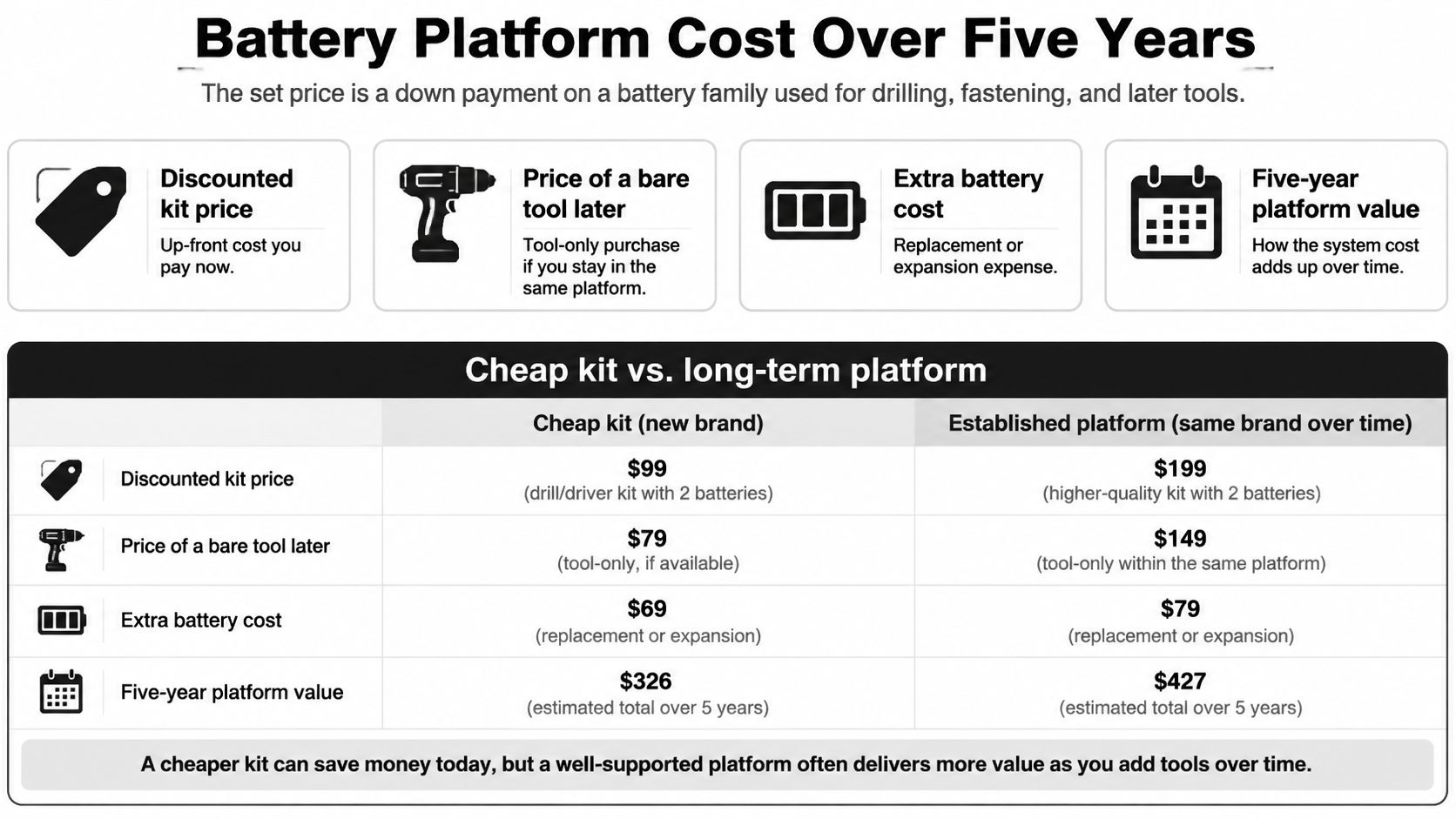
The Four-Number Ownership Check
Before you buy, write down four numbers. First, the discounted kit price. Second, the price of one replacement pack on that exact platform. Third, the charger price if the kit's charger is missing or slow. Fourth, whether older packs still fit current tools and chargers on that platform. If a fresh large pack costs a big share of the whole kit, a bargain set with tired batteries stops being a bargain fast.
There's a policy point worth knowing. The European Union's Battery Regulation requires portable-battery spare parts to remain available for at least five years after the final unit of an equipment model is placed on the market, at a reasonable, nondiscriminatory price. That rule doesn't automatically apply in the United States, so it doesn't guarantee you an affordable replacement pack here. You still have to check availability brand by brand before you commit.
| Platform | Buyer type | Pack and bare-tool range | Price pattern | Best fit |
|---|---|---|---|---|
| DeWalt | Pro | Broad packs and bare tools | Higher pack prices | Daily crew use |
| Milwaukee | Pro | Broad packs and bare tools | Higher pack prices | Daily crew use |
| Makita | Pro alternative | Broad packs and bare tools | Higher pack prices | Buyers comparing a second pro platform |
| Ridgid | Value | Solid packs and bare tools | Often cheaper to expand | Budget DIY and maintenance |
| Ryobi | Value | Wide packs and bare tools | Often cheaper to expand | Budget DIY and maintenance |
| Husky | Value | Stocked replacement pack only | Lower kit prices | Buyers who can get replacement packs easily |
DeWalt and Milwaukee offer deep pack and bare tool, or herramienta sola, catalogs, and you pay for that depth at replacement time. Makita raises the same platform question as a pro alternative, so run the same four numbers. Ridgid and Ryobi usually cost less to expand, which suits budget DIY and maintenance work well. I'd only buy Husky when the local replacement pack is on a shelf near you.
Prefer brushless, sin escobillas, on tools that will run daily, and don't migrate platforms for a small kit discount. Check our power tool battery compatibility guide before you lock in, and look at the cordless router and angle grinder guides if those are your likely next tools on the same packs. The kit with the cheaper healthy pack over five years beats the kit with the lower tag this week.
Who This Is For and Who Should Avoid This
Who This Is For
A framing or remodel crew gets the most from this pairing. The set handles structural screws, connectors, blocking, and predrilling all day, and one battery family keeps a small crew swapping packs instead of hunting chargers. The con is kit weight in the bags, plus the need for a second pack so a hot battery doesn't stop the day. For daily crew use, that trade is easy to accept.
A DIY homeowner upgrading from a corded drill earns the set back on decks, fences, cabinets, and furniture. You drill the pilot, drive the screw, and never drag a cord across the yard. The con is paying for impact power that a few indoor shelves will never call on. If a deck or fence is on your list this year, buy the set. If it isn't, a single drill may do.
A property manager or Elk Grove-area handyman gets one case that covers work orders from cabinet hardware to lag bolts on a gate. That range in a single kit is the value. The con is support cost when a charger goes missing or the platform turns out to be an odd one with expensive packs. Standardize on one platform across your properties and that problem mostly disappears.
Across all three, a good set shares the same pros, clutched control, impact power, and shared packs. The shared cons are overdrive risk on finish work, impact noise in occupied spaces, and no masonry ability unless the drill includes a hammer mode.
Who Should Avoid This
Skip this set as a substitute for a framing nailer. When plans call for mechanically driven nails, you need a framing nailer, or clavadora de marcos, set up for the approved fastener schedule, not a drill and impact driver. No torque number changes that.
A tool that drives a nail is not automatically approved for every structural application.
California work makes this concrete. Under UpCodes' summary of nail quality requirements, mechanically driven nails in Seismic Design Categories D, E, and F must meet the same dimensions required for hand-driven nails, including diameter, minimum length, and minimum head diameter, and clipped-head or box nails are not permitted in new construction. Sacramento and Central Valley crews should confirm the plans, the engineer's notes, local amendments, and the nailer's approved collation, including a 21° full round-head schedule when that's what the job requires. Compliant nails can cost more, but a failed inspection costs far more.
Also skip a two-tool kit for a one-afternoon indoor project, where a borrowed drill or a single compact driver finishes the job. And walk away from any combo being sold as a structural nailing solution, especially open-box, where the fastener documentation you need to verify compatibility may not be in the box.
Open-Box Checks Before You Pay
A clean drill can hide a dead pack. Treat tool condition and battery condition as separate risks, run the checks in order, and stop when something fails. A kit that feels strong on a free trigger pull can still sag once the bit bites, and a pack that has cooked in a truck will not announce itself from the shelf.
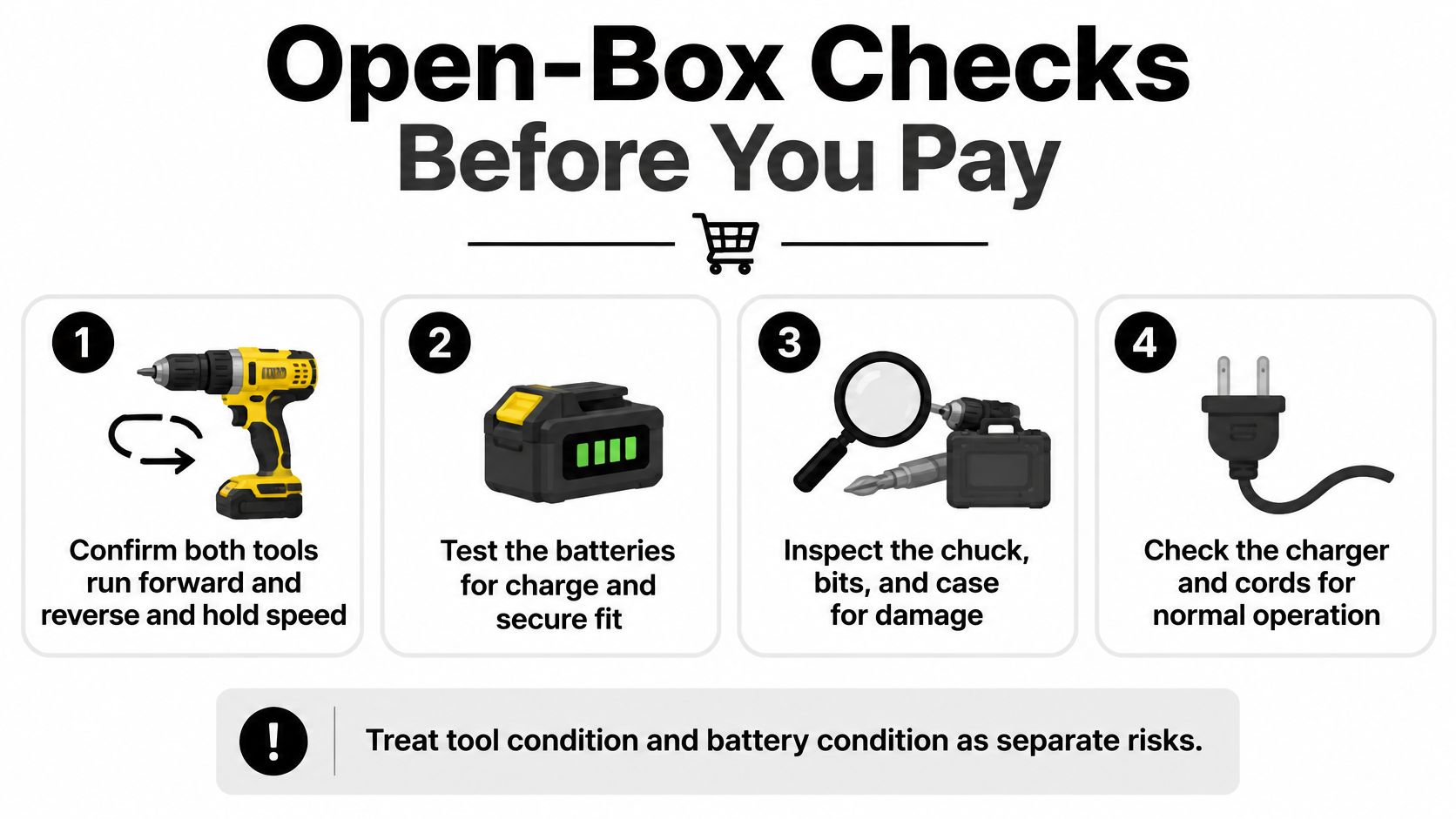
The Seven-Step Inspection
- Run both tools under load: Confirm forward and reverse, and drive a real screw so you know each tool holds speed under load, not just on a free trigger pull.
- Click through the clutch: Turn the drill's collar through every setting and reject a dead or gritty collar that won't engage consistently.
- Lock a bit in the collet: Seat a hex bit in the impact driver and reject the tool if the bit shows excessive wobble.
- Reject damaged packs: Walk away from swelling, cracks, corrosion, missing labels, heat-discolored terminals, or a case that smells burnt.
- Test the charger: Confirm it recognizes every included pack and doesn't fault immediately.
- Match the platform: Read the platform name on the tool, pack, and charger, and confirm all three agree.
- Check accessories last: Case, belt hook, and bit holder matter only after the power parts pass.
A tired pack creates downtime first and replacement expense second, and a damaged one is a fire risk you don't need in a hot garage. The wrong pack for the platform isn't a bargain at any price. When a pack does reach end of life, recycle it through a proper lithium-ion collection stream rather than household trash.
Heat should shape how you buy, too. New York's official lithium-ion consumer safety guidance says batteries should be kept in a cool, dry place, protected from direct sunlight and extreme temperatures, and should not be charged below 32°F or above 105°F. That makes in-person inspection worth more during a Valley summer than a small price break on a sealed box.
Buying locally pays when the alternative is finding a heat-cooked pack after delivery. Value Tools Co in Elk Grove sells open-box and lightly used tools at savings up to 55% off typical retail, with free U.S. shipping on qualifying orders, a short 2-day return window, and Sacramento-area phone and email support. For a local buyer, that means you can inspect packs, clutch, collet, charger, hooks, and case before a hot-weather job and use the return window quickly if something slips through. If you're new to the category, start with what an open-box item actually means. Pick up and test when the kit powers a crew; ship only when the saving justifies the risk.
Combo Questions the Spec Sheet Skips
Should I Buy a Bare Tool Instead of a Full Set
If you already own healthy packs and a charger on a platform, a bare tool, or herramienta sola, is the cheaper add-on and the right buy. You're paying only for the tool your kit is missing. If you own nothing on that platform, buy the full set, because packs and a charger bought separately usually erase the bare-tool savings.
Is Brushless Worth the Extra Money
For daily professional work, yes. A brushless, sin escobillas, motor holds speed under load and wastes less of the pack's energy as heat, which shows up as more screws per charge. For occasional DIY, a brushed kit can still be the right spend when the batteries test healthy and the price gap is large. Battery health matters more than motor type on a used kit.
How Many Packs Does a Two-Person Crew Need
Don't share one pack between two people. Plan at least two packs per active tool pair, so one can charge and cool while the other runs. If both of you are driving lags through a 100°F afternoon, add a third pack to the rotation. Crew downtime costs more than the extra battery.
Can This Set Drill Into Concrete or Brick
Most drill and impact sets don't include a hammer-drill function, and impact torque is not a substitute for hammering action. Anchors in concrete or brick need a separate hammer drill or rotary hammer. Check the drill's mode collar before you assume, because some combo drills do include a hammer setting and many don't.
One last point on protection. Warranty length follows the brand and the seller's stated open-box terms, so read the term on the specific kit in front of you. Don't assume a new-tool warranty transferred with an open-box purchase.
Pick the Set and Inspect It Locally
A combo pays off the first afternoon you switch from drilling pilot holes to driving structural screws without reaching for a second tool. If your work mixes clutched holes and long fasteners, choose a brushless cordless drill impact driver set on an 18-volt or 20V Max platform you can still buy packs for, with two batteries in the box. Headline inch-pounds matter less than a healthy shared platform and a second pack that can rotate through 100°F-plus jobsite heat.
The shelf is where that decision gets proven. Pick up both tools, cycle the clutch, check the collet for wobble, and look at both packs before you commit. A cheap open-box kit with tired batteries is still a cheap kit, and the savings disappear if one pack cannot finish a hot day.
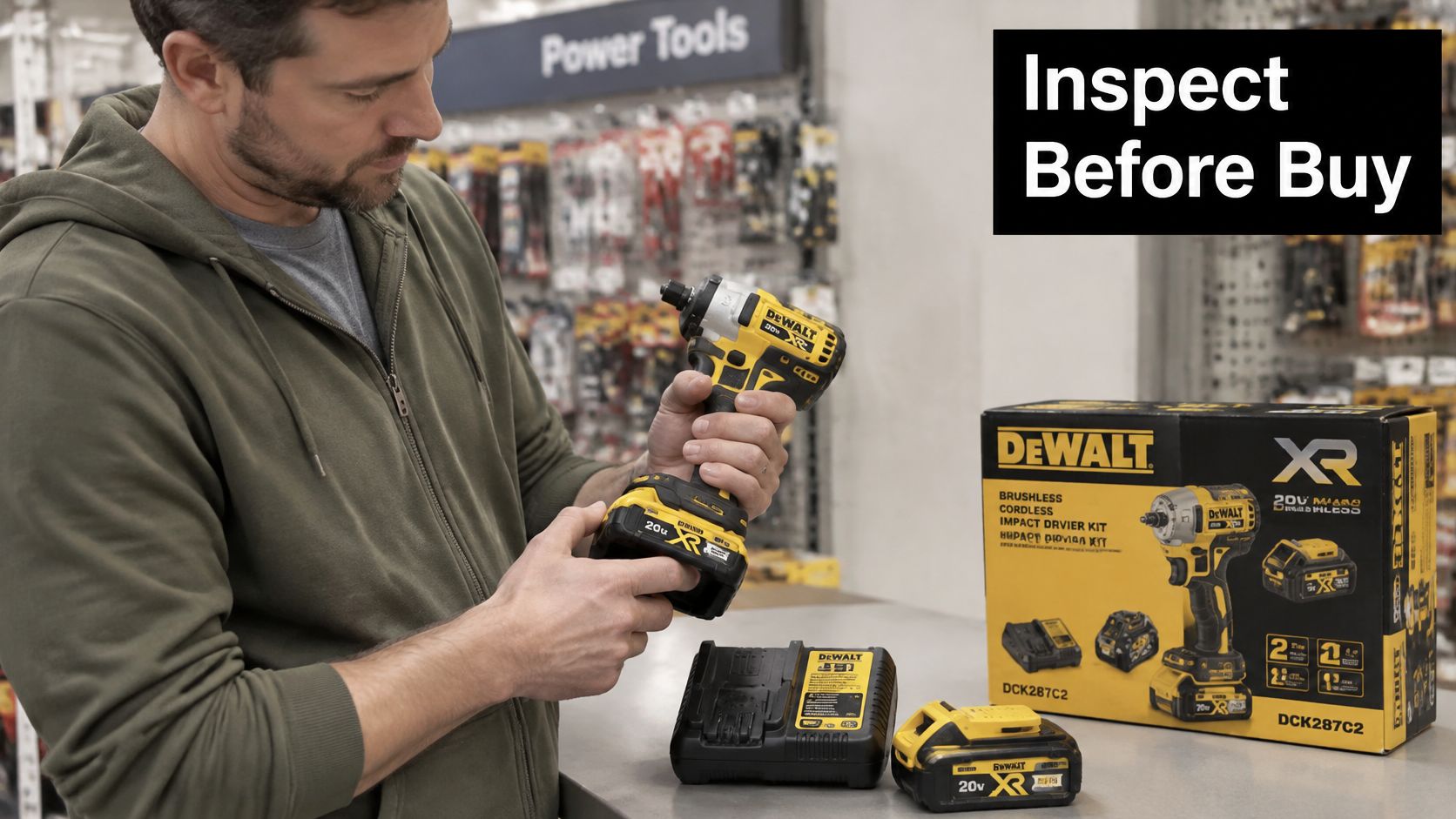
Choose a bare tool instead if your packs and charger are already healthy and you are filling one gap in the kit. Skip the combo entirely if you only need a few indoor screws, or if the specification on your plans is a full-head framing nailer. Those are different purchases, and forcing this set into them wastes money.
For kit shape, a pro user wants the two-pack brushless set on a platform with affordable replacement packs. A budget DIY or maintenance buyer should look first at the value platforms in open-box stock, provided the packs pass inspection. Judge ergonomics, durability, and value for money over the pack's life rather than a torque ranking.
Watching the two tools work side by side makes the torque difference easier to judge than any spec sheet.
Your next step takes five minutes. Write down the platform, pack amp-hours, and charger for the kit you are considering, then compare the replacement-pack price against the kit price. Run the same inspection on clutch, collet, and both batteries before you leave the store or before the return window starts. Ship the kit if you are not local. Pick it up in person if a bad pack would stop your crew for a day.
Once the set is settled, the cordless router and angle grinder guides are the natural next read if you will expand on the same battery family. That is a later purchase, separate from this decision. Buy the platform you would still choose at replacement-pack time, and the drill and impact choice gets easy.
Value Tools Co, based in Elk Grove, California, offers open-box and bare-tool drill and impact driver sets from DeWalt, Milwaukee, Makita, Ridgid, and Ryobi at up to 55% under typical retail, with a concise 2-day return window, so Sacramento and Central Valley buyers can browse the current selection at Value Tools Co and bring their platform and pack-size notes with them.


