

An impact driver adapter is a hex-shank-to-square-drive or chuck connector that lets an impact driver turn sockets or accept round-shank bits. Its safe capacity is set by the 1/4-inch hex shank: one manufacturer limits a 1/4-inch adapter to below 80 N·m, about 59 lb-ft, so it isn't a substitute for an impact wrench on lug nuts or heavy structural work.
The popular advice to “just match the drive size” misses the part that usually fails. An adapter is a bridge between the tool and the fastener, not a power upgrade; the whole setup is limited by its weakest component. That matters whether you're fastening cabinet hardware, assembling brackets, or trying to free a stubborn bolt.
What an Impact Driver Adapter Actually Does
An impact-rated adapter doesn't turn a compact driver into an impact wrench. It changes the connection format, allowing the driver's quick-change collet to hold an accessory it couldn't otherwise accept. The torque limit still depends on the narrowest and least capable part in the assembly.
Most socket adapters have a 1/4-inch hex shank on the tool end and a square drive on the other. A socket clicks onto that square end, commonly in 1/4-inch, 3/8-inch, or 1/2-inch drive sizes. Drill-chuck adapters use the hex shank to fit the driver and a three-jaw chuck to grip round-shank bits. In either case, the adapter adds another stress point between the impact mechanism and the fastener.
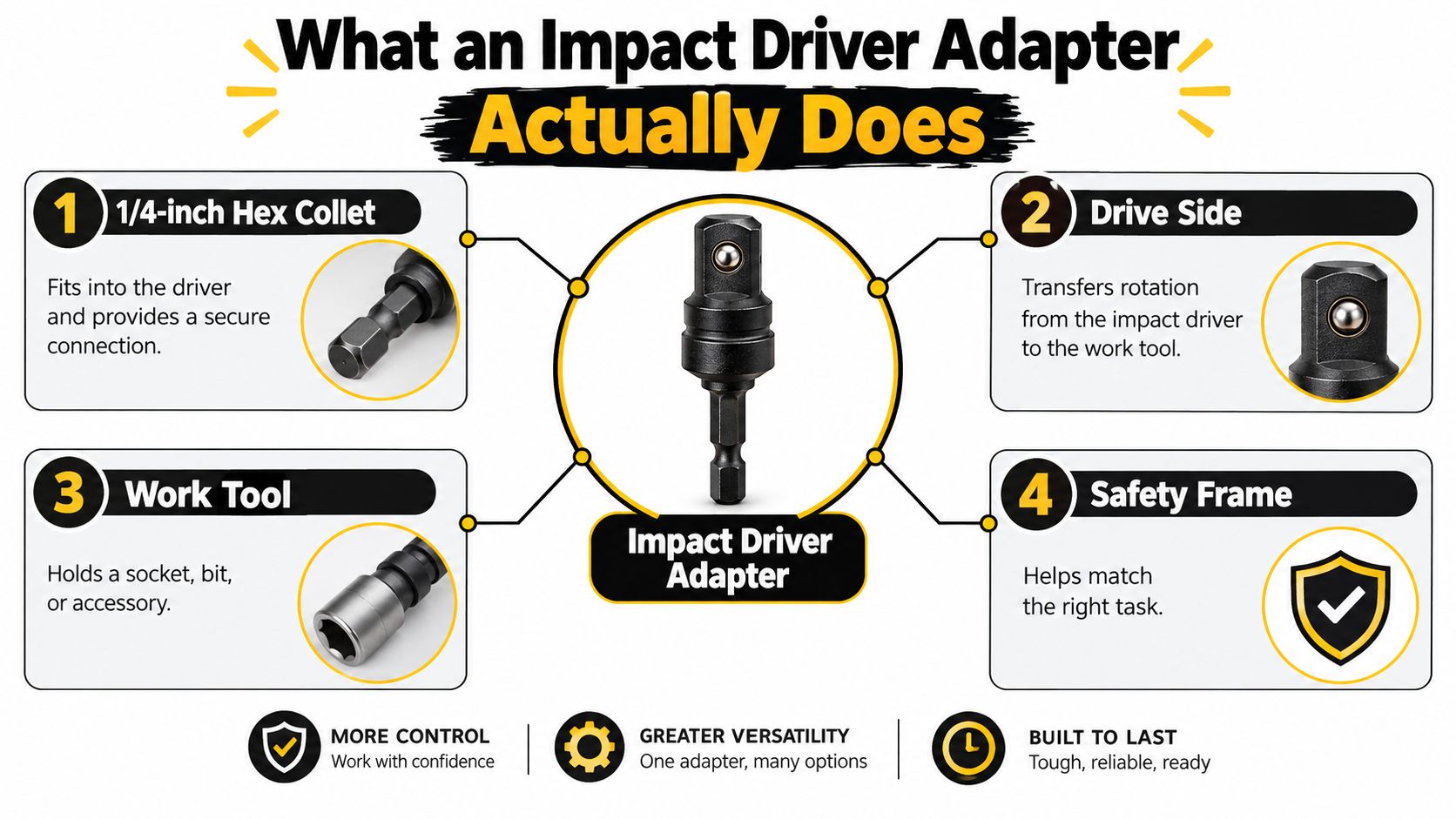
Why the smallest section matters
The hex shank is the bottleneck, not the socket's larger square-drive opening. One manufacturer's instructions set a maximum application limit below 80 N·m, approximately 59 lb-ft, and advise using an impact wrench with suitable sockets for heavier work. Exceeding that adapter's stated limit can damage the adapter or fastener (adapter torque limits and drive sizes).
Impact drivers deliver repeated hammer pulses rather than smooth, continuous rotation. That shock loading is why an ordinary chrome-vanadium hand-tool socket or unmarked adapter may fracture where an impact-rated accessory is designed to take repeated percussion.
The weakest component controls the setup. A larger socket drive doesn't strengthen the adapter's hex shank.
Choose an impact-rated adapter, check its stated load limit, and keep the connection direct. If the job demands more torque than the adapter and driver can safely handle, change tools instead of leaning harder on the trigger.
The Main Types of Impact Driver Adapters
A socket adapter is the usual choice when you need to turn a nut or bolt with an impact driver. Pick the drive size for the task, but don't mistake that size for a torque rating. A 1/4-inch hex-to-1/4-inch square adapter suits light socket work, 1/4-inch-to-3/8-inch suits moderate fastening, and 1/4-inch-to-1/2-inch is generally best kept to light-duty socket work. The small hex shank and driver still govern the assembly's capacity (impact-driver and adapter use).
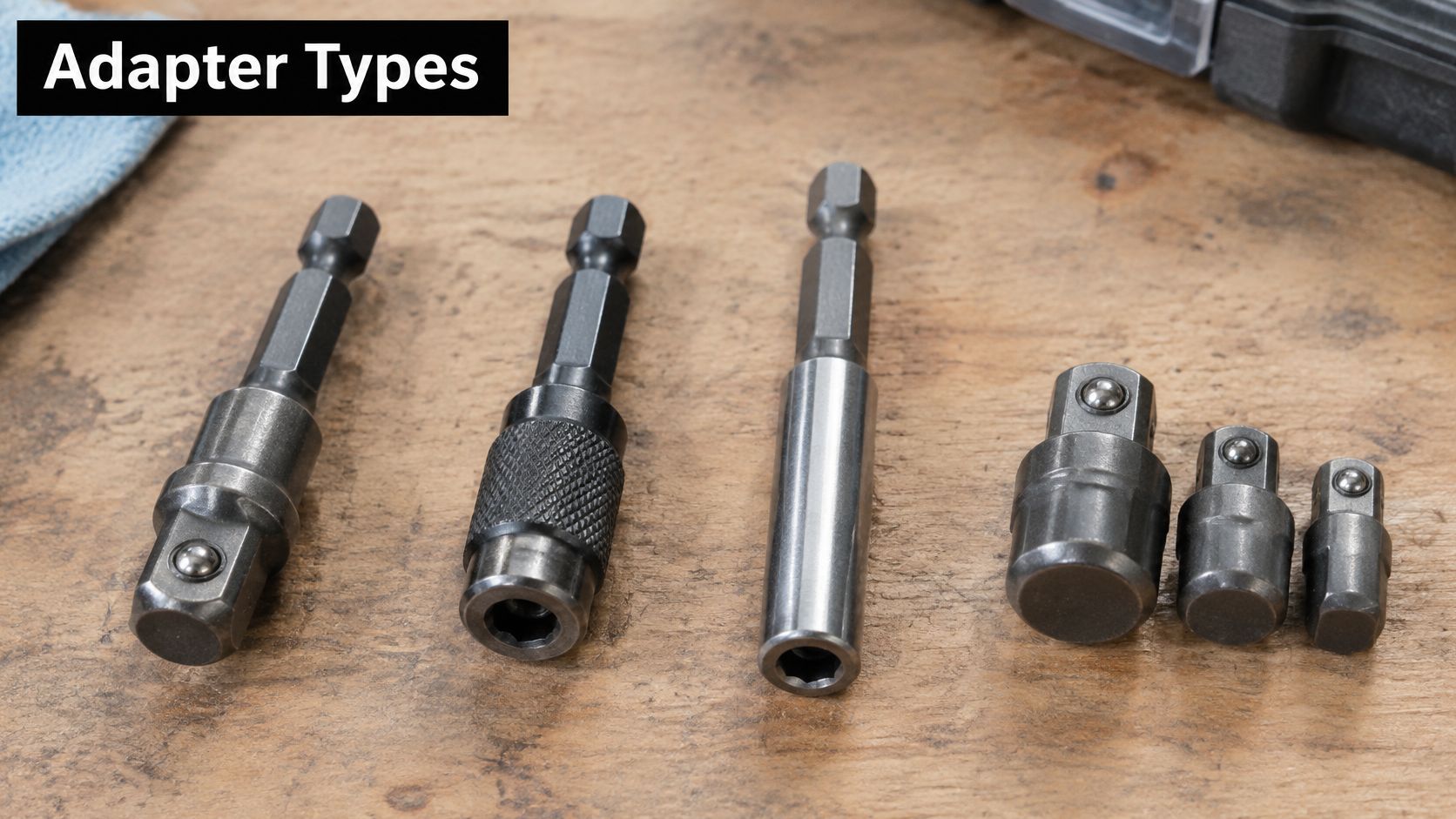
Match the adapter to the job
- Hex-to-square socket adapter: For a bracket, small machine fastener, or other light-to-moderate socket task. Use an impact-rated socket on the square drive.
- Bit holder or extension: For keeping a hex-shank driver bit in the collet or reaching a recessed screw. Added length can introduce flex, so use only as much reach as you need.
- Drill-chuck adapter: For occasional light drilling when you need a three-jaw chuck to grip a round-shank bit. Many impact drivers lack a mechanical clutch, so the tool may keep applying force until you release the trigger. Small drill bits can overheat, bend, or snap. Keep this setup to light drilling in wood or soft metal, not masonry, large holes, precision work, or sustained drilling (impact driver versus drill guidance).
- Swivel or universal joint: For reaching a fastener that's blocked by nearby structure. The articulation helps with access but reduces how directly impact energy reaches the socket.
Adapters and accessories aren't all built for the same loads or angles. A drill-chuck adapter is a workaround for occasional drilling, not a replacement for a drill/driver with a controllable clutch. A swivel is useful when straight access is impossible, but it's a poor choice for a demanding fastener.
For a visual overview of common adapter forms, see this demonstration:
How Impact Energy Moves Through an Adapter
An impact driver turns repeated shock loads into rotary motion. The operating principle has documented roots in a U.S. invention filed on August 16, 1965. U.S. Patent 3,366,187, published on January 30, 1968, describes a manually applied tool using hammer blows to create impact rotation in either direction (U.S. Patent 3,366,187).
The adapter carries those pulses from the driver's hex interface to the socket or bit. Every added joint, longer shaft, or articulated connection can absorb some of the energy before it reaches the fastener. Think of each joint as a place where the hammer's punch gets softened.
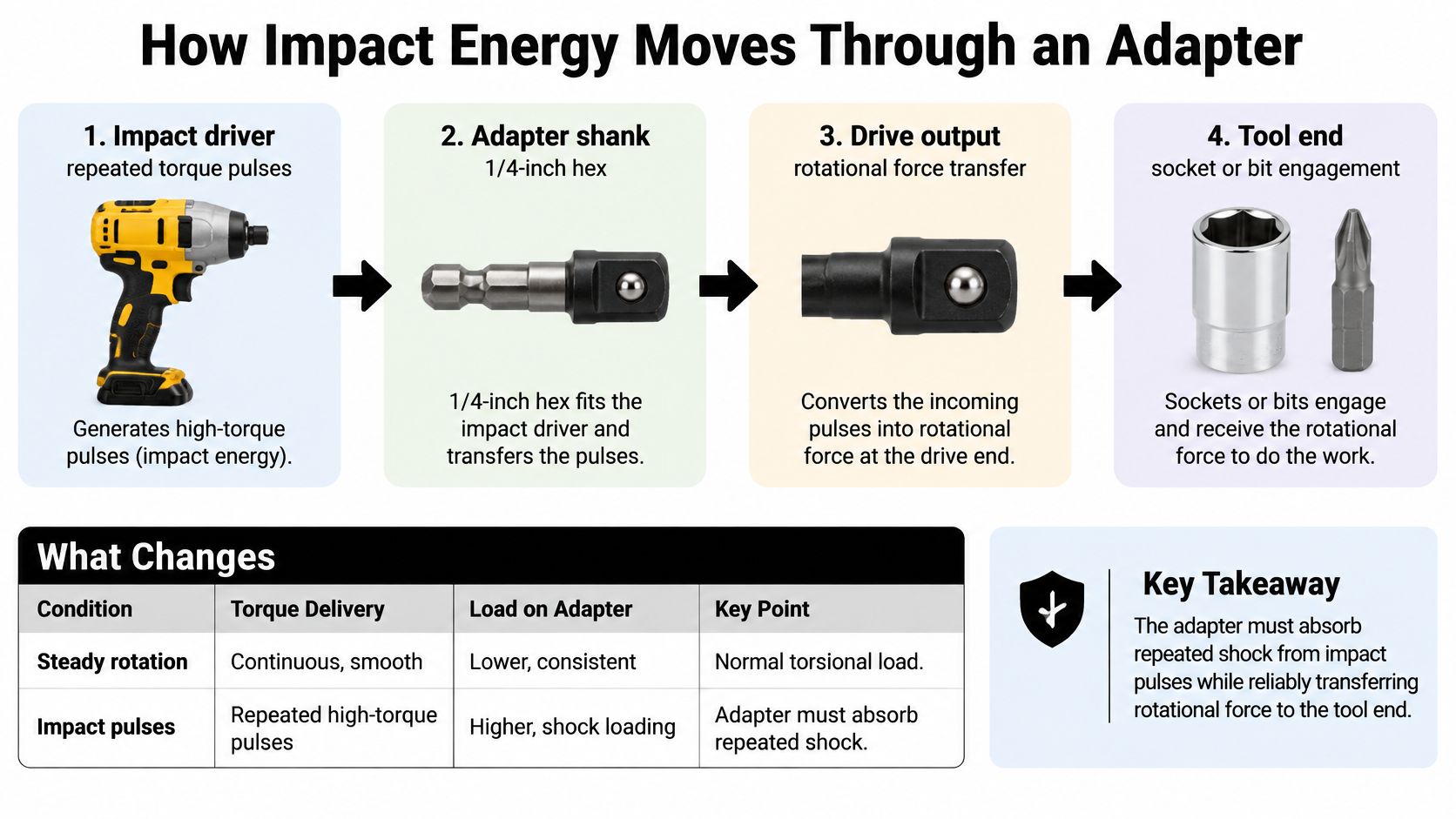
Why length and articulation cost performance
A technical review reports that short, non-swivel drive-size adapters may reduce torque by nearly one-third, while swivel-style adapters can reduce it by nearly one-half as movement and flex absorb impact energy. Extra length and mass can also lower output through torsional deflection (technical review of impact-wrench adapters).
That's why a tool's advertised maximum torque isn't a promise of what the fastener receives. Add an extension or swivel and the connection may deliver less force; use an adapter that's too weak for the job and the risk shifts from poor performance to damage or breakage. Keep the setup short and direct when access allows.
For the broader difference between these tools, compare an impact driver and impact wrench. The useful distinction on the job is simple: the adapter changes what fits, while the tool class determines what kind of work the setup can reasonably handle.
Compatibility and Safety Checks Before You Pull the Trigger
A socket that fits the adapter isn't automatically safe to use. Check the material, seating, load rating, and condition before applying impact. A correctly matched impact-rated setup is different from a loose assembly built around a bright chrome hand socket.
Four checks before use
- Material and rating: Use an adapter and socket explicitly marked for impact use. Impact sockets commonly use tougher, more ductile chrome-molybdenum steel; conventional chrome-vanadium hand sockets can fracture under repeated impact loading.
- Shank fit: Push the 1/4-inch hex shank fully into the quick-change collet and confirm it's retained. Don't run the tool with the shank partly seated.
- Socket engagement: Check that the socket matches the adapter's square drive and is held by its detent or retention system. Seat the socket fully on the fastener before pulling the trigger.
- Load and condition: Match the adapter's stated torque limit to the task, use the lowest effective driver setting, and inspect for cracks, chips, deformation, or looseness.
Loose or multiple adapters can dissipate impact intensity. A socket not designed for impact use may break apart and injure the operator or someone nearby, so don't treat an improvised stack of extensions as harmless. For safety-critical joints, including wheel or engine components, finish with a calibrated torque wrench rather than relying on the driver to establish final torque.
Before the trigger: If the socket rocks, the shank won't seat securely, or any part is damaged, stop and replace or rematch the components.
For socket selection and fit, review this guide to Milwaukee impact sockets.
Spotting Wear and Knowing When to Replace an Adapter
The stress concentrates where the narrow hex shank transitions into the wider square-drive section. That geometry creates a vulnerable point, so fitting a larger socket doesn't raise the adapter's safe capacity. The smallest cross-section remains the governing component (impact adapter inspection guidance).
Before a demanding job, remove the adapter and inspect the shank, square drive, and retention parts. Look for a twisted or mushroomed hex shank, cracks, deformation, a damaged detent ball or retaining ring, and a socket that no longer sits firmly. These are replacement triggers, not cosmetic details.
Separate surface wear from structural damage
A scuffed finish alone doesn't necessarily mean an adapter has failed. Twisting, cracking, a visibly deformed square drive, or a retention feature that won't hold the socket securely does. If the adapter wobbles unusually in the collet, check whether the shank or collet is worn; don't assume play is harmless or compensate by holding the tool at an angle.
Repeated high-resistance fastening is another reason to reassess the setup. An adapter can be impact-rated and still be the wrong choice if the socket is underrated, the joint adds excessive mechanical advantage, or the fastener keeps resisting. Use a larger, properly matched drive system or a dedicated impact wrench when the job repeatedly pushes the adapter toward its limit.
Replace an adapter after visible structural damage, abnormal wobble, or loss of reliable socket retention. Don't keep a questionable adapter in the bag for “one more” seized fastener. It's cheaper and safer to change the setup before a part fails under load.
Matching the Adapter to the Job
Choose the setup by the work and the resistance it is likely to meet. An adapter is the weakest link between driver and socket, not a way to increase the tool's torque. A power-tool guide compares impact drivers at roughly 50–350 N·m with impact wrenches exceeding 1,600 N·m, and notes a Bosch 1/4-inch adapter limit below 80 N·m. It recommends an impact wrench for wheel-changing work (impact-driver and impact-wrench guidance). Treat those figures as tool and adapter limits to check, not as a target to push toward.
| Task | Adapter and socket | Impact driver OK | Notes |
|---|---|---|---|
| Cabinet hardware | Direct hex bit, or a short 1/4-inch socket adapter for compatible hardware | Often, with care | Use a drill/driver when controlled depth and a clutch matter more than impact. |
| Construction bolts | Impact-rated adapter and socket matched to the fastener | For suitable light-to-moderate work | Check the adapter's limit. Stop if the connection flexes or the fastener resists heavily. |
| Automotive fasteners | Impact-rated 3/8-inch socket setup for appropriate lighter tasks | Sometimes | Drive size does not establish torque capacity. Use a dedicated impact wrench when breakaway torque is high. |
| Lug nuts | Properly rated impact wrench and impact socket | No | An impact-driver adapter is not suited to routine wheel-changing work. |
For cabinet hardware and lighter fasteners, a short adapter can be a practical way to use a socket with a driver. Keep the tool aligned and stop if the adapter twists, the socket shifts, or the fastener does not turn readily. Construction bolts call for more judgment: match the adapter and socket ratings to the fastener, and move to an impact wrench if resistance is beyond the driver's capacity.
Automotive work depends on the fastener, not just the vehicle. A 3/8-inch impact-rated setup can suit lighter tasks, while a stubborn fastener or lug nut calls for a properly rated impact wrench and socket. Do not use the adapter's square-drive size as a substitute for checking its limit.
An adapter is a useful bridge for suitable socket tasks, but it does not upgrade the driver. For practical guidance on using an impact driver, see the linked guide.
Choosing an Adapter on a Budget
An adapter is the weak link between the driver and socket, so compare its impact rating and stated limits before comparing price. Check the rating for both adapter and socket, and confirm the 1/4-inch hex shank seats fully in the collet. Use an impact socket, not a standard chrome hand socket. Standard cylindrical drill bits do not fit the collet directly, and hex-shank accessories that are not rated for impact can shatter under repeated hammering (impact-rated adapter and bit safety).
Value Tools Co offers the DEWALT DWAF12ADPT MAX IMPACT socket adapter, which converts a driver's 1/4-inch hex chuck to a 1/2-inch square drive for impact-rated sockets, and a FLEX 1/4-inch bit adapter for compatible driver bits. Match each product's stated use to the task. Neither adapter increases the driver's capacity. For stubborn or seized fasteners, check the adapter's limit against the work; if the driver and adapter are not rated for that load, use an impact wrench instead.
Check an open-box or bare-tool listing
A bare tool / herramienta sola listing can make sense when your crew already has compatible batteries and chargers. The adapter still needs an impact rating and a suitable stated limit, regardless of whether the impact driver / atornillador de impacto has a brushless / sin escobillas motor. Value Tools Co offers open-box and lightly used, fully functional tools. When comparing listings, confirm the included parts and the adapter's specifications rather than judging the deal by the tool price alone.
Treat product condition and fit as separate checks. A discounted driver does not make an unsuitable adapter safe, and a bit adapter is not a substitute for a socket adapter when the job calls for sockets. Choose the adapter for the task, then verify its rating and stated limits before use.
Field Checklist and Your Next Step
Before the next fastening job, check the whole connection, not just whether the socket fits.
- Confirm impact rating: Use an adapter and socket made for repeated impact.
- Match the load: Check the adapter's stated limit against the fastening task.
- Keep it direct: Avoid unnecessary extensions and swivels.
- Seat and retain: Fully insert the hex shank and secure the socket.
- Inspect the parts: Replace twisted shanks, cracks, deformation, or damaged retention features.
- Finish accurately: Use a calibrated torque wrench on safety-critical joints.
An adapter doesn't make a compact driver an impact wrench, and it doesn't replace a properly specified framing nailer and fastener system for code-governed structural work. Before your next job, check the adapter and socket already in your bag; replace anything unmarked or visibly worn, and plan on an impact wrench when the task calls for high breakaway torque.
Frequently asked questions
Can you use a socket with an impact driver?
Yes, with a compatible, impact-rated socket adapter and impact socket. The adapter's torque limit and the weakest component in the assembly govern whether it's appropriate.
Can an impact driver remove lug nuts?
An impact driver with an adapter isn't the recommended setup for lug nuts. Use a dedicated impact wrench and suitable impact sockets for wheel-changing work.
Are regular chrome sockets safe on an impact driver?
No. Standard chrome hand sockets aren't designed for repeated impact loading and may fracture. Use sockets explicitly rated for impact use.
Does a 1/2-inch adapter make an impact driver suitable for heavy bolts?
No. The square-drive size identifies the socket interface, not the adapter's safe torque capacity. The 1/4-inch hex shank and the rest of the setup remain limiting factors.
For impact-rated socket adapters, driver bits, and open-box or bare tools, compare the fit and specifications before buying from Value Tools Co. Elk Grove warehouse pickup and the 30-Day Peace of Mind Guarantee offer practical options for Northern California buyers who need to get the right setup onto the job.


