

Buying the most powerful tool isn't the right answer to cordless drill vs screwdriver. Buy a drill/driver when your jobs mix holes and fasteners. Choose a dedicated cordless screwdriver when controlled, repetitive fastening is the work, and keep a manual screwdriver for occasional adjustments that don't justify another battery.
Choosing Between a Cordless Drill and Screwdriver
A drill/driver is the more versatile purchase, but versatility doesn't automatically make it the better production tool. A cabinet installer fastening delicate hardware has different priorities from a maintenance technician switching between pilot holes, brackets, and repair screws.
Start with the work you repeat. Job volume, drilling requirements, access, and damage risk matter more than buying the biggest motor you can afford.
| Your usual work | Start with | Main buying consideration |
|---|---|---|
| Mixed repairs involving holes and screws | Cordless drill/driver | Useful drilling capacity and fastening control |
| Repeated light assembly | Cordless screwdriver | Comfortable grip and repeatable shut-off |
| Occasional loose hardware | Manual screwdriver | Simplicity and tactile feedback |
| Trade-specific production fastening | Purpose-built screw gun | Appropriate depth control and application rating |
Manual screwdrivers still deserve space in the kit. They need no battery, charger, electrical supply, or motor, and they suit low-volume fastening where feel matters more than speed. The historical distinction between manual and powered tools is about fastening demand, not replacing every hand tool with a motor, as outlined in this account of cordless drilling's practical development.
The comparison below separates mixed-use capability from fastening specialization.
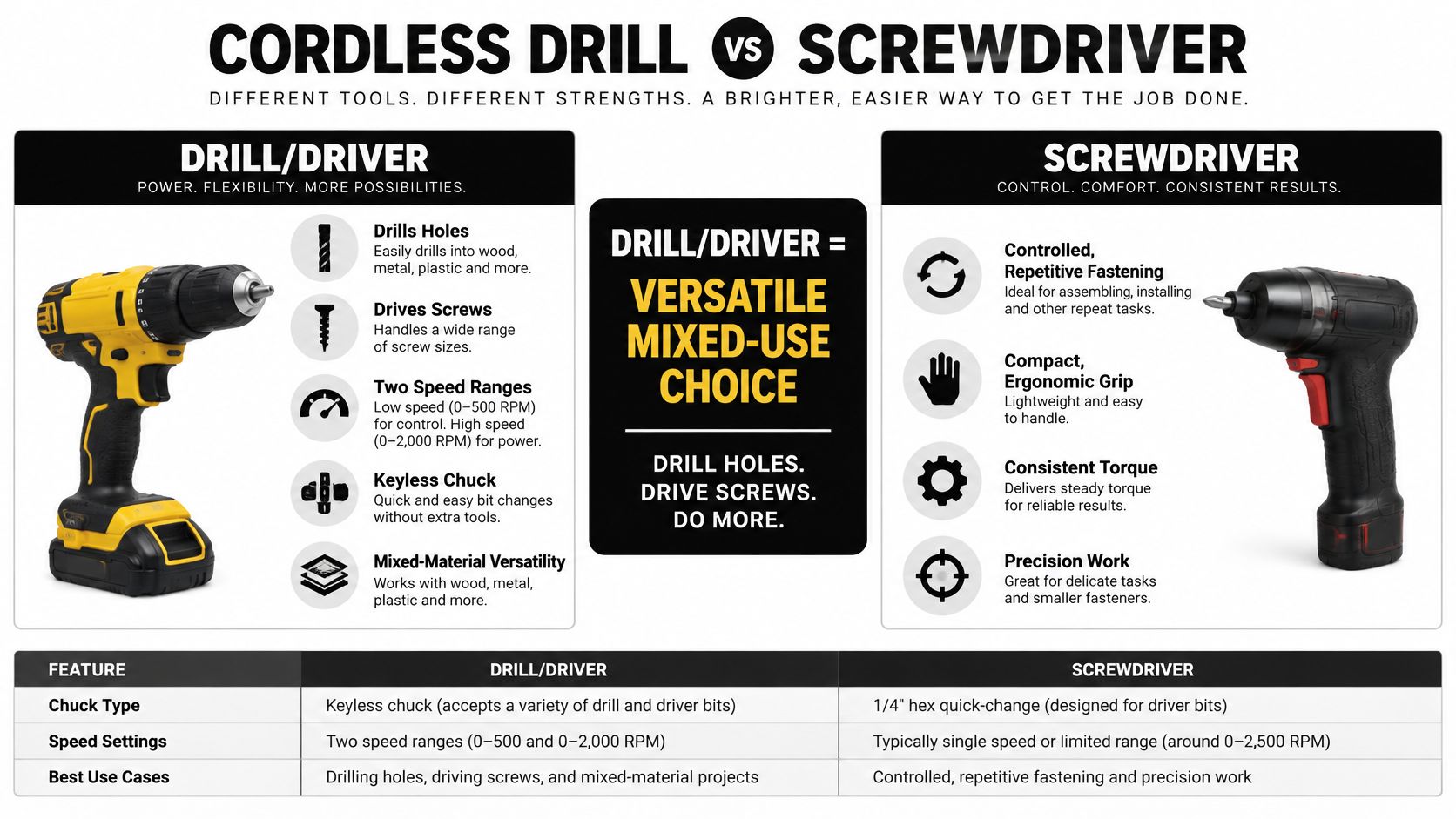
Buy around the next job, not the label
Before shopping, identify whether you need new holes, which bits the work requires, and whether your existing batteries are compatible. Then compare the complete purchase, including a charger and any missing accessories.
Keep impact drivers and framing nailers outside this head-to-head comparison. They solve different fastening problems and shouldn't be treated as interchangeable versions of a screwdriver.
Practical rule: Buy versatility for a varied workload. Buy specialization when the same fastening operation fills your day.
How Drill Drivers and Screwdrivers Work
A cordless drill/driver combines hole-making and screwdriving through its bit interface, gearbox, and fastening controls. A dedicated cordless screwdriver organizes those features around installing and removing screws.
The physical difference is easy to recognize beside a hand tool, but the controls determine how useful a powered tool becomes.
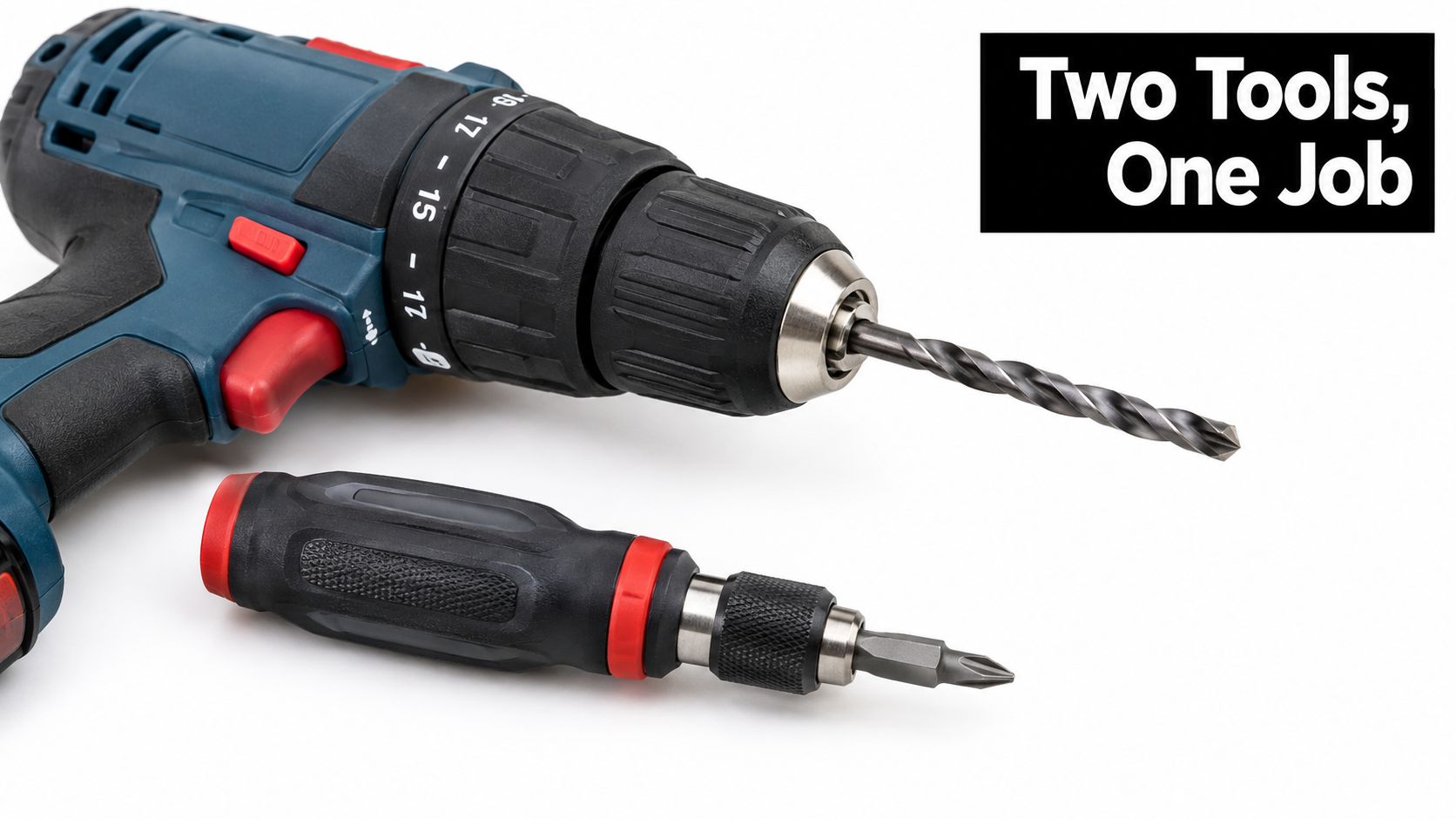
Understand the gearbox and clutch separately
A drill/driver normally has a chuck that accepts drill and driver bits, with mechanical speed ranges for different loads. Low gear provides more available torque; high gear provides more rotational speed.
The adjustable clutch is a torque limiter, not a speed control. When resistance exceeds its setting, the clutch slips, allowing the motor to continue while the chuck stops turning. That separation lets you select a suitable operating range and independently limit fastening force, as explained in this guide to drill controls and power-tool specifications.
For screwdriving, start in low gear with a modest clutch setting. Increase it only enough to seat the fastener properly, rather than using unrestricted drilling mode as your default.
Dedicated screwdrivers emphasize controlled rotation and shut-off behavior. Production screw guns may use a depth-sensing nosepiece instead, so don't assume every tool sold as a screwdriver controls the finished result in exactly the same way.
Know the categories before comparing features
- Impact driver / atornillador de impacto: A separate category that delivers rotary impacts rather than relying solely on continuous rotation.
- Brushless / sin escobillas: A motor description, not proof that a tool suits your fastening task.
- Manual screwdriver: A hand-operated alternative worth retaining for final adjustments and delicate work.
Battery portability developed over time. Black & Decker introduced a battery-powered cordless drill in 1961 using nickel-cadmium cells, and Makita introduced the removable-battery 6010D cordless drill in 1978, according to this history of modern construction tools.
For today's buyer, the useful lesson is practical: evaluate the battery system alongside the tool. A capable motor without dependable battery support isn't a complete working setup.
Comparing Torque Speed Bits and Control
Torque is turning force; speed is how fast the bit rotates. Neither specification tells you whether the tool will seat your particular fastener cleanly.
Representative cordless electric screwdrivers deliver about 0.5–8 N·m at roughly 250 RPM, while cordless drill/drivers commonly provide approximately 20–70 N·m and 400–1,500+ RPM, according to this electric screwdriver and drill comparison. These are category examples, not guaranteed specifications for every model.
Cordless drill versus screwdriver
| Criterion | Cordless Drill or Drill Driver | Electric Screwdriver | Selection Impact |
|---|---|---|---|
| Torque reserve | Better suited to demanding mixed work | Generally optimized for lighter fastening | Match output to fastener and material |
| Operating speed | Broader range for drilling and driving | Controlled operation for fastening | Don't confuse speed with finished quality |
| Bit interface | Chuck accepts suitable round and hex shanks | Typically a hex interface | Check your existing bit collection |
| Fastening control | Adjustable clutch and trigger | Clutch, shut-off, or application-specific depth control | Inspect the actual control system |
| Drilling role | Core capability | Limited and model-dependent | Buy a drill if holes are routine |
| Handling priority | Versatility under changing loads | Access and repetitive fastening comfort | Test in the actual working position |
Dedicated electric screwdrivers generally use a 1/4-inch hex interface, while drill/drivers use a chuck suited to a broader bit selection; this guide to electric screwdriver interfaces and ergonomics describes the distinction. A bit fitting the holder doesn't establish that the tool is rated for the application.
For long screws, dense timber, metal drilling, and larger bits, a drill's output reserve becomes useful. For appliance panels, furniture fittings, and cabinet hardware, buying extra torque can solve a problem you don't have.
Compare like-for-like specifications
Maximum torque, soft-joint torque, and hard-joint torque aren't interchangeable test conventions. Compare published figures under the same convention, then check gearbox operation, battery compatibility, and usable trigger control.
Voltage alone isn't a buying decision. It doesn't establish how progressively the trigger responds, how reliably the clutch releases, or how comfortably you can align the bit inside a cabinet.
Use the guide to the clutch on a drill when evaluating fastening settings. Don't assume identical clutch numbers produce identical results across different tools.
Test the working experience
Ask to test a used or open-box tool on material representative of your job. Drive a suitable fastener, check that the bit remains secure, and confirm that the controls respond predictably under load.
Assess ergonomics in the working position, not just with the tool hanging at your side. Reach, grip, balance with the installed battery, and visibility of the screw head all deserve attention.
A tool that seats the screw cleanly without awkward repositioning is worth more than unused torque on a specification sheet.
For durability, inspect the chuck or bit holder, gearbox engagement, housing, and controls. Visible wear deserves investigation; a recognizable brand name doesn't replace a functional test.
Matching Each Tool to Real Jobs
A remodeler installing shelving needs to make holes, position brackets, and drive fasteners. A drill/driver belongs in that workflow because the work changes, even within the same installation.
Use the application chart to separate mixed repair work from repetitive fastening.
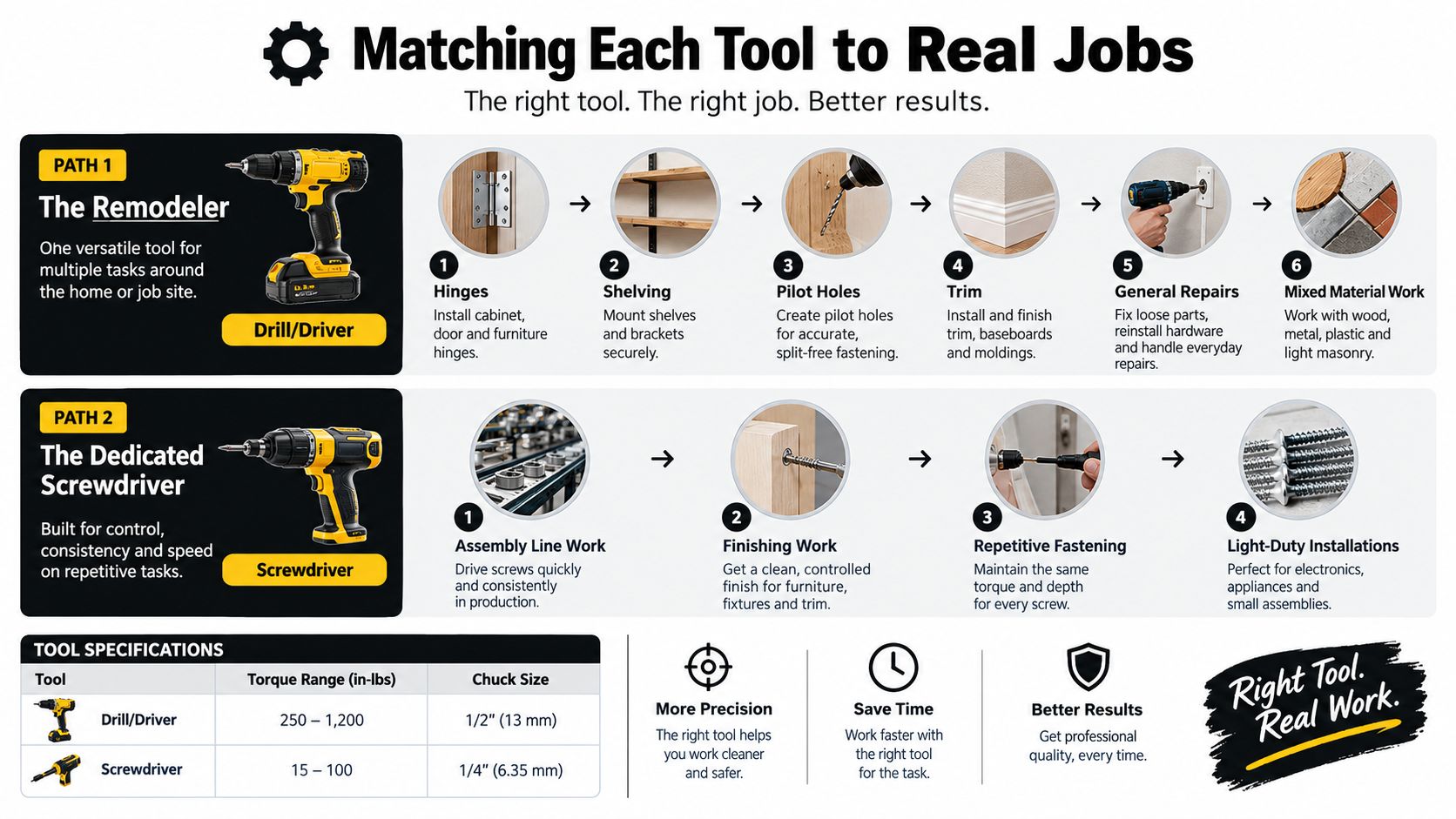
Remodeling and maintenance
Hinges, trim, pilot holes, shelving, and general repairs favor the drill/driver when your next operation is unpredictable. That doesn't mean running every screw at full speed. Change the setup to suit the material and hardware.
For furniture assembly and repeated cabinet fittings, a dedicated screwdriver becomes more attractive. The buying priority shifts toward reliable seating, access, and comfortable repetition rather than expanding drilling capacity.
If you're planning fitted cabinetry, custom carpentry for Chennai home interiors from Interiors by DeX offers a project-planning resource. Use that broader design context to identify the hardware and assembly operations before choosing the fastening tool.
A screwdriver earns its place through controlled production. A drill/driver earns its place by handling the changing operations around that production.
Sheet metal and application-specific screw guns
Drywall, HVAC, ductwork, and panel installation call for more precise category selection than buying a compact electric screwdriver. A purpose-built screw gun should match the fastener system and required depth control.
For self-drilling screws in painted or galvanized carbon-steel sheet up to approximately 1.5 mm thick, technical guidance identifies a clutched screw gun operating around 1,800–2,000 RPM as appropriate; a drill/driver can substitute only with careful trigger control, according to this sheet-metal fastening guidance. That application-specific recommendation is different from the compact assembly screwdriver category.
Overdriving matters when a washer must seal rather than be crushed. Match the tool's clutch or depth system to the required finished condition, not merely to whether it can turn the screw.
For a visual companion to the tool comparison, use the video below.
The practical purchase test is straightforward: decide whether your day consists of changing tasks or repeating a controlled fastening operation. That distinction is more useful than treating every powered screwdriver as a smaller drill.
Separating Structural Fastening from Screwdriving
A cordless drill or screwdriver isn't a framing nailer. Before buying for structural work, establish the specified fastening system, then select equipment that can install it.
A 21-degree plastic-collated framing nailer is commonly specified because it accepts full-round-head nails used in California seismic and high-wind applications, subject to the adopted code and engineered plans, as described in this framing-nailer selection guide. That's not a blanket statement that any nailer carrying that angle meets every project requirement.
Follow the fastening schedule
For a framing nailer / clavadora de marcos, verify the approved nail diameter and length, magazine compatibility, power system, and operating condition. Then check the plans, connector requirements, and local inspection requirements.
- Structural framing: Select the specified fastener and an appropriate production tool.
- Connectors and alterations: Confirm the approved fastening details rather than substituting convenient screws.
- Ordinary assembly: Furniture, cabinet hardware, and routine maintenance don't justify buying a framing nailer.
A door project illustrates why the distinction matters. Adjusting hinges is different from altering a framed opening, even though both operations happen around the same doorway.
For installation-planning context, consult the french door guidance from Home Pro's Remodeling, from Home Pro's Remodeling & Repairs. Use local requirements and the project's approved details to resolve structural decisions, not a general installation article.
Inspect the tool for its actual job
When evaluating an open-box nailer, inspect the magazine, driver blade, depth adjustment, battery, and safety contact. Don't treat a successful unloaded demonstration as proof that it will install the specified fastener correctly.
Likewise, don't buy a production nailer to solve a screwdriving problem. For work that involves repeated screw installation, the battery-powered screw gun guide is the more relevant buying reference.
The contractor's decision starts with the fastening requirement, not the tool aisle. Ordinary drilling, controlled screwdriving, and structural nailing are separate purchasing decisions, even when the same crew performs all of them.
Managing Battery Safety and Ownership Costs
A discounted cordless tool can become an expensive purchase when its battery needs immediate replacement. Inspect the pack before judging the deal, especially when buying used, open-box, or tool-only equipment.
Use this checklist before committing money to the tool.
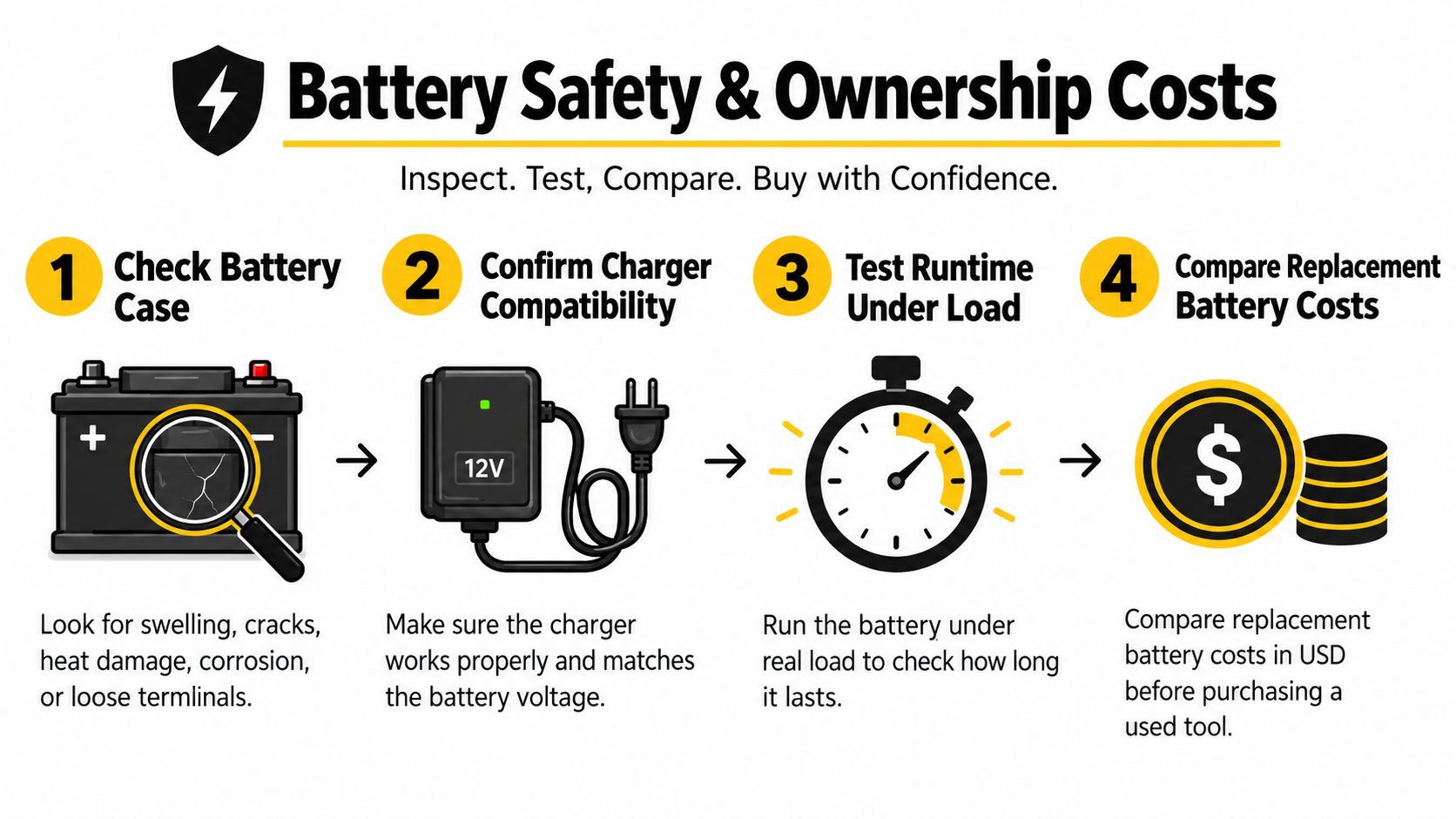
Inspect compatibility and condition
- Examine the casing: Look for swelling, cracks, heat damage, corrosion, and loose terminals.
- Confirm compatibility: Check that the manufacturer approves the battery and charger combination. A physical fit isn't sufficient.
- Test under load: Evaluate runtime during the intended work, not just whether the tool spins without resistance.
- Price replacements: Confirm that suitable packs remain available before accepting a low purchase price.
Damaged or abused packs can leak chemicals, cause burns, or vent flammable gas. Don't open or attempt to repair a suspect pack yourself; follow the manufacturer's handling instructions and distinguish authorized servicing from unsafe disassembly, as advised in the Power Tool Institute's cordless battery safety guidance.
Plan for Sacramento and Central Valley heat
For Sacramento and Central Valley crews working in 100°F-plus summer conditions, charging and storage deserve deliberate planning; the supplied battery-care guidance identifies a manufacturer charging range of 5–40°C (41–104°F) and another manufacturer's warning against storage above 50°C (120°F). These are manufacturer-specific limits, not universal permissions for every pack.
Keep spare packs shaded, allow hot batteries to cool before charging, and rotate packs rather than leaving them on a dashboard. Follow the temperature limits printed in your own battery and charger documentation.
A heat-related shutdown also deserves investigation before you declare the tool defective. Allow cooling according to the manufacturer's directions, then reassess operation.
Ownership check: A bargain is only useful if you can keep the tool working safely.
Calculate the working cost
Compare purchase price plus batteries, charger, replacement packs, downtime, and eventual disposal. For a small business, cost per completed job is more useful than advertised torque.
A bare tool / herramienta sola makes sense when you already own approved, serviceable batteries and a compatible charger. Otherwise, compare the complete setup against a kit rather than treating the tool-only price as the final cost.
Use the battery-life maintenance guide to support your care routine. Before purchase, also ask about warranty eligibility, battery coverage, and the seller's return conditions; don't assume those protections are identical.
For Northern California collection or delivery, confirm current stock and availability directly. Don't schedule a crew around an unconfirmed pickup time or shipping promise.
Who This Is For and Who Should Avoid One Tool
Buy the drill/driver first if you routinely alternate between holes and fasteners. Buy a dedicated screwdriver or application-specific screw gun when repeated fastening quality is the primary requirement.
Neither recommendation requires buying the highest-output model. Choose a tool that fits the work, then evaluate battery support, condition, and the complete price.
Who This Is For
| Buyer or workload | Recommended purchase | Budget priority |
|---|---|---|
| Homeowner building a first cordless kit | Drill/driver kit | Complete working setup |
| Remodeler or property maintenance technician | Drill/driver | Supported battery platform |
| Cabinet installer with varied operations | Drill/driver, with a screwdriver if repetition warrants it | Access and reliable controls |
| Cabinet shop or assembly worker | Dedicated cordless screwdriver | Repeatable fastening behavior |
| Drywall or sheet-metal crew | Application-specific screw gun | Correct depth-control system |
| Occasional furniture assembler | Manual screwdriver | Avoid unnecessary powered equipment |
The drill/driver's advantage is breadth; its compromise is that you're carrying drilling capability during jobs that may only need careful fastening. The dedicated screwdriver's advantage is focus; its limitation is that you still need another tool when the work calls for meaningful drilling.
Who Should Avoid This
Don't buy a dedicated powered screwdriver merely to tighten occasional loose handles. A manual tool is a sensible alternative when the workload doesn't justify charging, storage, and battery replacement.
Don't buy a drill solely because the torque figure looks impressive if your work consists of repeated delicate fasteners. Conversely, don't expect a compact screwdriver to become your general drilling tool through a change of bit.
Among buying options, compare a complete kit, an inspected open-box tool, and a bare tool for batteries you already own. The retailer's offer includes tested and inspected tools, up to 55% savings on Open-Box or Bare Tools, and a 30-Day Peace of Mind Guarantee with returns by mail or in-store and free return shipping on defective items, as detailed on the store website linked below.
Frequently Asked Questions
Can a cordless drill be used as a screwdriver?
Yes. Fit the correct driver bit, select low gear, and start with a modest clutch setting. Increase fastening torque only as needed.
Is a cordless screwdriver worth buying?
Yes, when repetitive controlled fastening justifies a dedicated tool. For occasional light adjustments, keep the manual screwdriver.
Should I buy a drill or screwdriver first?
Buy a drill/driver for mixed repairs involving holes and screws. Choose a dedicated screwdriver first only when controlled fastening dominates your workload.
Visit Value Tools Co to compare tested and inspected Open-Box or Bare Tools against the work you perform. Choose a drill/driver for a varied repair kit or a dedicated fastening tool for repetitive production, then confirm battery compatibility, included equipment, and the return terms before ordering.


