

A drill handles controlled drilling and screw seating, while an impact driver handles high-torque fastening with rapid blows, with typical mid-tier 20-volt models delivering around 3,200 to 3,600 impacts per minute, so most users need both rather than one tool for everything. If you're standing in a Sacramento supply aisle, in the truck before a deck job, or staring at a stripped lag in a pressure-treated post, that rule saves you money and callbacks.
Buying a drill with impact driver setup isn't about owning two tools that spin. It's about owning two different ways to deliver force. One gives you control. The other gives you punch when resistance climbs and a standard drill starts to stall, twist your wrist, or cam out of the screw head.
Why You Need Both a Drill and an Impact Driver
On a Central Valley framing crew, the drill and the impact driver / atornillador de impacto ride side by side for a reason. The drill bores clean holes, drives cabinet screws without snapping them, and runs hole saws under control. The impact driver sinks long structural screws into LVLs and pressure-treated lumber all afternoon without fighting you at every fastener.
Continuous Torque Versus Hammer and Anvil Impacts
A conventional drill/driver applies continuous torque through a three-jaw chuck. You feather the trigger, set the clutch, and the bit turns in one steady motion. That steadiness is exactly what you want for twist bits, spade bits, and finish work where overdriving ruins the piece.
An impact driver works differently. Inside the housing, a spring-loaded hammer strikes an anvil in rapid bursts, converting motor rotation into discrete rotational blows. Patent literature describes this hammer mechanism applying impacts on the order of hundreds or thousands of times per minute rather than relying only on geared rotational torque. Those short torque spikes keep a long screw moving when friction would stop a drill cold.
This isn't a new idea dressed up in cordless plastic. J. C. McCorkhill's U.S. Patent No. 2,448,995 for an Impact Screwdriver, filed in 1944 and issued in 1948, already combined rotary motion with sudden impact force to turn a fastener. The tool was never meant to be a faster drill. It was built around a different torque-delivery method from the start.
Practical rule: Choose a drill when versatility, hole-making, and controlled torque matter most. Choose an impact driver when repeated high-torque fastening is the main task.
That distinction matters when you're pricing a bare tool / herramienta sola against a full kit. A cheap impact driver doesn't replace the drill you skipped. It just leaves you without a proper chuck on the day you need one.
Drill vs Impact Driver at a Glance
| Feature | Drill / Driver | Impact Driver |
|---|---|---|
| Torque delivery | Continuous rotation | Hammer-and-anvil bursts |
| Chuck | 3-jaw, accepts round and hex shanks | 1/4-inch hex quick-change collet |
| Clutch | Numbered clutch settings | Generally no clutch |
| Best work | Drilling holes, finish screws, sheet metal | Structural screws, lags, deck framing |
| Reaction torque | Higher, can twist the wrist | Lower sustained force at the wrist |
| Noise and vibration | Moderate | High when impacting |
Run both on the same job and the workflow explains itself. You keep a pilot bit chucked in the drill and a driver bit locked in the impact, then swap tools instead of swapping bits a hundred times. That's faster, and it keeps screw heads intact.
Key Specs Worth Comparing Before You Buy
Spec sheets reward whoever reads them like a contractor instead of a marketer. Peak torque printed in big type tells you little about whether a tool will seat a cabinet screw cleanly or drive lags into a 4x4 without cooking itself in July heat. Match each number to a task you do.
The visual below breaks the spec hierarchy into the branches worth comparing first.
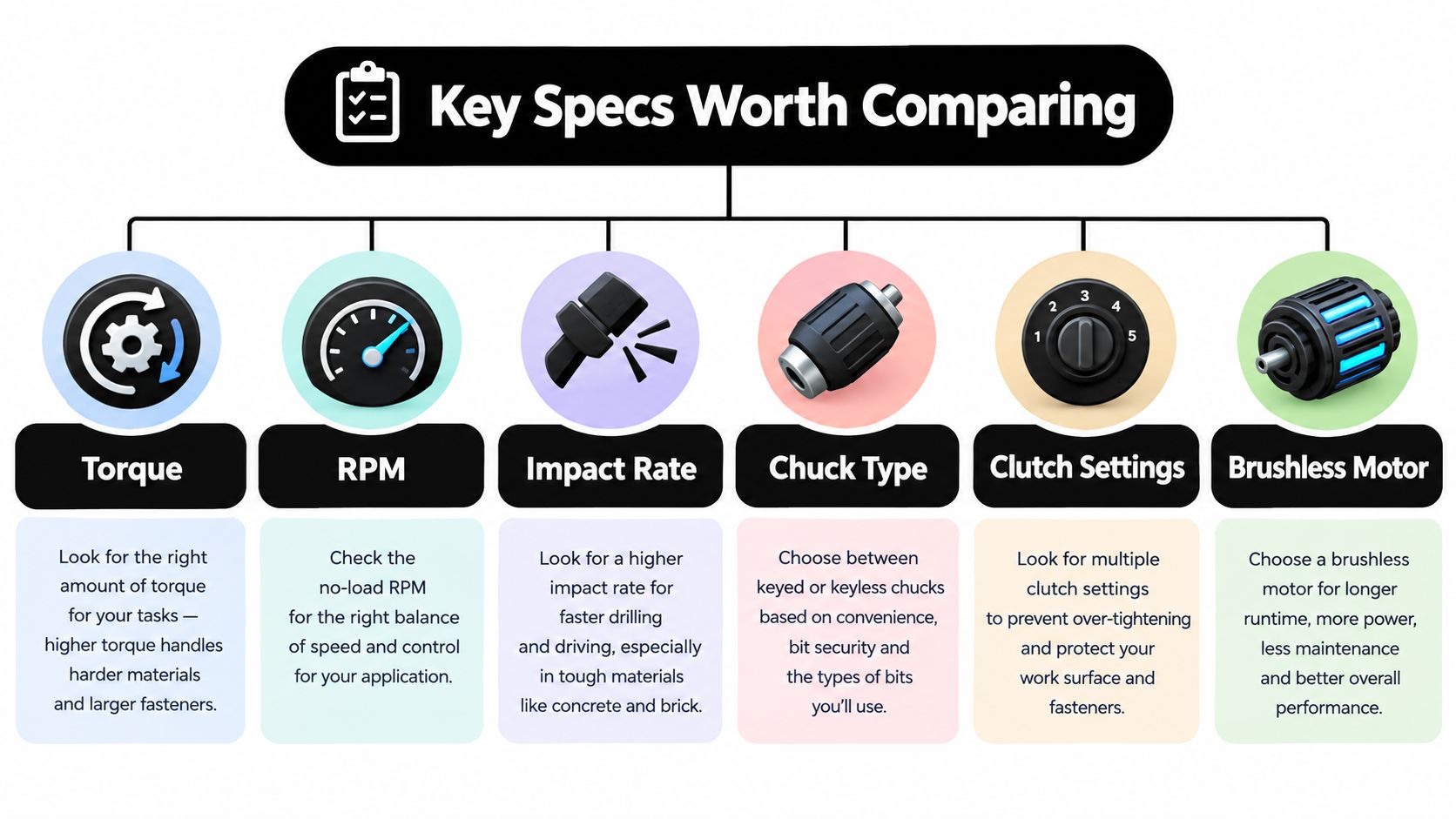
Torque Impact Rate and Chuck Type
For drills, torque and a good clutch decide whether you can drive small hardware without snapping it. For impact drivers, the impact rate tells you how the tool behaves under load. Published comparisons place typical mid-tier models at approximately 3,200 to 3,600 impacts per minute, with premium models exceeding 3,800 impacts per minute, and that action engages as resistance rises in hardwood or dense framing lumber.
Chuck type is the quiet dealbreaker. A drill's three-jaw chuck grips round-shank masonry bits, twist bits, and hex accessories alike. An impact driver's spring-loaded 1/4-inch quick-change collet accepts hex-shank bits only and won't hold ordinary round-shank bits, so your existing bit box may not transfer over.
| Spec | What It Controls | Job Where It Shows |
|---|---|---|
| Drill clutch | Screw seating depth | Cabinet hinges, electrical boxes |
| Impact rate | Fastening under resistance | Lags into pressure-treated 4x4s |
| Chuck type | Bit compatibility | Masonry, hole saws, round-shank bits |
| Speed settings | Control versus power | Sheet metal versus structural screws |
| Motor type | Efficiency and heat | All-day summer framing |
Brushless Motors and Sacramento Valley Heat
A brushless / sin escobillas motor runs cooler and pulls power more efficiently than a brushed motor, which matters when ambient air in Sacramento pushes past 100°F and there's no cool air left to shed heat into. Brushed tools cost less up front and still handle homeowner workloads fine. The trade-off is shorter runtime, more heat, and brushes that wear.
- Brushless pros: Better efficiency, less heat, longer motor life, electronic speed control
- Brushless cons: Higher purchase price, electronics cost more to repair
- Brushed pros: Lower cost, simple and proven design
- Brushed cons: Brush wear, more heat under sustained load
One caution belongs on every spec sheet. Impact action is wrong for precision sheet-metal fasteners, where impact installation torque of roughly 110 to 650 N·m at around 3,500 impacts per minute dwarfs dedicated screwguns operating up to about 30 N·m and can cut clamp load. High numbers aren't better numbers. They're only better when the fastener wants them.
Combo Kits, Bare Tools, and Open-Box Value
At checkout, you're not really choosing a tool. You're choosing a battery platform, a charger drawer, and how much you'll pay for the next three tools you buy. Get the platform decision right and everything after it gets cheaper.
The comparison below lays out the three buying paths most Northern California buyers face.
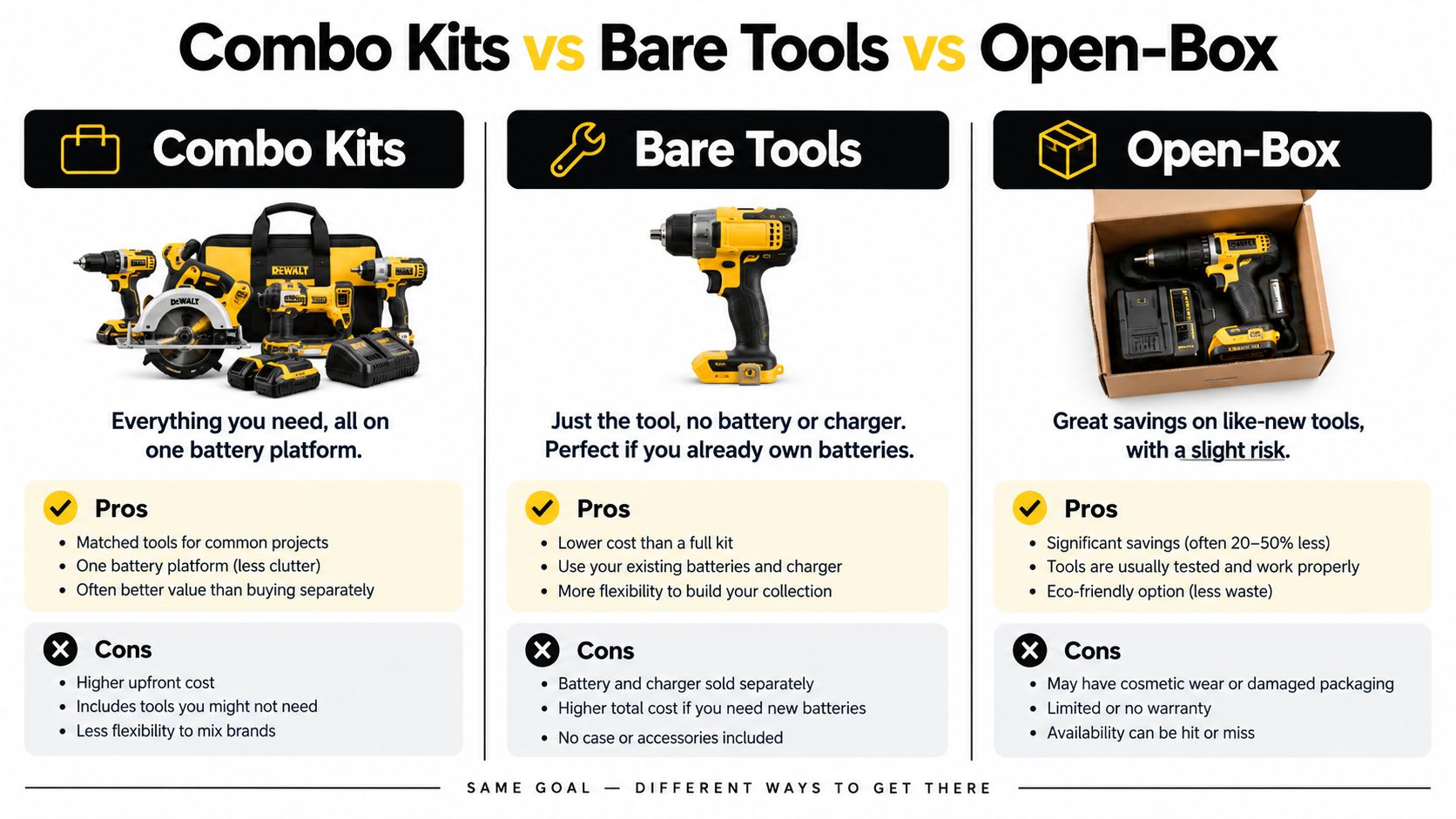
Combo Kits for a Matched Platform
A drill with impact driver combo kit is the fastest clean start. You get both tools, two batteries, and one charger that all speak the same language. For a homeowner building a first real kit or a maintenance tech standardizing a truck, that simplicity beats chasing individual deals. If you're weighing kit configurations, this guide to choosing a power tool combo kit walks through battery counts and tool pairings worth paying for.
Kits have a downside worth naming. Manufacturers sometimes bundle a strong impact driver with a weaker drill, or include compact batteries that sag under hole-saw work. Read the drill's specs as carefully as the impact driver's. The kit discount isn't a discount if one tool gets replaced in a year.
Bare Tools and Open-Box Savings
If you already own batteries on a platform, a bare tool / herramienta sola skips the duplicate charger and batteries you'd pay for again. That's how experienced crews expand a fleet, one framing nailer / clavadora de marcos or impact driver at a time. The savings are real, but only if your existing batteries are healthy enough to run the new tool hard.
Open-box is the third path, and it's where budget discipline pays off. Value Tools Co sells tested and inspected open-box and lightly used tools at up to 55% savings, backed by a 30-Day Peace of Mind Guarantee with 30-day returns by mail or in-store and free return shipping on defective items. For a remodel budget already stretched across lumber and fixtures, pairing that approach with solid design-build budgeting advice keeps tool costs from eating the contingency fund.
- Combo kit ideal user: First-time buyer or crew standardizing on one platform
- Bare tool ideal user: Pro with healthy batteries already in the gang box
- Open-box ideal user: Budget-focused buyer who wants pro brands without retail pricing
Speed matters too when a tool walks off a jobsite or dies mid-framing. Fast 1-day Northern California delivery and same-day Elk Grove warehouse pickup mean a replacement lands tomorrow instead of next week. For a contractor billing by the day, that gap is worth more than a small price difference.
Real-World Use Cases for Contractors and DIYers
Start a Central Valley framing day at 6 a.m. to beat the heat and both tools earn their keep before the first break. The drill runs pilot holes and bores for hardware. The impact driver sinks structural screws where California seismic detailing calls for positive connections, the same wall assemblies that rely on 21° full round-head framing nails from the nail gun sitting next to it.
The photo below shows the impact driver doing the work it was built for, driving into structural timber with the operator braced and the bit fully engaged.
Framing Decks and Fence Work
Pilot holes separate clean work from split lumber. Manufacturer guidance specifies a pilot hole slightly smaller than the screw diameter so threads bite while driving force and splitting risk drop, then you drive with the bit aligned and release the trigger as the head seats. Drill the pilot with the drill. Drive with the impact. No bit swapping, no split 2x6 ends at the joist hanger.
Fence repair follows the same rhythm for homeowners. You drill out a rotted rail connection, then run fresh structural screws into the post with the impact driver. If you're planning the layout and post work before the fastening starts, a step-by-step Connecticut fence installation guide covers the groundwork that makes the screw work hold up.
Kitchen Remodels and Finish Work
Inside a kitchen remodel, the roles flip toward finesse. The drill's clutch seats hinge screws and drawer-slide hardware without snapping small fasteners into particleboard. The impact driver stays holstered until you're lagging a ledger or driving long screws through cabinet rails into studs, where its bursts pull boxes tight without a fight.
Watch the clip below to see the hand-off between drilling and driving in a real sequence, paying attention to trigger control as each screw seats.
DIYers land somewhere on that same spectrum. If your year holds flat-pack furniture and the occasional picture hook, a drill alone covers you well. If you're building a deck, replacing a fence line, or maintaining rentals across Sacramento, the two-tool setup pays for itself in unbroken fasteners and unswollen wrists. The tool count follows the fastener count.
Battery Care and Heat Management in Hot Jobsites
Sacramento summers don't care about your battery warranty. A lithium-ion pack baking in a closed truck cab at 100°F plus loses capacity faster, charges slower, and can refuse a charge entirely until it cools. Treat batteries like the perishable equipment they are and they'll run seasons longer.
The checklist below covers the four heat habits that matter most on a Central Valley jobsite.
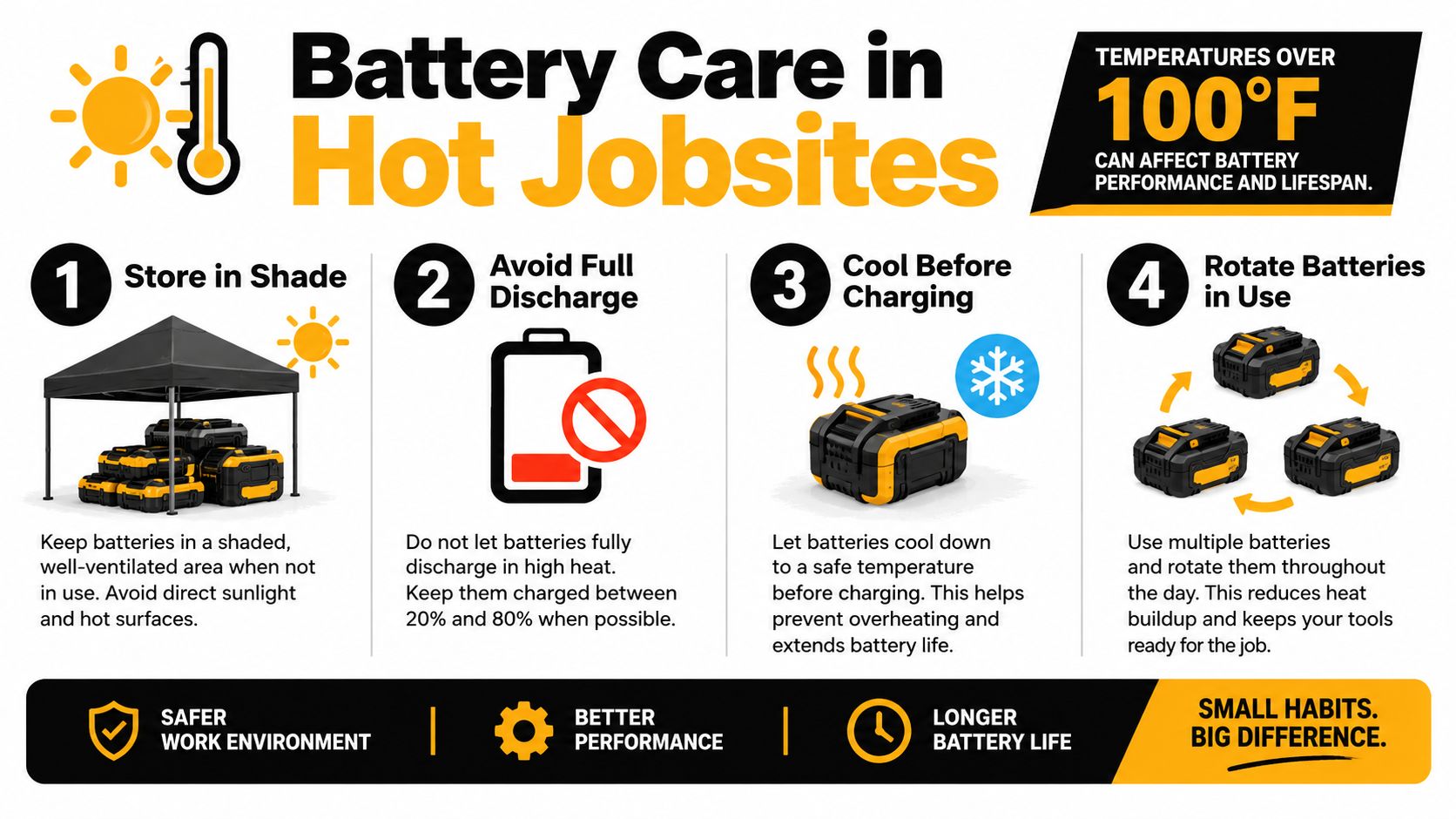
A Workday Cooling Routine That Works
Store packs in shade, never on a black truck bed or a sunny dash. An insulated cooler with no ice works as a cheap battery box in Stockton or Modesto heat. Bring packs inside at night instead of leaving them in an uninsulated garage that holds heat until midnight.
Rotate batteries instead of running one to dead flat. An impact driver pulls high current during long structural-screw runs, and a hot, depleted pack suffers twice. Swap at the first power sag, let the warm pack rest in shade, and charge it only after it feels cool to the touch. For a deeper routine, this guide on how to extend cordless battery life covers storage charge levels and charger habits in detail.
- Shade storage: Keep packs out of direct sun and closed vehicles
- Cool before charging: Let a hot pack rest until the housing feels neutral
- Rotate under load: Swap packs during long impact runs instead of forcing one flat
- Clean the contacts: Blow dust off terminals and vents after each day's work
Inspections That Catch Heat Damage Early
Check packs weekly during summer. A swollen housing, a latch that won't click, or a fuel gauge that lies about remaining charge all say the pack is done. Pull it from rotation before it fails halfway through a ledger board. Retired packs get recycled, not tossed in the dumpster with the cutoffs.
A battery that comes off the charger too hot to hold comfortably is telling you something. Listen the first time, not after it quits on a roof.
Buying habits help here too. Same-day pickup from an indoor Elk Grove warehouse means your new bare tool and batteries skip a day riding in a hot delivery truck across the valley. Small thing. Batteries notice it even if you don't.
Safety, Maintenance, and Bit Choices That Prevent Downtime
An impact driver feels easier on the wrist, and that's exactly where people stop thinking. The reduced reaction torque is real, but it trades against noise and vibration that accumulate across a career. Short intermittent fastening is one exposure. All-day production driving on a framing crew is another animal entirely.
Noise Vibration and Kickback Risks
The UK Health and Safety Executive identifies noise-induced hearing damage and hand-arm vibration syndrome as occupational risks from handheld power tools, with testing that specifically included impact drivers and combi-drills. Battery power doesn't erase the risk either, since cordless tools can run louder or quieter than corded equivalents. Wear hearing protection when impacting runs long, rotate tasks, and keep bits fully engaged so the tool isn't rattling loose in a worn screw head.
Kickback is the acute version of the same lesson. When a bit binds in dense material, OSHA recommends using a torque bar or a tool with a built-in kickback clutch, and applying light, even feed pressure rather than forcing the bit. That guidance applies doubly to large hole saws, which store enough rotational energy to wrench a wrist or worse. Eye protection is essential, since OSHA safety guidance calls for safety goggles and gloves matched to the hazards of hand and power tool work, and unsuitable bits can shatter under impact loading.
Impact-Rated Bits Are Not Optional
An impact driver can drill, but only with 1/4-inch hex-shank, impact-rated bits built for torsional shock. Ordinary bits fracture under repeated hammer blows, and specialty coatings or exterior materials raise the stakes further, the same way choosing nails suited for charred timber matters before you ever pick up the gun. Retail guidance makes the same point plainly, noting that drills offer better control and versatility for drilling while impact work demands bits designed for the tool. Before buying replacements, this overview of how to choose the right drill bit helps match shank, material, and rating to the job.
- Inspect before use: Retire bits with rounded tips, cracks, or bent shanks
- Match the rating: Impact-rated for the atornillador de impacto, standard bits stay in the drill
- Clear the dust: Blow out chuck jaws, collets, and motor vents weekly
- Skip sheet metal: Use a clutch-controlled drill for thin-gauge steel and roofing screws
Budget for impact-rated accessories carefully. A cheap bare impact driver plus a drawer of snapped bargain bits costs more than the right setup bought once, and tested, inspected open-box tools let you redirect that accessory money where it belongs.
Buying Checklist and Frequently Asked Questions
Who This Is For
You're framing, decking, remodeling, or maintaining property anywhere from Sacramento to Fresno and you drive long fasteners weekly. A drill with impact driver combo on one brushless platform, plus impact-rated bits, is your setup. Crew leads can pass the terms along easily, since the impact driver / atornillador de impacto and bare tool / herramienta sola are standard bilingual jobsite language.
Who Should Avoid This
Skip the impact driver if your work is flat-pack furniture, small hardware, thin sheet metal, or precision drilling. A quality drill/driver with a good clutch serves you better and costs less. Don't buy an impact driver as your only tool expecting it to drill like a drill.
Frequently Asked Questions
Can an impact driver replace a drill for drilling? Only for occasional pilot holes with hex-shank, impact-rated bits. Routine, large-diameter, or masonry drilling still needs a drill chuck and continuous speed control.
Is brushless worth the extra money? In Central Valley heat, yes for daily users. Cooler running and better efficiency protect batteries during summer production work.
Are bare tools a good deal? Yes, when your existing batteries are healthy. Weak packs make a new herramienta sola feel underpowered for reasons that aren't the tool's fault.
Will an impact driver reduce fatigue? It reduces wrist-twisting reaction torque, but adds noise and vibration. Hearing protection and task rotation keep that trade honest.
If you're ready to put a matched drill and impact driver to work without paying full retail, Value Tools Co stocks tested and inspected open-box and bare tools at up to 55% savings, backed by the 30-Day Peace of Mind Guarantee with free return shipping on defective items. Order for fast 1-day Northern California delivery or grab same-day pickup at the Elk Grove warehouse and get back on the job tomorrow.


