

BL1850B means a Makita 18V LXT pack rated at 5.0Ah, storing about 90Wh, and it should be used only in LXT tools with a matching receiver. Read the printed code that way and you can judge most Makita 18V packs before you pay for them.
You're likely standing in front of a used or open-box listing right now, trying to work out whether the pack in the photo will run your drill tomorrow or waste half a shift. The listing title may say "5 amp battery," the seller may call it "like new," and the price may look too good to pass up. Ignore the sales language first. Read the label, check your tool's receiver, then look for wear that tells you how the pack has really lived.
Decoding Makita 18V Battery Codes and Capacity
Read the printed pack code before relying on a listing title. BL1850B identifies the BL battery family, an 18-volt pack, a 5.0Ah capacity, and the B generation. The same pattern makes a BL1830B a 3.0Ah pack and a BL1820B a 2.0Ah pack.
The digits after the family indicate nominal voltage, while the next two digits express capacity in tenths of an amp-hour. The final letter marks the generation. On a used or open-box pack, compare that printed code with the listing and the tool's receiver marking, then consider whether the wear history fits the seller's description.
Turning Amp-Hours Into Stored Energy
Multiply nominal voltage by amp-hours to estimate stored energy. The Makita UK battery specification sheet gives approximately 54Wh for an 18V 3.0Ah pack and 90Wh for an 18V 5.0Ah pack. That makes the 5.0Ah pack's nominal energy about 67% greater.
Watt-hours help compare capacity, but they do not guarantee runtime. Motor efficiency, load, material, temperature, and tool electronics all affect how long a pack lasts. A brushless driver fastening short screws into pine draws power differently from a grinder cutting steel.
Match the printed model code, not the listing title. On used and open-box packs, check the label against the seller's description before paying.
| Model code | Capacity | Stored energy | Net weight | Rapid-charge time | Typical use |
|---|---|---|---|---|---|
| BL1815N | 1.5Ah | about 27Wh | 300g | Check the DC18 charger chart for the pack's stated charge time | Trim work, lights, small drivers |
| BL1820B | 2.0Ah | about 36Wh | Not stated here | 24 minutes with DC18RC or DC18RD | Light drilling, short tasks |
| BL1830B | 3.0Ah | about 54Wh | 640g | about 22 minutes with DC18RC | General drilling and driving |
| BL1850B | 5.0Ah | about 90Wh | 0.63 kg | about 45 minutes with DC18RC | Contractor rotation |
| BL1860B | 6.0Ah | about 108Wh | Not stated here | Not stated here | Heavy-draw tools, cold-weather use |
Weight figures can vary across Makita product listings: the specification sheet gives the BL1850B as 680g, while another Makita page lists it near 0.63 kg. The BL1830B is listed at 640g. Treat small differences cautiously and compare the exact pack's printed model code and condition rather than choosing on weight alone. Missing weight or charging figures are not a reason to guess; use the pack and charger documentation for those values.
For a broader explanation of lithium-ion battery advantages for power tools, consider how the chemistry fits your work before paying for extra capacity. The code and watt-hour calculation clarify what a pack is rated to hold; the tool's receiver marking and the pack's wear history help you judge whether a used or open-box pack is the right purchase.
Checking Compatibility With Your LXT Tool
An 18V LXT pack belongs to the LXT platform. It doesn't interchange with Makita CXT or XGT tools, even if a listing uses "Makita 18V" loosely.
That platform rule comes first because it prevents the most expensive mistake. Dual-battery 36V LXT tools are the exception that still fits the rule, since they run on two LXT packs together. A bare tool, or herramienta sola, gives you no battery in the box, so the platform check matters even more.
The Three-Step Receiver Check
- Find the tool model number: Read it from the tool label, not from memory and not from the box for a similar tool.
- Confirm platform and receiver marking: Look for the Star Protection symbol or a yellow battery receiver on the tool body.
- Search that exact model: Check the manual for approved packs before you buy a BL1850B or BL1860B for an older tool.
The Makita service FAQ identifies BL1850B and BL1860B batteries as compatible with tools bearing the Star Protection symbol or yellow battery receiver, while older tools may require different battery types. It also warns that non-genuine or altered batteries can defeat communication between the battery, charger and tool.
Physical fit isn't the same as approved electronic compatibility. A pack can slide onto a rail and still fail to communicate correctly with the tool or charger. That's a safety and reliability problem, not just a runtime problem.
Open-box buyers should photograph the tool label, the receiver, and the battery label before asking for help. Those three photos answer most compatibility questions without guesswork. The guide to power tool battery compatibility across platforms covers the same checks for mixed-brand kits.
I would not buy a pack for an older LXT tool until I'd seen the receiver marking myself. "It fit my drill" from a seller tells you almost nothing about your exact model.
Choosing Amp-Hours for Your Trade and Tools
A bigger pack only helps if the tool's weight and balance let you use the extra energy. Start from the job, then pick the smallest pack that finishes it without constant swapping.
The BL1850B as the General-Purpose Contractor Pack
The Makita BL1850B product page lists it as an 18V LXT lithium-ion battery rated at 5.0Ah, equivalent to 90Wh, with a net weight of approximately 0.63kg and a charge-level indicator. That indicator matters on real work, because you can check remaining capacity before climbing a ladder or starting a punch-list run.
- Pros: strong all-day rotation capacity, broad LXT compatibility where the receiver matches, and manageable weight for drills, saws and grinders.
- Cons: costs more than compact packs, adds bulk on overhead and detail work, and it's overkill for occasional short DIY tasks.
- Ideal users: remodelers, maintenance crews and serious DIY users who already own LXT tools and rotate packs through a rapid charger.
Impact driver work, atornillador de impacto, is where the 5.0Ah pack earns its weight. You're driving fasteners for hours, the tool stays close to your body, and fewer swaps keep the work moving. Deck work, framing hardware and repeated lag work all reward that extra stored energy.
Where the Smaller and Larger Packs Fit Better
The 1.5Ah and 2.0Ah packs suit trim, cabinet installs and short tasks because they're light and quick to swap at the bench. They run out fast under sustained load, so don't put them on a saw or grinder and expect contractor runtime. For a framing nailer, clavadora de marcos, or a small driver used in short bursts, light weight often beats capacity.
The 3.0Ah pack suits mid-length drilling and driving, and it's the better overhead choice when balance reduces fatigue. The 6.0Ah pack suits grinding, cutting, saw work and cold-weather use, but it adds the most bulk. Quote the printed spec-sheet weight for the exact pack you're buying, because published figures for the 3.0Ah and 5.0Ah packs don't always agree.
| Task | Suggested pack | Why it fits |
|---|---|---|
| Trim, cabinet install and punch list | 1.5Ah or 2.0Ah | Light and quick to swap at the bench |
| Drywall screwing and light drilling | 3.0Ah | Balance of weight and runtime for mid-length tasks |
| All-day impact driving and deck work | 5.0Ah | Sustained draw with fewer battery swaps |
| Grinding, cutting and saw work | 5.0Ah or 6.0Ah | High draw and longer load cycles |
| Overhead or ceiling work | 3.0Ah | Lighter balance reduces fatigue |
Durability follows how you treat the pack, not just its size. A 5.0Ah pack that's never left baking in a truck bed will usually outlast a 6.0Ah pack that's charged hot every day. Ergonomics, warranty terms on a genuine purchase, and the charger you already own should all factor into value for money.
Genuine vs Aftermarket Makita Batteries Compared
The main risk with aftermarket packs isn't brand loyalty. It's communication between the pack, the charger and the tool.
Genuine Makita packs are built to exchange data with Makita chargers and tools, including charge and temperature information. When an altered or non-genuine pack disrupts that exchange, you lose the protection layer that helps the system respond to heat, overload or a charging fault. That's why I treat unknown packs as a safety question first and a price question second.
The comparison below shows where that difference shows up in daily use.
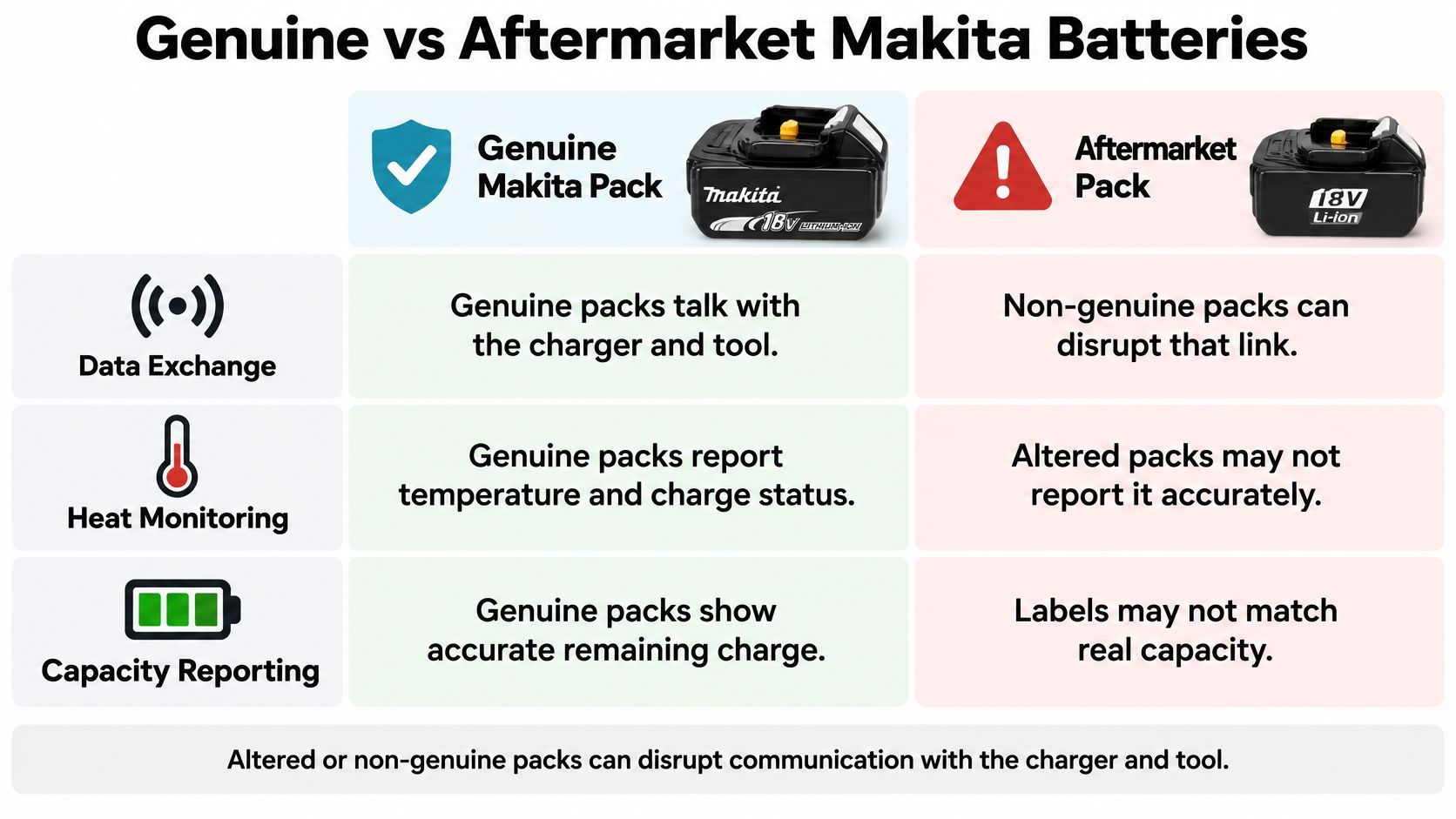
Forum threads about low-cost listings repeat the same pattern. Counterfeit or unbranded packs get sold as Makita replacements, the label promises high amp-hours, and the buyer finds out under load that the pack can't deliver. You can't verify cell quality from a product photo, and a low price doesn't tell you what's inside the housing.
| Factor | Genuine Makita LXT | Aftermarket pack |
|---|---|---|
| Battery-to-charger-to-tool communication | Designed to exchange data with Makita tools and chargers | Built to the maker's own design, which may not match Makita signaling |
| Warranty coverage | Covered under Makita terms for genuine purchases | Seller-specific terms, confirm them in writing before buying |
| Charging match | Matched to DC18RC and other Makita rapid chargers | Set by the pack's own electronics and charger limits |
| Cell traceability | Model labels and genuine packaging | Often unknown or unverified |
| Price | Higher new, lower open-box | Lower up front |
The practical middle path is a genuine open-box pack from a seller with clear inspection and return terms. It usually costs less than new retail and avoids most aftermarket risk. You're still buying a used energy source, so test it before the first full shift.
An aftermarket pack can suit a secondary tool or a non-critical task if the return policy is clear and you test it right away. For a crew that can't afford a failed pack on a deadline, I would stick with genuine packs. The savings disappear fast when a cheap pack kills a morning of billed work.
How to Charge and Store Packs in Central Valley Heat
Central Valley summer heat can leave a pack too hot to charge as soon as a tool comes off the job. Give it time to cool, then charge it in a shaded, ventilated place. Repeatedly charging a hot pack can shorten its working life.
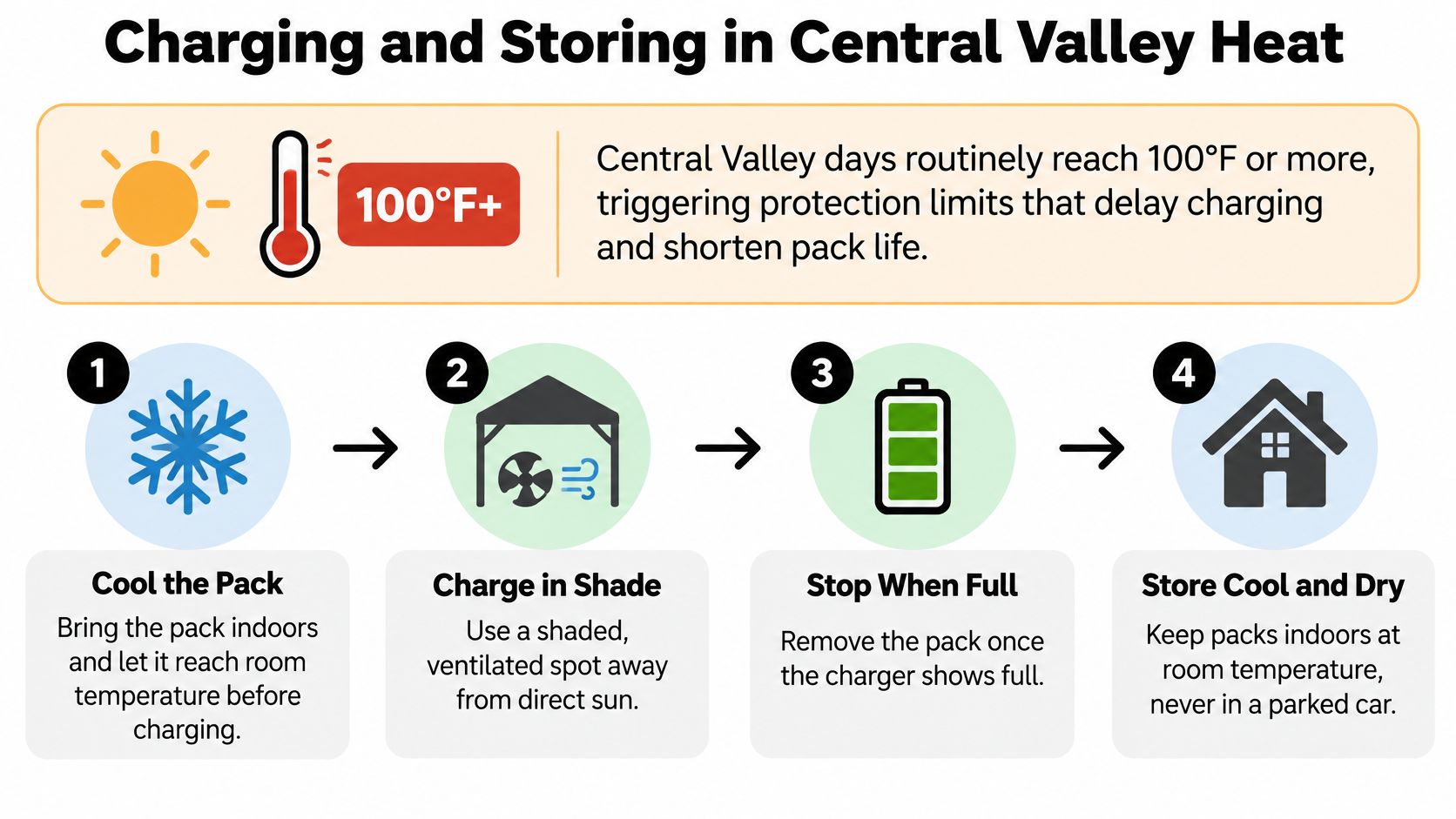
A Hot-Weather Charging Routine That Works
- Cool the pack first: Remove it from the tool and let it approach indoor temperature before charging.
- Check the charger model: The charger affects how long a pack takes to recharge.
- Charge in shade or indoors: Keep the charger out of a truck bed, closed cab, and direct sun on concrete.
- Remove it when full: Take the pack off the charger when its indicator shows a full charge.
- Rotate two packs: Use one while the other charges and cools, rather than putting a hot pack straight back to work.
- Store at partial charge: For storage longer than a few weeks, keep the pack partly charged in a cool, dry place and check it every month or two.
Charger choice affects turnaround time. The Makita BL1830B product page gives approximate DC18RC rapid-charger times of 22 minutes for a 3.0Ah BL1830B and 45 minutes for a 5.0Ah BL1850B. Makita also describes protection that monitors current, voltage and temperature, while a built-in memory chip communicates battery condition to the charger.
A common mistake is charging immediately after cutting or grinding, while the pack is still hot. The charger may delay charging, and the final phase can take longer. Let the pack cool in shade with air circulating around it before connecting it.
For guidance on seasonal storage and other care practices, follow this guide to how to extend power tool battery life. If a pack swells, smokes or catches fire, do not improvise. Review these lithium-ion battery fire suppression methods before an emergency. Same-day Elk Grove warehouse pickup can also help replace a failed charger or pack without waiting for shipping.
The video below covers safe handling habits that complement this charging routine.
How to Test a Used Makita Pack and Handle Worn Ones
A used Makita pack can look clean and still have little capacity left. Its 5.0Ah label describes its rating when new, not what it can deliver now. Read the printed model code, check the tool's receiver marking, and weigh the pack's wear history together before paying.
Age, storage conditions, heat and heavy use can all reduce remaining capacity, but the label does not show that history. Check the housing and terminals, then compare the pack under a repeatable load with a known-good pack of the same rating. The tool's receiver marking helps confirm compatibility; it does not tell you whether the cells are healthy.
Inspect the Housing, Terminals and Charger Behavior
Check the housing first. Swelling, warping, cracks or a case seam that no longer sits flat are reasons to stop. Set the pack on a flat bench: if it rocks, do not charge or load-test it.
Inspect the terminals for discoloration, bent contacts, melted plastic or heavy scoring, which can point to heat exposure or poor contact. Wipe away light surface dirt with a dry cloth. Do not file contacts or bend them back and treat the pack as safe.
If the pack has no visible damage, place it on a verified Makita charger in a cool indoor area. Watch for error lights, failure to start or unusual heat during the initial minutes. A warm pack may need time to cool before charging; repeated errors on a cool pack are a stronger reason to stop and investigate. The 2025 North Carolina lithium-ion recycling market assessment does not establish Makita charger guidance, so use the charger's own instructions for interpreting its lights and behavior.
A working pack may have ordinary scuffs. Cracks, deformation and damaged contacts are different.
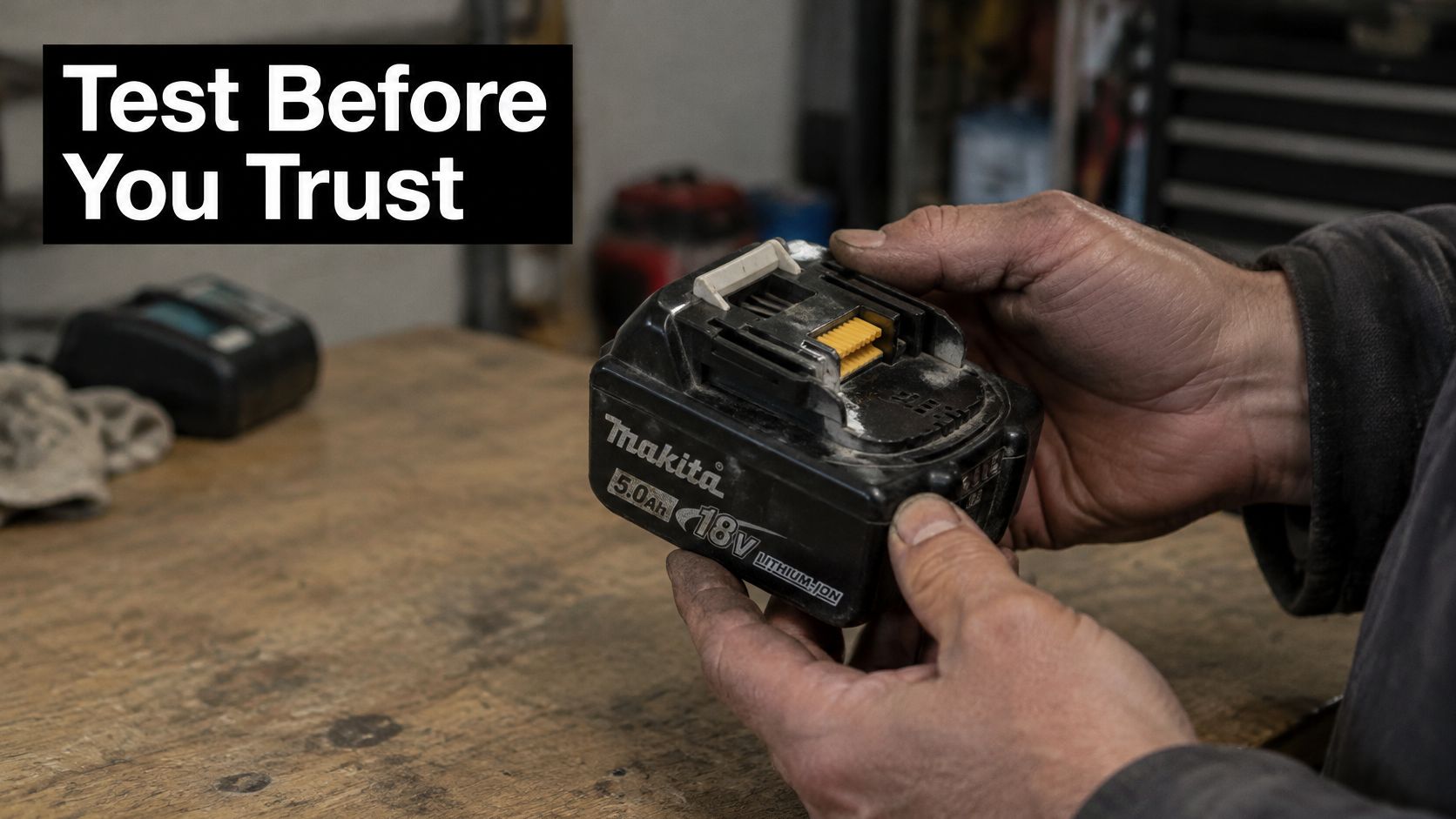
Run a Repeatable Load Test
Charge the pack fully, then let it cool before testing. Use the same tool, settings, material and screw length for both packs. Drive screws and count them until the tool noticeably slows or stops. Repeat with a known-good pack of the same rating.
Keep the conditions consistent: use the same lumber, driver setting and rest time between runs. If the used pack completes substantially fewer screws, its remaining capacity is lower than the comparison pack's. This test gives you a practical comparison, not an exact measurement of capacity.
Treat heat exposure as a reason for closer scrutiny. A pack used through hot summers on roofing or concrete work around Sacramento may have had a harder life than one kept in a shaded shop. Its appearance alone cannot settle the question; charge and load-test it before relying on it for a full shift.
Buy a used pack only if the return window gives you time to charge, cool and load-test it. Get the terms in writing, and check that they allow enough time to complete the test before the return period ends.
Value Tools Co offers open-box and lightly used items described as fully functional, with a concise 2-day return window. Before buying any used pack, confirm the seller's written terms and whether you can charge it, let it cool and run the comparison test within that window.
| Symptom | Likely cause | Action |
|---|---|---|
| Runs out in under half the expected time on the load test | Worn cells or heavy prior use | Compare with a known-good pack and retest; replace if the gap persists |
| Charger shows an error or refuses to start | Communication fault, deep discharge or temperature lockout | Let the pack cool, retry with a verified charger, then check the charger |
| Swelling, warping or heat without load | Possible internal cell damage | Stop use, isolate the pack and arrange appropriate battery recycling |
| Discolored or bent terminals | Heat exposure or poor contact | Wipe away minor dirt; do not use a pack with damaged contacts |
| Charges much slower than expected | Hot or cold pack, or a slower charger | Confirm the charger model and charge the pack at a suitable temperature |
Stop-Use Rules and Disposal for Worn Packs
Do not charge or use a swollen, hot, leaking or physically damaged pack, or leave it near combustible materials. Keep it dry on a non-combustible surface, away from other batteries, and tape over the terminals. Never puncture the pack, open its housing or try to revive it with another charger.
Keep worn lithium-ion packs out of household trash and curbside recycling. Take them to a retailer take-back point, battery recycler or county household hazardous waste site. For transport, keep the terminals taped and place the pack in a non-metal container. Carry damaged packs separately from good batteries.
End-of-life packs need a proper collection route. The North Carolina lithium-ion battery recycling assessment reports that 12 lithium-ion recyclers serving the state handled, processed or recycled 132.8 million pounds of end-of-life lithium-ion batteries collected across the United States. A dead pack belongs in an appropriate recycling or hazardous-waste stream, not in a jobsite dumpster.
Who This Is For and Which Pack to Buy Now
For a full day of impact driving, grinding or saw work, a 5.0Ah BL1850B or 6.0Ah BL1860B with a rapid charger is a practical choice. Short tasks with compact LXT tools call for a 2.0Ah or 3.0Ah pack, which keeps the tool lighter. Before buying used or open-box, read the printed model code, check the tool's battery receiver marking, and consider the pack's wear history together. A compatible model code alone does not tell you how a used pack will perform.
Who This Is For
- Remodelers and general contractors: Rotation packs can keep LXT tools available while one battery charges.
- Maintenance teams and property managers: A charge-level indicator helps you check remaining power between service calls.
- Serious DIY users: A compatible LXT pack lets you add runtime to bare tools without adding another platform.
- Bargain hunters: Check the pack's model code and condition, then test it promptly under load. The retailer's 2-day return window makes a quick check important.
Who Should Avoid This
- CXT or XGT owners: These are separate platforms; choose a battery for the tool's own system.
- Owners of older LXT tools without the Star symbol or yellow receiver: Check the approved battery for the exact tool model before buying.
- Buyers who won't check the charger: Confirm the charger model and charging speed before choosing a pack, especially if tools need to return to work quickly.
- Anyone considering an unbranded pack with no return terms: Unknown cells and communication electronics make performance harder to assess, and you may have little recourse if the pack fails.
Value Tools Co is an online and local retailer in Elk Grove, California, offering open-box and lightly used, fully functional tools from brands including Makita. Its listed savings reach up to 55% off typical retail pricing. Qualifying orders get free U.S. shipping, and the return window is 2 days. Same-day pickup in Elk Grove may be available, and support is offered 24/7. For a battery purchase, compare the printed pack code with the tool's receiver marking and check the pack's wear history before checkout.
If you're adding or replacing an 18V LXT pack, browse the open-box selection at Value Tools Co. Check the pack code, receiver marking and wear history before buying, then use the 2-day return window to act promptly if the pack does not meet your needs. Qualifying orders include free U.S. shipping, and same-day Elk Grove pickup may be available.


