

You're halfway through a Sacramento deck job when the impact driver starts chewing Phillips heads, the bit twists, and the battery comes off the truck hot enough that you can't charge it. The tool isn't necessarily the problem. Impact driver usage goes wrong when the fastener, bit, battery, material, and operator technique don't match.
An impact driver, or atornillador de impacto, is excellent for long screws, lag screws, structural fasteners, and dense material. It's a poor substitute for a clutch-controlled drill on delicate cabinet hardware, plastics, electronics, and precision work. The difference shows up in stripped heads, crushed sealing washers, damaged coatings, broken bits, rework, and, on structural jobs, inspection trouble.
Why Impact Driver Usage Matters on Real Job Sites
A Sacramento crew can lose a morning through small decisions. Someone grabs a high-torque impact driver for every fastener, uses a worn standard bit, runs full trigger speed, and leans hard into the screw. The first few screws go in quickly. Then the heads deform, the bit cams out, and the driver keeps hammering after the washer has already compressed.
That failure pattern is predictable. Impact tools can produce six to ten times more torque than a screw's strength, according to Metal Construction News' fastener error guidance. Excessive torque can strip heads, fracture fasteners, damage coatings, and crush sealing washers. Too much pressure or RPM can also stop the screw point from cutting efficiently and damage drill points, while an over-compressed washer may lose sealing performance and raise long-term leak risk.
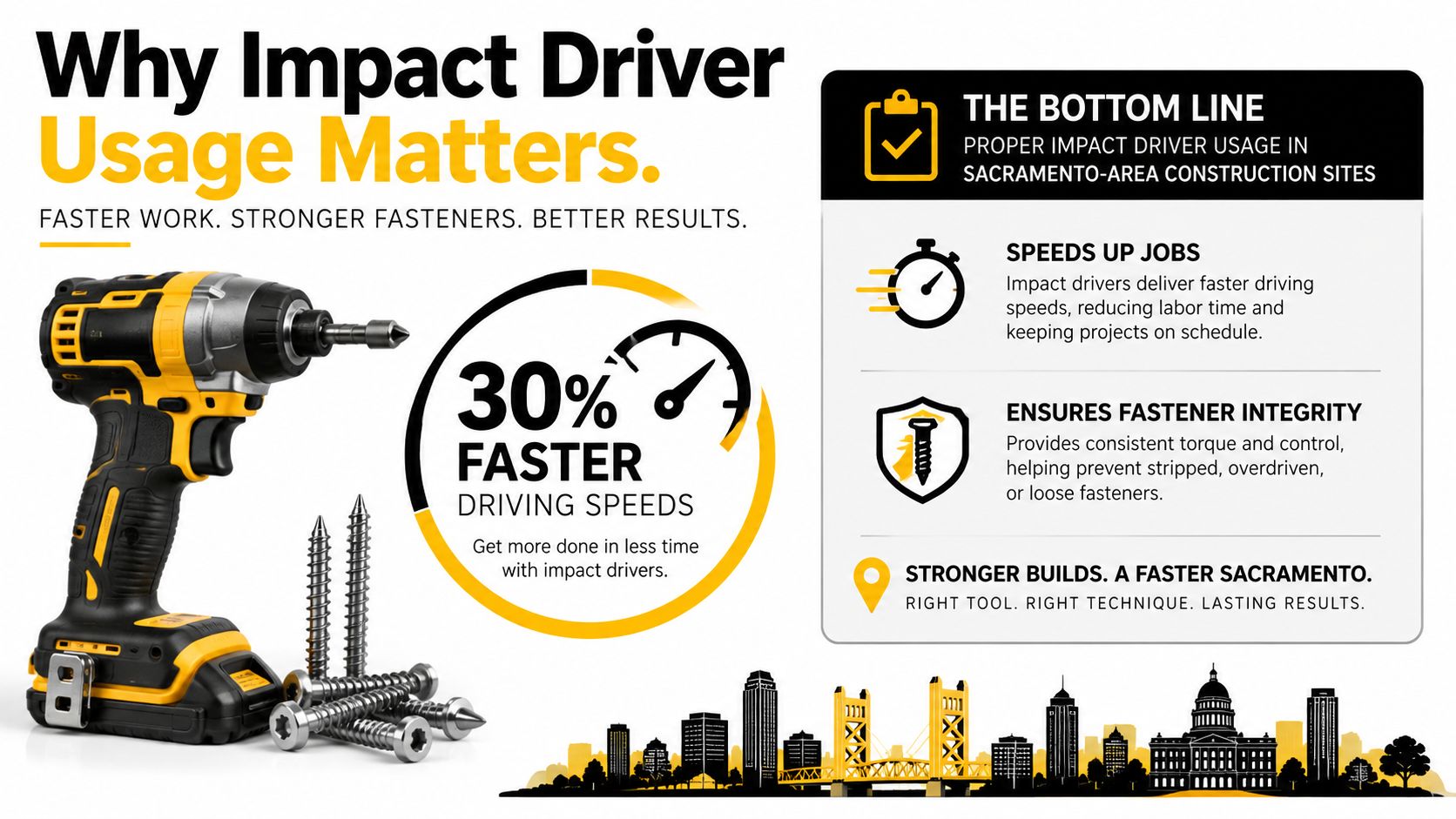
Field rule: Use the impact driver as a speed tool, not as a final torque instrument.
That rule matters even more on structural work. A framing fastener or roof screw isn't judged by how fast it disappeared into the material. It has to seat correctly, preserve its coating or washer, and meet the requirements of the connection. In California seismic regions, the wrong fastener system can also create inspection and rework problems.
Good usage starts before the trigger moves. Select an impact-rated bit or socket, start at low speed, hold the driver square, let the point establish its hole, and stop as soon as the head or sealing washer reaches the specified depth. For critical joints, verify final torque with a calibrated torque wrench because the required value changes with fastener size, material, thread condition, lubrication, and workpiece properties.
The practical difference between a productive crew and a destructive one often comes down to control. A contractor who understands impact action gets speed without sacrificing fastener integrity. A DIYer who treats the tool like a high-torque drill can waste screws, lumber, bits, and time. Value Tools Co's right-tool-for-the-job guide is useful when the question is whether the impact driver belongs in the job at all.
Impact Driver vs Drill and When Each Tool Wins
An impact driver delivers rotational force in repeated strikes. A drill driver applies continuous torque through a chuck and usually offers a mechanical clutch with more predictable control. That distinction matters more than the maximum torque printed on the box.
Use the impact driver for long structural screws, lag screws, deck fasteners, ledger hardware, and dense wood where continuous resistance can twist your wrist or stall a drill. Use the drill driver for pilot holes, countersinking, delicate screws, finish work, plastics, electronics, and any task where the clutch needs to release before the fastener or material gets damaged.
| Task | Better Tool | Why |
|---|---|---|
| Driving long wood screws | Impact driver | Repeated rotational strikes handle sustained resistance efficiently |
| Installing cabinet hardware | Drill driver | Clutch control helps prevent stripped threads and damaged faces |
| Drilling a clean pilot hole | Drill driver | Continuous rotation gives better control and chuck compatibility |
| Driving structural lag screws | Impact driver | High resistance and long engagement suit impact action |
| Fastening into plastic | Drill driver | Impact force can crack or deform the material |
| Removing a stuck screw | Impact driver | Impact action can help break the fastener loose |
| Driving small machine screws | Drill driver | Lower, controlled torque reduces thread damage |
The common mistake is choosing the impact driver because it feels stronger. Strength isn't the same as suitability. A compact brushless, or sin escobillas, impact driver may be comfortable on a deck but still be excessive on a small brass screw. A drill driver may feel slower on structural screws, yet its clutch can save a finished surface when the fastener reaches the correct depth.
Crews often carry both tools because they solve different problems. The drill makes the hole and handles controlled fastening. The impact driver handles repetitive driving where the material pushes back. A combination kit can make sense for a remodeler, maintenance technician, or serious DIYer, but check whether both tools share the same battery platform before buying.
For a more detailed purchase decision based on chuck type, voltage platform, drilling needs, and clutch control, use this cordless drill selection guide. The right setup is usually not the tool with the highest advertised output. It's the pair that lets you switch from controlled drilling to fast driving without forcing one tool to do both jobs.
Choosing Bits, Sockets, and Fasteners That Actually Fit
Most impact-driver damage starts at the consumable. A worn or mismatched bit slips inside the recess, rounds the fastener, and makes the operator press harder. More pressure increases cam-out and heat instead of fixing the underlying fit.
Choose an impact-rated bit for impact-driver work. These bits use a torsion zone designed to absorb repeated shock. Standard bits can fracture under impact use, while impact-rated consumables tend to fail through more sudden torsion-zone breakage rather than gradual tip rounding, as discussed in this trade guide to bit geometry and fastening torque.
Match the recess to the fastener
Phillips bits work when the screw is designed for them, but they're more vulnerable to cam-out than square or Torx recesses. Square-drive bits can hold well in decking and general wood fastening. Torx bits usually give the driver a more positive engagement on structural and exterior screws. Hex-shanked sockets are appropriate for hex-head screws, nuts, and bolts, but the socket itself must be rated for impact use.
Impact-rated sockets have thicker walls and heat treatment intended for repeated striking. A chrome hand-tool socket can crack or shatter when used on an impact driver. The socket may fit the nut perfectly and still be the wrong tool for the force being applied.
A magnetic bit holder is convenient for ordinary wood screws and quick bit changes. Use a locking hex sleeve or a secure retention system when working overhead, driving long fasteners, or using a socket where dropped hardware creates a real hazard. Magnetic retention alone isn't a substitute for positive engagement.
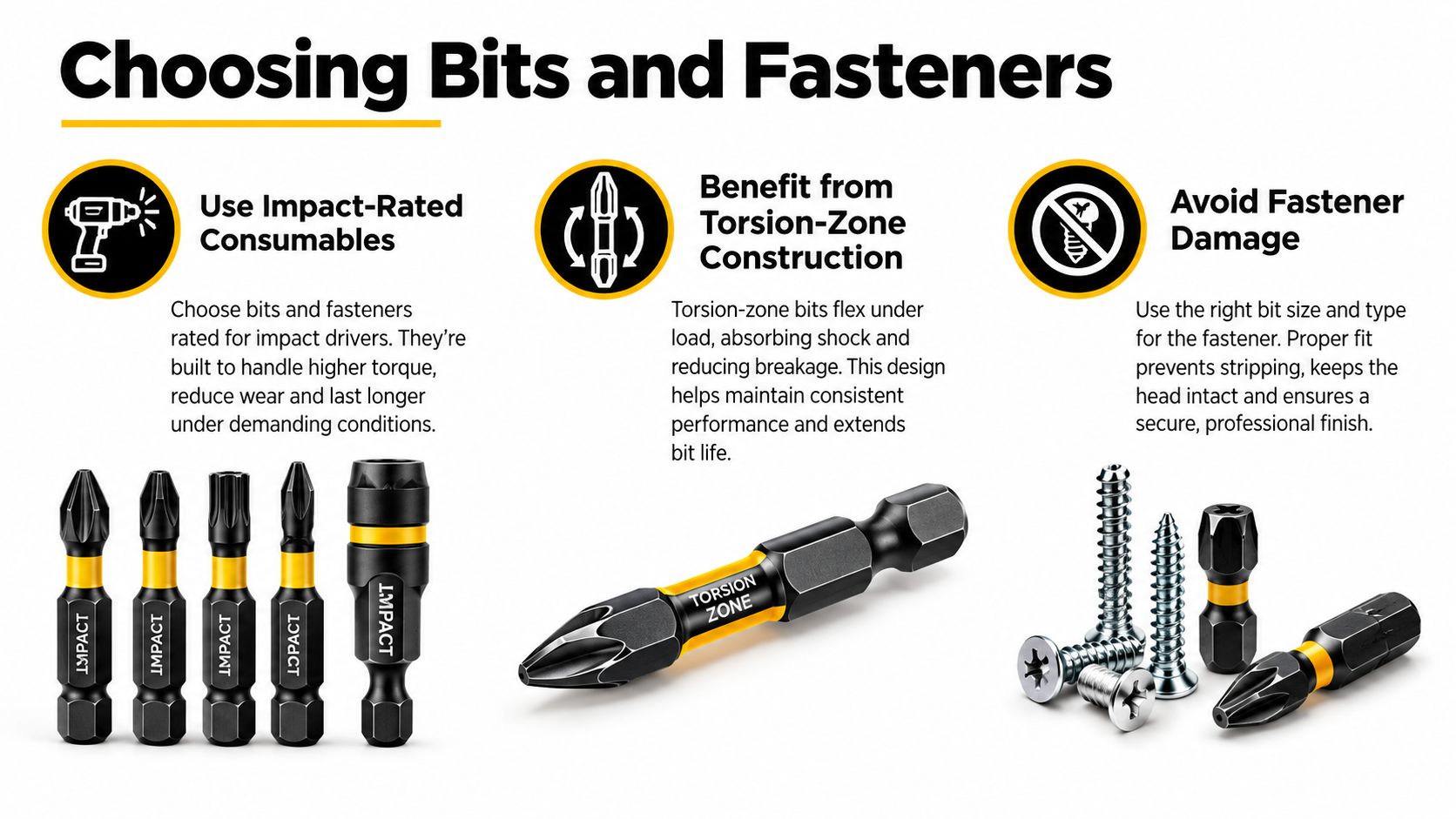
Before starting production work, inspect the bit tip and test one fastener in scrap or an unseen area. If the recess fills with chips, the bit walks, or the head starts to deform, stop and change the bit, speed, or fastener. The impact Torx bit set guide is a useful reference for crews deciding which Torx sizes belong in a working pouch.
Grip, Trigger Control, and a Field-Tested Driving Sequence
Hold the impact driver with the driving hand and support the rear or battery area with the other hand when the fastener is long, the material is dense, or the driver starts to twist. Keep the tool square to the fastener. A crooked driver puts side load on the bit and makes a good recess behave like a damaged one.
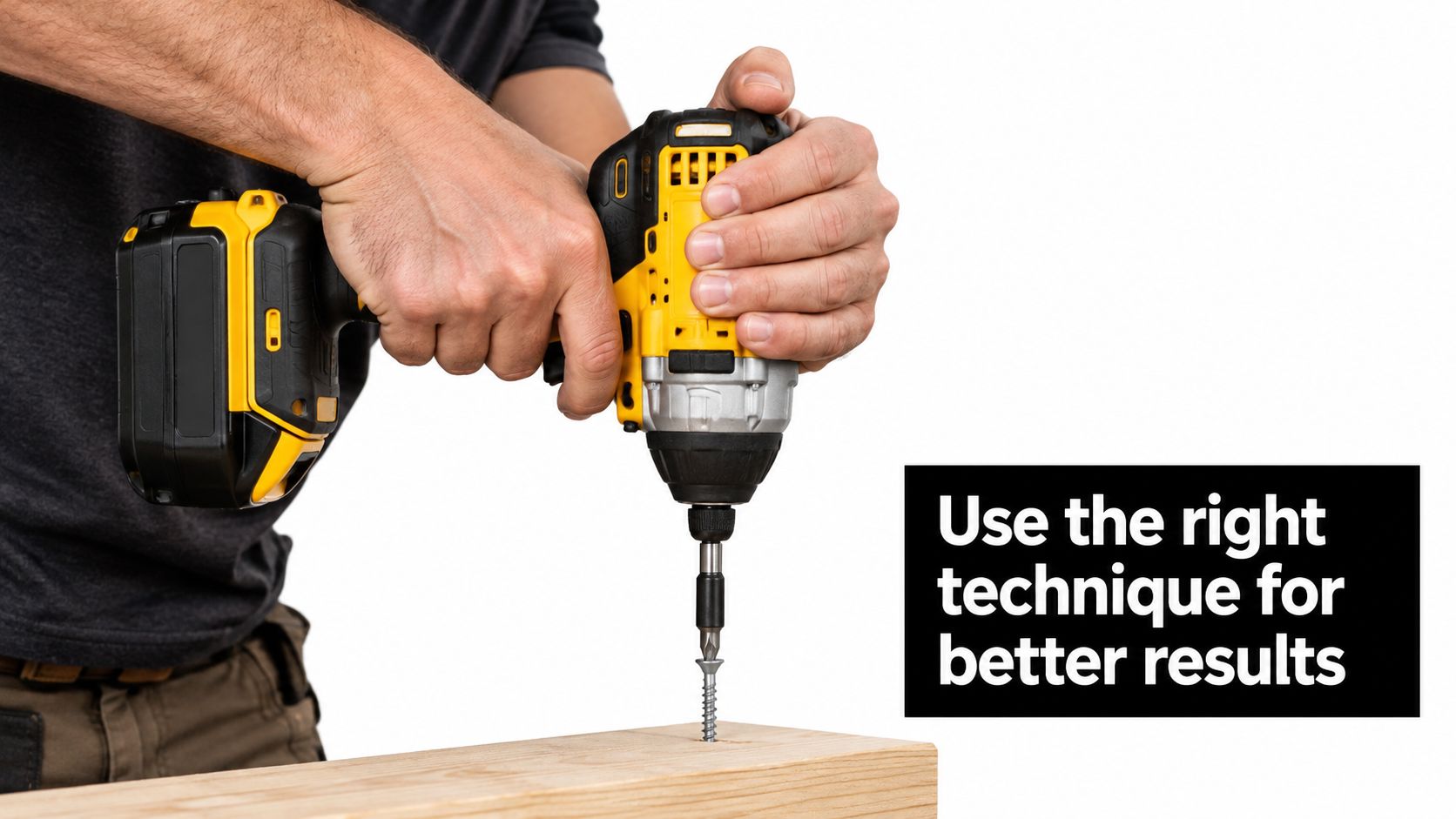
For a deck screw, seat the bit fully, touch the trigger slowly, and let the screw point cut rather than forcing it into the board. Increase speed only after the threads have established their path. As the head approaches the surface, ease off and stop when the head reaches the intended depth. Continuing to hammer after seating is how you crush a board, bury a head too far, or strip the recess.
For a structural lag or framing screw, start the same way but pay closer attention to the washer, head, and joint. The tool should drive the fastener through the required members without replacing the specified installation procedure. If the joint is critical, use the impact driver for speed and verify the final torque with a calibrated torque wrench.
Practical rule: Downward pressure should stabilize the bit, not force it through a fastener that has stopped cutting.
The same sequence applies whether the crew calls it an impact driver, an atornillador de impacto, a bare tool, or herramienta sola. The battery platform doesn't change the physics. A clavadora de marcos, or framing nailer, is a different tool entirely, and it shouldn't be substituted for a screw-driving operation because both appear in the framing aisle.
A driver that kicks or walks out of the recess usually needs one of four corrections: square the tool, reduce trigger speed, replace the bit, or confirm that the fastener is appropriate for the material. Don't solve every seating problem with more force.
This demonstration shows how body position and trigger control affect the result:
Reading Torque Numbers, Clutch Modes, and Depth Control
Torque numbers are useful for comparing tools, but they don't tell you exactly how a driver will install a particular fastener. Installation torque depends on friction, lubrication, thread geometry, material, and impact duration. Breakaway torque measures removal resistance, so it shouldn't be treated as an installation setting.
Independent bench testing found that approximately 1,500 to 1,800 in-lb can cover about 95% of general fastening work when paired with higher RPM, while the most powerful tested drivers reached roughly 2,656 in-lb fastening torque and 4,200 in-lb breakaway torque, according to Pro Tool Reviews' impact-driver torque testing. Those values help frame the buying decision, but they don't guarantee that a high-output driver will seat a screw cleanly.
Treat control features as working equipment
Electronic speed modes, trigger response, clutch systems, and depth-control collars are more valuable than raw output on finish-sensitive work. Use a lower mode for small screws or soft material. A depth-control system can make repetitive roofing or decking work more consistent, but it still needs to be tested against the actual fastener and substrate.
Comparative testing also found an 8% to 25% forward and reverse measurement difference in standard impact drivers, so a single advertised torque figure shouldn't be assumed to represent both directions. Use forward performance for installation decisions and reserve breakaway output for removal.
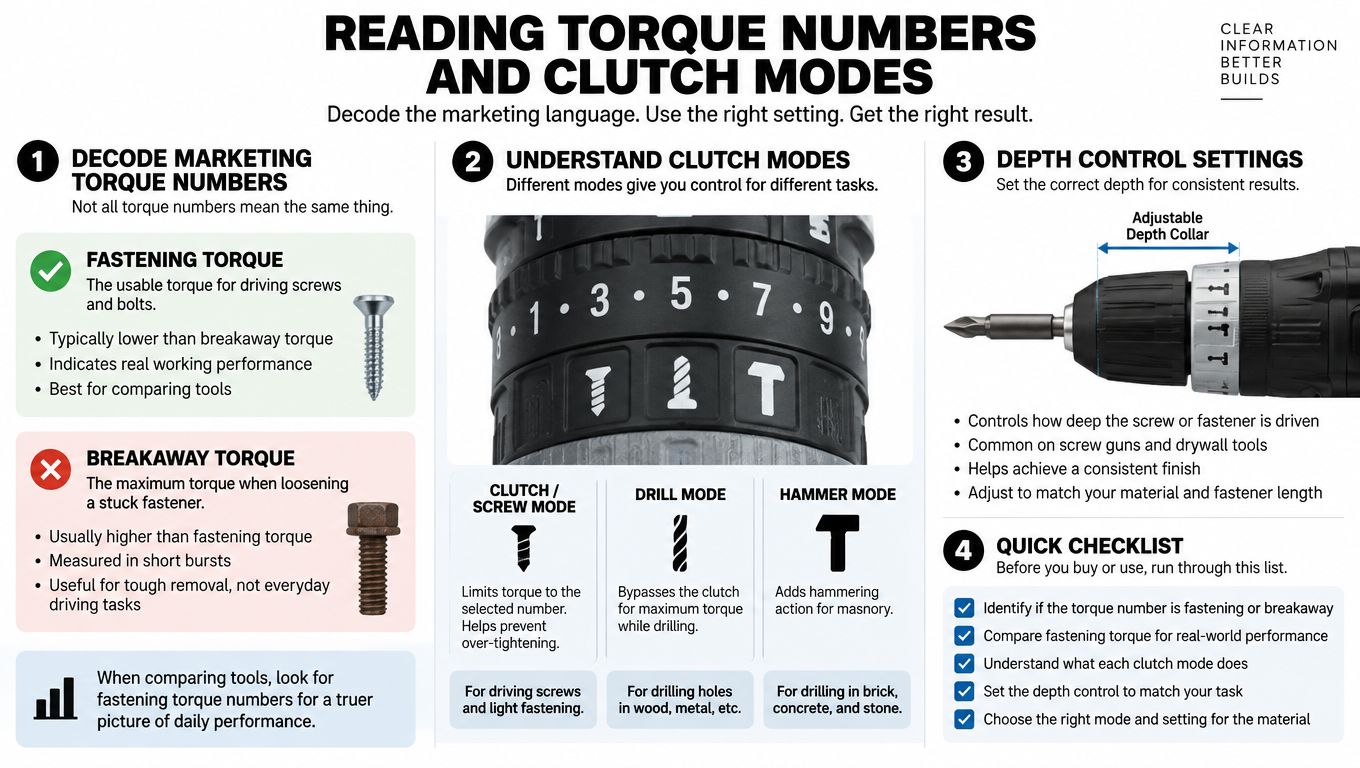
For deck work, depth is part of the finished result. The XTREME EDEALS INC. deck screw guide offers useful context on seating depth, especially when the visible finish matters as much as holding power. Test one screw, inspect the head and material, then adjust speed or depth control before driving a full row.
Battery Care, Heat Management, and Storage in Hot Climates
A cordless impact driver is only productive while its battery is healthy and compatible. Charge lithium-ion packs only with the charger designed for that battery type, in a ventilated area, and within the manufacturer's temperature range. Milwaukee's battery safety documentation recommends an ambient charging range of 40°F to 105°F in its safety instructions, available in this battery safety document.
That range matters in Sacramento and the Central Valley. A pack that sat on a roof, in direct sun, inside a truck, or in an enclosed job box may be hotter than the surrounding air. Remove it from service, move it into shade or a ventilated area, and let it cool before charging. Don't block charger vents, charge beside flammable materials, or leave batteries in a parked vehicle.
UL's lithium-ion battery safety guidance explains that charging or discharging cells beyond safe limits can cause internal damage, overheating, and thermal runaway. A damaged pack after a drop or water exposure deserves inspection rather than an optimistic return to the charger.
Build a rotation that fits the workload
For repetitive fastening, two compatible batteries let one pack cool while the other works. That improves continuity, but it adds weight, cost, and storage responsibility. Homeowners doing occasional repairs may prefer a compact battery and lower carrying weight. A framing, decking, HVAC, or maintenance crew usually benefits from a larger-capacity setup and a spare.
Compatibility is not optional. Confirm the exact voltage platform, battery series, charger model, and manual before using a bare tool. A pack that looks similar may belong to a different system, and an incompatible charger can create a fire risk.
Noise and vibration also affect the operator. Wear hearing protection, rotate repetitive tasks, take rest intervals, and avoid carrying a heavy high-capacity battery overhead when a compact pack will handle the work. For organized storage between jobs, practical advice on how to cut tool storage costs for contractors can help keep batteries, chargers, and consumables protected and separated.
Troubleshooting, Open-Box Buying, and Picking the Right Setup
The highest-torque impact driver won't fix a wrong bit, a damaged fastener, a hot battery, or poor alignment. Start with the symptom and correct the cause.
| Field problem | Likely cause | Practical fix |
|---|---|---|
| Bit slips from the head | Worn or mismatched bit, crooked alignment, excessive speed | Install the correct impact-rated bit, hold square, start slowly |
| Screw stops before seating | Wrong fastener length, dense material, damaged point | Confirm the fastener, drill a pilot hole where appropriate, reduce pressure |
| Head buries too deeply | Excessive speed or torque, no depth control | Use a lower mode, release the trigger at seating, test depth first |
| Driver kicks under load | Side loading, high resistance, poor grip | Support the tool, keep it aligned, check the fastener and substrate |
| Battery dies early | Heat, age, heavy workload, wrong capacity for the task | Rotate compatible packs, cool before charging, inspect battery condition |
| Tool won't charge | Incompatible charger, excessive temperature, damaged pack | Verify platform and charger, allow cooling, remove damaged packs from service |
Kit, bare tool, or open-box purchase
A complete kit suits a first-time buyer who needs the driver, compatible battery, and charger together. The advantages are straightforward setup and fewer compatibility decisions. The trade-offs are higher purchase cost and duplicate batteries if you already own tools on another platform.
A bare tool, or herramienta sola, is more economical for a contractor already invested in DeWalt, Makita, Milwaukee, Ridgid, or Ryobi batteries. Its disadvantage is that the buyer must verify the exact platform and buy the compatible power source separately. Don't assume that a visually similar battery from the same brand will work.
Open-box tools can reduce equipment cost, but condition and return coverage matter. Value Tools Co states that its 30-Day Peace of Mind Guarantee covers tested and inspected tools, 30-day returns by mail or in-store, free return shipping on defective items, and savings of up to 55% on open-box or bare tools, as described in its buyer and product information. Before checkout, confirm what the listing includes, the tool's condition, the battery series, charger model, and return terms.
A commercial buyer comparing tool purchases with broader equipment planning may also find this machinery financing guide from Business Loan Warrior useful for evaluating total equipment cost rather than focusing only on the sticker price.
California framing and regional buying checks
For structural framing in California and other seismic regions, a 21-degree full-round-head framing nailer, or clavadora de marcos, is the safer specification than a clipped-head model for many structural connections, including wall framing and shear panels. Confirm the approved fastener type and length with the project plans and local building department. The angle alone doesn't establish code compliance, and engineered plans or the California Building Code still control.
A 21-degree tool suits framers, remodelers, and DIY builders handling load-bearing work. Its advantage is compatibility with full-round-head fasteners used in structural applications. Its drawback is that 21-degree plastic-collated nails can be bulkier to carry and may require more frequent reloads than some clipped-head systems. This is a project-specific checkpoint, not a universal buying rule.
Who This Is For
- Professional contractors: Crews driving structural screws, deck fasteners, HVAC hardware, and maintenance fasteners benefit from impact speed, spare compatible batteries, and tested consumables.
- Remodelers and property managers: A drill driver plus a compact impact driver covers controlled work and repetitive fastening without forcing one tool into every task.
- DIY homeowners: A compact kit makes sense for decks, repairs, and general construction when the user is willing to control trigger speed and learn fastener selection.
- Open-box buyers: Existing battery-platform owners can reduce equipment cost if they verify condition, included accessories, compatibility, and return coverage.
Who Should Avoid This
Avoid using an impact driver as the only cordless tool if your work is mostly cabinet installation, electronics, plastics, precision drilling, or small machine screws. A drill driver with a clutch will provide better control.
Avoid an open-box bare tool if you don't already own the matching battery platform or if the listing doesn't clearly identify the charger, battery series, condition, and returns. Avoid charging any hot, wet, dropped, swollen, or visibly damaged battery until it has been properly evaluated.
Final job-site checklist
- Before driving: Match the fastener, bit, socket, material, and battery platform.
- At startup: Keep the driver square and begin with low trigger speed.
- During seating: Let the point cut, reduce pressure, and stop at the specified depth.
- On critical joints: Use the impact driver for speed, then verify final torque with a calibrated torque wrench.
- During hot work: Rotate packs, keep them shaded and ventilated, and cool them before charging.
- After the job: Inspect bits, sockets, fastener heads, washers, batteries, and the driver chuck.
Frequently asked questions
Is a brushless impact driver worth it for contractors?
A brushless, or sin escobillas, impact driver is a sensible choice for repetitive professional use when battery compatibility, ergonomics, speed control, and service support fit the workload. It isn't automatically the right choice for delicate fastening. Contractors should still match the tool to the fastener and keep a clutch-controlled drill for precision work.
Should I use an impact driver or a high-torque drill?
Use an impact driver for long screws, lag screws, structural fasteners, and dense material where repeated rotational strikes help manage resistance. Use a drill driver when continuous torque, pilot-hole control, or clutch release matters. A high-torque rating doesn't replace application-specific control.
What should I check before buying an open-box impact driver?
Verify the exact tool model, voltage platform, battery series, charger compatibility, included accessories, physical condition, operating manual, and return coverage. Test the chuck, trigger, direction switch, speed modes, battery contacts, and work light if the seller permits inspection. Don't buy a bare tool unless you already have or can safely source its matching battery and charger.
What framing nailer is appropriate for structural work in California seismic regions?
Many structural applications call for a 21-degree full-round-head framing nailer, but the approved nail type and length depend on the plans and local requirements. Confirm the specification with the project documents and building department before buying. A 21-degree angle by itself doesn't establish compliance.
For Sacramento-area contractors, fast fulfillment can matter when a failed tool stops production. Value Tools Co's Elk Grove location offers local support and same-day warehouse pickup subject to inventory and store policy, while Northern California delivery options can help crews replace a tool without waiting on a distant supplier. Match the driver and battery system first, then use condition, return coverage, and pickup availability to make the purchase practical.
Value Tools Co carries open-box and bare-tool options from brands including DeWalt, Makita, Milwaukee, Ridgid, Ryobi, and Husky, with tested and inspected tools covered by its 30-Day Peace of Mind Guarantee. Check the compatible battery platform and included accessories, then visit Value Tools Co to compare an impact driver setup that fits your fasteners, workload, and Sacramento-area schedule.


