

You're standing over a stack of subfloor with no outlet nearby, or you're at a Sacramento framing bench ripping lumber while a fully charged cordless battery sits hot on the tailgate. The choice between a corded vs cordless circular saw comes down to more than peak watts. It's about total task time, dependable cutting under load, battery management, electrical safety, and what the tool costs across its working life.
A corded circular saw is still the practical choice for long, repetitive cuts near reliable power. A modern brushless cordless saw earns its place on roofs, punch-list work, room-to-room remodels, and unfinished sites where extension cords slow you down. Value Tools Co helps buyers compare tested tools, including open-box and bare-tool options, so the right saw can be matched to the job rather than the marketing label.
Why This Choice Matters on a Real Jobsite
A remodeler trimming subfloor inside a room without a convenient outlet has two problems: getting power to the saw and keeping the cord clear of the cut line. A framer at a stationary bench has the opposite problem. The outlet is close, the material keeps coming, and stopping to change a battery interrupts the rhythm of the work.
Then there's the DIYer replacing fence boards in July. In the Sacramento and Central Valley heat, the saw may work hard while the battery and charger sit in a hot truck or on a south-facing slab. A cordless tool can be convenient right up until thermal protection reduces output or the pack needs a swap.
The real jobsite trade-off
The stakes are practical:
- Cut quality: Blade speed must stay predictable through framing lumber, sheet goods, hardwood, or treated material.
- Task time: Setup, cord repositioning, battery swaps, and charger access all count.
- Safety: A cord can become a trip or cut hazard, while a cordless saw still needs a working guard and sound battery.
- Cost: The saw is only part of the system. Batteries, chargers, extension cords, GFCI protection, and replacement parts affect the ownership calculation.
Practical rule: Choose the power system that removes the biggest interruption from your actual workflow.
A corded saw usually wins at a fixed cut station and during long production runs. A cordless saw usually wins when the worker changes rooms, climbs, works outdoors, or makes scattered cuts. Neither platform automatically produces a cleaner cut. Blade condition, shoe alignment, feed pressure, and operator control matter more than the label on the power source.
The decision framework here is simple. Identify where the cuts happen, how continuously they happen, how much battery support you already own, and what summer heat will do to that setup. Value Tools Co is one place to source the recommended configuration, whether that means a corded workhorse, a cordless bare tool, or an open-box platform with compatible packs.
How Circular Saws Got Here
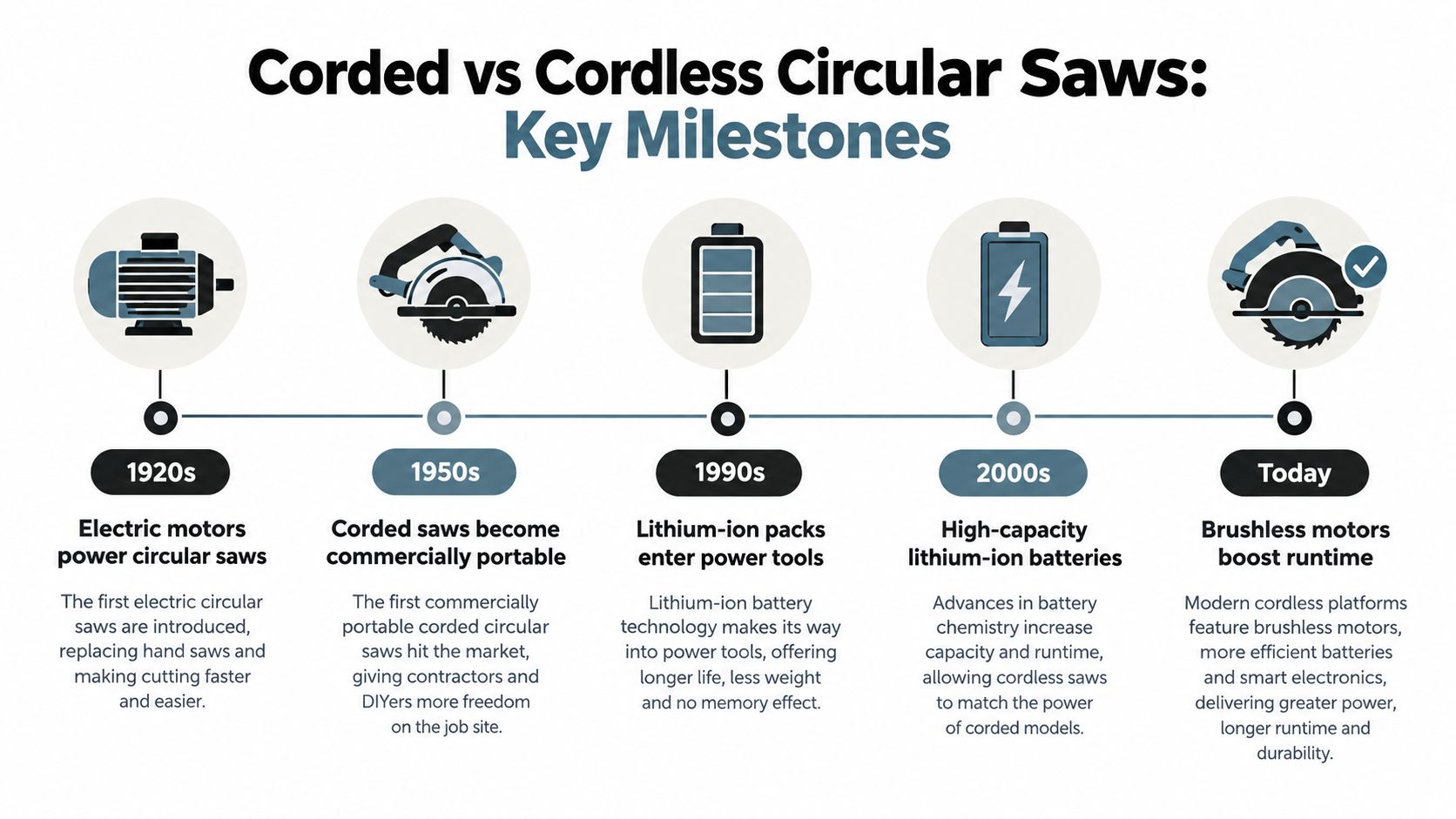
Portable circular saws earned their place on jobsites long before battery platforms showed up. Edmond Michel and Joseph Sullivan founded the Michel Electric Handsaw Company in 1924. The company released the Model E in 1928, widely described as the first portable worm-drive saw, and the Model 77 followed in 1937 and set the pattern for worm-drive designs that builders still recognize today (circular saw history and design milestones).
That history matters because corded saws solved the basic job early. Put one on a bench, plug into utility power or a generator, and it keeps cutting without waiting on a charger or a fresh pack. On repetitive framing, sheet breakdown, and shop work, that simple power path is still hard to beat. Sticker price never told the whole story here. Time lost to setup, battery rotation, or weak site power always affects the true cost of getting cuts done.
Cordless becomes a professional platform
Cordless circular saws came later, and they became credible once lithium-ion packs, better electronics, and brushless motors matured. Today you see professional platforms from 18 V to 60 V. A notable milestone came in 2013, when an 18 V cordless saw using a 190 mm blade reached the market. By 2018, manufacturers were openly pitching newer high-output battery systems as capable of corded-level performance.
That shift changed the buying decision. Corded remained the baseline for predictable energy delivery. Cordless became a system purchase, not just a tool purchase, because the saw's performance depends on pack size, charger speed, motor efficiency, and how the platform handles heat.
That last part gets real fast in Northern California. On 100°F+ Sacramento Valley days, battery tools can lose pace before the blade or motor is the limiting factor. A cordless saw may still be the faster choice when you are moving room to room or working where power access is poor, but over five years the platform cost and downtime matter as much as the saw itself.
Analysts at Market Intelo estimated the 2025 global market for circular saws at $2.8 billion, with cordless models at $1.2 billion, or 42.8%, and corded models at about $907 million, or 32.4% (global circular saw market estimate). The same report projected annual growth of 6.2% for cordless models and 2.8% for corded models, and cited a European Union forecast that cordless tools could reach 65% to 70% of new unit sales by 2026, up from about 45% in 2019.
Power, Runtime, and Cutting Performance
On a Sacramento Valley afternoon, the difference shows up halfway through the work, not on the first cut. A corded saw and a cordless saw can both feel strong when you are trimming a sheet or knocking out a few quick crosscuts. Keep feeding the blade through dense stock, long bevels, or repeated rips, and they separate fast.
A typical 120 V, 15 A corded saw can draw approximately 1,800 W continuously, assuming the circuit and extension cord are properly rated (corded and cordless power comparison). That steady power is why corded saws still hold their pace better in production work. They do not wait on a battery to cool down, and they do not gradually lose snap as the pack drains.
| Criterion | Corded Circular Saw | Cordless Circular Saw |
|---|---|---|
| Power delivery | Continuous alternating current from an outlet or generator | Battery-limited output with voltage sag under load |
| Sustained cutting | Strong fit for repetitive ripping, production framing, and long bevel cuts | Dependent on battery state, pack changes, and thermal limits |
| Mobility | Restricted by outlet and cord routing | Strong fit for roofs, remote work, and scattered cuts |
| Setup | Requires cord, receptacle, and sometimes GFCI protection | Grab-and-cut once a charged pack is installed |
| Ergonomics | Often easier to keep light at a fixed station | More freedom of movement, with battery weight at the tool |
| Best value | High-volume work near dependable power | Existing battery platforms and intermittent mobile work |
Where the power gap shows up
Cordless performance is tied to stored battery energy, how hard the cut is, and how the electronics handle sag and heat. The same comparison estimates that a 5.0 Ah battery stores about 90 Wh, while hard cutting can demand roughly 900 to 1,200 W. In simple terms, that is only about 4 to 6 minutes of equivalent continuous maximum-load cutting before inefficiency, thermal protection, or reduced output cut into real runtime.
That sounds harsh on paper, but it matches what happens in the field. Most cutting is stop-and-go. You line up, cut, set material, move, and cut again. A cordless saw can stay productive for a while in that rhythm. Start ripping thick material continuously, especially in 100°F+ heat, and total task time changes because pack swaps, charger rotation, and cooling breaks creep into the job.
Field reporting indicates that a high-end cordless model may match a 15 A corded saw for roughly the first 20 to 30 cuts in demanding laminated-beam work, after which voltage sag and thermal limiting can reduce output until the pack is replaced or cooled (field comparison of cordless and corded tools)).
What the operator notices
The operator feels it in blade speed and pace. For continuous bevel cuts, dense hardwood, production framing, and long shop cuts, corded saws stay more predictable. They also remove a hidden cost. You are not managing charge levels, waiting on a fast charger, or carrying enough spare packs to keep one saw working all day.
Cordless still wins plenty of jobs. On roofs, punch-list work, second-story remodels, and scattered cuts around a house, skipping cord setup often saves more total time than raw power numbers suggest. Over a five-year platform decision, that matters just as much as sticker price. Corded wins continuous production cutting. Cordless wins intermittent and remote work.
The Battery Numbers That Matter
A cordless saw lives or dies by the battery system behind it. On a mild day, a mediocre pack can seem fine. On a Sacramento or Central Valley roof in 100°F+ heat, weak thermal control, slow charging, or too few spare packs can turn a fast saw into a stop-and-wait tool.
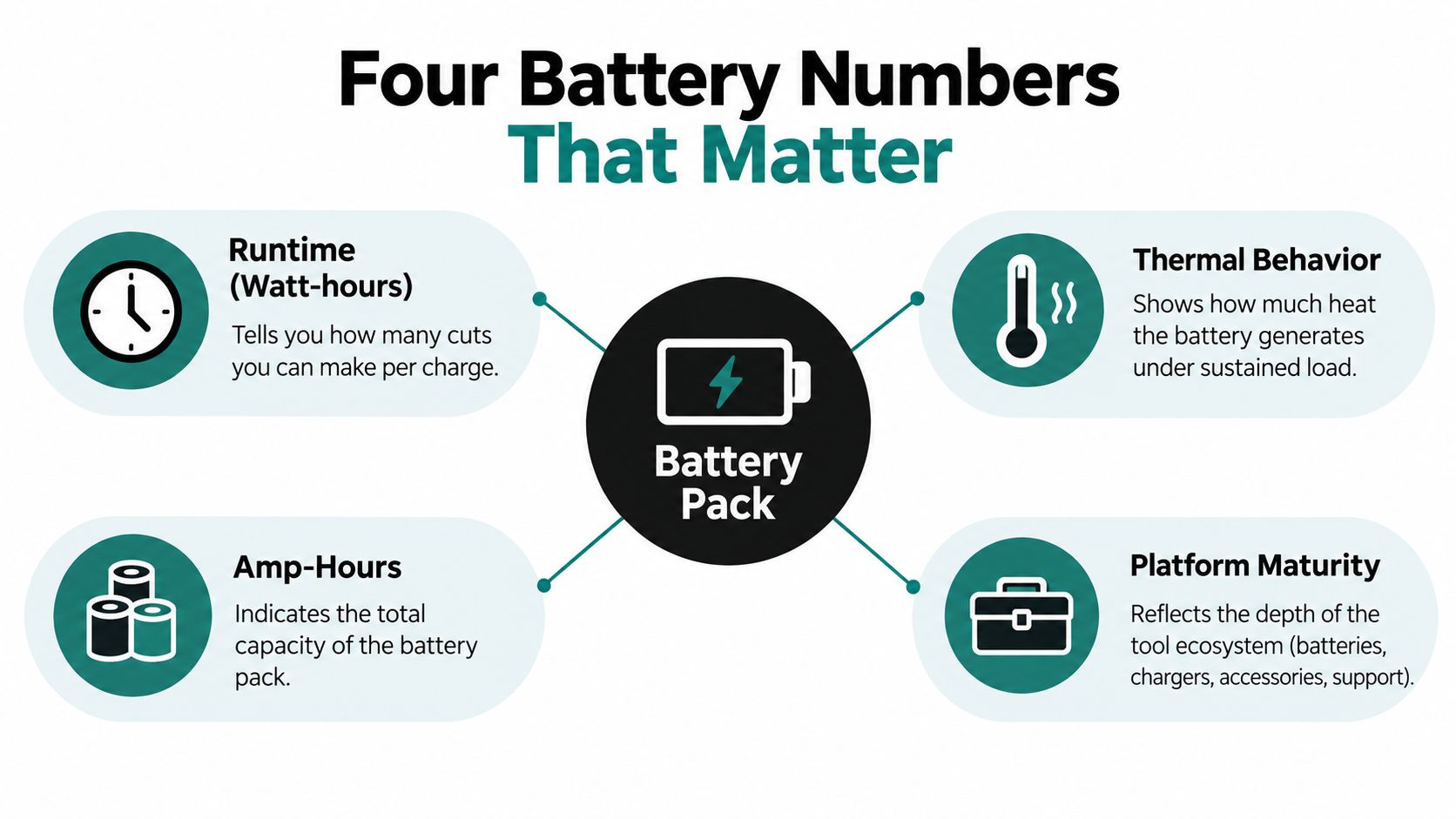
Voltage helps you identify the platform, but it does not tell you how long the saw will keep cutting under load. Compare amp-hours, watt-hours, thermal behavior, and spare-pack availability before you put much weight on the number printed on the case.
A higher Ah rating usually means more stored capacity within the same voltage family. Watt-hours are better for comparing different platforms because they combine voltage and capacity. Multiply volts by amp-hours and you get watt-hours. That still does not tell the whole story, because the motor, controller, and pack cooling all affect how the saw feels once the cut gets long or the material gets dense.
Read the battery as a work system
Use this checklist when comparing a cordless circular saw:
- Amp-hours: Capacity, not a guarantee of how many cuts you get.
- Watt-hours: A better cross-platform comparison of stored energy.
- Voltage sag: Loss of blade speed during dense or repeated cuts.
- Spare packs: How many charged batteries you need before the charger catches up.
- Thermal behavior: How the saw and battery hold up after repeated heavy cuts.
Manufacturers rarely publish runtime in a way that makes side-by-side comparison easy. Makita figures showing up to 610 crosscuts in 2×4 SPF lumber or 320 crosscuts in 2×10 lumber on two 5.0 Ah batteries are useful because cut counts mean more than vague minute claims, but they still represent favorable conditions, not a guarantee on every job (workload-specific cordless saw runtime comparison).
Heat changes the math fast. A battery can hit protection before it is empty, especially with a dull blade, thick stock, or an operator pushing feed rate harder than the saw wants. That is why total task time matters more than one fresh-pack test. A platform that needs frequent swaps, cooling breaks, and charger babysitting can cost you more time over five years than a cheaper corded saw or a better-managed cordless setup.
Keep spare packs out of direct sun. Rotate them instead of hammering one pack over and over. Let a hot battery cool before charging, and follow these battery-life practices that help preserve usable capacity.
The question on site is simple. How many framing crosscuts, sheet-good cuts, or treated-lumber cuts can you finish before a swap, and how many packs and chargers does it take to hold that pace? That answer predicts the workday better than voltage alone.
Total Cost of Ownership Over Five Years
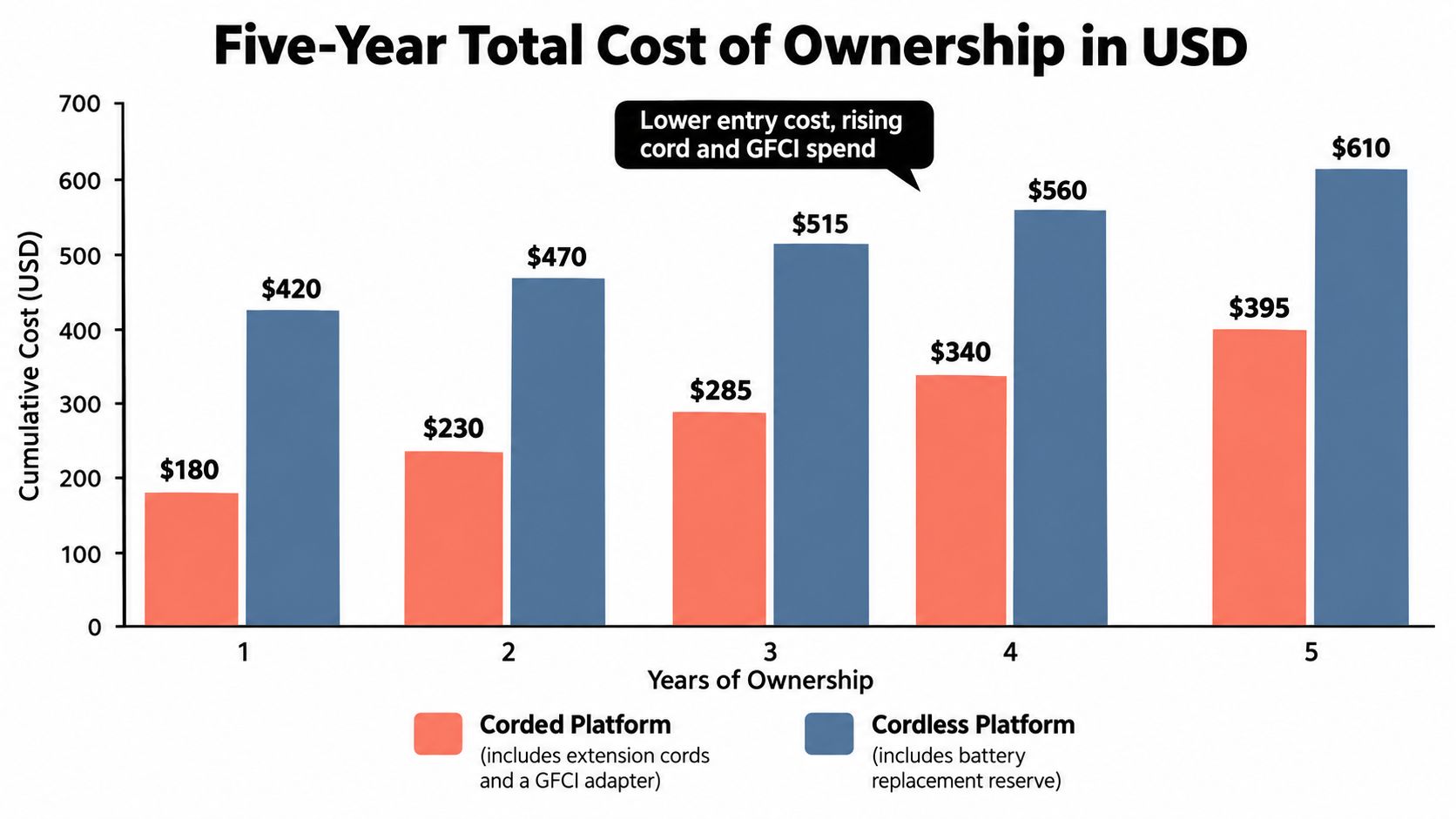
A low sticker price doesn't automatically make a corded saw cheaper. A cordless kit doesn't automatically make a poor value. Compare the entire platform over five years, including the saw, batteries, charger, extension cords, GFCI equipment, electricity, downtime, and resale value.
Replacement batteries are commonly estimated at roughly $80 to $150 each, with noticeable capacity decline after about 3 to 5 years or approximately 500 to 1,000 charge cycles (power-tool ownership and battery-cost comparison). Those figures are planning ranges, not a guarantee for every pack or user.
The platform changes the math
For a homeowner buying one saw, a corded model can be sensible. The initial tool cost is usually easier to control, and there's no battery or charger to add. The buyer still needs a suitable extension cord, safe power routing, and GFCI protection where the work environment requires it.
A small remodeling crew already using the same battery platform has a different calculation. A bare cordless saw can share packs and chargers with a drill, impact driver / atornillador de impacto, light, or other tools. The saw's purchase price may be higher than a corded alternative, but the added platform cost is lower because the crew isn't building the battery system from scratch.
| Ownership factor | Corded platform | Cordless platform |
|---|---|---|
| Initial purchase | Saw plus suitable cord and electrical accessories | Saw, compatible battery, and charger if not already owned |
| Daily continuity | Provided power remains available | Depends on charged packs and swap planning |
| Maintenance exposure | Cord, plug, switch, and brush or motor service | Batteries, contacts, charger, electronics, and motor |
| Shared-tool value | Limited | Strong when the platform already supports other tools |
| Five-year question | How much cord and electrical equipment will be added? | How many packs will be used, shared, or replaced? |
A sensible five-year worksheet should include battery replacement timing, charger utilization, downtime during swaps, and resale value. Open-box and bare tool / herramienta sola purchases can shift the result significantly when the buyer already owns compatible batteries.
Insurance is another ownership consideration for contractors carrying tools between sites. A resource such as cover for trade tools can help you review the type of protection available for mobile equipment, though coverage terms should be checked directly with the insurer.
Value Tools Co offers tested and inspected open-box and bare-tool options, with savings of up to 55% in some cases. Its 30-Day Peace of Mind Guarantee includes returns by mail or in-store and free return shipping on defective items, which reduces the risk of testing a platform that doesn't fit the workflow.
Matching the Saw to the Work
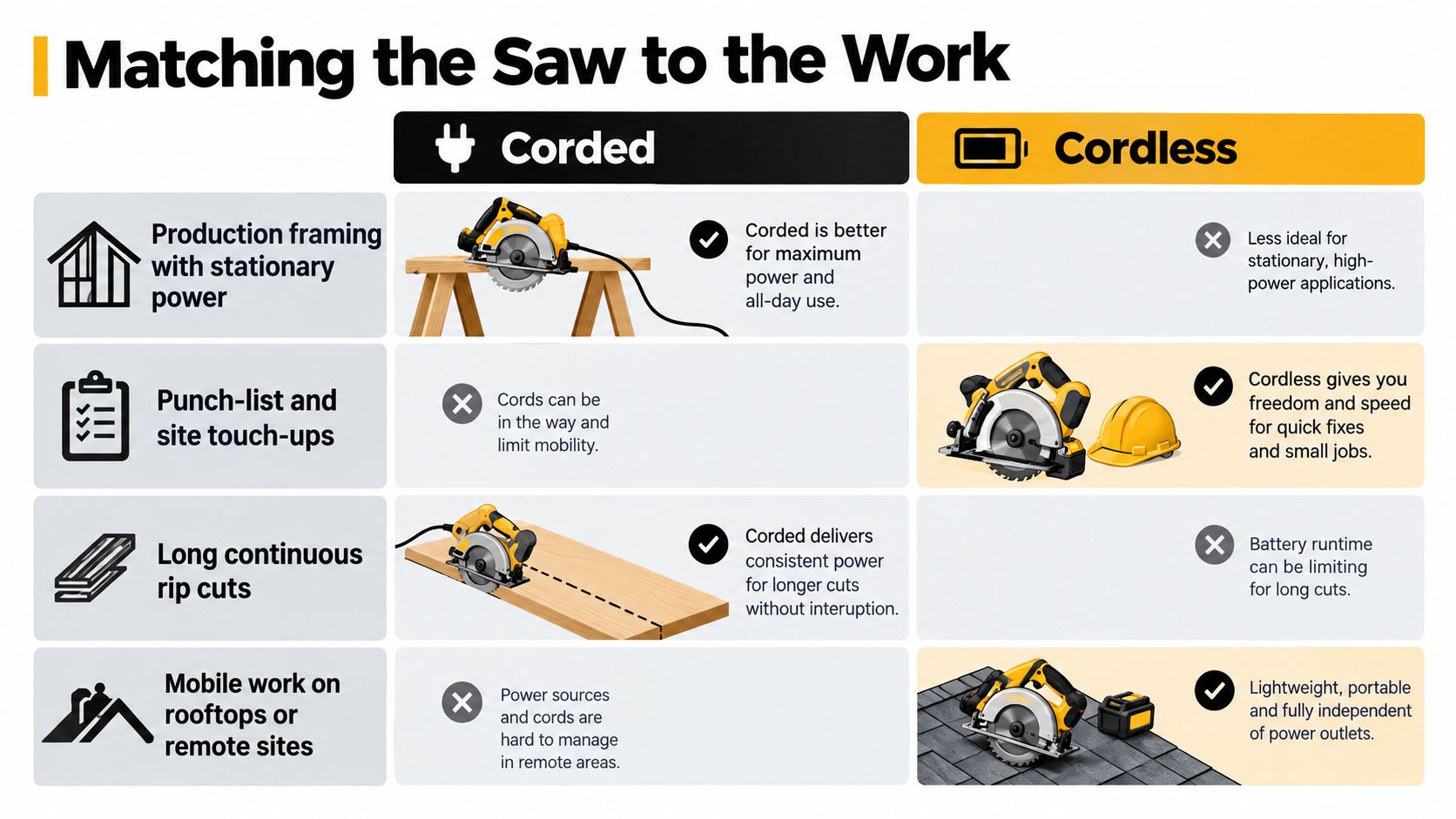
The right saw is the one that removes the most wasted motion from the job. A production framer with a fixed cut station values uninterrupted power. A service contractor crossing a house, yard, or roof values a saw that starts cutting without finding a receptacle.
Production framing and shop cuts
At a stationary framing bench with dependable power, choose corded. Repetitive ripping, long cuts, and gang work expose every weakness in battery planning. The cord must be routed safely, but a properly arranged station avoids repeated pack changes and keeps blade speed steady.
Ideal user: Production framers, cabinet shops, and contractors who make long cuts near a grounded outlet or generator.
Punch-list work and interior remodeling
Cordless is usually faster for scattered cuts. Trimming a door, cutting blocking in several rooms, or sizing sheet goods in an unfinished space often involves more setup than actual sawing. A cordless brushless / sin escobillas saw saves time by removing the search for a receptacle and the need to drag a cord around corners.
Ideal user: Remodelers, service contractors, maintenance workers, and property managers moving between rooms or buildings.
Roofs, second stories, and remote sites
Cordless earns its premium on high-altitude work. There is no extension cord across a scaffold or roof path, and the saw can move with the worker. Keep charged spare packs available, especially in Central Valley heat, and don't leave batteries baking on the roof.
Ideal user: Roof crews, punch-list technicians, and contractors working on unfinished sites without reliable temporary power.
Elk Grove property maintenance
For an Elk Grove property manager or handyman, intermittent cuts usually favor cordless. Fence repairs, blocking, sheathing patches, and outdoor maintenance rarely justify a corded setup unless a reliable outlet is already beside the work.
Same-day Elk Grove warehouse pickup can matter when a repair can't wait. Fast 1-day Northern California delivery also changes the practical cost of choosing a tool, especially when a crew would otherwise lose productive time sourcing a replacement.
The wrong choice costs time in predictable ways:
- Corded on a roof: Cord routing becomes a second job and creates a trip path.
- Cordless at a production bench: Battery swaps interrupt the cut cycle.
- Cordless without spare packs: The saw becomes dependent on charger timing.
- Corded in a scattered remodel: Repositioning the cord can exceed the actual cutting time.
For accessories and task-specific additions, review circular saw attachments before buying a second tool just to solve a setup problem.
Safety, Codes, and Bilingual Trade Terms
Both saw types need the same basic blade protection. OSHA requires portable power-driven circular saws to have guards above and below the base plate or shoe, with the lower guard covering the blade to the depth of the teeth except for the minimum opening needed to contact the work. The lower guard must return automatically after the cut, and the tool must use constant-pressure switching that shuts off power when pressure is released (OSHA circular saw safety guidance).
Corded tools add electrical controls. OSHA guidance calls for double insulation or a three-wire cord with a grounding connection to a grounded receptacle. Construction users also need GFCI protection or an assured equipment-grounding conductor program, and damaged cords must not be used (OSHA electrical tool requirements).
A practical inspection before cutting
- Guard: Cycle the upper and lower guards by hand and confirm they close completely.
- Shoe: Check that the base is straight and the bevel adjustment locks securely.
- Switch: Verify that constant pressure is required and released power stops the tool.
- Corded setup: Inspect the plug and cord, use appropriate grounding and GFCI protection, and route the cord away from the blade and walking path.
- Cordless setup: Inspect the battery housing, contacts, charger, and trigger before installing the pack.
- Blade: Use a sharp blade suited to the material and confirm the arbor hardware is secure.
California framing and seismic compliance are separate from the saw choice. The applicable plans and building rules govern lumber, fastening schedules, connectors, and nail specifications. A framing nailer / clavadora de marcos using 21° full round-head framing nails is a separate compliance and tool-selection issue. The circular saw only cuts the material.
California crews may call the options sierra circular con cable and sierra circular inalámbrica. They may also ask for a bare tool / herramienta sola, an impact driver / atornillador de impacto, or a brushless / sin escobillas model. The terminology changes by crew, but the inspection standard doesn't.
For dust control and cleaner interior work, compare saw options through circular saws with dust collection.
The Final Verdict and Buyer FAQs
The production framer should buy corded when the crew cuts at a powered station for most of the day. The remodeler or service contractor should buy a brushless cordless model when mobility and setup time dominate. A Sacramento-area property manager will usually get more value from cordless for scattered repairs, while a budget-focused DIY homeowner should choose corded if reliable power is available and the saw will serve one primary cut station.
The ownership decision is just as important as the task decision. Cordless makes financial sense when compatible batteries and chargers already support the tool system. Corded remains the cleaner economic choice for a single-purpose, high-volume shop saw.
Value Tools Co's 30-Day Peace of Mind Guarantee gives buyers a practical way to validate the choice. Tools are tested and inspected, returns are accepted by mail or in-store, defective items qualify for free return shipping, and open-box or bare-tool purchases can offer savings of up to 55%.
People Also Ask
How long does a 5.0 Ah battery last when crosscutting 2x4s?
There isn't one universal runtime because blade sharpness, feed pressure, temperature, material, and cut direction change the result. Published figures from Makita cite up to 610 crosscuts in 2×4 SPF lumber using two 5.0 Ah batteries, but that should be treated as a best-case manufacturer claim rather than a guaranteed jobsite result (published battery cut-count comparison).
Can a cordless circular saw replace a corded saw for production framing?
It can handle many framing tasks, but sustained production remains workload-dependent. A high-end cordless saw may match a 15 A corded model for roughly the first 20 to 30 demanding laminated-beam cuts before voltage sag or thermal limiting reduces output, so production crews need charged spare packs and a workable charging rotation (cordless framing performance comparison).
Which circular saw should a first-time buyer choose?
Buy corded if your work happens near dependable power and includes long repetitive cuts. Buy cordless if you already own a compatible battery platform or expect to work outdoors, on roofs, between rooms, or at sites without convenient outlets.
How does Sacramento Valley heat affect cordless saw runtime?
High heat can accelerate output reduction because battery and motor protection may limit performance during sustained cutting. Keep packs shaded, rotate batteries, avoid charging a hot pack, and plan spare capacity when cutting in 100°F or hotter conditions.
Value Tools Co offers tested and inspected corded saws, cordless circular saws, and open-box or bare-tool options for Sacramento-area contractors, property managers, and DIY users. Compare the platform you already own, choose the configuration that fits your workload, and visit Value Tools Co to find a circular saw with the right balance of runtime, mobility, and five-year value.


