

You're probably standing in the same spot a lot of buyers stand. One drill is cheaper, one drill is easier to carry, and both claim they'll handle the job. The short answer is simple. Buy a cordless drill if you need mobility, ladder work, service calls, or fast punch-list drilling. Buy a corded drill if you need long, uninterrupted runtime and steady output in one place.
That answer holds up on real jobs. If you're moving room to room on a remodel, climbing in an attic, working under a sink, or drilling overhead on a retrofit, cordless is usually the better tool. If you're set up at a bench, boring repeated holes, mixing material, or drilling dense stock for long stretches, corded still earns its keep.
The market has shifted hard toward cordless, and that matters. Cordless electric drills held a 62.5% share of the global electric-drill market in 2025, while corded drills held 37.5% according to Dataintelo's global electric-drill market report. That same report says cordless share rose from 38% in 2019 to 62.5% in 2025, which tells you this isn't a passing trend. Buyers changed because batteries got better and crews got tired of dragging cords.
But popularity doesn't answer the ownership question. A lot of articles stop at power versus portability. That's not enough if you're a contractor watching tool spend or a homeowner trying not to buy twice. The better question is when a battery platform pays you back, and when a corded drill stays the smarter buy.
Northern California adds a few wrinkles. Sacramento and the Central Valley run hot, and that heat changes how cordless tools behave on long summer days. Remodel crews also don't work in a vacuum. A drill often sits next to an impact driver / atornillador de impacto, a framing nailer / clavadora de marcos, and whatever battery platform the truck is already carrying. That's where the decision gets made.
Introduction to the Cordless Drill vs Corded Drill Decision
A maintenance tech replacing gate hardware in Elk Grove wants to get in, drill, fasten, and leave without hunting for power. A cabinet installer in Sacramento cares more about balance, reach, and speed inside finished spaces. At a shop bench, drilling steel or mixing material for twenty minutes straight, the priorities flip. Steady output matters more than mobility.
That decision turns on ownership cost and workflow break-even. A cordless drill saves trips to the cord reel, keeps ladders and walkways cleaner, and moves faster from task to task. A corded drill usually costs less up front, runs as long as power is available, and avoids battery replacement later. The right buy is the one that loses the fewest labor minutes over a month and ties up the least money over a few years.
Northern California adds jobsite realities that change the answer. Summer heat in Sacramento and the Central Valley is hard on batteries during long stretches of drilling, especially when packs sit in a truck between stops. Seismic retrofit work also changes the drill mix. If a crew is bouncing between anchors, pilot holes, hardware, and ladder work, cordless often keeps production moving. If the work stays planted at one station, corded still makes financial sense.
What usually settles the choice
Three factors decide more drill purchases than brand loyalty does:
- How the day is laid out: Service calls, punch work, attic runs, and overhead drilling favor cordless because setup time stays low.
- How long the tool runs at a stretch: Repeated drilling, hole saw work, and mixing tasks expose the limits of batteries and chargers fast.
- What you already own: An existing battery platform can make a bare tool / herramienta sola the cheapest path. No batteries, no charger, no duplicate kit.
For contractors, the break-even point is simple. If cordless cuts enough setup and movement time to pay back battery and charger cost, it earns its spot. If the drill will live near one outlet and work hard for long sessions, corded usually wins on total cost of ownership.
Open-box value shifts the math too. Corded drills often make strong second-owner buys because there is no battery health question hanging over them. Bare cordless tools can also be smart buys if the packs you already own are still strong and the platform is stable. That matters for small crews, landlords, and homeowners who want pro-grade tools without paying full retail for every case, charger, and battery.
How Each Drill Works and What Sets Them Apart
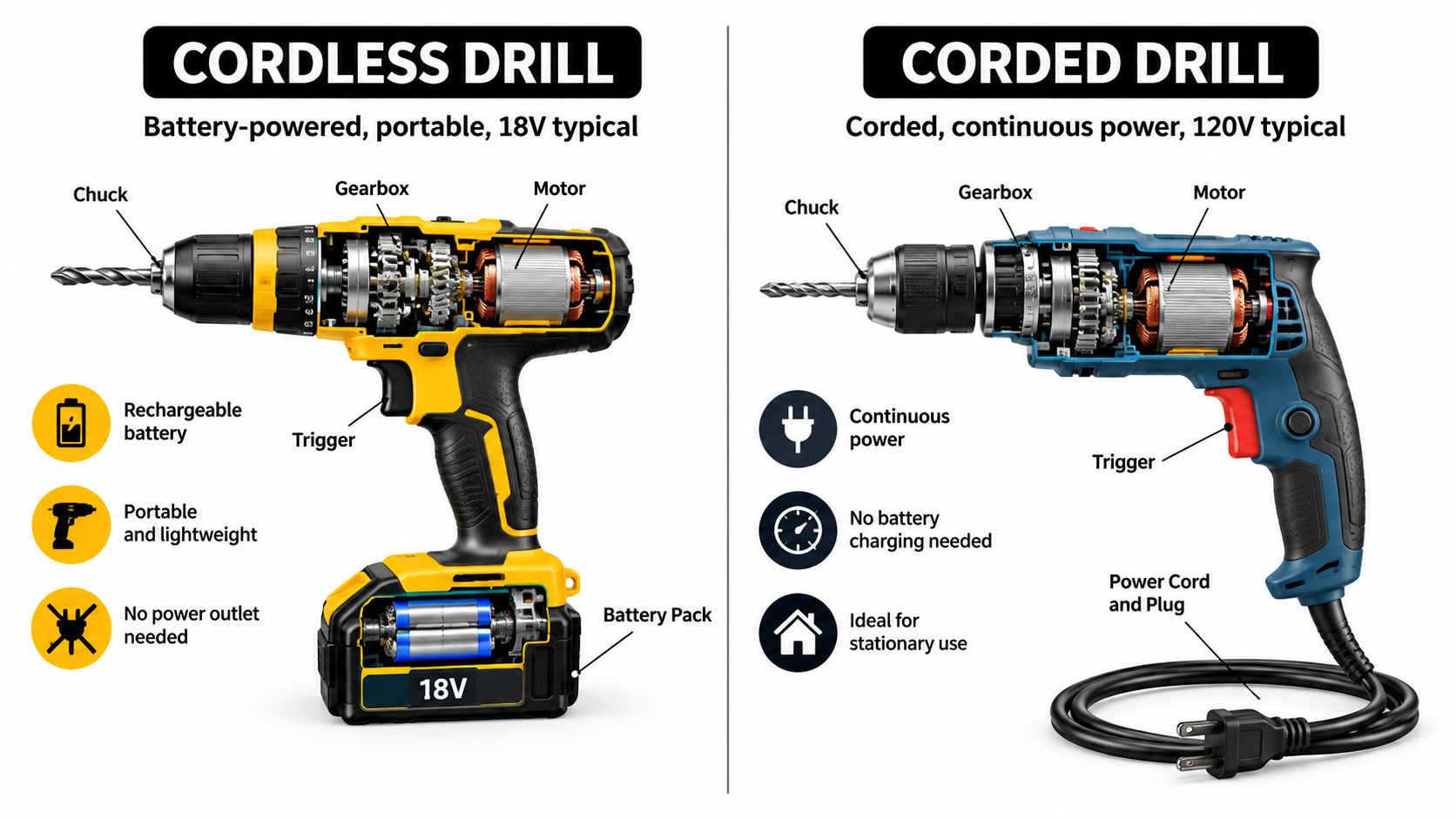
A cordless drill is a battery-powered drill/driver that carries its power source on the tool. A corded drill plugs into an outlet and pulls power continuously from the wall. That one difference affects runtime, balance, heat, mobility, storage, and long-term cost.
The distinction still matters in buying terms. Engineer-focused guidance notes that corded drills run as long as power is available, while cordless runtime is finite and tied to battery capacity rather than wall power. That's why corded models fit uninterrupted sessions better, while cordless models fit mobility better, as explained in this corded vs cordless drill comparison from Engineer Fix.
Core parts that change the experience
A cordless drill usually includes a battery pack, charger, motor, trigger, clutch, gearbox, and chuck. A corded drill swaps the battery system for a power cord and plug. In your hand, that changes both weight distribution and how the tool behaves over a full workday.
A few terms matter at the counter:
- Brushless / sin escobillas: A motor design used in many newer cordless drills. In practice, it usually means better efficiency, less maintenance, and less wasted energy than older brushed designs.
- Bare tool / herramienta sola: Tool only. No battery, no charger. This makes sense when you already own packs on the same platform.
- Chuck size: Commonly 3/8-inch or 1/2-inch. Bigger chucks usually suit heavier drilling and larger bits.
- Clutch settings: Help control fastening depth and reduce stripped screws.
Why they don't feel interchangeable
Cordless drills are built around movement. They're easier to carry onto ladders, into crawlspaces, and around finished homes where cords get caught on every chair leg and corner. They also pair naturally with battery-platform kits, where the drill, impact driver, work light, and saw all share the same packs.
Corded drills are simpler systems. No battery management, no charger to track, no waiting for packs to cool. If you need a compact 3/8-inch variable-speed drill for repetitive bench work or a drill that lives in the shop and always starts ready, that simplicity still matters.
Cordless solves access problems. Corded solves endurance problems.
Power Torque Runtime and Durability Compared Head to Head
You feel the difference on a real job when the pace stays high for hours. Drilling ledger holes in a hot garage, setting structural screws for seismic retrofit hardware, or running a hole saw through old-growth studs will expose weak runtime, heat buildup, and soft gearboxes fast.
Current cordless drills are far better than the old homeowner-grade stuff many people still picture. Premium 18V and 20V Max brushless models can deliver serious short-burst torque, enough to handle large fasteners, spade bits, and many hole-saw tasks, as covered in this cordless drill vs corded drill performance review. On service calls, punch-list work, cabinet installs, and retrofit jobs where you keep moving, that matters more than a raw spec sheet.
Corded drills still own one part of the conversation. They hold output longer under steady load. Tool comparisons on sustained-use work consistently point to the same advantage. Corded tools keep pulling as long as you have power, while cordless tools can soften once the pack heats up or drops off its top charge range, as explained in this corded vs cordless tool endurance comparison.
That difference is the workflow break-even point.
If the job is a series of short moves with repeated setup changes, cordless usually keeps the day cleaner and faster. If the drill is going to stay in your hands for long, uninterrupted stretches, corded often finishes with fewer pauses, less battery rotation, and less babysitting from the lead tech.
| Criteria | Cordless Drill | Corded Drill |
|---|---|---|
| Peak torque | Strong in short bursts, especially in pro brushless models | Strong and consistent, especially with larger bits under load |
| Runtime | Limited by pack size, charge level, and battery temperature | Continuous if power is available |
| Mobility | Better for ladders, crawlspaces, roofs, and occupied homes | Limited by cord management and outlet access |
| Endurance under load | Good for intermittent drilling and fastening cycles | Better for repetitive heavy drilling and longer duty cycles |
| Heat management | Output and charging pace can suffer in hot conditions | Less sensitive to battery heat limits |
| Workflow interruptions | Battery swaps and cooling breaks can slow production | Fewer interruptions once set up |
Northern California heat changes runtime more than buyers expect
In Sacramento, Stockton, Modesto, and inland Bay Area jobs in summer, battery temperature is not a small side issue. It affects pace. A U.S. Department of Energy review on lithium-ion thermal behavior shows that high temperatures can sharply reduce usable battery capacity, as discussed in this DOE lithium-ion thermal behavior review.
On paper, a cordless drill may have enough power for the task. On a 100-degree day in direct sun, after repeated heavy drilling into PT lumber or concrete form material, the same tool may need a pack change or a cooldown right when the crew wants to keep pushing. That is one reason many Northern California contractors still keep at least one corded drill in the van, even if the daily carry is mostly cordless.
Field note: Heat kills runtime first, then production.
Durability in the truck, shop, and jobsite
Corded drills are mechanically simple. No battery contacts, no charger issues, no pack replacement cycle. For shop stations, jig work, bench drilling, and repetitive tasks where the tool stays close to power, that simplicity usually means lower total wear cost over time.
Cordless durability depends on the whole system, not just the drill body. The tool can be well built, but the packs age, chargers fail, and repeated exposure to truck-bed heat shortens battery life. That matters in Northern California, where summer storage conditions are rougher than many buyers account for.
Open-box buyers should pay attention here too. A used corded drill with a clean chuck, smooth trigger, and no gearbox noise can still be a very safe value. An open-box cordless kit can also be a good buy, but only if the battery age, charge behavior, and charger condition check out. That is the trade-off. Cordless often wins on workflow. Corded often wins on service life per dollar when the job keeps the tool under load for long stretches.
Total Cost of Ownership and Battery Ecosystem Economics
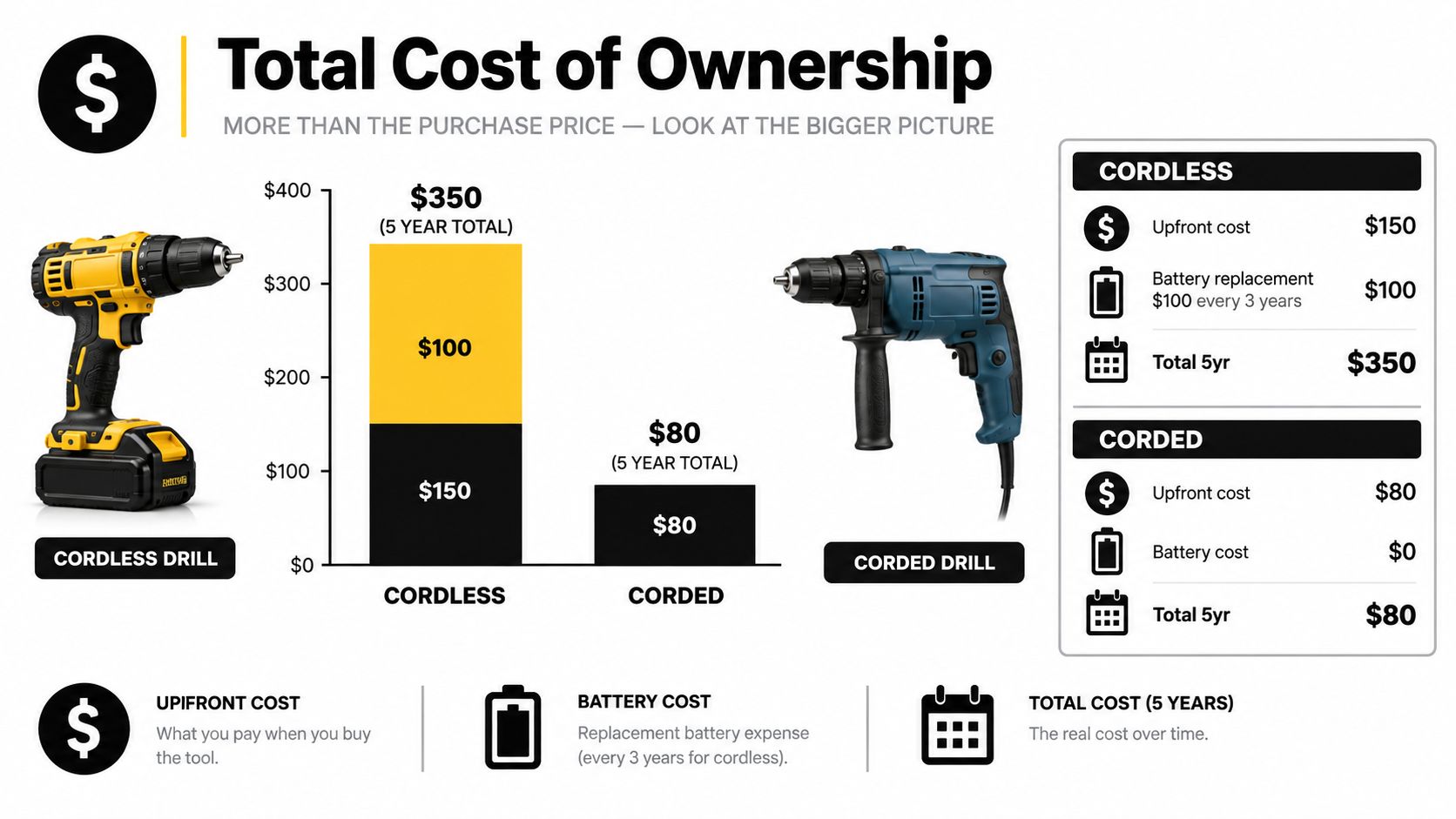
A lot of buyers compare ticket prices and stop there. That's how people overspend on cordless and underspend on what they need. The question is whether a battery platform saves enough labor, setup time, and tool sharing to offset batteries, chargers, and future replacements.
The cordless side is no longer niche. The global cordless drill market was valued at $12.8 billion in 2025, and a separate market view estimates about $13.0 billion in drill revenue alone in 2025, with drills making up roughly 30.4% of total cordless power-tool revenue, according to Dataintelo's cordless drill market report. That same market research says drills are the largest product segment in cordless power tools, which fits what buyers see on shelves and in service vans.
When cordless pays for itself
Cordless makes the most financial sense when you're buying into a platform, not a single tool. If your drill shares packs with your impact driver, recip saw, grinder, light, and blower, the battery cost spreads across the whole setup. If you're adding a drill as a bare tool, the economics improve again.
The battery market itself keeps expanding, which tells you platform lock-in is becoming more common. Market estimates cited by Mordor Intelligence put the power tool battery market at around USD 3.72 billion in 2026 growing to USD 6.02 billion by 2031, while another forecast in the same source puts the broader market at USD 3.1 billion in 2025 and USD 7.9 billion by 2035 in this power tool batteries market analysis. More buyers are living inside ecosystems now. That's convenient, but it also means battery replacement becomes part of tool ownership.
When corded stays the lower-friction buy
If you drill often but own only one or two tools, corded can still be the smarter spend. No battery degradation. No charger decisions. No compatibility chart. You buy the drill, plug it in, and use it.
That's where open-box and lightly used tools can be especially strong. A tested corded drill often gives a small shop, maintenance tech, or homeowner exactly what they need without the hidden battery lifecycle cost. If you already own one battery platform, a bare tool can still be the move. If you don't, the battery math matters, and this battery compatibility guide is worth checking before you mix brands or generations.
One practical option in that middle lane is Value Tools Co, which sells tested and inspected open-box and lightly used tools with up to 55% savings and a 30-Day Peace of Mind Guarantee that includes 30-day returns by mail or in-store plus free return shipping on defective items. For buyers weighing a corded drill against a bare cordless tool, that kind of inventory can change the break-even point without forcing a full-price kit.
Real World Use Cases for Trade Crews and DIY Homeowners
A drill choice gets easier when you stop thinking about features and start thinking about the next three jobs. Overhead anchoring, cabinet install, shop drilling, tenant turnover, deck repair, and weekend furniture assembly all ask for something a little different.
Cordless drill use cases that make sense
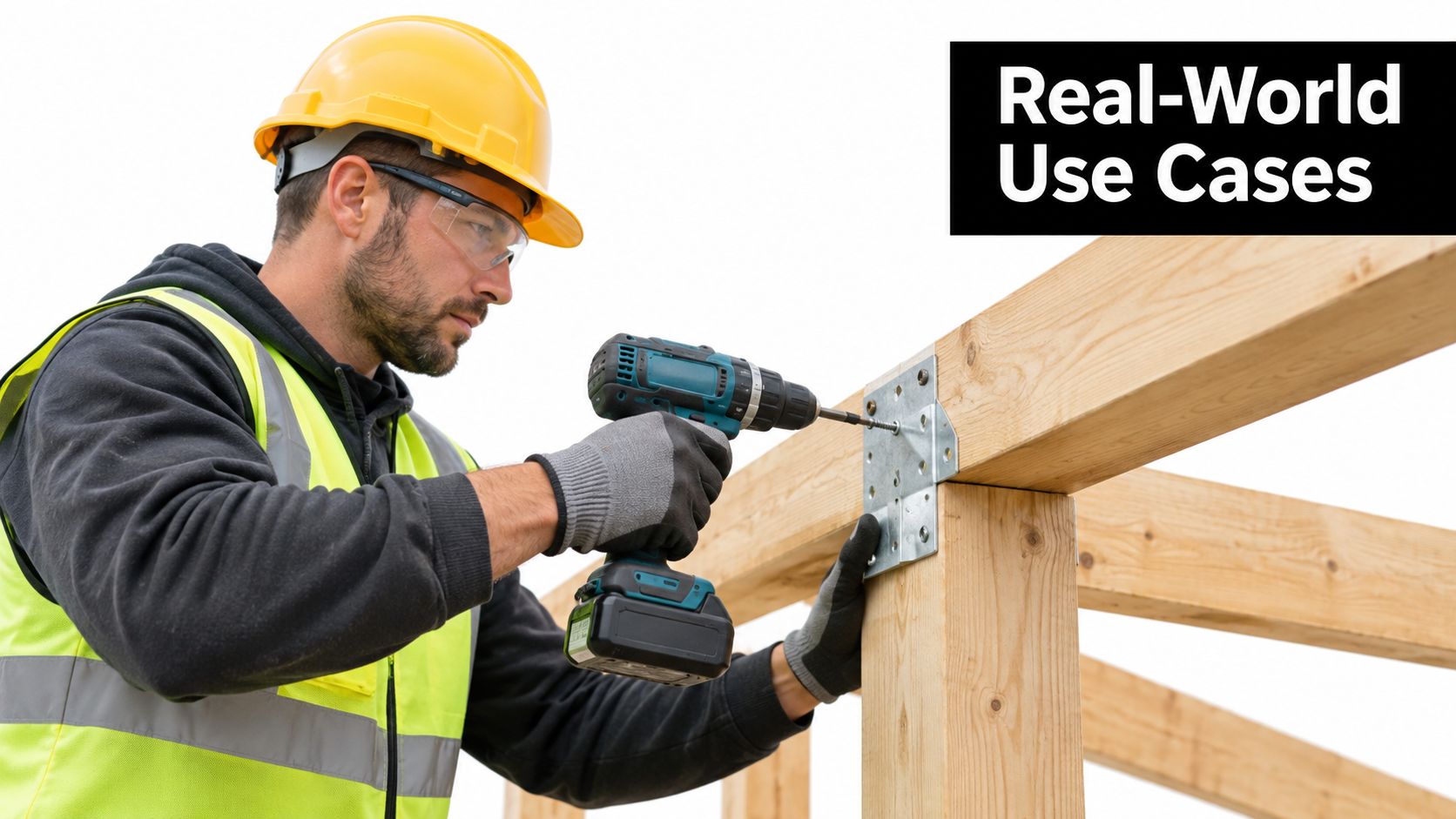
Cordless is the first pick for mobile work. Retrofit punch lists, HVAC strap installs, electrical rough touchups, fence hardware, under-sink repairs, and attic work all get easier when there's no cord snagging on every corner. If your drill rides with an impact driver / atornillador de impacto, cordless also keeps your kit compact.
Battery technology and workflow changes keep pushing more pros this way. Independent market forecasts cited by 360iResearch estimate the power tool battery segment at USD 3.11 billion in 2026 with an 8.06% CAGR to 2032, while another forecast in the same source says lithium-ion held 62.9% of the market in 2025. The same source also cites 70% brushless-motor penetration in professional drills and lithium-ion pack prices of USD 108 per kWh in 2025, all in this power tool batteries market intelligence report. The practical meaning is simple. For repeated overhead work, jobs with limited power access, and crews already standardized on one platform, cordless keeps making more sense.
Who This Is For
Cordless drill buyers
- Service and remodel crews: Moving all day, working in finished spaces, and drilling in awkward spots.
- DIY homeowners: Hanging shelves, assembling furniture, drilling pilot holes, and handling mixed household jobs.
- Property maintenance teams: Fast in-and-out work in occupied units where dragging cords slows everything down.
- Crews already on one battery system: Bare tool purchases are usually the cleanest move.
Corded drill buyers
- Shop users: Bench drilling, repetitive production work, and fixed-location tasks.
- Budget-focused buyers: One drill, no battery platform, no charger management.
- Users drilling for long stretches: Less interruption and steadier output.
- Owners who already have specialty cordless tools: Keep the corded drill as the stationary workhorse.
Who Should Avoid This
Skip cordless first if:
- You mostly work in one location with easy power access.
- You don't want to manage batteries, chargers, and compatibility.
- Your use leans toward long production runs more than mobile drilling.
Skip corded first if:
- You do ladder work, attic work, or room-to-room service calls.
- You regularly work where power access is inconsistent.
- You need one general-use drill for mixed home projects.
Trade-specific examples that come up in California
Framing and seismic retrofit work often gets discussed like the drill is the whole story. It isn't. If your day includes structural fastening, anchors, and hardware placement, the drill may work alongside a framing nailer / clavadora de marcos that must match California requirements such as 21° full round-head framing nails. In that workflow, cordless often saves time on movement and setup, but the drill still needs enough endurance for repeated boring and fastening between structural tasks.
For urgent jobs around Sacramento, logistics matter too. Fast 1-day Northern California delivery helps when a tool dies midweek, and same-day Elk Grove warehouse pickup matters when the crew needs to be back on the job today. If you're still sorting out fit, this cordless drill buying guide is a practical next read.
How to Choose Open Box and Bare Tool Options With Confidence
Open-box and bare-tool listings save real money when you know what to inspect. They also create a lot of bad purchases when buyers assume every “tool only” listing is a deal. A smart buy starts with checking the system, not just the sticker price.
What to inspect before you buy
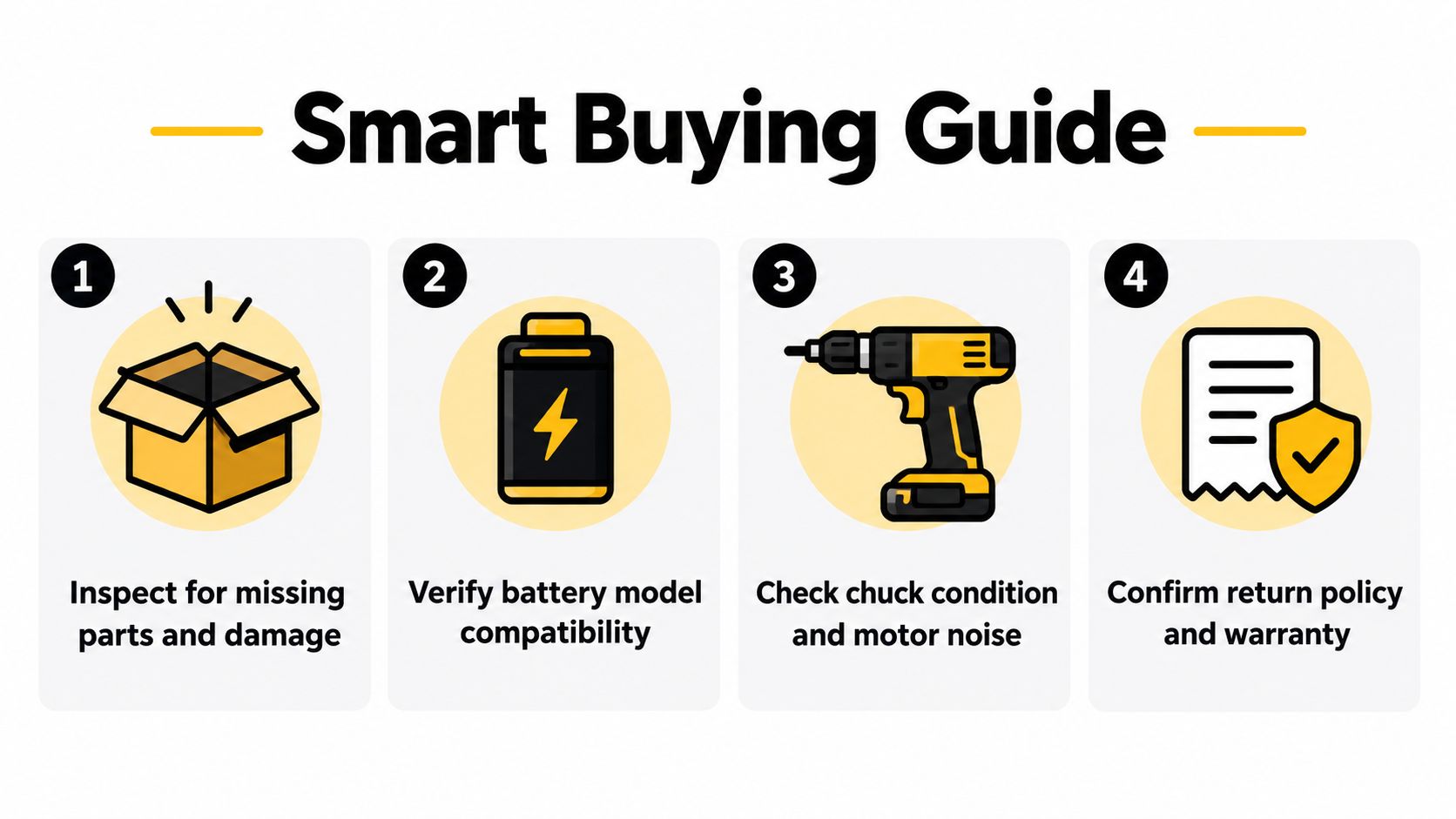
Start with the chuck. It should tighten smoothly, hold a bit without wobble, and show no signs of abuse from pipe-wrench treatment or dropped bits. Then check the trigger feel, forward/reverse selector, clutch ring, and any speed selector. On a corded drill, inspect the cord jacket and plug carefully. On a cordless drill, check battery terminals for corrosion or damage.
Listen to the tool under no load. You're listening for grinding, rattling, or a rough start-stop feel that suggests internal wear. Cosmetic wear is one thing. Mechanical slop is another.
Use this quick checklist:
- Confirm what's included: Battery, charger, case, side handle, belt hook, and manual often vary.
- Match the platform: A bare tool / herramienta sola only makes sense if your batteries and charger already fit.
- Check wear points: Chuck jaws, vents, housing cracks, cord strain relief, and battery rails tell you a lot.
- Read the return terms: You want a clear path if the tool arrives with a problem.
A bare tool is a money saver only when it drops straight into the battery system you already own.
When open-box is the better buy
Open-box is strongest when the tool itself matters more than the packaging. That's common with drills, impact drivers, circular saws, and jobsite tools that buyers use hard and store in gang boxes anyway. A clean, tested drill with minor shelf wear can be a better value than a sealed budget model with weaker components.
A short explainer on what counts as an open-box item can help if you're comparing conditions. It also pays to browse by brand collection when you already know your battery family. If you're shopping DeWalt, Makita, or Milwaukee, keep your search inside that ecosystem instead of forcing compatibility that isn't there.
Safety and confidence checks
Before first use, install a straight bit and test for excessive runout. On corded tools, don't ignore damaged insulation or a loose plug. On cordless tools, don't force a pack that doesn't seat cleanly. Wear eye protection, clamp work when possible, and use the side handle on heavier drilling jobs.
The return policy matters almost as much as the inspection. A seller offering tested and inspected tools, reasonable return options, and a process for defective items reduces the risk that comes with open-box buying.
Final Recommendation and Where to Buy in Northern California
If you only buy one drill for general use, most homeowners and mobile tradespeople should start with cordless. It fits more situations, wastes less setup time, and handles the kind of intermittent drilling and fastening that fills most real workdays. That's why cordless now leads the market and why a good brushless model has become the default first purchase for many buyers.
If your drill lives in a shop, at a bench, or on long boring jobs, keep a corded drill in the lineup. It's still the better workhorse for steady output and long sessions. For small businesses and maintenance departments, the smartest setup is often both. A cordless drill for field work and a corded drill for fixed heavy use.
Pay attention to ergonomics and safety. Balance matters when you're drilling overhead. Side handles matter when bits bind. Cord condition matters on used corded tools. Battery heat matters in Sacramento and the Central Valley when summer jobs push packs hard.
The buying decision also gets easier when you don't overbuy the platform. If you already own batteries, a bare cordless drill can be the cleanest move. If you don't, a corded drill or a carefully chosen cordless kit may be the smarter first spend.
If you want to compare open-box cordless drills, bare tools, and corded workhorses without paying full retail, Value Tools Co carries tested and inspected tools from major brands with a 30-Day Peace of Mind Guarantee. For Sacramento-area buyers, the Elk Grove location adds a practical edge when you need same-day pickup or a fast replacement that keeps the job moving.
FAQ
Is a cordless drill better than a corded drill?
A cordless drill is better when mobility matters more than nonstop runtime. A corded drill is better when you need steady power for long, uninterrupted work.
Are cordless drills as powerful as corded drills?
Modern premium cordless drills can exceed 2,000 inch-pounds of peak torque in top-tier models, which lets them match or beat many corded drills in short-duration tasks, according to this cordless versus corded drill review. Corded drills still hold the edge in sustained heavy drilling because they don't depend on battery charge and heat limits.
When should I buy a corded drill instead of cordless?
Buy a corded drill if you work at a bench, drill for long stretches, or want a simpler low-maintenance tool with no battery ecosystem to manage.
Does Central Valley heat affect cordless drill batteries?
Yes. High heat can reduce battery capacity and force cooling breaks. That matters on Sacramento and Central Valley job sites during hot weather, especially when packs sit in direct sun or go straight from heavy use to charging.
Is a bare tool worth buying?
A bare tool is worth it when you already own compatible batteries and a charger on the same platform. If you don't, the lower sticker price can be misleading because you still need the rest of the system.
Are open-box drills safe to buy?
They can be, if the tool has been tested and inspected and you verify chuck condition, controls, cord or battery terminals, and the return policy before you buy.


