

A 7-1/4-inch corded circular saw with precise depth controls is the best circular saw for beginners starting out. That format offers approximately 2-1/2 inches of cutting depth at 0° on representative models, while keeping the saw manageable for common lumber, sheet goods, and trim cuts (Home Depot circular saw reference).
The popular advice says to buy the cheapest cordless bare tool, or the lightest saw on the shelf. I disagree. A low tool price means little if the saw has a sticky guard, a bent shoe, loose adjustment levers, or no battery and charger included. After watching beginners fight crooked cuts and kickback, I'd put guard operation, depth control, bevel-lock security, blade visibility, and total ownership cost ahead of headline amperage or RPM.
Why the Best Circular Saw for Beginners Isn't Always the Cheapest Deal
Cheap is how a lot of beginners end up paying twice. They grab a discounted bare tool, then realize the battery, charger, replacement blade, and even basic accessories push the cost much higher than expected. If you mostly work near a garage bench, driveway, or patio outlet, a corded saw often makes more sense for a first purchase because it gives steady power and avoids locking you into a battery platform before you know what else you'll buy.
I've seen plenty of low-priced saws cut badly for reasons that have nothing to do with motor power. The usual trouble starts with a lower guard that hangs up, a shoe that doesn't sit flat, or bevel and depth locks that slip once the cut begins. Those flaws teach bad habits fast, and they make a beginner blame themselves for a tool problem.
Kickback is part of that equation. OSHA links kickback to stock that binds or catches the blade, which is exactly why control and saw condition matter more than a flashy deal price. Any saw with a sticky, damaged, or missing lower guard is out, period, because portable circular saws are required to have an upper guard and a retracting lower guard that remains functional (OSHA kickback guidance).

What experienced buyers inspect first
The best starter saw is the one that makes correct setup obvious and repeatable. Check these basics before you worry about headline specs:
- A marked depth scale: You should be able to set blade projection without guessing.
- A positive depth lever: It should clamp firmly and stay put through the cut.
- A stable shoe: The base needs to stay flat and resist twisting if the saw gets bumped.
- A readable bevel gauge: You need to verify angle settings before the blade enters the work.
- A correctly matched blade and arbor: Blade diameter and arbor size have to match the saw, as shown in this Home Depot circular saw reference.
A real bargain is a saw with sound mechanics, complete ownership costs you can live with, and controls that stay honest under load. I'd hand a beginner a clean, well-balanced corded saw like that before I'd hand them a cheaper cordless kit that looks good on the shelf but shows up incomplete.
Understanding Circular Saw Parts and Basic Terminology
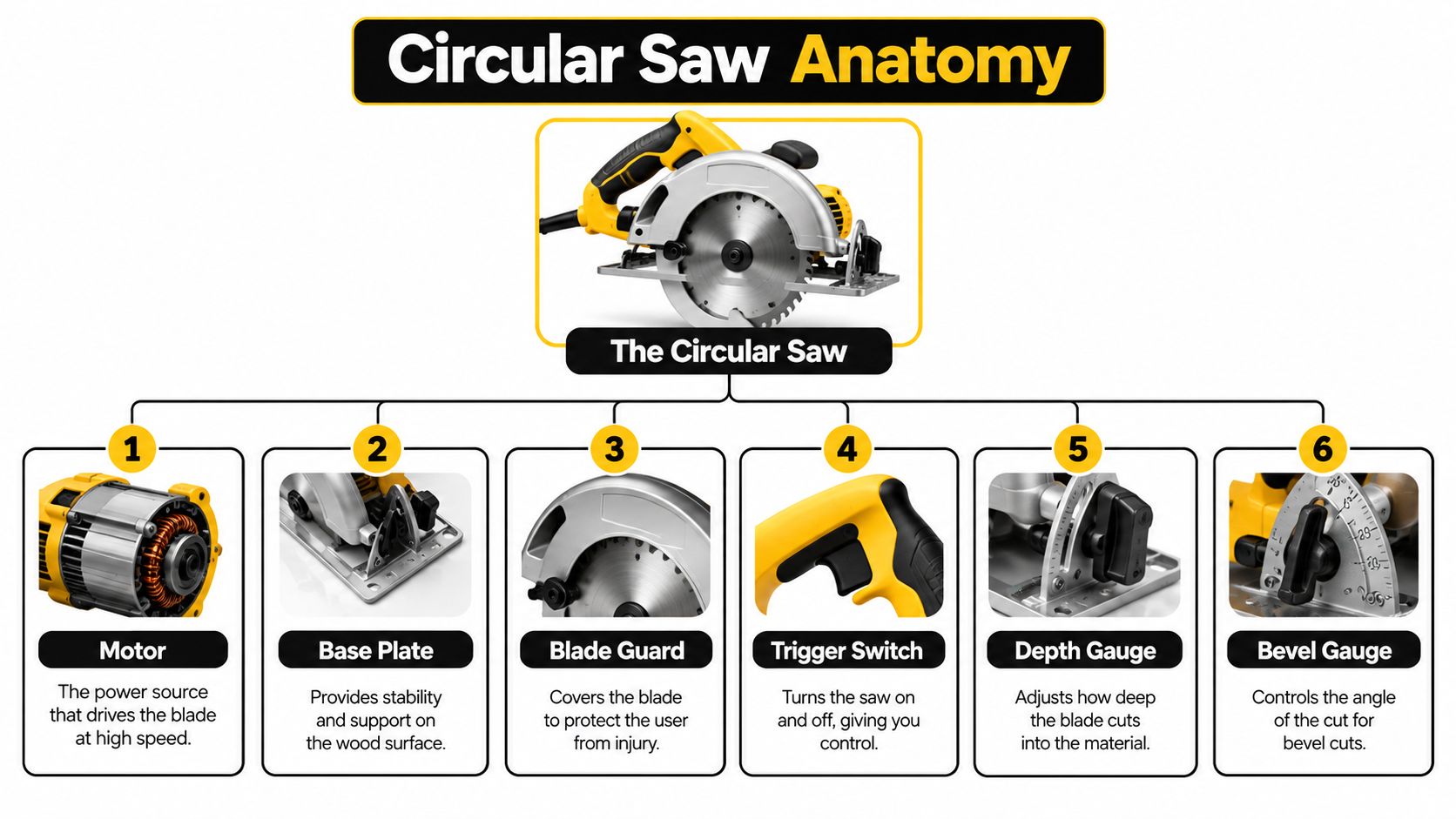
The shoe, also called the base plate, is the flat surface that rides on the wood. It controls stability and helps keep the blade at the intended relationship to the workpiece. If the shoe is bent, the saw can wander even when your pencil line is perfect.
The arbor is the shaft that holds the blade. Before fitting a blade, disconnect the cord or remove the battery, then confirm the blade diameter, arbor size, and cutting direction match the saw. The upper and lower blade guards cover the moving teeth, and the lower guard should retract during the cut and return smoothly afterward.
The controls that build good habits
The depth adjustment lever sets how far the blade projects below the stock. The bevel adjustment tilts the shoe and blade for angled cuts, while the bevel lock holds that angle. The trigger switch, safety lockout, and any electric brake affect how deliberately the saw starts and stops.
A brushless motor, or motor sin escobillas, can reduce maintenance associated with brushes and is common on cordless tools. That doesn't automatically make a saw easier for a novice to control. An impact driver, or atornillador de impacto, is a different tool for driving fasteners and shouldn't be confused with a circular saw's cutting mechanism.
You can review practical accessory choices in this circular saw attachments guide, but learn the saw's controls before adding guides or tracks.
Before the first cut, cycle the lower guard by hand with the power disconnected. Check that the depth and bevel locks hold, the shoe is flat, and the blade spins freely without contacting the housing. Those five minutes of inspection can expose a dangerous tool before it reaches the lumber.
Key Specs That Actually Matter When Choosing a Saw
Start with blade size, because that choice affects cost, cut capacity, and how forgiving the saw feels in your hands. For most beginners, a 7-1/4-inch circular saw is still the practical middle ground. It handles common framing lumber and sheet goods without pushing you into specialty blades or odd replacement parts. Smaller saws can feel lighter, but that bare-tool deal often leads to compromises in depth, blade selection, or battery runtime that show up later.
Depth setting matters more than maximum depth on the box. Set the blade so it projects only about 1/4 inch below the workpiece, or use the stricter practical reference of about 1/8 inch below the wood from CCOHS circular saw guidance. The Power Tool Institute circular saw safety guidance says the same thing in another way, keep exposure to about 1/8 to 1/4 inch beyond material thickness, with less than a full tooth visible under the stock. Beginners who run the blade too deep usually get more exposed blade, more resistance, and a saw that feels jumpier than it should.
Read the hardware, not the box
| Specification | What to look for | Why it matters |
|---|---|---|
| Blade format | 7-1/4-inch | Balances reach, blade availability, and handling |
| Depth adjustment | Clear scale and firm lever | Helps prevent excess blade exposure and wandering cuts |
| Bevel adjustment | Readable gauge and positive lock | Keeps angled cuts from drifting |
| Arbor | Correct blade and arbor match, commonly 5/8-inch on this format | Prevents wrong-blade installation |
| Power source | Corded or complete cordless system | Changes runtime, weight, and total ownership cost |
| Shoe | Flat, rigid base | Improves tracking and cut accuracy |
Motor power gets too much attention from first-time buyers. I would take a saw with a flat shoe, a solid depth lock, and a guard that moves cleanly over one with bigger numbers and sloppier hardware. Corded models often make better sense for occasional garage projects because the actual cost stays low. Cordless earns its keep when you are working on a roof, outside, or far from an outlet, but only if you price the full battery system instead of the bare tool.
Bevel capacity still matters. Most 7-1/4-inch saws tilt the shoe to 45 degrees. The Army cutting safety guidance is useful here for the habit it reinforces, confirm the gauge is readable and the lock is tight before angled cuts. That matters more in the field than an extra spec line on the carton.
Mastering Kickback Prevention and Safe Operating Geometry
Beginners get hurt and ruin good material the same way. They chase a cheap bare-tool deal, then treat kickback like bad luck instead of a setup problem. In practice, kickback usually starts before the blade touches wood, with poor support, too much blade hanging below the stock, or a body position that puts you right behind the saw when the cut binds.
Stand to the side of the blade path. Keep both hands on the grip areas your saw is designed for. Set blade depth so only a small portion of the blade extends below the work, and support the piece so the kerf stays open instead of closing on the blade. A sharp blade matched to the material also helps the saw track without forcing it.
Practical rule: Disconnect power before changing the blade or setting depth, then confirm the guard, shoe, and locks before reconnecting it.
A repeatable pre-cut check
- Mark the cut line and confirm which side of the line is waste.
- Set depth with the cord unplugged or battery removed.
- Set the bevel and tighten the lock.
- Support the stock so the cut can finish without pinching the blade.
- Position your body outside the kickback path.
- Start the saw clear of the stock, then enter the cut with steady pressure.
That six-step check is where safe geometry becomes a habit.
Used and open-box saws need more than a trigger test. Check that the lower guard snaps back freely, the shoe sits flat, the depth and bevel locks hold under hand pressure, and the blade fits the arbor correctly. Then inspect the cord or battery contacts, trigger lockout, blade alignment, and charger. A bargain saw gets expensive fast if the guard sticks or the base is bent.
The six-step pre-cut check above is a personal habit. A site safety manager responsibilities guide shows how contractors turn checks like these into daily site-wide routines, with tool inspections and setup expectations handled before the first cut. For hands-on setup and cutting technique, use this circular saw cutting guide.
Corded vs Cordless Circular Saws for the Budget-Conscious DIYer
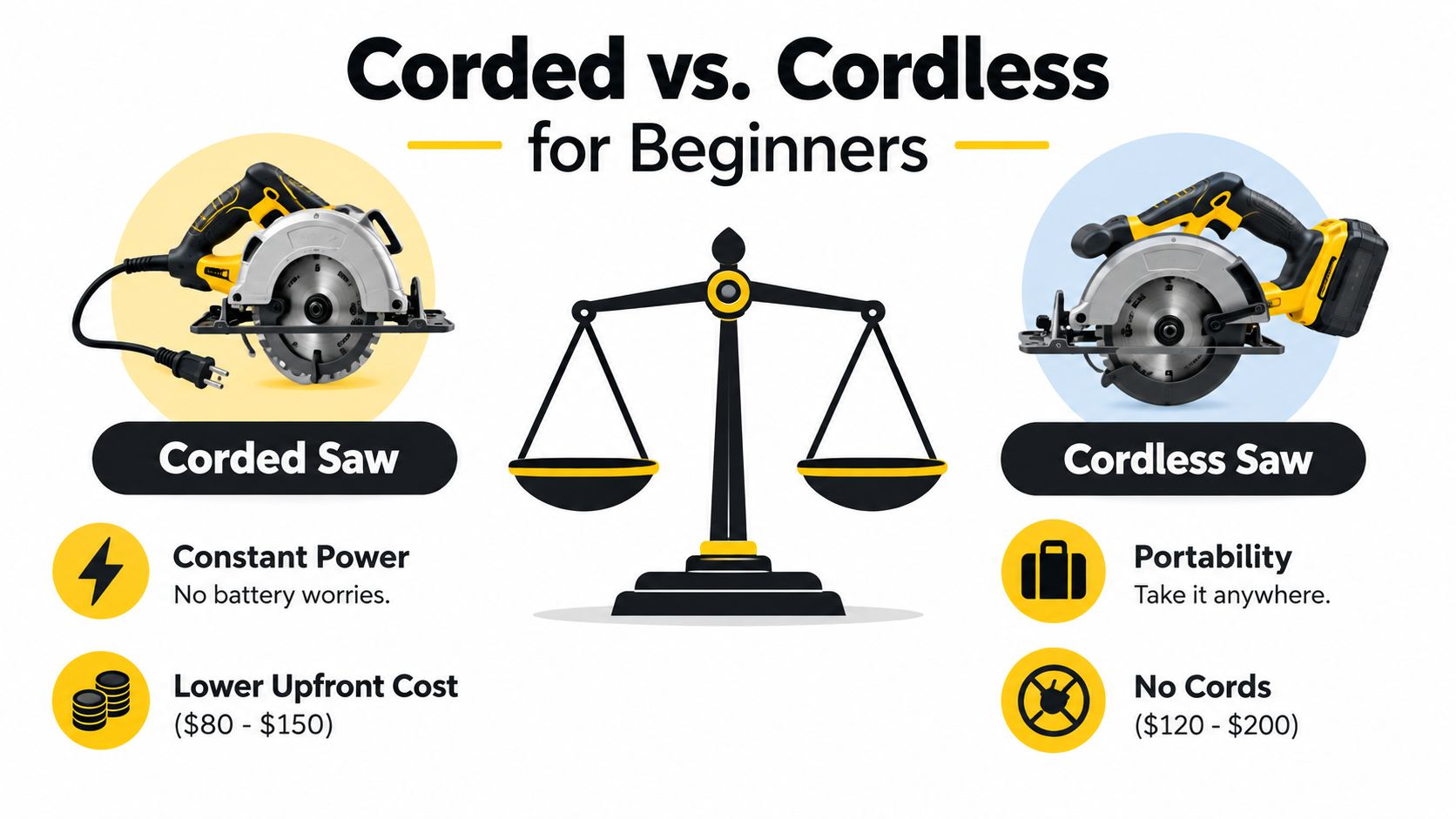
Corded and cordless saws solve different problems. A corded model works well for short cuts in a garage, shop, or driveway where an outlet is close. A cordless model removes the cord from roof work, exterior repairs, and remote job sites, but its purchase price may cover only the tool.
The comparison includes the battery, charger, replacement pack, and eventual recycling or disposal. Research on tool lithium-ion batteries notes that specific recycling data remains unavailable and cites an EU battery collection figure of approximately 46% of batteries sold in 2025, based on Eurostat-related figures (battery recycling research). The figure isn't a reason to avoid cordless tools, but it is a reason to treat the battery as part of ownership rather than an accessory.
Match the saw to your workflow
| Buyer situation | Better starting point | Main trade-off |
|---|---|---|
| Occasional cuts near an outlet | Corded 7-1/4-inch saw | Requires cord management |
| Roof or exterior remodeling | Cordless platform saw | Battery and charger add cost |
| Existing reliable battery ecosystem | Matching cordless saw | Bare-tool savings depend on owning compatible packs |
| First power saw with no battery system | Corded kit or complete cordless package | Compare the full system, not tool-only price |
Sacramento and Central Valley buyers also need to think about heat. During 100°F+ summer conditions, keep cordless batteries out of direct sun and allow packs to cool before charging or heavy use. A battery platform can reduce long-term cost when you already own dependable packs, but a discounted bare tool can cost more than a complete corded setup for a first-time buyer.
Portability is valuable, but it doesn't replace good geometry. A cordless saw with a weakly supported cut, poor depth control, or unclear bevel scale remains a poor beginner tool. This cordless versus corded tools comparison is useful when your project list includes both indoor and outdoor work.
How Value Tools Co Brings Pro-Grade Safety to Your Budget
A cheap bare tool is not a bargain if the guard drags, the shoe is bent, or the kit shows up missing the charger you assumed was included. For a first circular saw, the safer buy is the one with a clear condition description, a realistic return policy, and enough detail to help you avoid somebody else's problem tool.
Value Tools Co in Elk Grove sells open-box and gently used tools from brands many beginners already recognize, including DeWalt, Makita, Milwaukee, Ridgid, Ryobi, and Husky. The appeal is straightforward. You can often buy into a better-built saw, with better guard action and more dependable adjustments, without paying full retail. That matters more than chasing the lowest sticker price, especially when poor fit, weak locks, or missing parts can erase the savings fast.

Check the tool like a contractor would. The lower guard should snap back freely. The base plate should sit flat. Depth and bevel locks should hold without slipping. The blade should match the saw. On cordless listings, confirm whether you are getting a bare tool, a battery, a charger, or a full kit. Value Tools Co also advertises a 30-Day Peace of Mind Guarantee for tested and inspected tools, with return options by mail or in store, so confirm the current policy and the exact item condition before you buy.
Local pickup removes some of the usual friction for Sacramento-area buyers. If a property manager loses a saw mid-repair or a small remodeler needs a replacement before the next morning, Elk Grove pickup can be more useful than a rock-bottom online deal.
After the purchase, storage decides how long that savings lasts. This guide to equipment storage for builders is a practical starting point for protecting saws, batteries, and blades from heat, moisture, and jobsite abuse.
Who This Circular Saw Guide Is For (and Who Should Skip It)
Who This Is For
This guide fits homeowners building shelves, cutting plywood, trimming framing lumber, or handling repairs around Sacramento and the Central Valley. It also suits property managers, on-site handymen, and small remodeling businesses that need a dependable saw without tying up their whole equipment budget.
Choose a corded saw if most cuts happen near an outlet. Choose cordless when roof work, exterior repairs, or repeated moves across a jobsite make cord management a problem.
Who Should Avoid This
Heavy industrial users and crews needing continuous-duty production should prioritize a tool selected for that workload, service support, and replacement availability. A light-duty or open-box saw may not be appropriate when the tool will run for long periods under demanding conditions.
Cordless buyers in 100°F+ Sacramento summer heat should plan battery cooling and shaded storage. If you won't manage batteries carefully, a corded saw may be the simpler choice.
Final Buying Recommendations and Common FAQ
For most first-time buyers, choose a 7-1/4-inch corded circular saw with a clear depth scale, secure depth and bevel locks, a smooth lower guard, a flat shoe, and a correctly matched blade. A cordless model earns its place when portability is central to your work or you already own a compatible battery platform.
Is a bare-tool circular saw a good beginner purchase?
It can be, but only when you already own the correct battery and charger. Otherwise, compare the complete system cost against a corded saw or battery-included package.
What should I check on a used circular saw?
Disconnect power, operate the lower guard, inspect the cord or battery contacts, check the shoe for bends, test the depth and bevel locks, confirm the blade and arbor match, and verify that the trigger lockout works. Apply the same discipline when inspecting a framing nailer, or clavadora de marcos, before relying on it for structural work.
Do California buyers have warranty protection?
California buyers should read the seller's written return policy separately from legal warranty rights. The California Attorney General explains that defective merchandise may be covered by an implied warranty unless sold as-is, and that covered remedies can include repair, replacement, or a refund when repair isn't possible (California Attorney General refund guidance). Documentation and condition records matter, especially for open-box tools.
Keep saws, batteries, and accessories organized rather than leaving them exposed in a truck. Businesses with larger inventories can consider Container Self Store business units when ordinary jobsite storage no longer protects valuable equipment.
Value Tools Co offers tested open-box and gently used circular saws from recognized tool brands, with up to 55% savings, a 30-Day Peace of Mind Guarantee, and Elk Grove pickup for local buyers. Visit Value Tools Co to compare corded saws, cordless bare tools, batteries, and complete packages against your actual workload before you buy.


