

You're halfway into an engine-bay repair when the straight impact wrench hits the frame rail before the socket reaches the fastener. A ratchet may fit, but corrosion-bound suspension hardware still needs repeated impact force, not just more arm strength. A right angle impact wrench solves that access problem by putting the drive at 90 degrees, allowing high-torque fastening and breakaway in tight engine bays, suspension areas, underbodies, frames, and industrial assemblies.
The right model still depends on drive size, torque type, battery platform, duty cycle, and socket compatibility. A compact cordless tool can be the fastest answer in a Sacramento garage, while a pneumatic model remains the better choice for repeated heavy fastening where an air system is already available.
What a Right Angle Impact Wrench Is and Why It Exists
A straight impact stops at the frame rail while the socket is still short of a rusted fastener. A ratchet may reach it, but repeated impact force is often what breaks corrosion loose. A right angle impact wrench places the drive at 90 degrees to the motor, so the tool body runs beside the fastener instead of directly behind it. That layout turns a blocked engine bay, suspension area, underbody, or industrial assembly into a workable access point.
The tool combines a compact gearbox with a square-drive anvil. Its purpose is narrow but practical: deliver repeated hammer blows where a standard inline impact cannot be positioned. Automotive technicians use angled tools around engine mounts, brake assemblies, and suspension hardware. Maintenance crews use them inside machinery frames and confined service areas. On the job, access can save more time than extra torque if using a larger straight tool would require removing surrounding parts.
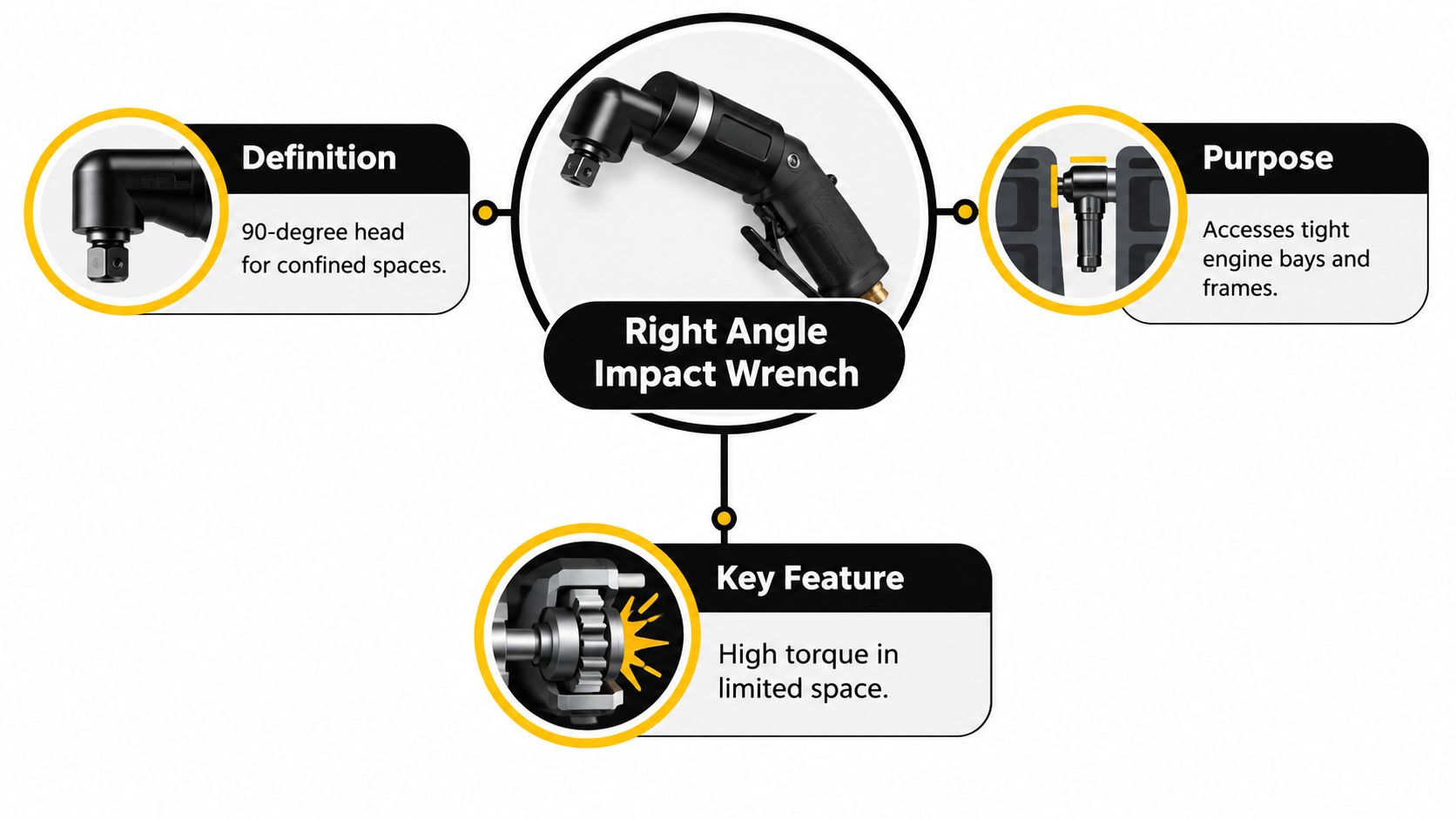
The geometry is the reason to buy it
Open access still favors a straight impact. Straight models are easier to brace, cover more torque classes, and suit wheel bolts, large suspension fasteners, and heavy fabrication. A right angle model gives up some general-purpose range to reach fasteners that would otherwise call for a long extension, awkward wrist positioning, or component removal.
The impact wrench family traces back to a basic model patented in 1935 by Robert H. Pott of Evansville, Indiana, as documented in the history of the impact wrench. Modern cordless right-angle tools arrived much later. Milwaukee's 2020 press release described its brushless right-angle impact wrenches as the first brushless models on the market, reflecting the move from pneumatic specialty tools toward compact cordless equipment.
What current cordless tools can do
Milwaukee's M12 FUEL right-angle impact wrench is rated for up to 220 ft-lbs of nut-busting torque and 200 ft-lbs of fastening torque. Those figures put a compact tool within reach of serious automotive and maintenance work, provided the fastener and duty cycle match its limits.
Pros include access, maneuverability, cordless portability, and fewer removed parts. Cons include a lower torque ceiling than the strongest straight or pneumatic tools, heat buildup during repeated use, and the need to match the square drive with your sockets. That trade-off suits automotive technicians, maintenance professionals, mobile mechanics, and serious DIYers who regularly work in confined spaces. For Value Tools Co shoppers, an open-box model can make sense when the battery platform, drive size, and tested condition fit the job.
How a Right Angle Impact Wrench Works Inside
A right-angle impact wrench earns its space through the head design. Inside the housing, a motor drives a reduction gearbox and a hammer-and-anvil mechanism. The motor provides rotation, while the hammer builds and releases energy in repeated blows against the anvil. The anvil carries that force through the 90-degree gearbox to the square drive and socket.
A drill applies comparatively steady rotational force. An impact wrench adds short, repeated impacts, helping loosen fasteners resisting a continuous load from rust, thread damage, or corrosion. That hammer action also reduces the reaction torque transferred to your wrist, though the socket and fastener still demand controlled handling.
Practical rule: RPM spins the socket quickly. IPM measures how often the hammer strikes when the fastener refuses to move.
RPM and IPM do different work
RPM, or revolutions per minute, describes drive speed with little or no load. IPM, or impacts per minute, describes hammer-strike frequency. A high IPM rating can help work through a seized bolt by delivering rapid impacts instead of relying on your wrist to hold continuous reaction torque.
Published specifications place current cordless right-angle models in a practical range of about 220 to 270 ft-lbs of nut-busting torque, with brushless designs reaching roughly 3,000 to 3,200 RPM and 3,600 to 4,000 IPM, as shown in the Milwaukee M12 FUEL product details. Milwaukee's M12 FUEL model lists 220 ft-lbs, 3,000 RPM, and 3,600 IPM. Makita's XLT03 lists 250 ft-lbs fastening torque, 390 ft-lbs breakaway torque, 3,200 RPM, and 4,000 IPM.
Those figures describe capability, not a guarantee that every seized fastener will release. Rust depth, bolt size, socket fit, battery condition, and heat during repeated cycles all affect the result.
Why the gearbox changes access
The right-angle gearbox redirects rotation while preserving the impact mechanism. It lets the operator keep the tool body beside the work while the socket points into the fastener. In an engine bay or between structural members, that geometry can avoid removing components or forcing an awkward wrist position.
Electronic controls add practical restraint. Milwaukee's M12 FUEL model has four drive modes and an auto-shutoff setting intended to reduce overtightening after breakaway, according to published M12 FUEL specifications. Use lower settings on delicate fasteners, then complete critical joints with the specified torque procedure and a calibrated torque wrench.
Key Specs That Actually Matter on the Job
A tight engine bay exposes the difference between a useful specification and a marketing number. Start with square-drive size, then compare fastening torque with breakaway torque. Check RPM, IPM, battery voltage, balance, and the duty cycle your work requires. Those details determine whether the wrench reaches the fastener, loosens it, and survives repeated use.
Fastening torque describes tightening performance under the manufacturer's test conditions. Breakaway, reverse, or nut-busting torque describes loosening capability. It is often higher because the impact mechanism can build energy against a seized fastener before the fastener turns.
Read the numbers like a technician
Professional cordless right-angle models publish torque figures from 170 to 250 ft-lbs, depending on the model and battery setup, according to Ingersoll Rand's right-angle impact wrench specifications. Ingersoll Rand's 20V model lists 170 to 180 ft-lbs of forward and maximum reverse torque, with 3,000 blows per minute and 1,850 RPM. Makita's 18V model lists 250 ft-lbs fastening torque and 390 ft-lbs breakaway torque. Ridgid's 18V model reaches 250 ft-lbs breakaway torque, 3,800 IPM, and 3,200 RPM.
A 3/8-inch square drive fits many automotive, HVAC, plumbing, and maintenance sockets. A 1/2-inch drive accepts larger impact sockets and suits heavier automotive fastening. Choose drive size around the socket range you use, not the largest number on the box.
| Spec | Cordless compact example | Pneumatic example |
|---|---|---|
| Power source | 12V or 18V battery platform | Compressed air |
| Torque range | Compact models vary widely, with breakaway output depending on platform and test method | Published air models can reach high maximum and bolt-breakaway torque at specified pressure |
| Speed | Brushless examples commonly provide high no-load speed | Air-motor speed depends on supply and tool design |
| Impact rate | Varies by model and operating mode | Depends on the air motor and supply |
| Main advantage | Portable access without a hose | Consistent repeated output where air is available |
| Main limitation | Battery heat, runtime, and recharge planning | Compressor, hose, fittings, and air-line dependence |
The Harbor Freight pneumatic model specifications provide one concrete air-tool reference, while cordless figures should be compared only when manufacturers use similar test conditions. A headline torque value does not predict every seized bolt. Rust, fastener size, socket fit, battery condition, and heat can change the result on the job.
Power-source design also affects how torque arrives at the socket. For background when comparing systems, compare hydraulic vs electric torque motors and note the different ways each motor type delivers rotational force. That comparison does not replace checking the wrench's own specifications, air requirements, or battery platform.
Fastening control matters as much as output
High breakaway torque is useful for rusted hardware. It is poor justification for driving every fastener at full power. Use lower electronic settings for delicate threads and soft materials, then verify safety-critical joints with the specified procedure and a calibrated torque wrench. Value Tools Co's impact wrench torque guide helps separate the tool's impact output from the torque the joint requires.
Brushless, or sin escobillas, motors reduce motor wear and support electronic control, but they still produce heat. In Sacramento and the Central Valley, summer work can exceed 100°F. Keep batteries out of direct sun, let hot packs cool before charging, and judge duty cycle from repeated real work rather than one short test. For open-box buying, prioritize a known battery platform, an undamaged square drive, and a return option over a high headline torque number.
Right Angle vs Straight Impact Wrench and When to Choose Each
A rusted fastener buried behind an engine, frame rail, or suspension bracket can decide the tool choice before torque does. Choose a right angle impact wrench when the head must enter a narrow opening and the body or battery of a straight tool cannot line up. Choose a straight impact wrench when the fastener is exposed and higher output, faster work, or a wider socket range matters more.
A straight inline impact wrench is easier to brace and commonly provides a higher torque ceiling. It suits wheels, open suspension components, structural bolts, and general shop fastening. Its limitation appears when the pistol-grip body or battery hits nearby parts before the socket seats fully.
| Job condition | Right angle impact wrench | Straight impact wrench | Right angle drill or impact driver |
|---|---|---|---|
| Tight engine bay | Strong fit because the head enters narrow gaps | Often blocked by the body or battery | Useful for screws and light fastening |
| Open suspension work | Works when clearance is restricted | Usually the easier and stronger option | Usually under-equipped for large nuts |
| Nuts and bolts | Square drive accepts impact sockets | Square drive accepts impact sockets | Less suitable, especially with a quarter-inch hex collet |
| Screw-driving | Awkward and inefficient | Not the intended use | Better match for bits and smaller fasteners |
| Repeated heavy fastening | Cordless heat and battery planning matter | Better choice when high output is needed continuously | Not the right category |
Right angle versus right angle drill
A right angle drill or impact driver, atornillador de impacto, can enter a smaller opening, but its quarter-inch hex collet is intended for bits and driver accessories. Impact wrenches use a square drive for sockets. Trade tool documentation describes this drive-standard difference and supports choosing an impact wrench for nuts and bolts.
For automotive socket work, a right angle impact wrench provides better breakaway force and socket compatibility. The trade-offs are greater bulk than a drill, higher cost than a basic driver, and less usefulness for screws. A right angle drill is the better fit for cabinet assembly, conduit work, and drilling through awkward framing. It is a poor substitute when a rusted suspension nut needs repeated hammer impacts.
For repeated heavy fastening, a straight wrench usually handles the workload more efficiently when there is room to brace it. In a cramped engine bay, the right angle model can finish the job faster because the socket reaches the fastener without removing surrounding parts.
Choose by fastener first: If the job is mainly nuts and bolts, start with square-drive compatibility. If it's mainly screws or drill bits, start with a hex-driver platform.
How to Choose the Right Model and Ensure Compatibility
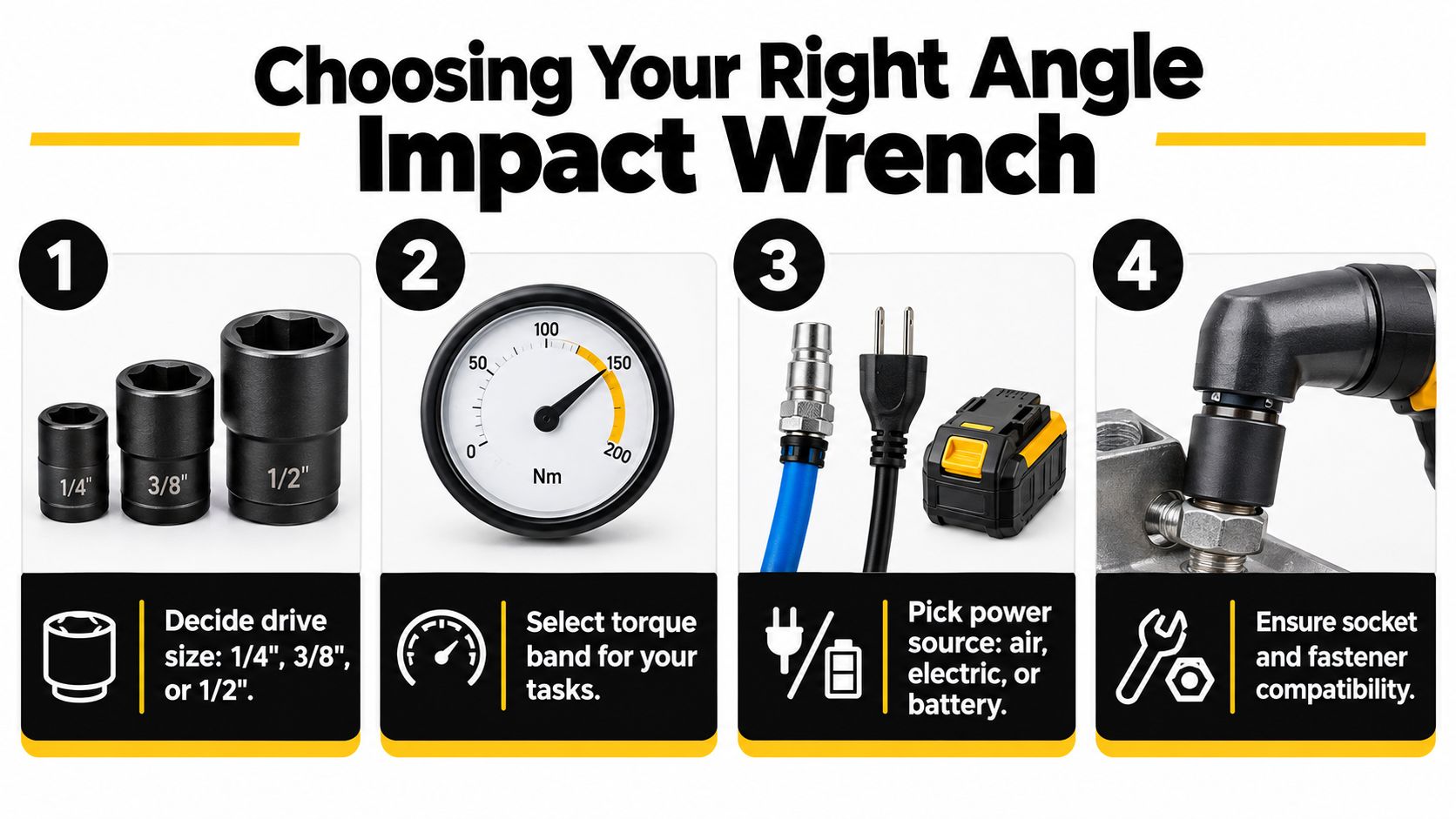
Start at the fastener, then work backward to the tool. A 3/8-inch square drive suits compact mechanical work and many service applications. Choose a 1/2-inch drive when larger automotive or industrial sockets are routine. Drive adapters can bridge those sizes, but they add length and another connection in the tight spaces where a right-angle wrench is most useful.
Read fastening torque and breakaway torque as separate figures. A model rated at 270 Nm fastening torque and 300 Nm nut-busting torque shows the difference clearly. Multiple drive modes and an auto-shutoff setting can also give better control during reassembly, as shown in the Milwaukee M12 FUEL model specifications. Treat those figures as a guide for matching fastener size and condition, not as a promise that every rusted nut will release at the listed rating.
Match power to the workday
Cordless tools suit mobile repair, service calls, and jobs where moving a hose takes longer than changing a battery. Stay with a platform already used on the job when possible. A bare tool, herramienta sola, lowers the initial cost, but only if compatible batteries and a charger are already available.
Pneumatic tools remain practical in busy shops with a properly sized compressor, clean air delivery, and a short hose run. Cordless brushless models are easier to carry around a vehicle or jobsite, while repeated fastening can heat the battery and motor. In Central Valley summer conditions, schedule charging and cooling instead of treating a compact cordless wrench like an unlimited air tool.
An angle drill adapter can help with some access problems, but it does not turn a drill into a square-drive impact wrench. Review angle drill adapters for tight-access work before buying an accessory, then confirm its drive type, clearance, and intended load.
Confirm sockets, accessories, and local timing
Use impact-rated sockets, not chrome hand-tool sockets. Check the anvil retention system, confirm that extensions preserve the required clearance, and avoid stacking adapters in a cramped engine bay. A friction ring speeds socket changes. A pin-detent system can retain a socket more securely during overhead or awkward work.
Northern California contractors must also separate tool selection from material compliance. Related framing work can call for 21° full round-head framing nails, so a right-angle impact wrench does not replace a compliant framing nailer, or clavadora de marcos, where that fastening method applies. For an urgent repair, fast 1-day Northern California delivery and same-day Elk Grove warehouse pickup may matter more than a small specification difference.
Value Tools Co lists tested and inspected open-box and bare-tool options from DeWalt, Makita, Milwaukee, Ridgid, Ryobi, and Husky. Its 30-Day Peace of Mind Guarantee covers 30-day returns by mail or in-store, free return shipping on defective items, and savings of up to 55% on Open-Box or Bare Tools. That gives buyers a defined return path while lowering the cost of entering a cordless platform.
Maintenance Safety and Getting Long Life in Real Use
A right-angle impact wrench can handle professional work, but repeated fastening still creates heat and load. Follow the user manual's guidance for a 20V right-angle model: reduce the load when the tool becomes too hot, and stop before heat damages the motor, battery, or housing. This matters in automotive, maintenance, and construction work, where a compact body may run repeatedly with little recovery time between fasteners.
Sacramento and Central Valley heat makes battery care part of the daily routine. Keep packs shaded, remove them from a hot tool bag when practical, and let them cool before charging. If output drops or the housing feels unusually hot, stop forcing the fastener. Use a hand tool, another impact wrench, or a cooling break instead of holding the trigger harder.
Use the right maintenance routine
Cordless brushless tools need less motor service than pneumatic models, but they still require inspection. Clear debris from the vents, check the battery connection, inspect the square drive for wear, and verify that the friction ring or detent mechanism holds sockets correctly. A loose socket can fall into an engine bay or transmit force unevenly.
Pneumatic tools need clean, regulated air and suitable lubrication. Drain moisture from the line and follow the manufacturer's oiling instructions, because water and poor lubrication can damage internal parts and reduce consistent performance. Air tools also depend on the complete setup, including hose condition, pressure at the tool, drive size, and hammer design. The available torque can vary widely between models, so match the wrench to the duty cycle rather than choosing by head shape alone.
Protect the joint and yourself
Wear eye protection, use impact-rated sockets, keep hands away from the socket and reaction surfaces, and never use the impact wrench in place of a torque wrench on a critical joint. Begin in a lower drive mode when the fastener or surrounding material could be damaged. After the bolt breaks loose, control the trigger rather than allowing the socket to spin unattended.
Store batteries away from excessive heat and keep sockets organized by drive size. A dedicated 3/8-inch or 1/2-inch impact socket set reduces the temptation to improvise with adapters. Inspect the tool after hard jobs, especially if it has been dropped, exposed to water, or used against seized fasteners. Open-box buyers at Value Tools Co should confirm that the battery interface, charger requirements, socket retention, and visible housing condition match the intended workload before putting the wrench into daily service.
Final Buying Recommendation for Value Tools Co Shoppers
Buy a right-angle impact wrench when clearance is the problem you face repeatedly. Its compact 90-degree head lets you put a socket on fasteners in engine bays, suspension areas, vehicle underbodies, frames, and machinery where a straight impact wrench cannot sit squarely. That access can save more time than a higher torque rating you cannot use because the tool will not fit.
Automotive technicians, maintenance professionals, mobile mechanics, and serious DIYers are the natural users. A cordless model also removes the air hose from roadside, field, and service-vehicle work. For repeated repairs, it can replace slow ratcheting in confined areas, while still leaving room in the toolbox for a straight impact wrench and a torque wrench.
Choose a straight high-torque impact wrench when the work is mostly open and the job demands the greatest available breakaway force. Choose a right-angle drill or impact driver, atornillador de impacto, when the main tasks involve screws, hex bits, or drilling. Tool geometry should follow the fastener and working space, not the appearance of the tool.
Who This Is For
- Automotive technicians: Engine-bay, suspension, underbody, and confined service work where socket alignment is difficult.
- Maintenance professionals: Machinery and industrial assemblies with restricted access around guards, frames, and adjacent components.
- Mobile mechanics: Cordless portability for work away from a compressor, shop, or fixed air line.
- Serious DIYers: Repeated automotive repairs where a hand ratchet is too slow or awkward.
- Budget-focused contractors: Buyers who can match an open-box or bare tool to an existing battery platform and avoid paying for duplicate batteries.
Who Should Avoid This
- Heavy industrial users: Choose pneumatic or straight high-torque equipment when repeated maximum output is the normal workload. A compact right-angle tool is built to solve access problems, not replace shop equipment designed for sustained heavy fastening.
- Screw-focused trades: A right-angle drill or impact driver is more useful for hex bits, screws, and drilling.
- Buyers without compatible batteries: Add the cost and availability of the battery and charger before choosing a bare tool. A low tool price does not represent the complete setup if the platform is new to you.
- Users expecting one tool for every fastener: Right-angle geometry solves access, but it does not replace a straight impact, ratchet, drill, and torque wrench.
For a compact 3/8-inch cordless option, review the Milwaukee M12 FUEL right-angle impact wrench. Confirm that its square drive matches your sockets and that the M12 battery platform fits the kit you already own. The bare-tool format makes the most sense when you have compatible batteries, a charger, and impact-rated sockets on hand.
Value Tools Co's open-box inventory can include tools from DeWalt, Makita, Milwaukee, Ridgid, Ryobi, and Husky. Check the listed condition and inspect the tool for housing damage, battery-interface wear, socket retention, and missing accessories. Tested and inspected condition, the 30-Day Peace of Mind Guarantee, returns by mail or in-store, free return shipping on defective items, and up to 55% savings on Open-Box or Bare Tools can make an open-box purchase practical, provided the tool matches the work rather than just having the lowest price.
The buying decision comes down to fit, platform, and duty cycle. Pick 3/8-inch when your existing sockets and confined mechanical work favor a compact setup. Pick 1/2-inch when the fasteners and sockets are larger and the job calls for more capacity. Choose cordless for mobility and quick deployment. Choose pneumatic when a compressor, regulated air, and sustained shop output are already part of the workplace.
Do not select the highest torque number printed on the box without considering access and use. A tool that gets the socket onto the fastener can outperform a stronger tool that cannot seat properly. Use the impact wrench for removal and controlled fastening, then confirm critical joints with the correct torque procedure.
Frequently Asked Questions
What is a right angle impact wrench used for
A right angle impact wrench tightens and loosens nuts and bolts in confined spaces. Common work includes engine bays, suspension components, vehicle underbodies, frames, HVAC equipment, plumbing assemblies, and industrial machinery. The right-angle head gives the operator a better approach when surrounding parts block a straight tool.
Is a right angle impact wrench better than a straight impact wrench
It is better when access is restricted and a straight impact wrench cannot seat on the fastener. A straight impact wrench is usually the better choice for open work, maximum torque, and repeated heavy fastening. Many working mechanics keep both because they solve different problems.
What drive size should I choose
Choose 3/8-inch for compact mechanical and trade work when your sockets match that drive. Choose 1/2-inch for larger automotive or industrial sockets and heavier fasteners. Avoid relying on adapters if their added length makes the tool difficult to position or prevents the socket from sitting squarely.
Can a right angle impact wrench replace an impact driver
No. An impact driver normally uses a quarter-inch hex collet for bits, while an impact wrench uses a square drive for sockets. Use the impact driver for screws and bit-driven work. Use the right-angle impact wrench for nuts and bolts that require sockets.
Are pneumatic right angle impact wrenches stronger
Some are. One 1/2-inch pneumatic model is rated at 300 ft-lbs maximum torque and 400 ft-lbs bolt-breakaway torque at 90 PSI, but those figures come with setup requirements. Pneumatic tools need a compressor and air line. Cordless models are easier to carry and deploy, especially for mobile work, although their output and runtime depend on the battery platform and duty cycle.
How do I prevent overheating
Reduce the load when the tool becomes hot, let the motor and battery cool, keep the vents clear, and avoid charging a hot battery. Long work on seized fasteners creates more heat than short removal cycles, so give the tool recovery time instead of holding the trigger continuously. Sacramento and Central Valley crews should take extra care during summer work above 100°F, when heat can shorten productive runtime.
Value Tools Co carries tested and inspected open-box and bare-tool right-angle impact wrenches from trusted brands, with up to 55% savings and a 30-Day Peace of Mind Guarantee. Match the drive size and battery platform to the fasteners you service, then visit Value Tools Co to find a compact tool suited to the access problems on your jobs.


