

Angle grinder safety glasses must carry the ANSI Z87+ high-impact rating and have wraparound side shields, but they're only one layer of a broader guard, eyewear, and face-shield system. The right setup starts with the grinder itself, because a missing guard, damaged disc, or mismatched RPM can create a hazard no lens can reliably control.
The popular advice is to buy the thickest, most expensive glasses and get to work. That's incomplete job-site thinking. In Northern California, I've seen plenty of eye injuries start with a small shortcut: a guard removed for “better access,” a cutting disc used for grinding, or glasses left on the bench because the job would only take a minute.
The right angle grinder safety glasses are inexpensive compared with an eye injury, but they don't make a defective grinder safe. Use them with a sound tool setup, a properly selected disc, and a face shield whenever sparks or fragments can reach the rest of your face.
Why Premium Lenses Cannot Fix a Bad Grinder Setup
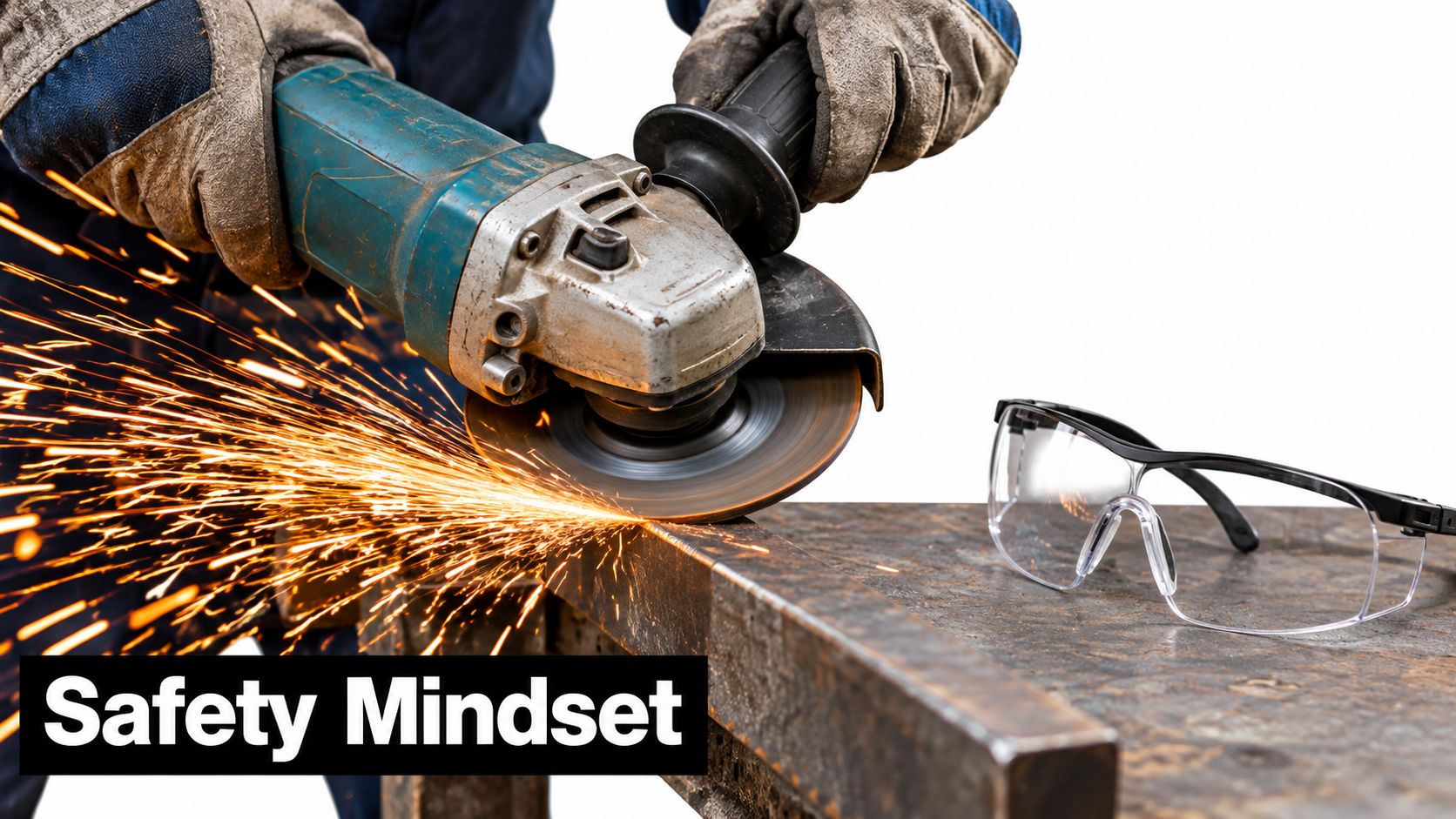
A premium lens can protect your eyes from a flying particle. It can't correct a cracked wheel, contain a broken flange, or redirect fragments from an unguarded grinder. PPE is the last line of defense, not a replacement for the machine controls that prevent debris from reaching you.
OSHA requires abrasive-wheel guards to cover the spindle, nut, and flange projections, and warns that an unguarded, mismatched, or over-speed accessory can create a hazard that no lens reliably controls. The OSHA abrasive-wheel requirements also support checking the wheel, guard, mounting arrangement, and operating conditions before work begins.
The grinder setup comes first
Before choosing between glasses and glasses plus a shield, check the tool:
- Guard: It must be secure, aligned, and positioned to deflect particles away from you.
- Disc: Confirm that it's designed for the operation. A cutting disc isn't a grinding disc.
- RPM: The disc's rated speed must meet or exceed the grinder's speed.
- Wheel condition: Reject discs with cracks, deep damage, or questionable storage history.
- Mounting: Verify the correct flange and nut are fitted and tightened properly.
- Workpiece: Clamp or restrain the material so it can't shift and pinch the wheel.
- Startup position: Don't stand in the wheel's plane during startup.
OSHA's angle-grinder guidance recommends holding a grinding wheel roughly 5 to 15 degrees from the work surface. That shallow working angle helps keep the wheel controlled and reduces the chance of catching an edge. If the setup fails any of these checks, stop there. Better glasses aren't a permission slip to continue.
For broader workshop practices, the Value Tools Co guide on bench grinder safety is useful because the same principle applies: guards, wheel condition, and operator position matter before personal protection.
Practical rule: If the grinder would be unsafe without your glasses, fix the grinder before putting on better glasses.
Decoding Z87+ Ratings and Side Shield Requirements
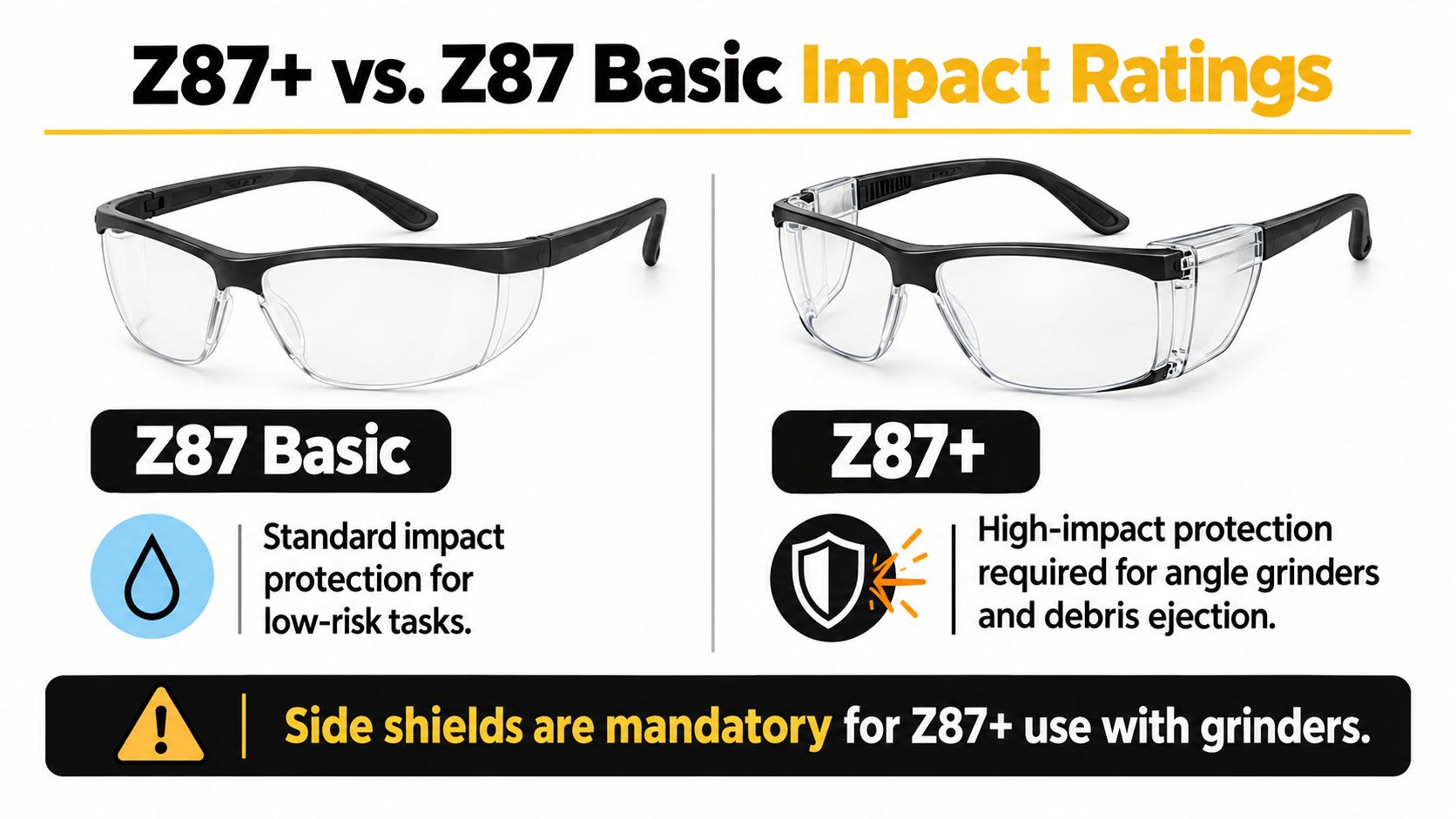
A thick lens does not make a grinder setup safe. The eyewear must match the hazard, and the marking to look for is Z87+, not merely Z87. The plus sign identifies high-impact protection under ANSI/ISEA Z87.1. The specified testing includes an approximately 1.1-pound object dropped from 50 inches, as described in this 3M eye-protection product guide.
Basic Z87 eyewear may suit lower-risk work. Angle grinding is different. Fragments can come from the wheel, workpiece, or abrasive material, and their direction can change after impact. Ordinary shop glasses, fashion eyewear, and prescription glasses are not substitutes for certified grinder protection.
What to inspect on the frame
Look for the manufacturer's identification marking and a visible Z87+ marking on the assembled eyewear. Check the lens and frame, not only the packaging. The glasses should stay in place when you look down, turn your head, or hold the grinder with both hands.
Side coverage matters as much as impact rating. OSHA calls for side shields where flying-object hazards exist, and CDC/NIOSH guidance on protective eyewear identifies wraparound coverage or side shields as part of impact protection. A fragment can rebound from a workpiece and approach from the side, particularly while cutting bolts, dressing welds, or grinding an irregular edge.
The historical BLS record shows the scale of debris-related eye hazards. In 2008, 27,450 nonfatal occupational eye injuries or illnesses involving days away from work were reported. Scrap, waste, and debris accounted for 18,950 cases, approximately 52% of qualifying eye injuries. The BLS eye-injury report provides that baseline. It does not describe every grinder incident, but it supports treating side coverage as a basic requirement for abrasive work.
| Feature | What works | Limitation |
|---|---|---|
| Z87+ lens | High-impact protection for flying particles | Does not cover the entire face |
| Permanent side shields | Continuous lateral coverage | May interfere with some earmuffs |
| Wraparound frame | Better peripheral protection | Can retain more heat |
| Prescription-rated eyewear | Correct optical and impact protection | Usually costs more than standard glasses |
| Over-the-glasses design | Fits over approved prescription frames | Can be bulkier and fog more easily |
Lens tint can help with glare, but it does not change the impact rating. The Value Tools Co guide to polarized safety glasses explains the visibility trade-offs. Polarization alone does not establish high-impact grinder protection.
The Pre-Use Safety and PPE Checklist
A five-minute inspection prevents a bad setup from becoming an emergency. I use the tool condition to determine the PPE, rather than putting on glasses and assuming the job is covered.
Check the machine and work area
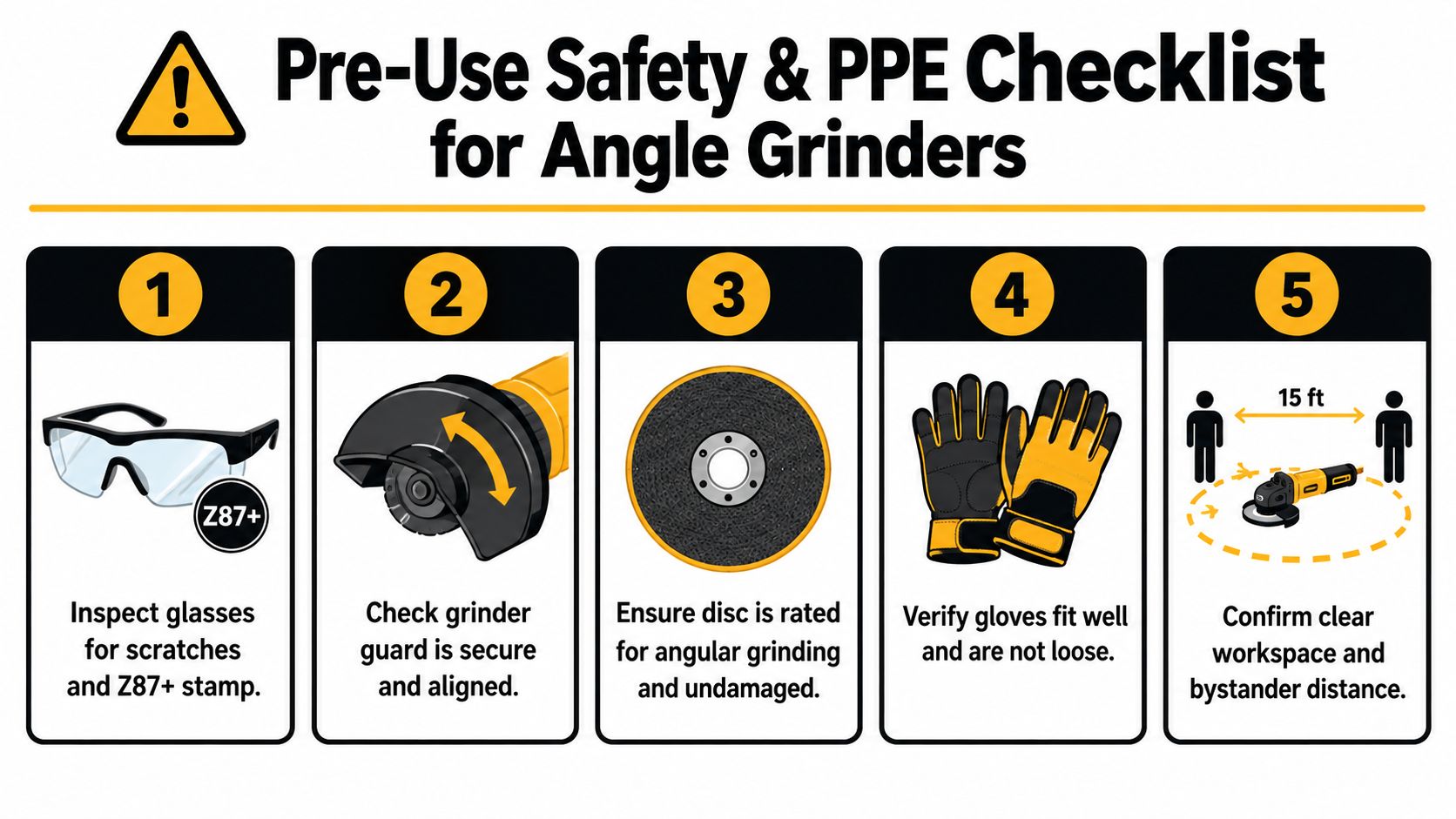
- Inspect the disc. Look for cracks, chips, distortion, or damage around the arbor hole. Use the correct disc type for the operation and verify its rated speed.
- Check the guard. It must be fitted, secure, correctly aligned, and able to deflect sparks and fragments away from your body.
- Inspect the mounting hardware. Confirm the flange, nut, and spindle arrangement match the manufacturer's instructions.
- Secure the workpiece. A clamp or stable fixture prevents the material from moving into the wheel.
- Clear the spark path. Remove combustible materials and keep other workers out of the line of fire.
- Choose your stance. Start the grinder away from your body and avoid standing in the wheel's plane.
The wheel should be inspected and ring-tested before mounting when the wheel type and manufacturer's instructions call for it. Keep both hands on the grinder, use the side handle, and don't force the wheel into the material.
Then inspect your PPE
Check the glasses for deep scratches, crazing, heat damage, and chemical damage. Replace them after a significant impact, even if they still look usable. Appearance alone doesn't prove the eyewear retained its impact performance.
Fit matters as much as lens material. A safety fact sheet reports that more than 90% of injuries among workers wearing protective eyewear occurred because objects went around or underneath the protector. That's why stable side coverage and a close fit deserve the same attention as the Z87+ marking.
Use a face shield over the glasses for cutting, wire-wheel brushing, overhead grinding, heavy rust removal, or sustained work that produces substantial sparks and fragments. For dust-heavy work, review practical options for industrial dust collection systems instead of relying on eyewear to manage airborne contamination.
The Value Tools Co resource on angle grinder accidents is also relevant for crews building a toolbox talk around kickback, wheel failure, and PPE selection.
Managing Fogging and Heat in Extreme Climates
Sacramento and the Central Valley punish poorly ventilated PPE. In 100°F+ summer heat, sweat, a sealed frame, and a face shield can turn clear lenses into a fogged-up liability. The answer isn't to lift the glasses or shield during a cut. It's to choose ventilation and coatings that keep your vision usable.
Permanent anti-fog coatings generally provide more consistent performance than relying on a wipe after fogging starts. Wipes are convenient in a truck or gang box, but they wear off and require clean application. A coated lens still needs proper cleaning, because abrasive dust and oily fingerprints can create haze that resembles fog.
Choosing between airflow and coverage
Ventilated frames improve comfort and reduce condensation, but large openings may allow more fine dust around the eyes. For metal grinding with flying fragments, prioritize stable Z87+ glasses with side protection. For concrete, masonry, or coated material, consider whether sealed goggles are more appropriate for the dust hazard.
A face shield adds broad facial coverage, but it also adds heat and fogging risk. Cornell's laboratory safety guidance on face shields supports wearing a shield over safety glasses when grinding creates substantial sparks while recognizing the comfort problem in hot environments.
| Option | Works well for | Trade-off |
|---|---|---|
| Anti-fog Z87+ glasses | Short and sustained grinding | Coating needs careful cleaning |
| Ventilated face shield | Spark-heavy operations | More heat and bulk |
| Sealed goggles | Fine dust and particulate | Less airflow and greater fog risk |
| Temporary anti-fog wipes | Field maintenance | Performance depends on application |
| Glasses alone | Light deburring with contained debris | No facial protection beyond the eyes |
For a hot Central Valley shift, use an adjustable ventilated shield, anti-fog Z87+ glasses, and breaks that let you inspect and clean the equipment. Don't trade visibility for coverage. If the lens fogs, stop the tool, move clear of the work zone, and correct the problem before continuing.
Who Needs This Setup and Who Should Avoid It
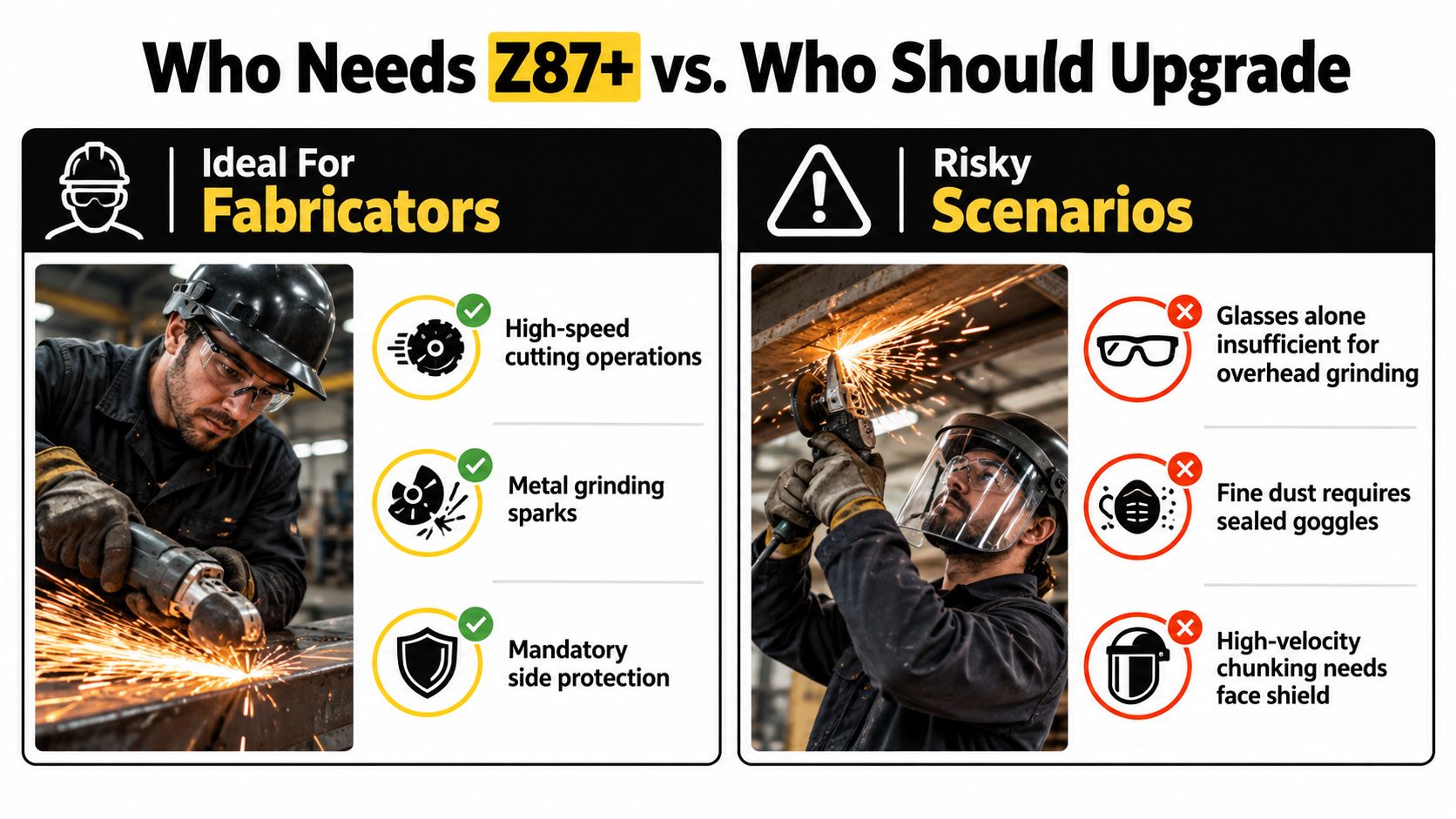
Z87+ angle grinder safety glasses with permanent side shields suit fabricators, maintenance crews, contractors, and homeowners performing controlled grinding, cutting, deburring, or weld cleanup. They're lightweight, easy to keep in a tool bag, and less cumbersome than a face shield for short, moderate-impact tasks.
A fabricator cutting small steel parts benefits from glasses that stay in place while using both hands. A maintenance technician dressing a weld needs lateral coverage because fragments can rebound from the workpiece. A homeowner doing occasional light deburring can usually work comfortably with Z87+ glasses, provided the grinder has its guard and the work area is controlled.
Who should avoid relying on glasses alone
Don't use glasses as the complete system for:
- Overhead grinding: Debris can fall toward your face and neck.
- Heavy wire-wheel brushing: Broken wires and loosened rust can travel unpredictably.
- Thick weld removal: Sustained sparks and larger fragments need broader coverage.
- Work near bystanders: Control the area and add a face shield when fragments may escape.
- Dust-heavy cutting: Sealed goggles or suitable respiratory controls may be needed.
- Unstable workpieces: Fix the material before deciding that basic PPE is enough.
ANSI's guidance on high-impact safety eyewear makes the limitation clear. High-impact glasses are practical for flying particles, but their coverage stops around the eye area. For overhead grinding or heavy rust removal, pair them with a face shield.
Prescription users should choose prescription-rated safety eyewear or an approved over-the-glasses model. Regular eyeglasses can shift, leave gaps, and usually aren't the impact-rated protector your eyes need. If you're deciding whether to keep a single pair or several glasses for different work conditions, prioritize the pair that fits the actual task and remains available when you need it.
Common PPE Questions and Smart Buying Tips
Can I wear prescription glasses under grinder safety glasses?
Yes, provided the protective eyewear is prescription-rated or specifically approved for use over prescription frames. Ordinary glasses do not replace Z87+ protection. Check that the safety eyewear stays stable, does not press the prescription frames into your face, and maintains coverage while you move or look down.
When should I replace scratched safety glasses?
Replace them after a significant impact, deep scratching, crazing, haze, or heat or chemical damage. Abrasive dust can cloud lenses quickly, so inspect them before every shift and replace them when the surface interferes with a clear view. A lens that looks intact may still have compromised impact performance.
Are tinted lenses suitable for indoor grinding?
Tint works indoors only when it preserves a clear view of the disc, sparks, and workpiece edge. Clear lenses are usually the practical choice inside shops and garages. The safety marking, side coverage, and fit matter more than lens color.
Do I need a face shield?
Use a face shield over Z87+ glasses when grinding produces substantial sparks, fragments, or dust. Glasses protect the primary eye area, while the shield adds coverage across the cheeks and face. A shield alone leaves gaps around the eyes, so it should supplement, not replace, safety glasses.
I treat side coverage and consistent use as baseline requirements, not optional upgrades. Set the shield at the correct distance, keep the grinder guard installed, and replace lenses that become too cloudy to show the work clearly.
Value Tools Co sells inspected open-box and bare tools at up to 55% off retail, with a 30-day return window. Same-day pickup at the Elk Grove warehouse can help when a job cannot wait for showroom packaging.
Choose ANSI Z87+ glasses with permanent side shields, then verify the guard, disc type, RPM rating, and workpiece before grinding. Value Tools Co carries inspected tool options for Sacramento-area crews. Visit Value Tools Co to find a grinder and PPE setup suited to the job.


