

You're standing beside a stack of patio pavers, a chipped tile, or a concrete slab that needs trimming, and the wheels on the shelf look almost interchangeable. Choose a continuous rim for clean tile edges, a segmented wheel for production masonry cuts, and a turbo wheel for mixed repair work. Then check the bond, material rating, and tool compatibility before buying, because rim shape alone won't tell you how long a diamond cutting wheel will last.
Continuous Rim, Segmented and Turbo Wheels Compared
The rim design decides where a diamond cutting wheel works best. A diamond cutting wheel is a steel disc with industrial diamond grit bonded to its rim. Continuous rims prioritize finish, segmented rims prioritize material removal and debris clearance, and turbo rims offer a compromise between speed and edge quality.
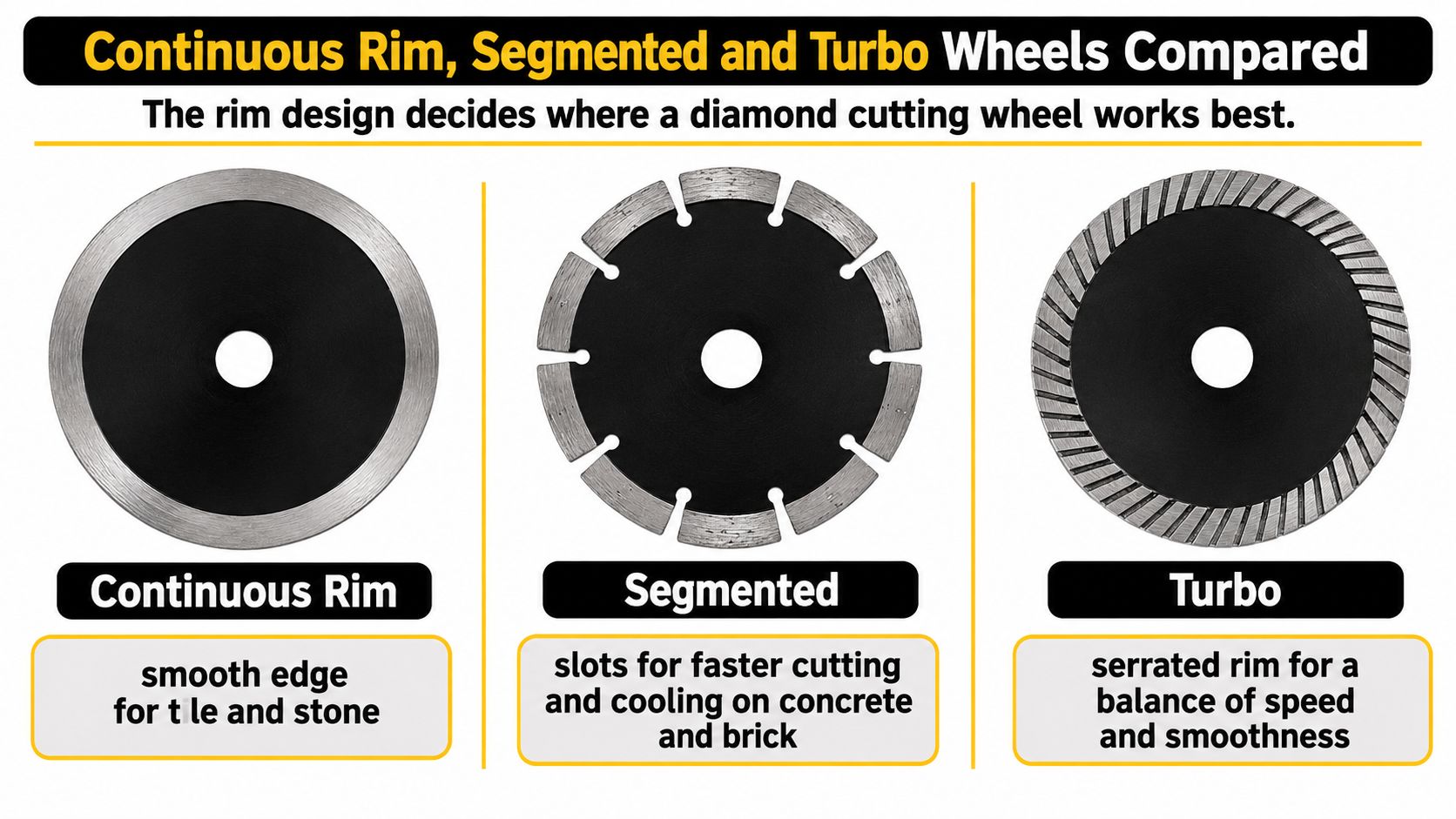
Diamond cutting wheel types by rim design
| Wheel type | Rim design | Best materials | Cut quality | Typical use |
|---|---|---|---|---|
| Continuous rim | Unbroken solid diamond edge | Porcelain, ceramic tile, glass, thin stone | Smoothest edge, slowest cut | Wet cutting preferred |
| Segmented | Gaps between diamond segments | Cured concrete, brick, block, natural stone | Fast cut, rougher edge | Wet or dry, dust control needed for dry |
| Turbo | Wavy or serrated rim | Concrete, brick, mixed masonry | Faster than continuous, cleaner than segmented | Versatile, mostly dry for quick cuts |
These are purchasing categories, not permission to cut every listed material with every wheel. Glass, porcelain, and natural stone still require an explicit application rating.
Continuous rim for exposed tile edges
A continuous rim diamond blade supports the cut along an uninterrupted abrasive edge. That makes it the starting choice for a tile setter trimming ceramic tile or porcelain where the cut remains visible.
- Pros: Better chip control and a smoother finished edge.
- Cons: Slower progress through thick material, with heat management especially important during sustained cuts.
- Ideal user: Tile installers and remodelers working around exposed corners, fixtures, and finished surfaces.
Don't assume a smooth edge makes an ordinary tile wheel suitable for precision glasswork. The abrasive specification and saw setup still matter.
Segmented wheels for concrete and masonry
The spaces between segments help clear cutting debris and slurry. For a flatwork contractor cutting cured concrete or a masonry crew trimming block, that clearance is usually more useful than a polished edge.
- Pros: Efficient material removal and good debris evacuation.
- Cons: Rougher edges and greater chipping risk on brittle finish materials.
- Ideal user: Concrete contractors, masonry crews, and demolition trades.
Turbo wheels for mixed repair work
A turbo wheel's serrated rim is useful when the job includes brick, pavers, and miscellaneous masonry rather than repetitive finish cuts.
- Pros: A practical balance of cutting speed and finish.
- Cons: Neither the cleanest tile option nor the automatic choice for sustained concrete production.
- Ideal user: Homeowners tackling a patio and handymen carrying a compact repair kit.
If a coworker asks for a disco de diamante for an amoladora angular, confirm the material and rating, not just the shared trade name. Match the rim to the first material you'll cut.
How Grit and Bond Control Cut Speed and Wheel Life
Say you fit a concrete wheel, start cutting dense material, and find yourself pushing harder while progress slows. The grinder may have enough power. The wheel may have the wrong bond, the metal matrix holding the diamonds.
A diamond blade grinds rather than cuts with conventional teeth, and its self-sharpening action depends on the matrix wearing away to expose fresh diamond points, as explained in Norton Abrasives' diamond blade guide. Diamonds fracture and wear during use; the surrounding bond must release spent abrasive without throwing away usable grit.
Think of mortar holding bricks in a wall. If the mortar never releases, worn bricks remain in place; if it crumbles too readily, useful bricks fall out early.
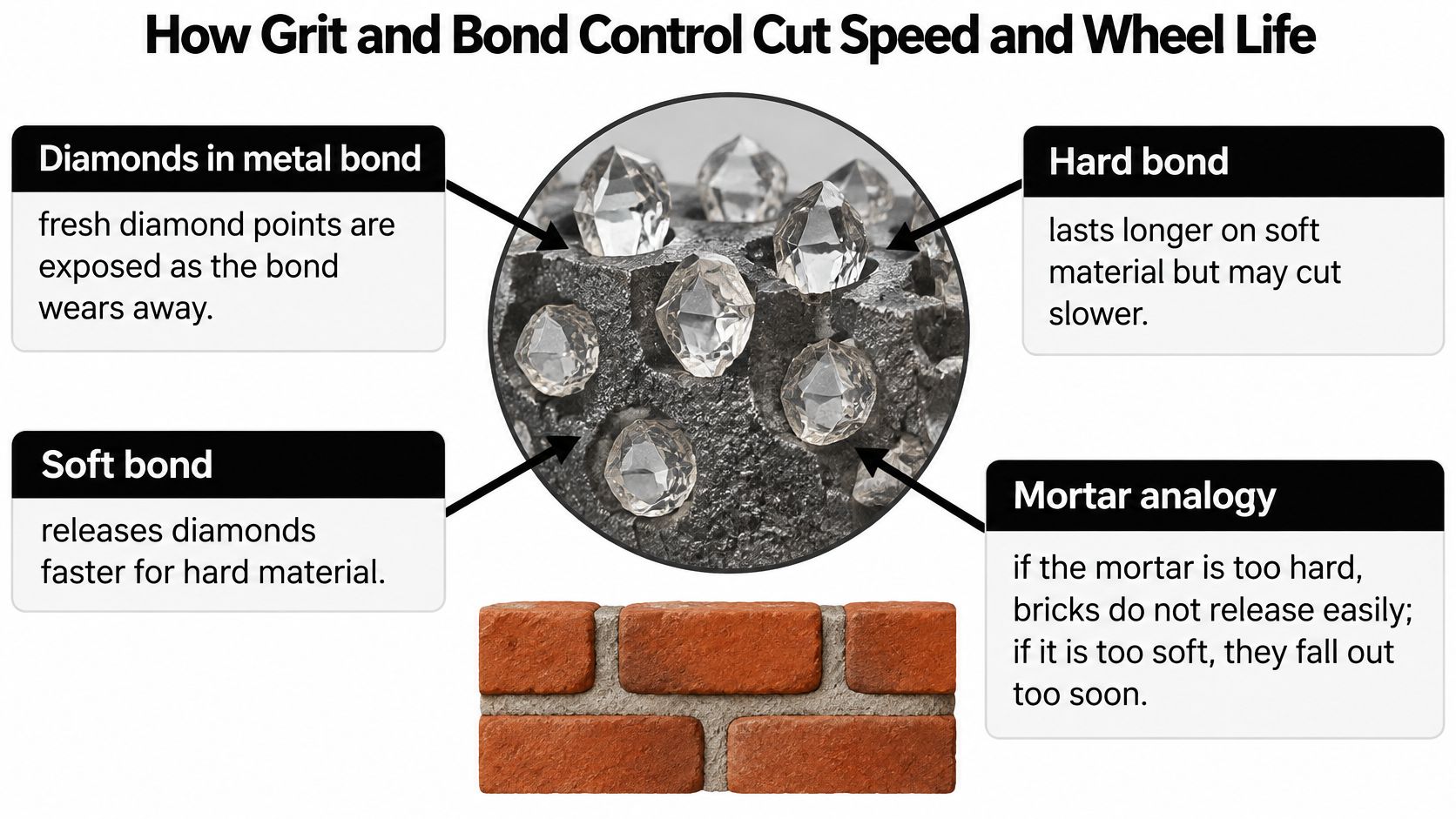
Grit size and concentration are different specifications
Coarser grit generally favors material removal, while finer grit favors surface finish and chip control. A tile installer needs the finish the wheel leaves behind, not merely the fastest plunge through the tile.
Diamond concentration describes how much diamond is incorporated into the cutting segment. More abrasive can improve useful cutting life, but concentration doesn't rescue an unsuitable bond or poor diamond retention.
The segment has to work as a system. A heavily loaded segment that won't expose fresh grit can rub instead of cutting; another that sheds diamonds prematurely can look aggressive while wearing away quickly.
Read the symptoms before adding pressure
- Slow cutting with a shiny rim: Glazing is possible. The bond may be too hard for the material, although operating technique and speed also need checking.
- Hot smell or increasing resistance: Stop and inspect. Don't treat overheating as a request for more feed pressure.
- Rapid segment-height loss: The bond may be too soft for an abrasive workpiece.
- Loose, cracked, or missing segments: This is damage, not ordinary self-sharpening. Remove the wheel from service.
Practical rule: Buy the application and bond first. A familiar brand name doesn't make the wrong matrix suitable.
Where bond and grit aren't printed clearly, use the manufacturer's application chart rather than guessing from packaging color. Diameter and arbor remain mandatory compatibility checks, but they aren't enough to select the cutting specification. A cured-concrete wheel isn't an automatic substitute for an asphalt, brick, or green-concrete wheel.
Choosing a Diamond Wheel for Tile, Stone and Concrete
A porcelain tile cut that chips at the edge, or a concrete wheel that wears down too quickly, often points to a mismatch between the material and the wheel design. Choose for the workpiece first. Hardness and abrasiveness differ: hard material can dull exposed diamonds, while abrasive material can wear away the bond that holds them.
The general selection rule is a softer bond for hard materials and a harder bond for softer, abrasive materials. Reinforced concrete adds another requirement: use a wheel with a core and rating suitable for reinforced cutting.
Wheel type and bond by material
| Material | Wheel type | Bond direction | Cutting note |
|---|---|---|---|
| Cured concrete | Segmented or turbo | Softer bond | Helps expose fresh diamond; avoid excessive feed pressure |
| Green (fresh) concrete | Segmented | Harder bond | Resists rapid erosion from soft, abrasive paste |
| Asphalt | Segmented | Harder bond | Abrasive and sticky; maintain debris clearance with an approved cutting method |
| Brick and block | Segmented or turbo | Medium bond starting point | Dry for short cuts with dust control, or wet where equipment permits |
| Porcelain and ceramic tile | Continuous rim | Fine grit, medium bond starting point | Prioritize chip control; wet cutting preferred |
| Natural stone (granite, marble) | Segmented or continuous rim | Medium to hard only when specified for that stone | Control speed and depth; hard stone may need a softer specification |
| Reinforced concrete | Reinforced steel core, segmented | Bond rated for impact | Use a wheel explicitly rated for reinforced cutting |
These are starting points, not universal bond recipes. Granite, marble, brick, and block vary, so follow the wheel maker's recommendation for the specific material.
Three mistakes that waste the purchase
Using a cured-concrete wheel on asphalt can wear down the segments before the wheel delivers useful production. The bond may not suit the abrasive substrate.
Cutting rebar with an unrated wheel puts the wheel into an application it was not designed for. Locate reinforcement where practical, then choose a wheel rated for reinforced cutting.
Using a segmented wheel on finished tile can save time on the cut and cost more in chipped pieces. For a reference on tiling equipment, see tiling equipment from Melbourne Tiling Services.
Compare cost per meter, not shelf price
Cost per meter cut equals wheel cost divided by usable cutting length. Compare wheels on the same material, cut depth, finish requirement, and cutting method. Otherwise, the result can mislead.
Record labor time and rejected pieces too. A low-priced wheel that stalls or chips finished edges can cost more than one suited to the application.
For a remodel involving tile, block, and cured concrete, carry separate wheels for finish cuts and masonry rather than forcing one wheel through every material. Note the material before buying.
Wet Cutting or Dry Cutting for Your Job
Choose wet cutting for tile, stone, and sustained cuts; choose dry cutting for short masonry cuts only when the wheel, tool, and dust-control setup allow it. Water cools the cutting zone, carries slurry away, and suppresses airborne dust, but it also creates cleanup and electrical-safety responsibilities.
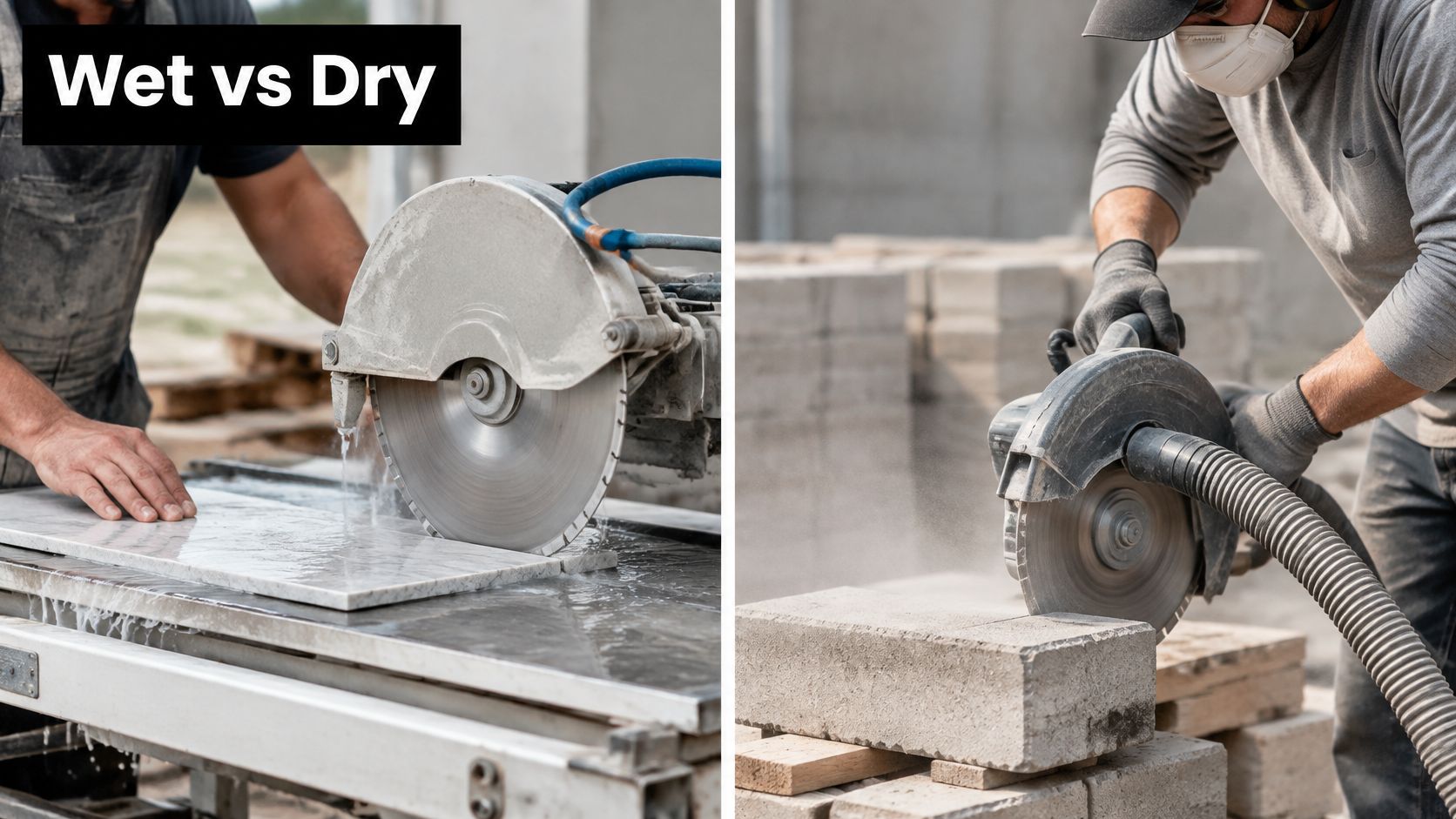
Wet cutting versus dry cutting at a glance
| Factor | Wet cutting | Dry cutting |
|---|---|---|
| Best materials | Tile, stone, long cuts | Short cuts on concrete and brick |
| Heat control | Water cools segments | Heat builds fast; use cooling intervals |
| Dust | Suppresses respirable dust | Needs effective extraction and task-appropriate respiratory protection |
| Edge quality | Often cleaner with less chipping | Greater chipping risk on finish materials |
| Setup | Wet saw or approved water feed, slurry cleanup | Portable grinder or handheld saw with dust controls |
| Wheel life | Cooling and slurry removal can improve life | Forcing the cut accelerates wear |
Water helps, but the equipment must support it
A homeowner completing a tile installation usually benefits from a matched wet saw and continuous rim wheel. A concrete flatwork contractor making sustained cuts has a similar reason to prioritize cooling, although the saw and wheel specification will differ.
Use only equipment designed for water delivery, with appropriate electrical protection and connections kept out of the wet area. Don't improvise a hose attachment on a dry-only electric grinder.
In granitic-rock experiments, specific wear increased with peripheral and traverse speed but decreased with greater coolant flow, according to the Rock Mechanics and Rock Engineering study. Cutting depth doesn't affect every material identically, so avoid treating deeper cuts as automatically better or worse.
Dry cutting needs a heat and dust plan
Make controlled, intermittent passes instead of forcing the wheel through its full capacity. For portable saw selection, our dry cut-off saw guide helps distinguish the tool setup from the wheel specification.
During Sacramento and Central Valley summer heat, schedule demanding work earlier where practical, take recovery breaks, and keep batteries out of direct sun. A hot battery and a hot operator are separate problems from blade cooling.
Concrete and masonry cutting also require a silica-control plan consistent with applicable Cal/OSHA requirements. Use the specified water-delivery or local-exhaust system, and provide properly fitted respiratory protection when the task requires it; a respirator alone isn't a substitute for source control.
If you can't manage the dust dry or the slurry wet, change the setup before cutting.
Safe RPM Limits and Diamond Blade Care
A wheel rated for a lower maximum RPM can fail on a faster tool, even if you plan to cut gently. Check the wheel's marked limit against the tool's maximum no-load speed before fitting it.
The table below is a hypothetical illustration of how example speed limits might vary with blade diameter. It is not a specification for any wheel; use the rating printed on the wheel and follow its manufacturer's instructions.
Hypothetical RPM illustration by blade diameter
| Blade diameter | Example maximum RPM | Example operating RPM |
|---|---|---|
| 12 in | 4,500 RPM | 2,900 RPM |
| 14 in | 3,900 RPM | 2,900 RPM |
| 16 in | 3,400 RPM | 2,600 RPM |
OSHA's abrasive-wheel definitions and requirements cover diamond and reinforced wheels. A masonry label does not remove the need to follow applicable abrasive-wheel safety requirements.
Follow a repeatable cutting procedure
- Confirm compatibility. Check the application, diameter, arbor, rotation direction, and marked maximum RPM against the tool.
- Fit the guard and protective equipment. Use eye and hearing protection, suitable clothing, and the respiratory protection required by the dust-control plan.
- Let the wheel reach speed before contact. Stand clear of its plane. Stop if the tool vibrates or runs abnormally.
- Feed steadily without side loading. Keep the cut aligned. Twisting the wheel to correct a wandering kerf can damage it.
- Stop before inspecting. Wait for the wheel to stop completely, isolate the power source, and let hot components cool.
Heavy pressure adds heat and mechanical load. If cutting slows, forcing the wheel or twisting the tool can make the problem worse. Our angle grinder accident-prevention guide covers safe handling before you fit a cutting accessory. A comfortable auxiliary handle and balanced grip help with control, but do not replace the guard.
Inspect the wheel, flange, and arbor
Store wheels dry and protect them from impacts and bending. Before use, check for cracks, a distorted core, damaged mounting holes, or loose or bent segments. Discard a damaged wheel rather than trying to straighten it.
The arbor and mounting flanges must match the wheel's specifications. Do not force a stone-saw blade onto a grinder or use improvised mounting hardware.
Value Tools Co does not provide professional installation, engineering advice, or safety certification unless explicitly stated. Confirm suitability using the wheel manufacturer's markings and documentation. A tool powering on does not confirm that the wheel is compatible.
Who Should Avoid Diamond Wheels and What to Use Instead
Don't run a diamond wheel if you can't fit the guard, confirm its speed rating, or provide the required dust protection. Borrowing a more powerful cordless grinder won't correct an incompatible accessory or an unsafe work area.
Choose an alternative when the setup is wrong
- Enclosed dry-cutting work: Move to a controlled cutting area or arrange an approved extraction or wet-cutting setup. Don't accept a room full of dust as unavoidable.
- Precision glass or gem work: Use a purpose-built diamond saw with the appropriate fine abrasive, work support, and controlled feed.
- Occasional tile work: Price a wet-saw rental before buying a saw and a collection of wheels. A manual tile cutter may suit straight score-and-snap cuts.
- Wood cutting: Use the appropriate woodworking saw and blade, not a masonry diamond wheel.
- Metal cutting: Choose a metal-rated cut-off wheel, saw blade, or specialty diamond product explicitly approved for that metal.
- Fiber cement: Use a dedicated fiber-cement cutting system with the specified blade and dust controls.
For oversized tile, support and cutter capacity matter as much as the blade quality. Large-format tile cutting advice for renovators, from Tiles Mate Pty Ltd, helps frame that equipment decision before you buy a grinder accessory.
A cordless tool hunt isn't a substitute for a rated wheel. If the correct accessory won't fit the tool safely, change the tool rather than modifying the wheel or removing the guard.
Frequently Asked Questions About Diamond Cutting Wheels
What is a diamond cutting wheel used for?
A diamond cutting wheel grinds through approved materials such as tile, stone, brick, block, and concrete on a compatible grinder or masonry saw. Use the rim-design comparison to narrow the choice, then check the specific material rating.
Can a diamond cutting wheel be used wet or dry?
Only if its manufacturer approves that cutting method. Wet cutting generally suits tile and stone, while dry cutting requires heat management and effective dust control; the wet-versus-dry cutting guide outlines the practical trade-offs.
What RPM should a diamond blade run at?
Use the manufacturer's recommended operating speed and never exceed the wheel's marked maximum. Don't apply a large masonry-saw blade's speed recommendation to a small grinder wheel because both contain diamond abrasive.
Is a segmented or continuous rim wheel better for tile?
A tile-rated continuous rim wheel is generally better for visible edges because it reduces chipping. Finish also depends on grit and bond selection, workpiece support, and controlled feed.
Can a diamond wheel cut rebar?
Only use a wheel explicitly rated for reinforced-concrete cutting when rebar is present. Confirm the required core construction and application rating; an ordinary masonry label isn't sufficient approval.
Who This Is For and the Buying Checklist
The right wheel depends on the cut you need and the tool you own. Flatwork contractors should match wheel design to the material and job, while remodelers and tile installers should prioritize a wheel suited to the required edge finish. Homeowners handling patio or small masonry repairs need a compatible wheel and a practical dust-control setup. Property managers and handymen can keep a small, clearly labeled selection for masonry and finish tile rather than relying on an unmarked general-purpose disc.

Make the buying decision in order
- Identify the material. Note its condition, the finish required, and whether reinforcement may be present.
- Choose the rim. Decide whether edge quality, production cutting, or mixed-use convenience matters most.
- Confirm bond and grit. Use the application chart if the specification is unclear.
- Check maximum RPM. The wheel's marked limit must accommodate the tool's maximum available speed.
- Confirm diameter and arbor fit. Check guard clearance and approved mounting hardware.
- Check operating approval. Confirm the wheel is approved for wet or dry use and, where relevant, reinforced concrete.
- Compare cost per meter. Use comparable job records or application-specific reviews rather than unsupported wheel-life claims.
- Plan dust and heat control. Account for water or extraction, cleanup, and operator access.
Before cutting, check the wheel, guard, and arbor fit together. The right-angle grinder buying guide can help you match the power tool to the job.
If the work extends beyond trimming to concrete placement or structural tasks, assess the scope before buying cutting equipment. Browse concrete and masonry services to help distinguish a small repair from work suited to a specialist.
Lower tool cost without lowering compatibility standards
Value Tools Co is an online tool shop based in Elk Grove, California, selling power tools from DeWalt, Husky, Milwaukee, Makita, Ridgid, and Ryobi. Its products include tested and inspected open-box and lightly used items, with discounts up to 55% off retail price. Every item is inspected and tested before listing.
The 30-Day Peace of Mind Guarantee applies to tested and inspected products. It does not replace checking accessory ratings or the manufacturer's warranty terms.
A bare tool, or herramienta sola, can be a practical choice if you already own compatible batteries and a charger. Whether a grinder is brushless, or sin escobillas, does not determine which cutting wheel it can safely accept.
The wheel's markings determine compatibility. Call 916 201 4365 with questions before buying, and note the material, wheel type, and RPM requirement on your job list.
Visit Value Tools Co to compare tools for your concrete, masonry, or tile-cutting setup. Have the material, required wheel diameter, arbor specification, and tool speed ready so you can choose suitable equipment without spending more than the job requires.


