

On a Sacramento remodel, concrete dust doesn't wait for cleanup. It rolls under doors, coats finished surfaces, and hangs around the grinder operator long after the wheel stops. A properly matched angle grinder dust shroud captures dust at the wheel, but the attachment alone isn't enough. The grinder, shroud, hose, extractor, and filter have to work as one system.
For most indoor mortar removal, thinset grinding, slab preparation, and masonry cutting, buy the shroud around the job rather than buying the cheapest universal collar. Match the guard to the grinder, size the extractor from the wheel diameter, and use high-efficiency filtration. The numbers below are practical buying specifications, not decoration.
What an Angle Grinder Dust Shroud Actually Does
On a hot Central Valley afternoon, an unshrouded grinder can turn a small mortar repair into a gray cloud before the operator finishes a single joint. Concrete, mortar, tile adhesive, and masonry contain materials that can generate respirable crystalline silica when the wheel abrades them. A respirator matters, but it doesn't keep settled dust off the floor, protect nearby workers, or stop contamination from moving through a Sacramento house.
A dust shroud is an engineering control. It forms a sealed or semi-sealed enclosure around the wheel, then connects to a vacuum hose so the extractor pulls dust away at the point where the wheel meets the work. That source capture is different from sweeping after the job or placing a shop vacuum somewhere in the room.
Why a shop vacuum alone falls short
A basic shop vacuum may move air, but it doesn't automatically seal the grinder interface or filter respirable particles effectively. If the shroud leaks, the hose is too restrictive, or the filter loads with fine dust, airflow at the wheel drops and dust escapes even though the attachment remains physically installed.
OSHA specifies a commercially available shroud matched to the grinder and wheel, connected to a dust collector providing at least 25 cubic feet per minute, or cfm, per inch of wheel diameter. It also calls for filtration rated at 99% or greater efficiency for respirable particles, along with either a cyclonic pre-separator or an automatic or manual filter-cleaning mechanism. See the OSHA respirable crystalline silica standard before setting up production work.
Practical rule: A shroud without adequate airflow is a cover, not dust control.
The difference is obvious on a finished floor. With a close-fitting brush ring and a suitable extractor, visible dust drops sharply and cleanup becomes manageable. If you're comparing grinding methods for stone or tile, the Varun Marbles resource can also help with material-specific considerations, but the dust-control principle remains the same.
Before starting any grinder work, review the job hazards and guarding practices in Value Tools Co's guide to angle grinder accidents. The shroud helps control dust, but it doesn't replace the grinder's proper guard, eye protection, hearing protection, secure work positioning, or operator training.
Inside the Shroud and How Airflow Captures Dust
A useful shroud has four working parts. The housing surrounds the wheel, the brush ring or rubber skirt contacts the surface, the hose port connects to the extractor, and the mounting collar secures the assembly to a compatible grinder guard. Each part affects capture, but the seal at the wheel-work interface usually determines whether the system performs well.
Read the shroud before buying it
Start with the mounting collar. It should fit the grinder's guard shape and lock firmly enough that vibration won't rotate the shroud away from the work. A universal-fit collar can be convenient across several tools, but extra adjustment points and loose adapters create more opportunities for leaks.
The brush ring is designed for surface grinding on a relatively flat plane. Its bristles ride over small surface changes while allowing air and dust to move toward the hose port. A damaged, packed, or uneven brush ring leaves gaps around the wheel, and those gaps can become visible dust leaks.
An enclosed cutting guard works differently. It provides more coverage around the disc and can include depth adjustment, but it may limit access to edges, corners, and narrow joints. The right choice depends on whether the wheel needs to sit flat against a slab, reach a wall edge, or plunge into a controlled masonry cut.
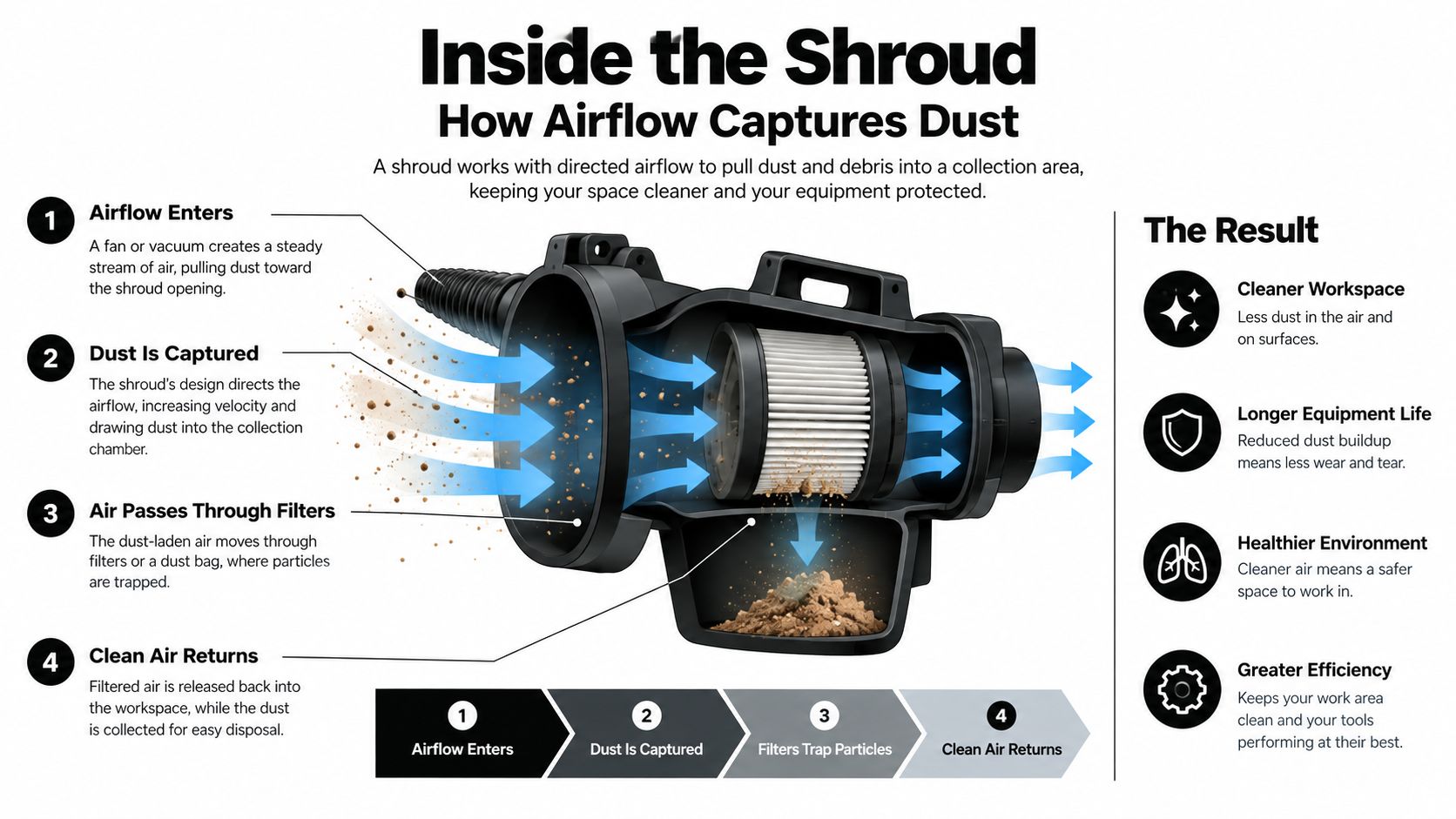
How negative pressure does the work
When the extractor runs, it creates lower pressure inside the shroud. Air enters around the brush ring or skirt, carries the dust away from the wheel, and travels through the hose to the collector. The vacuum isn't just removing dust after it becomes airborne. It is shaping the airflow at the source.
A tight, even contact surface matters more than whether the housing feels heavy or looks industrial. A shroud that seals well on a flat slab may perform poorly on an uneven mortar joint. For broader indoor air-quality practices after construction work, guidance on how to fix stale bedroom air provides useful context, although room ventilation doesn't replace source capture at the grinder.
OSHA and NIOSH Numbers That Matter on the Grind
The most useful buying rule is simple: allow at least 25 cfm for every inch of wheel diameter at the shroud. A 4-1/2-inch grinder requires at least 112.5 cfm, a 5-inch grinder requires at least 125 cfm, and a 7-inch grinder requires at least 175 cfm. Those figures come from OSHA's silica-control guidance.
| Wheel Diameter | Minimum cfm at Shroud | Typical Application |
|---|---|---|
| 4-1/2 inches | 112.5 cfm | Tile notches, small mortar joints, punch-list grinding |
| 5 inches | 125 cfm | Slab prep, surface grinding, general masonry work |
| 7 inches | 175 cfm | Larger concrete areas, heavy edge work, production grinding |
The rating on a vacuum box isn't the same as airflow at the wheel. A long hose, rough interior, sharp bend, loose adapter, clogged filter, or overloaded collector can reduce the effective flow where capture matters. For that reason, a vacuum advertised with a high peak-cfm figure may still perform poorly once connected to a restrictive setup.
What the NIOSH testing shows
Controlled evaluations demonstrate why matching matters. NIOSH reported that a local-exhaust-ventilation shroud connected to a vacuum reduced quartz and respirable-dust exposures by approximately 95% compared with uncontrolled block cutting, while commercially available grinder and shroud combinations reduced dust exposure by at least 90%. Those figures apply to configured systems, not a loose guard used without an extractor. The findings are documented in the NIOSH dust-control evaluation.
A CPWR controlled evaluation of mortar grinding found that an uncontrolled grinder produced respirable-silica exposure about 145 times the NIOSH recommended exposure limit of 0.05 mg/m³. With a shroud and dust collector, average exposure fell by approximately 98.7%. This is why a shroud that isn't paired with the correct airflow and filtration can create false confidence.
California jobsite expectations
California contractors still need to follow applicable Cal/OSHA requirements and the silica-control method appropriate to the work. The same engineering-control logic applies on a Central Valley residential remodel, a Sacramento commercial repair, or a small masonry punch list. Keep the shroud close to the surface, preserve airflow under load, and don't treat the vacuum's maximum number as proof of capture at the wheel.
Matching Shroud Geometry to the Cut You Are Making
A shroud that works beautifully for slab grinding can be the wrong attachment for wall chasing. The wheel's path, the surface shape, and the access required at the edge should determine the design.
| Work Type | Suitable Shroud Style | What to Look For |
|---|---|---|
| Slab or countertop surface grinding | Brush-ring surface shroud | Even contact on a flat plane and a replaceable brush ring |
| Wall chasing or tuckpointing | Narrow open-bottom design | Access to the joint while retaining contact around the working area |
| Rebar or scored masonry cutting | Enclosed or full-cover cutting guard | Depth adjustment, compatible disc size, and strong coverage |
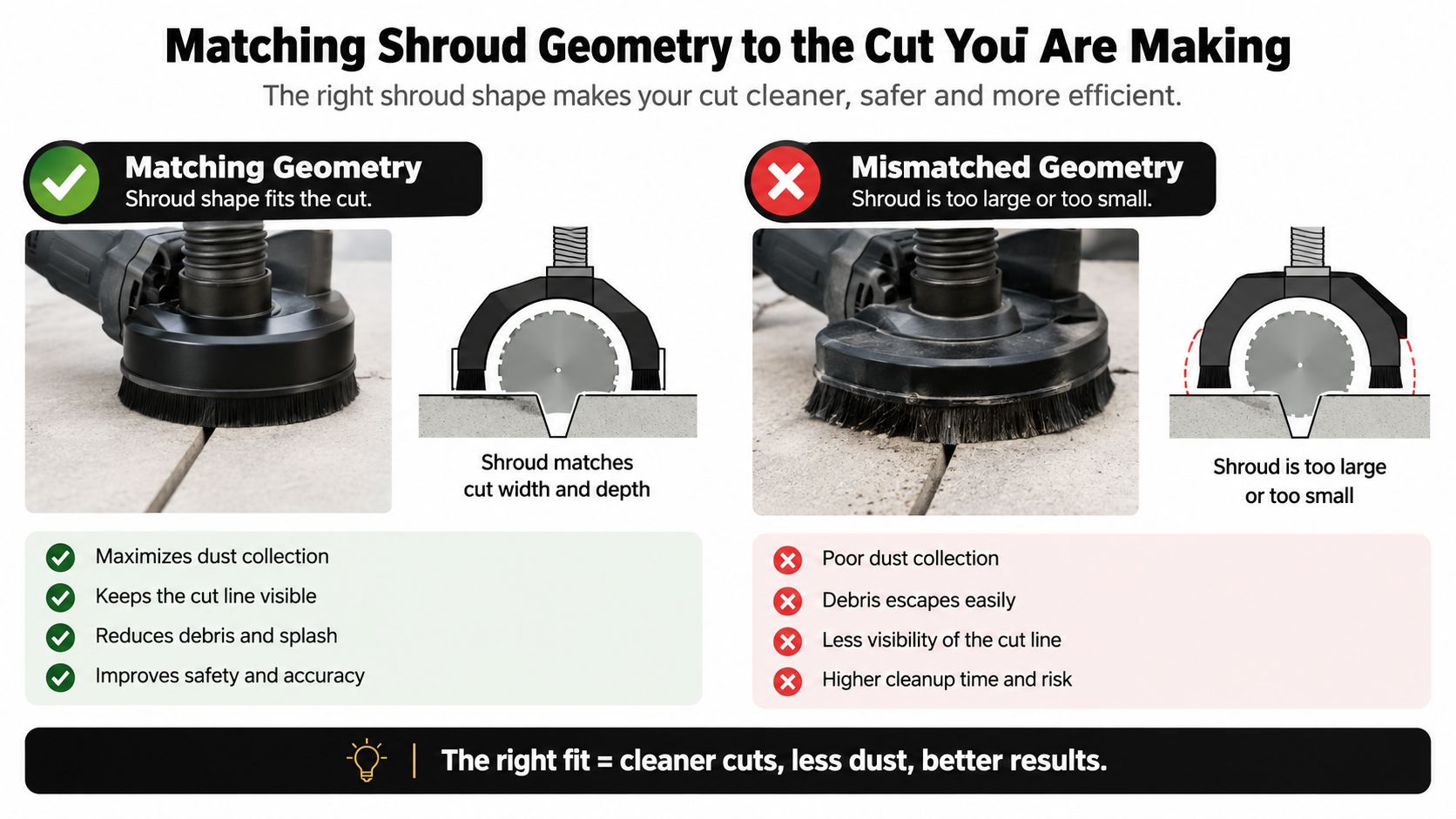
Surface grinding and flush access
A brush-ring shroud is the practical choice for removing mortar ridges, grinding thinset from a slab, or flattening a small concrete repair. The skirt follows the surface while the extractor pulls dust underneath the housing. On countertops and finished areas, the brush also helps keep debris from spreading across the work.
For flush grinding along a wall, Bosch's 5-inch surface-grinder shroud uses a rotating opening point that lets the disc reach the edge. Bosch also describes a replaceable brush ring that helps contain dust under the shroud. That design is useful when a fixed housing would leave an unground strip along the perimeter.
Wall chasing and masonry cuts
Wall chasing requires access rather than maximum enclosure. A narrow, open-bottom shroud can let the wheel enter a mortar joint or chase while preserving contact around the cut. The trade-off is that exposed areas may leak more readily if the operator twists the grinder or lifts the skirt away from the wall.
For cutting applications, Bosch lists adjustable cutting depth and Easy Adjust and Full Cover guard styles. The referenced specifications include maximum depths of 20 mm with a 115-mm disc and 25 mm with a 125-mm disc, with a listed guard weight of 0.7 kg. Check the Bosch surface-grinder and cutting-shroud specifications against the grinder and disc you own.
A full-cover guard is a better fit for controlled masonry cuts and rebar work than a brush-only surface shroud. It adds bulk and can slow access, but that compromise is worthwhile when the cut needs depth control and more complete wheel coverage.
Installing and Pairing the Shroud With the Right Extractor
Set up the grinder, shroud, hose, and extractor at the bench before entering a finished room. Confirm the collar seats tightly, the hose matches the port, and the extractor can maintain suction once the brush ring contacts concrete.
A reliable installation sequence
- Confirm the grinder and guard. Match the shroud to the grinder model, guard profile, wheel diameter, and application. A 5-inch surface shroud will not automatically fit every grinder that accepts a 5-inch disc.
- Secure the collar. Attach it at the manufacturer-specified guard position. Tighten the fasteners against vibration, then move the shroud by hand. It should stay stable without rotating into the disc or restricting adjustment.
- Choose the hose by the port. NIOSH recommends a relatively smooth hose measuring 1 or 2 inches in diameter and no more than 15 feet long for compatible grinder and shroud systems. See NIOSH's grinder dust-control guidance. Keep the run short, sealed, and sized to the shroud port. A loose household-vacuum adapter can reduce capture even when the extractor sounds powerful.
Verify airflow under load
Start the extractor and check for pull at the shroud opening before grinding. Then press the brush ring lightly against the surface. A collapsing hose, weak pull, or dust escaping around the skirt signals a restriction, leak, or undersized extractor. Stop and correct it before putting the wheel into the concrete.
A cyclonic pre-separator keeps heavier debris out of the filter. Automatic filter cleaning helps preserve airflow as fine dust accumulates. A manual-shake filter can also work, provided the operator stops often enough to clean it.
Choose the extractor by airflow at the shroud, not only by the inlet rating. When comparing hose, port, and collector arrangements, match the port diameter and hose length against the NIOSH 1 or 2 inch, 15-foot guideline. Value Tools Co's guide to dust attachment vacuum selection can help compare those configurations before purchase, including open-box options when a new collector would strain the job budget.
Maintenance That Keeps Dust Where It Belongs
A Sacramento remodel can expose a shroud to concrete fines, mortar grit, vibration, and heat in the same shift. The system may look intact while the brush ring packs with dust and loses contact. Once that happens, the operator often sees the problem first as a dirty floor or a haze in the work area.
Inspect the capture path
Check the brush ring before each substantial grinding session. Replace it when bristles are frayed, flattened, or packed with hardened material. Inspect rubber skirts for cracks, and tighten the mounting collar if vibration has introduced movement around the guard.
Filter condition matters just as much. Empty the collector before it overfills, clean a manual filter according to the extractor's procedure, and replace a high-efficiency filter before suction drops noticeably. Fine silica dust can load filtration quickly, especially when the collector operates without a pre-separator.
Field check: If the shroud no longer stays lightly pulled to the surface, stop and find the airflow problem before grinding more material.
Don't put wet slurry into a dry dust extractor. Use the collection method appropriate to the process, and keep moisture away from equipment that isn't designed for wet pickup. Store the shroud so the brush ring isn't crushed under tools or bent against a sharp edge.
Heat changes the routine
Central Valley summer conditions can push jobsite temperatures above 100°F. That heat can shorten filter life and increase stress on a battery-powered extractor or grinder, so inspect airflow more often during hot work. Cordless tools also need sensible cooling intervals when grinding continuously.
A failed filter on a Wednesday can stop a small remodel. Same-day Elk Grove warehouse pickup makes it practical to replace filters or related accessories without waiting for the next shipment. For overhead dust that escaped before the control system was corrected, Arelli Cleaning's high-dusting service illustrates why settled construction dust can require specialized cleanup rather than a quick sweep.
For equipment selection and collection capacity, use Value Tools Co's guide to the best shop vac for dust collection.
Who Should Buy a Dust Shroud and Who Can Skip It
A dedicated shroud earns its place when grinding happens indoors, repeatedly, or near finished surfaces. Concrete and masonry contractors, tile setters, and remodelers removing mortar or thinset are the clearest buyers. Restoration crews, abatement workers, property managers handling punch lists, and serious DIYers renovating a kitchen or bathroom also benefit from capturing dust at the wheel.
A contractor cutting an occasional paver outdoors may not need a dedicated system for every task, provided the work method, respiratory protection, and applicable controls are appropriate. A hobbyist doing brief metalwork on a bench grinder is looking at a different hazard profile and may not benefit from a concrete-grinding shroud. The decision should follow the material, location, frequency, and cleanup risk.
Buyer fit by trade and use case
| Trade or Use Case | Recommended Setup | Shroud Worth Buying |
|---|---|---|
| Concrete or masonry contractor | Matched grinder, surface or cutting shroud, suitable extractor | Yes |
| Tile setter grinding installed thinset | Compatible surface shroud and high-efficiency extractor | Yes |
| Indoor remodeler | Grinder-specific shroud, sealed hose, filtered collector | Yes |
| Restoration or abatement work | Task-matched enclosure and compliant collection system | Yes |
| Property manager punch-list work | Compact grinder and shroud kit for recurring repairs | Usually |
| Occasional outdoor paver cutting | Appropriate outdoor control method and respiratory protection | Often not |
| Hobby metalwork | Metalworking guard and suitable local cleanup | Usually not |
Dedicated fit versus universal fit
A dedicated shroud generally offers better alignment, more predictable sealing, and fewer adapters. Its downside is limited compatibility. If your crew uses several grinder brands, buying a separate shroud for each tool can increase equipment cost.
Universal collars cost less to standardize across a mixed fleet, but they need careful adjustment. A loose collar, uneven skirt, or hose adapter that reduces airflow can erase the expected benefit. For a 4-1/2-inch grinder, the setup is easier to carry for small repairs. A 5-inch kit offers a larger working area for surface grinding, but it still needs the extractor capacity required by its wheel diameter.
Value Tools Co carries open-box and bare-tool inventory from brands such as DeWalt, Makita, Milwaukee, Ridgid, Ryobi, and Husky. Its 30-Day Peace of Mind Guarantee covers tested and inspected tools, 30-day returns by mail or in-store, and free return shipping on defective items. Open-box or bare-tool purchases can provide savings of up to 55%, which may leave room in the budget for the shroud, hose, and filter that make the grinder useful indoors.
Buying Tips and Final Recommendation
Buy the system in this order.
- Match the shroud: Confirm the grinder model, guard shape, disc diameter, and whether the work is surface grinding, wall chasing, or cutting.
- Size the extractor: Use OSHA's 25 cfm per inch of wheel diameter rule at the shroud, not just the vacuum inlet.
- Check filtration: Choose a filter rated at 99% or greater efficiency for respirable particles, with pre-separation or filter cleaning.
- Budget for wear parts: Include the hose, adapters, brush ring, rubber skirt, and replacement filters.
- Choose the power source: A cordless grinder works for short punch-list tasks, while continuous concrete grinding generally benefits from a corded grinder drawing at least 10 amps, as reflected in NIOSH's tested configuration.
For Sacramento and Central Valley contractors, compare the grinder, dust extractor, hose, and shroud as one capture system before you buy. A tight setup that matches the cut will do more than a bigger vacuum with the wrong collar or weak airflow. If you need a practical starting point, angle grinders is a useful reference for tool choice and fit. As noted earlier, the right combination of shroud geometry and extractor setup is what keeps dust moving away from the cut instead of back into the room.
If the job is mostly indoor grinding, spend the money where it counts, on the shroud, the hose, and the filter. Then choose the grinder that gives you the right balance of reach, power, and control for the work you do.


