

You've got a truck on jack stands, four lug nuts that a shop gun torqued last spring, and two wrenches within reach. One is corded and hanging off a reel near the garage outlet. The other is cordless with two bars of charge left in a pack that spent the night in the truck bed.
The marketing answer is easy. The useful answer has to survive the third rusted nut, a 104°F afternoon in Fresno, and the moment your helper asks where the extension cord went. Neither format wins outright. The wrench that fits is the one matched to where it spends its hours, how many fasteners it drives per shift, and what the cord or the pack costs you across five years rather than on the day you buy it.
Corded or Cordless Impact Wrench at a Glance
A corded impact wrench suits a fixed shop, bench or service bay where a grounded outlet sits within reach and the work cannot pause for a battery swap. A cordless impact wrench suits mobile work, where moving fast and working away from an outlet matters more than unlimited runtime.
Both are impact wrenches (llave de impacto on most California crews), a different tool from an impact driver (atornillador de impacto). The distinction is practical. An impact wrench delivers far more rotational force, which is what frees a seized lug nut or an axle nut, while an impact driver is built for screws and smaller fasteners. Buy the wrench for fasteners that fight back.
Power source is the whole argument. A corded model pulls continuous mains power through a cord, so runtime ends only when the outlet dies. A cordless model runs on a battery pack rated in amp-hours, which sets how much charge it carries, not how much torque it makes. A plug on the wall also does not guarantee more usable torque at the socket. The main split is logistics: where power comes from, how heat is handled, and what the cord or packs cost across years of use.
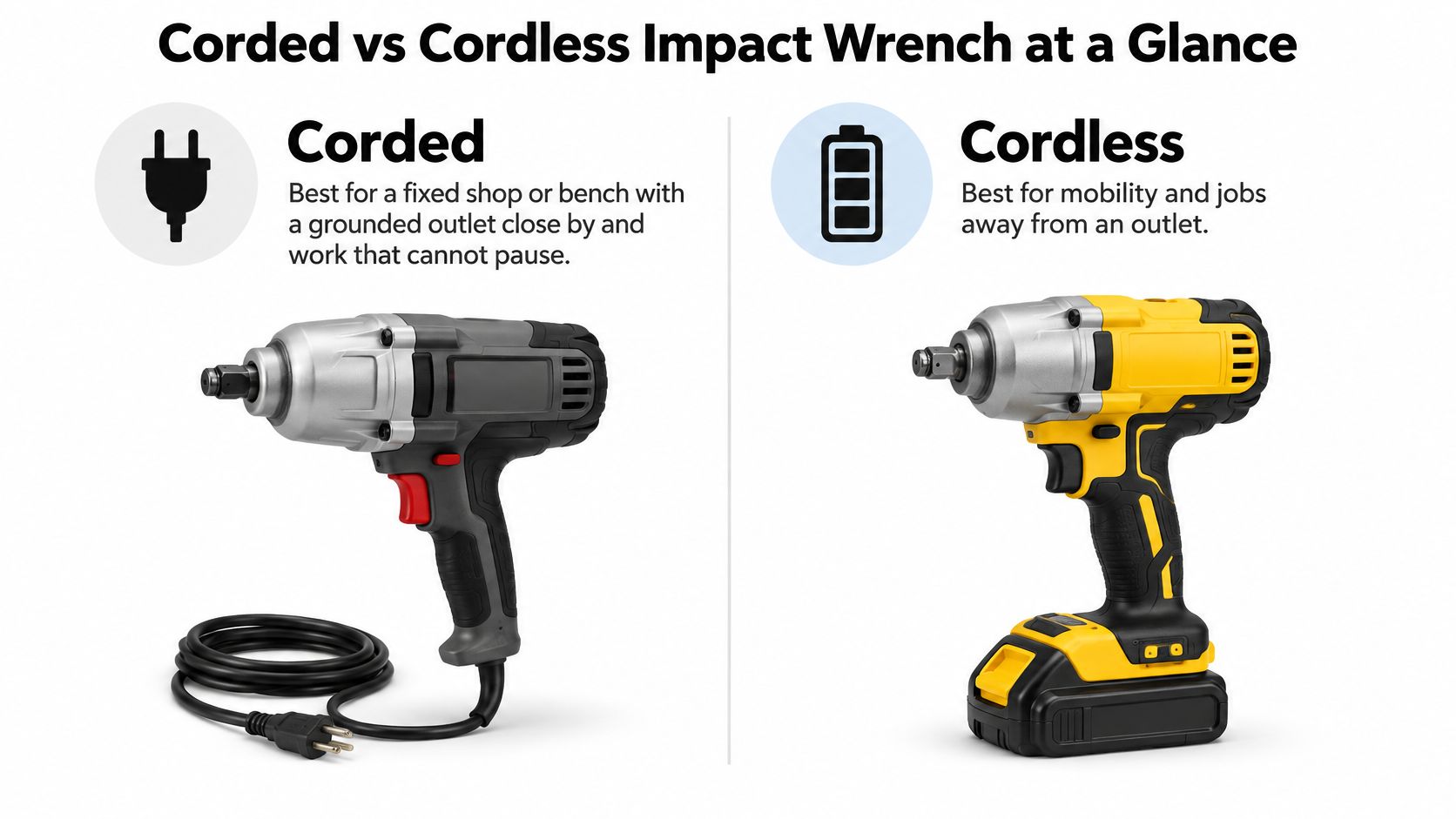
The table below carries the rest of the comparison. Read it as a map of where the wrench will spend its day, not as a spec sheet.
| Factor | Corded | Cordless |
|---|---|---|
| Power source | Continuous mains power through a cord | Battery pack rated in amp-hours |
| Runtime | Unlimited while the outlet is live | Set by pack capacity, heat, battery age and fastener count |
| Mobility | Tied to outlet and cord length | Works anywhere a charged pack goes |
| Setup | Route the cord and confirm a grounded outlet | Charge or swap a pack |
| Main weakness | Cord trip hazard and voltage drop on long runs | Battery heat and charging downtime |
| Best fit | Fixed shop with repeated fastening | Roadside, rooftop, vehicle and job-site work |
Cordless stopped being the compromise format years ago. Modern lithium-ion packs made high-output battery wrenches practical, and the choice now turns on duty cycle, temperature, access to power and ownership cost rather than on a simple corded-equals-strong assumption.
The fastest way to decide is to write down the three places you used a wrench most in the last month. If two of those three answers involve an outlet within twenty feet, buy corded and stop paying for batteries. If the work moves, the pack usually earns its keep.
How Torque Ratings Compare Between Corded and Cordless Models
The number printed on the box is almost always a manufacturer's claimed peak, measured however the brand chose to measure it. That makes 1,000 ft-lb on one box and 900 ft-lb on another close to meaningless side by side, and it's the reason cross-shopping a corded model against a cordless one on paper goes wrong so often. Our impact wrench torque guide breaks down how those advertised figures get built. What matters on a jobsite is how they're measured against a real fastener.
Independent testing shows the gap. Pro Tool Reviews runs an Inertia Torque L1000 tester, applies three five-second maximum-power bursts separated by three-second cooling intervals, and reports the highest measured torque instead of the claimed peak. In one benchmark, a premium cordless Makita 40V XGT model produced 502.3 ft-lb, and a Metabo HPT 36V model reached 441.2 ft-lb.
That's substantial measured output from a battery tool. It still doesn't prove continuous-duty equivalence with a corded wrench, because three bursts with cooling intervals is not the same duty cycle as forty fasteners in a row.
What the number actually tells you: a claimed peak describes the best single moment the tool produced on the brand's own bench. It says nothing about what it holds on the tenth lug nut of a shift.
Fastening torque and nut-busting torque are not the same number
Two figures get quoted constantly and routinely get confused. Fastening torque is the force used to drive and tighten a fastener. Nut-busting torque (sometimes called breakaway torque) is the force used to break a rusted or overtightened fastener loose, and it's always the bigger number.
A wrench advertising 1,500 ft-lb of nut-busting torque is not tightening anything to 1,500 ft-lb. If a listing only shows one number, check which one before you compare it with anything else.
Cordless has also moved into territory that used to require air. Industrial coverage has cited an 18-volt, half-inch cordless impact wrench rated at 450 foot-pounds as the kind of tool that took over work previously dominated by pneumatic equipment, per The Fabricator's reporting on cordless hand tools. That's not a marketing claim. It's what a half-inch gun needs for most passenger-vehicle work.
A three-step way to compare a torque claim honestly
- Identify which figure the listing uses. Fastening torque and nut-busting torque are different measurements, and mixing them produces a comparison that means nothing.
- Ask what the job involves. Intermittent fastening on vehicles and equipment is cordless territory. Sustained production fastening in one spot is where a cord earns its keep.
- Finish critical joints with a calibrated torque wrench. An impact gun drives and removes fasteners. It doesn't verify torque, and no impact wrench should be your final word on a wheel, a suspension bolt or a structural connection.
Compare tested results produced by the same method, and treat every manufacturer number as a starting point until it's been measured. Choose corded or pneumatic when repeatability across hundreds of fasteners matters more than moving the tool.
Battery Runtime and Summer Heat Limits for Cordless Wrenches
Voltage tells you what a pack can push. Amp-hours tell you how long it can push it. An 18V 3Ah pack holds roughly twice the stored charge of an 18V 1.5Ah pack under comparable conditions, so the bigger pack mainly buys you a longer shift. Across tested 1/2-inch cordless models, fastening torque spans roughly 300 to 1,100 ft-lb, with bare weights around 2.47 lb and up to about 6.1 lb depending on the model and whether the battery is counted, based on Bob Vila's cordless impact wrench testing overview.
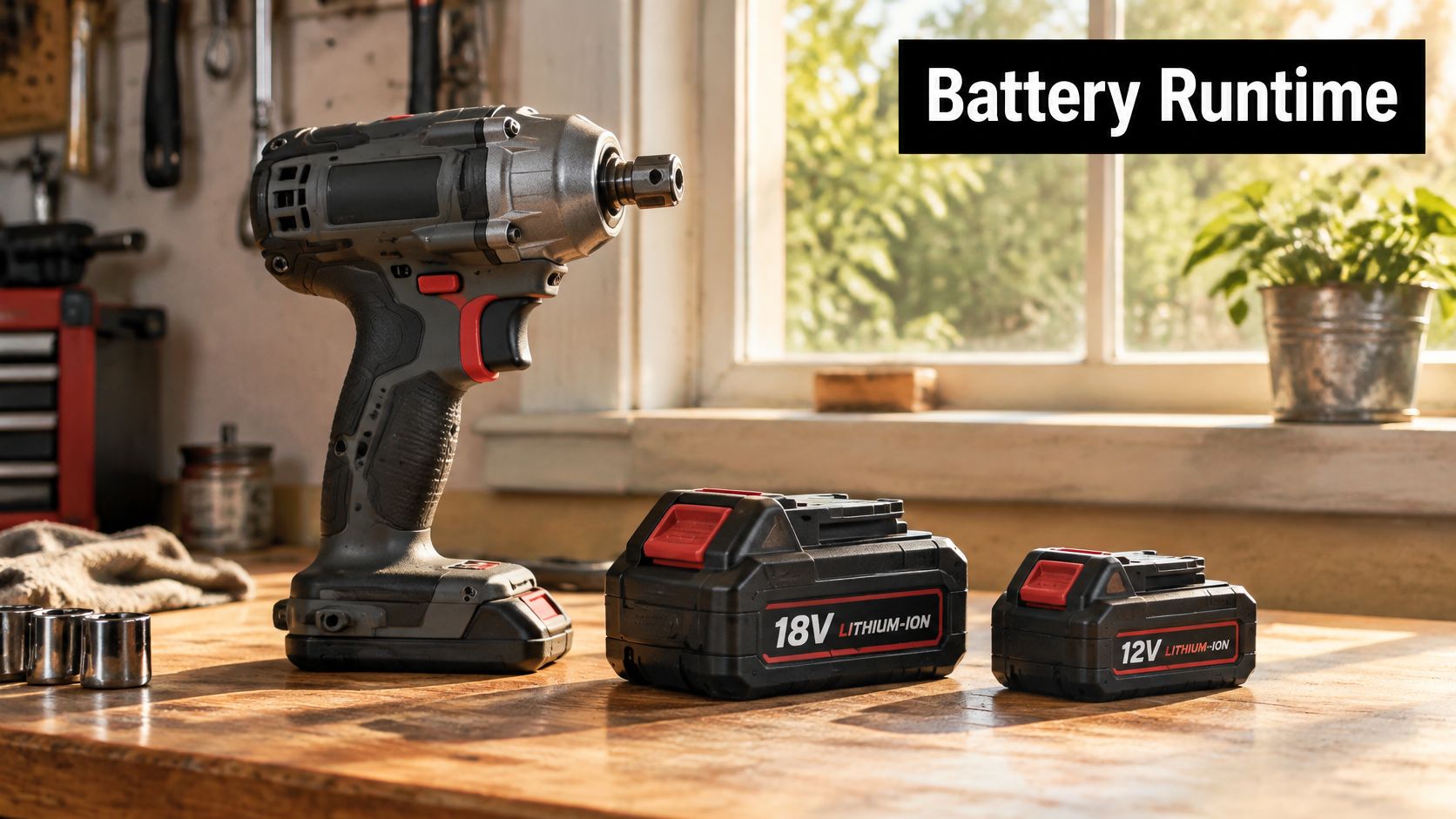
Several things eat that runtime, and only one of them is the pack:
- Fastener size and torque mode. Lug nuts in a high-torque setting drain a pack far faster than trim bolts in a low mode.
- Material and corrosion. Rusted hardware takes longer to break loose, and time under load is what empties a battery.
- Ambient temperature. A pack in a hot truck bed starts behind where a pack stored in shade starts.
- Battery age. Capacity fades over years of charge cycles, so a three-year-old pack behaves like a smaller new one.
- Voltage sag near depletion. As the pack approaches empty, voltage drop reduces fastening torque, which is when a stubborn nut suddenly stops cooperating.
Heat is the runtime variable most buyers never price in.
On a summer day above 100°F, a pack left in direct sun or a closed toolbox can reach its charging limit before you ever connect it. New York's lithium-ion battery safety guidance says batteries shouldn't be charged below 32°F or above 105°F (New York Division of Homeland Security lithium battery guide). Charging a pack while it is still hot can push it past its temperature rating and cause failure, so a hot or fully drained battery needs time to cool before it goes on the charger. Every pack killed early by heat is a replacement cost, and over five years of ownership that cost belongs in the cordless column of the comparison.
A workable summer routine looks like this:
- Keep spare packs shaded. A towel over an open crate beats a sealed toolbox sitting in the sun.
- Cool a hot pack before charging. Indoors or in an air-conditioned vehicle cab, not on the tailgate.
- Charge only on the manufacturer-approved charger. No shop-built adapters, no mystery chargers from a clearance bin.
- Wait after a full discharge. Let the pack come down to room temperature before it goes back on the charger.
Brushless (sin escobillas) motors waste less energy as heat than older brushed designs, so they stretch both runtime and pack life on long shifts. Our guide to cordless tool battery storage covers the storage side in more depth.
Buying a bare tool (herramienta sola) only makes sense when compatible packs, shade and a real charging plan already exist. Otherwise the money saved on the tool goes straight into packs, a charger, and the replacements heat will demand.
Extension Cord Setup and Grounding for Corded Impact Wrenches
Extension cord choice changes both the power that reaches the wrench and how safe the setup is. Find the wrench's current draw on its label, or calculate it. Amps equal watts divided by volts, so a wrench pulling 7.5 amps on a 120-volt circuit is drawing about 900 watts. That label number, not the motor's physical size, is what the cord has to carry.
A long or undersized cord behaves like a resistor in series with the tool. Voltage at the wrench drops, the motor works harder to compensate, and the conductor heats up. On a long enough run, that heat can start a fire on a cord the building breaker never notices, because the breaker is protecting the circuit, not the cord.
Grounding is the other half. OSHA's guidance on flexible cords in construction requires three-wire extension cords so connected tools can be grounded, and requires exposed non-current-carrying metal parts of cord-and-plug equipment to be grounded unless a listed exception such as approved double insulation applies. A corded impact wrench in a wet bay or on a damp slab is exactly the situation that rule exists for.
The setup routine that keeps a corded wrench honest:
- Read the amp draw off the tool's data plate before you grab a cord.
- Match the gauge to the load and the run length. Long runs need heavier gauge, which is why matching a 100 ft 10-gauge extension cord to the load beats grabbing whatever is coiled on the wall.
- Inspect the plug, ground pin and jacket before every use, and pull damaged cords out of service immediately.
- Keep the cord clear of oil, heat, sharp edges, wet areas and moving parts, and run it overhead or along a wall rather than across a walkway.
A corded wrench belongs in a garage, shop or service bay with a properly grounded outlet near the work. Cordless removes the cord entirely from roadside repairs, equipment yards and unfinished structures. Treat the cord as part of the tool system rather than an accessory, because it appears on the cost worksheet right next to the tool itself.
Five-Year Cost of Each Setup Beyond the Purchase Price
Purchase price is the wrong number to compare. What matters is what each setup costs across five years of work, and the two formats spend money in different places. One pays up front for batteries and chargers. The other pays in minutes lost to cords, outlets and routing.
| Cost item | Corded setup | Cordless setup |
|---|---|---|
| Tool purchase | Tool price | Bare tool or kit price, plus charger if needed |
| Spare batteries | Not needed | One spare per wrench slot; pack price times spare count |
| Charger | Not needed | One per battery platform; bundled in most kits, extra with a bare tool |
| Extension cords | Heavy-gauge cords sized to the run | Not needed |
| Battery replacement | Not needed | Pack price times packs in use, divided by the years a pack holds capacity |
| Electricity | Per-use power cost | Per-charge power cost |
| Downtime | Cord routing and outlet hunting | Charging and pack-swap delays |
Cordless is not automatically the cheaper side of that table. Spare packs and chargers add real money, capacity fades whether or not the tool gets used, and a pack that quits mid-job costs you the job. Battery ownership carries a storage and disposal cost too. A damaged, overheated or improperly discarded lithium-ion pack can start a fire, which is why inspection, cool dry storage, careful transport and proper recycling belong in the budget rather than the footnotes.
Why the corded side isn't automatically cheaper either
Corded ownership has its own quiet costs. Crews lose minutes routing cords around vehicles, hunting for a live outlet in an older building, and stopping work entirely where the power is unreliable or the run needs a heavier cord than anyone brought.
Those minutes have a dollar value, yet they rarely appear on a purchase worksheet. The same math prices delays on both formats. Say a two-person crew loses 12 minutes a shift to pack swaps and charging. At $45 an hour, that is $9 a shift and $45 in a five-day week, a number you can hold up against the price of a second battery.
Open-box buying and the five-year number
Value Tools Co sells top-brand power tools, accessories and hardware at up to 55% off retail price, which changes the math on the purchase line of the worksheet considerably. It does not change the lines below it. A discounted pack still ages on the same schedule, still needs a compatible charger, and still gets replaced at the same interval as a full-price one, so the savings live in year one rather than across all five.
To run the comparison on your own fleet:
- List every cost line for both setups, including cords on the corded side and packs plus chargers on the cordless side.
- Price your downtime. Minutes lost per shift, divided by 60, times the crew's hourly rate, times shifts per year.
- Convert to cost per job. Divide the five-year total by the number of jobs you run annually, and compare that figure instead of the sticker.
Small crews and property managers running three or four wrenches get the most out of that exercise, because the worksheet reveals which format costs less for their work pattern rather than somebody else's.
Answers to Common Corded and Cordless Impact Wrench Questions
Is a corded impact wrench more powerful than a cordless one? Not automatically. Tested cordless models reach nut-busting torque that covers most automotive and maintenance fasteners, and the corded advantage is steady output while the outlet is live rather than a bigger peak number. Compare measured results produced by the same test method before assuming the cord is the stronger option.
Can a standard extension cord run a corded impact wrench? Only if the gauge matches the wrench's amp draw and the run stays short. OSHA's electrical safety guidance explains that an undersized or excessively long cord creates voltage drop that can damage equipment, and that overloading a cord can heat the conductor enough to start a fire even when the building breaker doesn't trip (OSHA electrical safety guidance).
How long does a cordless battery last under a wrench? One pack doesn't map to a fixed number of fasteners. Runtime depends on amp-hour rating, torque mode, fastener size, ambient temperature and battery age, so the honest answer comes from counting fasteners per pack on your own job with your own sockets.
Is a bare tool a good buy? Only when you already own compatible packs, a charger and a plan for keeping them cool in summer. Verify battery age, physical damage, charger compatibility and return terms before counting an open-box discount as savings.
Which Wrench Fits Your Job and Who Should Avoid Each
Match the wrench to the work and the argument mostly settles itself. Corded does not automatically mean high power. Car and Driver's cordless impact wrench testing ran battery-powered wrenches against severely rusted axle nuts, and tested high-torque models reached roughly 1,100 to 1,500 lb-ft of nut-busting torque. On many automotive fasteners, cordless output already exceeds what the job requires.
| Job | Better choice | Reason |
|---|---|---|
| Lug nuts and wheel service in a driveway | Cordless | No cord running across the work area |
| Rusted axle nuts or suspension bolts | Either, test first | Cordless models already reach nut-busting ranges on many fasteners |
| Repeated structural or industrial fasteners in a fixed shop | Corded | Continuous output with no pack swaps |
| Rooftop, scaffold or elevated work | Cordless | No cord to haul up and secure |
| Remote or unfinished structures | Cordless | No reliable outlet nearby |
| Production bench with protected outlets | Corded | Consistent output across long runs |
| Mixed-site contractor crew | Cordless with spare packs | Moves between sites without stopping for power |
Who This Is For
A roadside call at midnight and a fab shop running identical flange bolts all shift are different jobs with different right answers. Cordless suits mobile contractors, framers, roadside mechanics, property managers and on-site handymen who move between locations and cannot count on an outlet. It buys fast repositioning, zero cord setup and reach into tight engine bays. It costs charging downtime, battery heat on long runs and the price of spare packs.
Corded suits bench mechanics and fabrication shops with protected outlets and a fixed work position. It runs a full shift without a swap and never adds a battery to the inventory. The trade is cord management, voltage drop over a long run and torque lost at the far end of an undersized extension cord.
Who Should Avoid This
Skip cordless if you will not manage charging, cooling and a battery inventory, or if the shop runs continuous fastening where every pack swap costs production time. Skip corded on roofs, scaffolds, roadsides and any site without a nearby grounded outlet, and anywhere a cord across a walkway becomes a trip hazard underfoot.
Four questions settle most purchases:
- Where does the wrench spend most of its hours?
- How many fasteners per shift, and at what torque?
- Is a grounded outlet within reach of the work?
- Can you keep packs charged and shaded through a Central Valley summer?
Fixed-bench answers to the first and third questions point to corded. Mobile or roadside answers point to cordless, bought with two spare packs and a shaded spot for the charger.
Value Tools Co carries DeWalt, Husky, Milwaukee, Makita, Ridgid and Ryobi, with open-box and bare tools priced up to 55% below retail. Shipping is free within the U.S. on qualifying orders, support runs 24/7, and the return window is a tight 2 days, so put the tool under load the day it lands. Browse the Power tools category and the cordless router and angle grinder guides before you commit to a platform.
Sort last month's jobs by location before you buy. If the list splits between a fixed bench and the road, the honest answer is one wrench for each rather than a single wrench that is wrong for both.
Value Tools Co sells power tools, hand tools and accessories from DeWalt, Husky, Milwaukee, Makita, Ridgid and Ryobi, with open-box and lightly used options that cut up to 55% off retail, free U.S. shipping on qualifying orders and a 2-day return window that rewards a fast inspection. Visit Value Tools Co to match the right wrench to the work you do.


