

A cordless hand router is a compact, battery-powered handheld tool for edge profiling, trimming, and light-to-medium routing. It trades sustained power and unlimited runtime for freedom from a cord.
If you're fitting cabinet trim inside a tight kitchen, rounding an edge on a ladder, or moving between rooms to finish laminate, a cordless router can save setup time and keep a cord out of your way. Its limits show up on long, deep cuts in dense hardwood, where sustained output and uninterrupted runtime matter more than mobility. Judge runtime and heat by the task, not battery voltage: in Central Valley summer heat, demanding cuts can shorten working time and affect cut quality. The practical choice comes down to the work, your battery platform, and how often you can let the tool cool between tasks.
What a Cordless Hand Router Is and Where It Fits
A cordless hand router, also called a fresadora manual inalámbrica, uses a removable battery to spin a cutter for edge profiling, laminate trimming, hinge mortising, and other light-to-medium routing. Its compact palm or trim-router format suits jobs where an outlet is awkward or a cord could snag. It is not a universal replacement for a full-size corded router.
The handheld router has a longer history than its cordless counterpart. Construction-history research credits George Kelley with a hand-held router patent in 1906. A dedicated cordless-router application from Porter-Cable/Delta was filed in 2001 and published as US20030039880A1 in 2003, as battery platforms developed. The construction-history paper and patent timeline describes the design considerations behind cordless routers, including compact motors, removable packs, and electronic controls.
In a Central Valley summer, judge runtime and cut quality by the task, not battery voltage alone. Short edge breaks and fitting work make good use of a cordless router; sustained cuts put more load on the tool and battery, and heat can shorten runtime or make clean, consistent cutting harder to maintain.
The format suits finish carpenters routing ceiling trim, cabinet installers working inside boxes, and handymen carrying a kit between repairs. It also fits quick edge breaks, fitting, and template work in a customer's home. For broader project coordination, Greater Boston home renovation planning offers guidance on renovation decisions.
Practical rule: Short, mobile edge jobs across several locations favor cordless. Long, deep, full-load cuts in dense hardwood still favor a corded router.
Cordless vs Corded Hand Routers, Who This Is For and Who Should Avoid This
Cordless and corded routers can make similar kinds of cuts, but they suit different work rhythms. A cordless model is easier to move around a jobsite and into cabinet interiors. A corded router is a better fit when the cut is long, deep, and repeated, or when the tool will stay in a shop or router table.
| Factor | Cordless | Corded |
|---|---|---|
| Cord and outlet access | No cord; works on ladders and inside cabinets | Needs an outlet within cord reach |
| Sustained power | Lower under heavy load and pack-dependent | Full power as long as the cord is live |
| Runtime | Limited by pack capacity; spare packs extend it | Unlimited while powered |
| Setup time | Faster at new locations | Slower because the cord must be routed |
| Weight and balance | Pack adds weight near the handle | Lighter body with no pack |
| Up-front cost | Battery and charger needed unless already owned | Lower when no battery is involved |
A finish carpenter gets more reach without dragging an extension cord along ceiling trim, but the battery's weight can become tiring on long overhead runs. Cabinet installers can work inside boxes without managing a cord, though a large kitchen can use up a pack before the routing is done. Handymen benefit from carrying one compact kit between service calls, provided they keep batteries charged. DIYers who already own a compatible battery platform avoid buying another charger and pack, but a compact router still isn't the right tool for every deep cut.
For more on how the two power types fit into a tool setup, see this guide to cordless vs. corded tools.
Who This Is For
A cordless router is a good match if most of your routing involves edge work, trimming, fitting, or short cuts in different locations. It's especially useful when cord management would slow you down or put the cord across a walkway. Choose the battery platform you already use where possible, and plan for a spare pack if you have a run of repeated cuts.
Who Should Avoid This
A production shop cutting dados and profiles all day will generally get better continuity from a corded fixed-base router. For deep profiles in hard maple, a corded router is the better choice when the work calls for sustained heavy cutting. Anyone who needs router-table work should choose a suitable corded router and setup instead. If you don't already own a compatible battery, charger, or a plan to buy them, a corded model can be the more economical starting point.
Key Specs That Decide Real Cutting Performance
Choose a cordless router by matching its features to the cuts you make, not by voltage alone. Start with the battery platform: using packs you already own can reduce the cost of adding a router, while a new platform also requires a battery and charger. Then compare the motor, collet, speed control, base, depth adjustment, runtime, and weight.
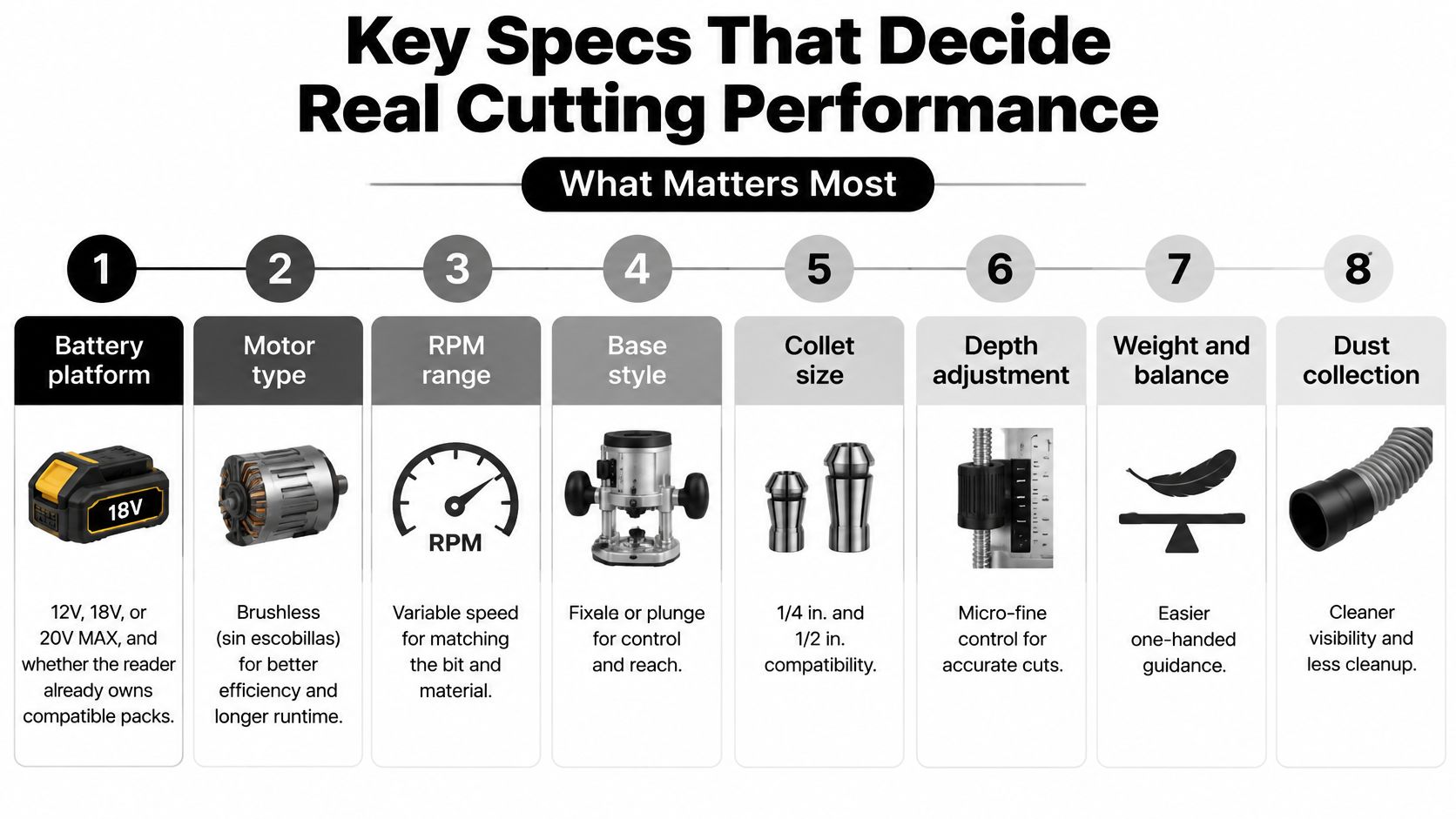
| Spec | What to Check | Why It Matters |
|---|---|---|
| Battery platform | 12V, 18V or 20V MAX; packs already owned | Affects runtime and the cost of sharing packs across tools |
| Motor type | Brushless (sin escobillas) or brushed | Brushless designs typically run cooler and last longer; verify per model |
| Collet size | 1/4 in., 1/2 in. or 8 mm | Determines bit-shank compatibility; 8 mm and 1/4 in. bits don't interchange |
| Speed range | Variable speed dial and maximum RPM | Lower speeds are needed for large-diameter bits |
| Plunge and depth | Micro-adjust and plunge lock | Helps control depth for dados and mortises |
| Base and sole | Base size and fixed or plunge design | Affects stability on edge work; small bases tip more easily |
| Battery runtime | Amp-hour rating and tested job count | Amp-hours alone don't predict runtime; compare the same task |
| Weight | Tool plus pack weight | Affects fatigue during overhead trim work |
A battery's amp-hour rating cannot tell you exactly how long a router will run. Runtime changes with battery size and condition, cutter size, depth, feed rate, material hardness, and how long the motor spends cutting. The Fine Woodworking cordless trim-router test reported that one machine cut a deep molding profile through 144 feet of hard maple, equivalent to 24 six-foot boards. The Bosch model with the lowest voltage in that comparison was still operating afterward. Treat that result as a specific test, not a runtime promise for other tasks or routers.
Measure performance against the work you need to complete. Fully charge the battery, then use a representative task and count matching cuts until the tool slows or the pack needs changing. Keep the bit, material, and depth consistent if you repeat the test. The result gives you a practical job count for planning; it also shows why voltage alone is a poor guide to runtime.
Temperature belongs in that assessment. In Central Valley summer heat, battery life and cut quality depend on the task and the conditions during the cut, not just the voltage printed on the router. A long, deep cut in hard material puts a different demand on the tool than brief edge trimming. Judge runtime by the work you do, and compare like with like.
Battery Heat, Kickback and Dust in Central Valley Shops
A cordless router removes a cord from the work area, but the cutter can still kick back, dust can cloud the cut, and heat can affect both the battery and the quality of the work. In Sacramento and the Central Valley, summer days above 100°F make battery care part of the job. Keep packs out of hot vehicles and direct sun, and let a hot pack cool before charging after a demanding cut. Follow the manufacturer's charging and storage instructions.
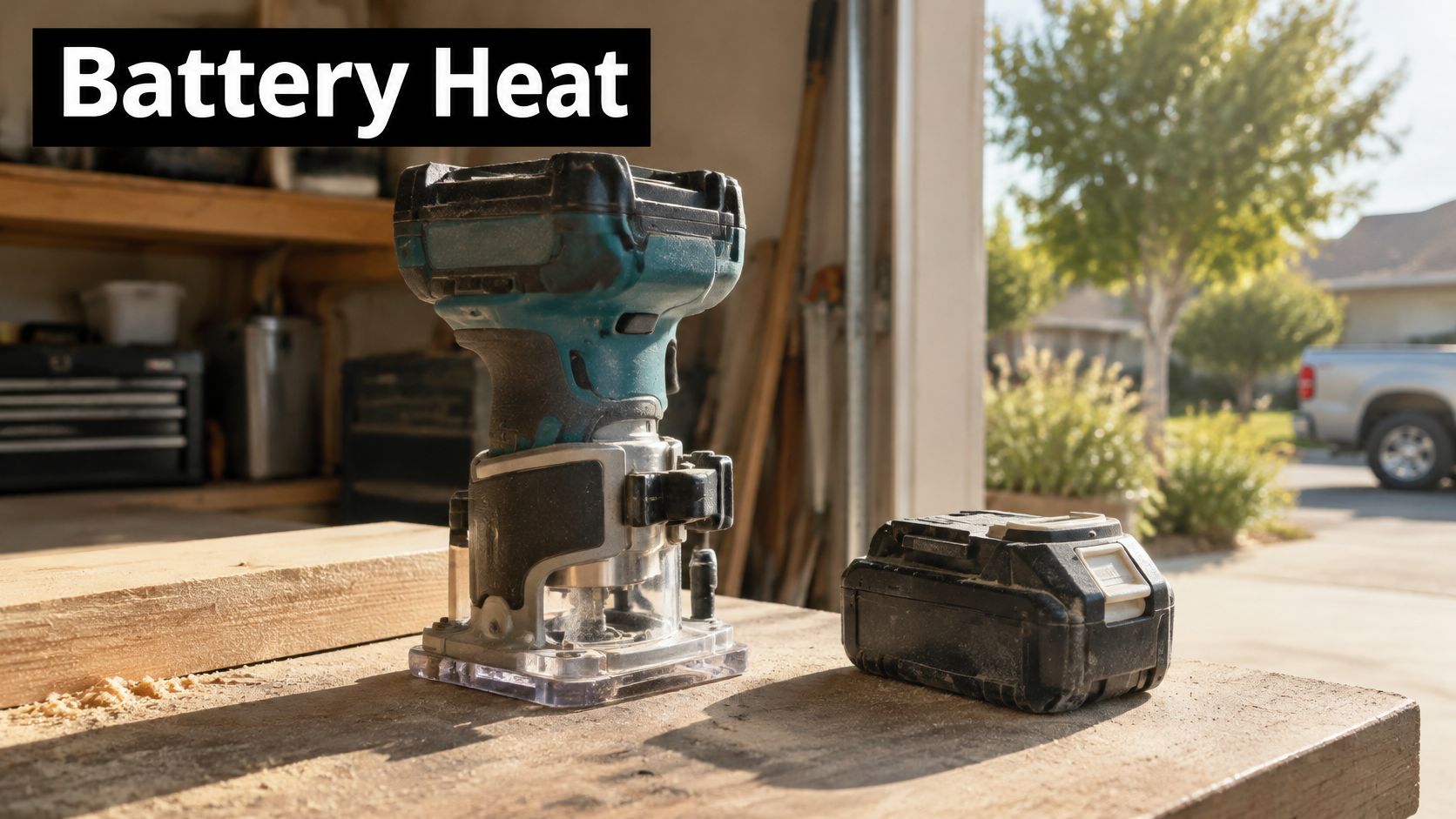
Judge runtime and cut quality by the task, not battery voltage alone. A hot pack or motor may lose performance sooner during sustained, demanding cuts. If the router slows or the cut starts to deteriorate, stop and let the tool cool rather than forcing the feed. A second charged pack can keep suitable cordless work moving, while repeated heavy routing may call for a corded tool.
End grain needs particular care because the cutter can catch and pull the router off its path. OSHA's handheld-router safety guidance recommends securing the workpiece, avoiding an initial cut in end grain, using jigs or guards where possible, and avoiding excessively slow operating speeds. Begin on long grain or in a waste area. Approach end grain only with the router supported and the cut direction controlled.
Keep the Work Controlled
Before starting, check the battery for damage, make sure the bit is secure in the collet and rated for the tool's speed, and confirm the base sits flat. Keep both hands on the router until the bit stops. Never set it down while the cutter is still turning.
Connect dust extraction when the router and setup permit it. Compare the work area and cut visibility with extraction on and off. Wear eye and hearing protection, plus respiratory protection suited to the task and conditions. The 3M respirators at Material Handling USA are one option to evaluate for the work. Cordless mobility does not control dust, particularly during repeated remodeling or maintenance cuts.
Stop if the pack or motor overheats, the tool loses speed, or the base wobbles. For heavy or repeated routing, a corded router may be safer and more productive than pushing a depleted pack. Use a second charged battery when the work suits a cordless router but exceeds one pack's practical capacity.
How to Set Speed and Feed for Clean Cuts
A clean router cut depends on matching bit speed, feed, and cut depth to the wood. Chip load is the thickness of wood each cutter removes per revolution. Feed too quickly and the motor takes on too much load; feed too slowly and the bit rubs, building heat that can scorch the edge. Use the router's RPM range and the bit maker's limit first, then treat the settings below as starting points.
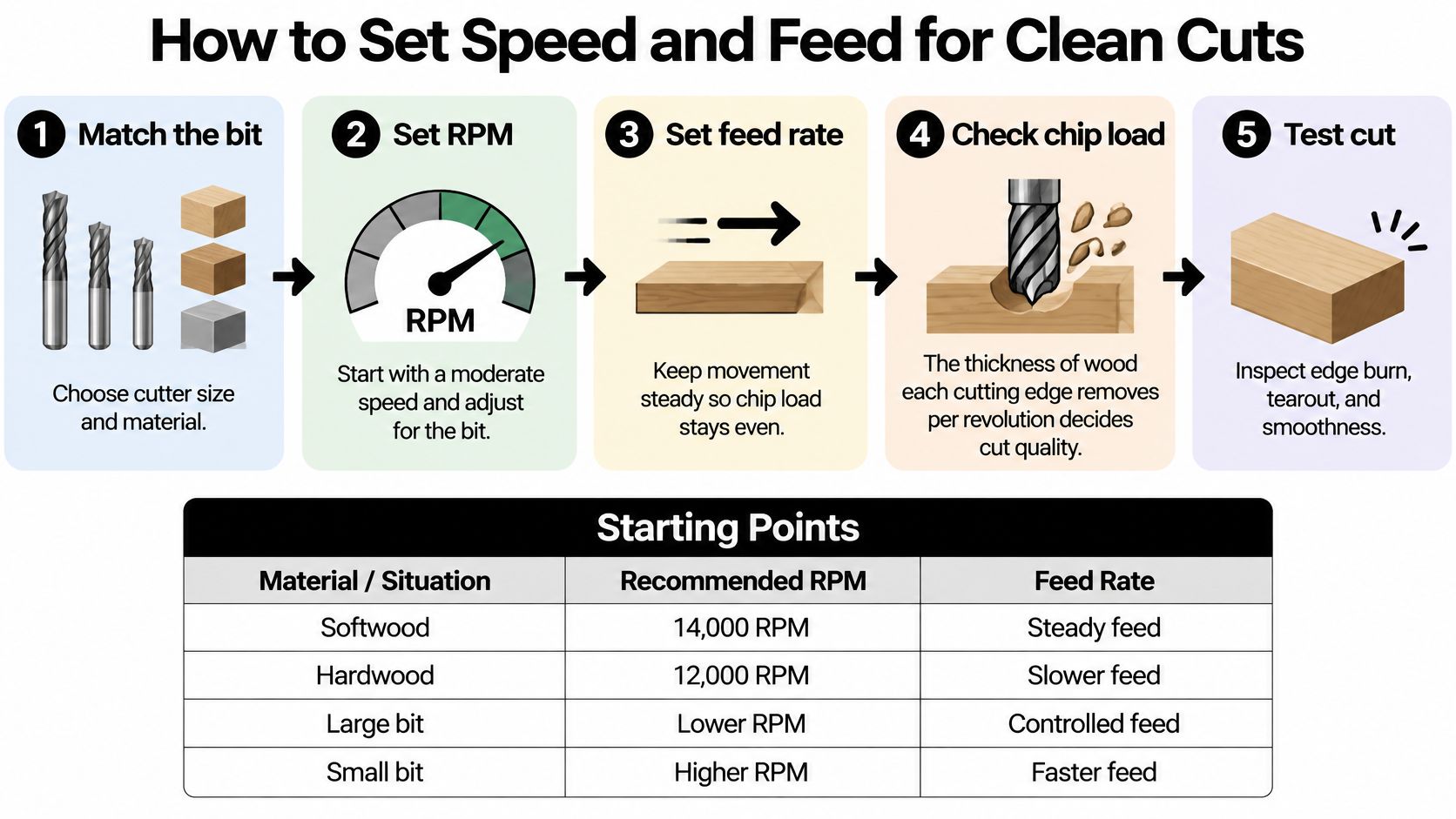
| Bit and Material | RPM Range | Feed Rate |
|---|---|---|
| 1/4 in. straight bit, softwood | 22,000–24,000 RPM | 4–6 in. per second |
| 1/4 in. straight bit, hardwood | 22,000–24,000 RPM | 2–3 in. per second |
| 1/2 in. bit, hardwood | 16,000–20,000 RPM | 2–3 in. per second |
| Any bit | Manufacturer's RPM range and bit maker's limit take precedence | Adjust for load and sound |
The router feed-rate guidance provides practical starting points for hand-fed routing, including a slower speed range for larger 1/2-inch bits in hardwood. These figures are not fixed settings: wood density, cut depth, and the router's response all affect the pass. For cabinetry, review these cabinet-making router bits when choosing a cutter for the profile and material.
A Repeatable Setup
- Check the limits. Read the router's RPM range and the bit maker's maximum speed before fitting the cutter.
- Choose and secure the bit. Match the shank to the collet, seat it correctly, and tighten it securely.
- Set speed for the cutter. Start with the table, lowering RPM for larger bits while staying within the tool's allowed range.
- Secure the work and plan the cut. Prevent the piece from shifting and choose a controlled direction of travel.
- Make a shallow first pass. Take successive passes instead of removing too much material at once.
- Keep moving. Feed steadily for the material, rather than pausing with the cutter spinning in one spot.
- Listen and watch. Burning, a noticeable RPM drop, or a slowing motor indicates the cut is loading the tool.
- Back off when needed. Reduce cut depth or feed rather than forcing the router. Excessive feed force can trigger electronic current limiting and use battery charge faster.
A clean pass leaves a smooth edge, fine dust, and a steady sound. Central Valley summer heat can shorten battery runtime, so judge the pack by the work it is doing, not its voltage alone. If the edge burns, check whether the bit is moving too slowly and rubbing; if the router is already creeping, keep it moving consistently or reduce cut depth.
Checking Open-Box and Used Routers Before You Buy
An open-box or used cordless router can be a sensible buy, but only if the tool's condition, included parts, and return terms are clear. Run this checklist at the counter or as soon as the package arrives.
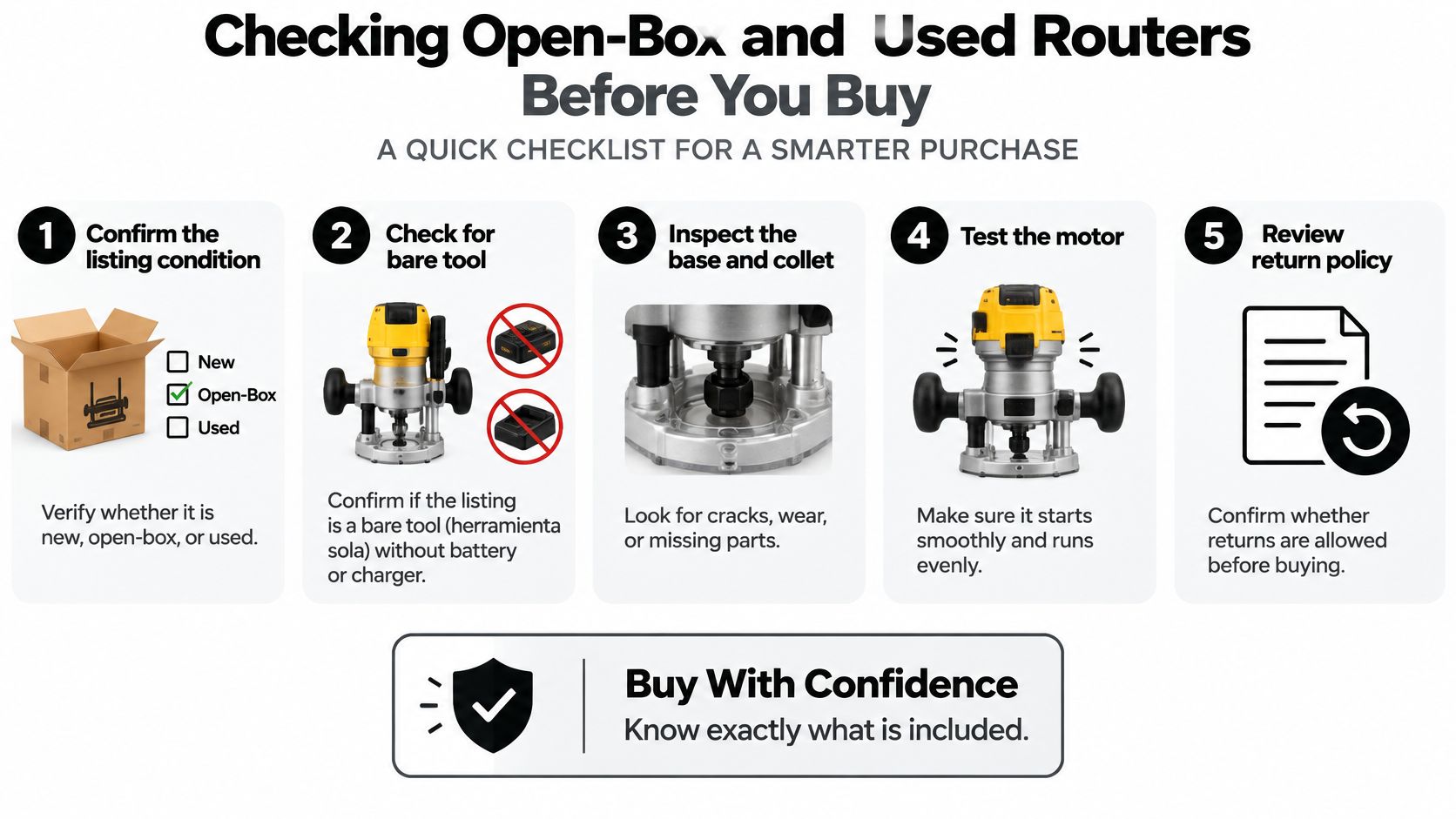
- Confirm the listing condition. Check whether it's sold as new, open-box, or used.
- Check what's included. A bare tool, or herramienta sola, may not include a battery or charger.
- Read the return period. Confirm the seller's stated terms before you buy.
- Test the controls. Run the variable-speed trigger through its range; check the plunge, depth lock, and micro-adjust if fitted.
- Inspect and test the tool. Look for damage to the base and battery contacts, verify the collet tightens and holds a bit, charge the pack to check that it holds charge, and make a short cut in scrap.
For a broader used-tool inspection approach, see this guide to buying used tools. Record the purchase date and test results, including any fault you report to the seller. That record makes it easier to explain what happened if you need warranty service.
California consumer-warranty law provides specific protections when a defective product is sent for repair. Under the California warranty statute, the warranty period can be extended by each whole day the product is out of your hands, and it doesn't expire while a defect that appeared during the warranty period remains unrepaired. After a reasonable number of unsuccessful repair attempts, a buyer may be entitled to a replacement or refund, subject to a reasonable deduction for use.
Ordinary returns are different from warranty claims. California doesn't require every retailer to accept nondefective returns, so check the store's posted return policy and the applicable warranty before you buy. Keep your paperwork and test notes together.
Choose Your Router and Confirm the Terms Before You Buy
Match the router to the work, then account for the batteries and charger. A compact 12V or 18V platform can suit short trim and edge-profiling jobs where mobility matters. For daily production trim, an 18V or 20V platform with two packs is more practical: one can charge while the other is in use. If you already own compatible batteries, a bare tool may cost less overall. If you do not, compare the kit price and check whether it includes a charger.
| Work Type | Recommended Platform | Battery Plan |
|---|---|---|
| Trim and edge profiling | Compact 12V or 18V platform | One pack, plus a spare for long sessions |
| Daily production trim | 18V or 20V platform | Two packs and a charger |
| Occasional DIY, owns a battery | Bare tool (herramienta sola) | Existing pack |
| Occasional DIY, no battery | Kit with battery and charger | Included pack; count the charger in the price |
A brushless motor can be a useful feature, but the label alone does not tell you how well a router will suit your work. Compare the base, depth adjustment, collet, and tool weight with the battery attached. Those details affect handling and setup, particularly when making repeated edge cuts. Include any spare packs in your total cost if the job involves back-to-back trimming.
Value Tools Co sells open-box and lightly used tools that are fully functional, with savings of up to 55% off typical retail pricing. The store offers free U.S. shipping on qualifying orders and has a concise 2-day return window. Check the product page for the exact return terms and what is included before checkout, particularly whether the listing is for a bare tool or a kit.
FAQ
Is a cordless router strong enough for hardwood?
Yes, a cordless router can handle hardwood when the bit, depth, and feed are appropriate, especially for edge work and controlled passes. Long, deep cuts in dense wood demand sustained output, so a corded router is the better choice for that work.
Can I use a bare tool with my existing battery?
Yes, if the battery is compatible with that exact tool and platform. Confirm on the product listing whether a battery and charger are included. A bare tool generally makes most sense when you already have a matching battery.
Are open-box routers safe to buy?
They can be a good value if the listing describes the condition and the seller provides a clear return process. Use the inspection checklist from the previous section before putting the router into production use.
Before checkout, compare the battery arrangement, tool condition, and return terms. Browse the available tools at Value Tools Co.


