

For cordless tool battery storage lasting a month or longer, keep packs at 30% to 50% charge in a cool, dry place and check them every two to three months. Keep batteries out of temperatures above 130°F, which can damage lithium-ion cells.
That matters on a Central Valley jobsite, where a truck cab or enclosed gang box can get much hotter than the air outside. Battery care isn't just about preserving runtime: a damaged, overheated, or poorly stored pack can also become a safety hazard. Here's a practical way to store, charge, and sort cordless tool batteries, including packs that should never go back into service.
Storage Targets for Charge Level and Temperature
Charge level gets most of the attention in storage advice. Temperature does more of the damage, and it carries the safety risk with it: a pack forgotten in a hot truck cab or gang box ages fast, and sustained heat is what pushes an already marginal pack toward failure. Use the table to build a routine you can repeat instead of leaving packs wherever they came off the tool.
| Condition | Charge level | Temperature | Check or action |
|---|---|---|---|
| Long-term storage, a month or longer | 30% to 50% | Cool, dry, room-like; avoid freezing | Check every 2 to 3 months |
| Charging | Charge to full, then unplug | 32°F to 105°F | Charge only after the pack cools |
| Hot vehicle, gang box, or shed | Any level; worst when full | Above 130°F can damage cells | Remove pack from heat immediately |
| Charging below freezing | Any level | Below 32°F can damage cells | Warm pack indoors before charging |
The Canadian Centre for Occupational Health and Safety's lithium-ion battery guidance recommends storing packs at approximately 30% to 50% charge, checking them every three months, and recharging to 50% when needed. Treat that as a solid default; where your battery maker publishes its own storage limits, those win.
The research on charge level is messier than the rule of thumb suggests. A 2016 electrochemical study stored cells at 16 charge levels, from 0% to 100%, and found storage temperature was a major driver of capacity loss while the charge-level effect wasn't linear. A fully charged pack doesn't degrade in one predictable way, but a hot shelf makes things worse at every charge level. If the only spot you have runs warm, I'd keep the pack near the bottom of the range rather than topping it off.
The charging limits in the table reflect common occupational safety and manufacturer guidance: charging a pack that is still hot from use, or one that has sat below freezing, can permanently damage cells. The same logic applies to where the shelf sits. A shaded indoor spot beats a parked truck, attic, unconditioned shed, or a window in direct sun.
At each check, look for swelling, odor, corrosion, unexpected warmth, or a sharp loss of charge. A pack showing any of those signs comes off the shelf for closer sorting instead of going back into rotation, and normal runtime plus steady power under load on the next job tells you the routine is working.
How to Store a Pack for Months Without Losing Capacity
A good long-term storage routine is straightforward: inspect the pack, set its charge level, protect its terminals, and record when you put it away. The LiFePO4/graphite storage study supports keeping packs at a moderate, manufacturer-approved partial charge and in a dry location with stable temperature. Its detailed aging findings are chemistry-specific, so use them to understand the risk, not to replace your battery maker's instructions.
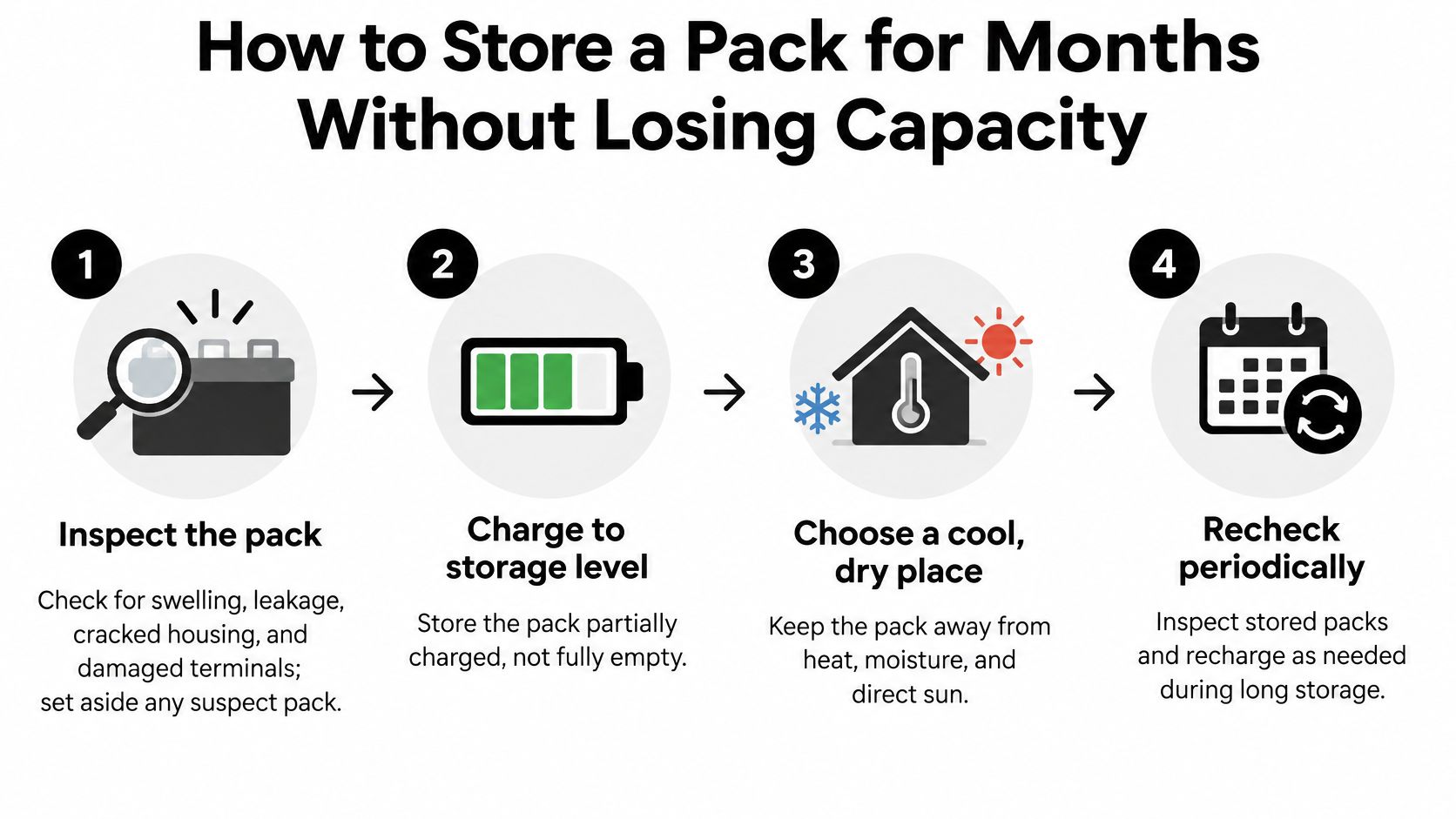
- Inspect before storing. Check for swelling, leakage, a cracked housing, or damaged terminals. Set aside any suspect pack instead of putting it into long-term storage.
- Remove it from the tool and charger. For a pack that'll sit for months, start with it disconnected from both. Charge it to roughly 50% using the compatible tool or approved charger, then unplug it.
- Let it cool. A pack that's just been used or charged should come back to a moderate, room-like temperature before it goes on the shelf. If it's cold from an outdoor work area, let it warm in its case before opening it, which helps avoid condensation on the terminals.
- Protect the terminals. Use the original case or a dry, nonconductive bin, and cover exposed terminals. Keep packs away from coins, keys, loose screws, and other metal that could bridge the contacts and cause a short.
- Choose the shelf carefully. Store the bin in a cool, dark, dry spot away from ignition sources and combustible materials. Don't use a freezer or other sub-freezing space as a substitute for a cool room, and keep the storage area out of damp conditions.
- Log the date and recheck. Inspect packs every two to three months for heat, odor, swelling, corrosion, or unexpected voltage loss. Skip routine top-offs that leave a pack sitting at maximum voltage; recharge to the storage target only when needed.
A healthy pack at the next check should be cool, undamaged, and not sharply depleted. If you find a problem, move it out of the usable group and assess it before charging or returning it to service. The most common storage mistake is leaving a fully charged pack in a hot garage or vehicle. Manufacturer storage limits take priority over these general defaults.
Charging and Heat Routines for Central Valley Jobsites
Leaving batteries on the charger overnight is the habit to drop first. Use the manufacturer-approved charger, charge in a well-ventilated area at room temperature, and unplug the pack when it reaches full charge. NFPA's battery safety guidance warns that incorrect charging equipment can damage a battery and increase fire risk.
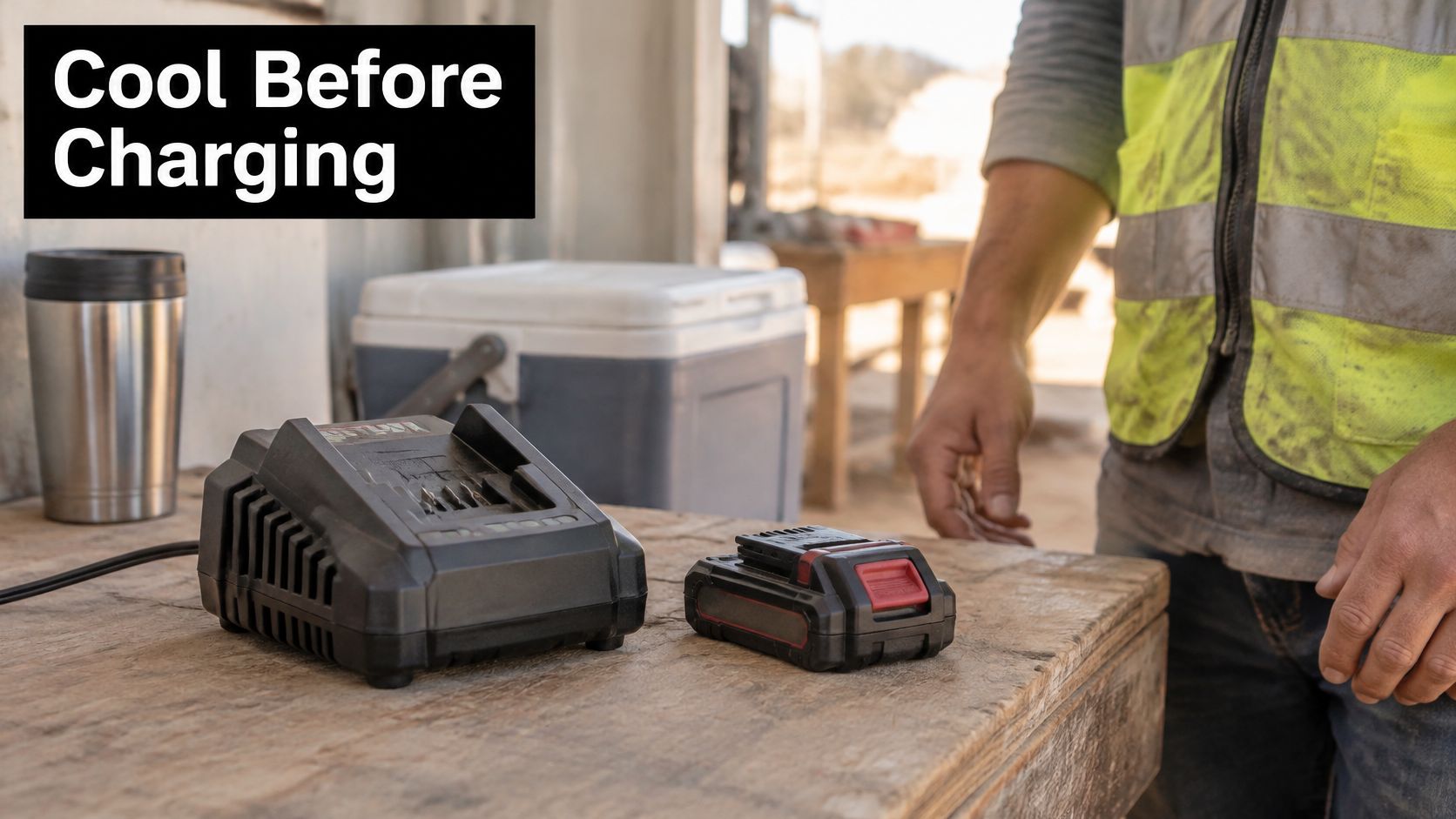
Put the charger on a hard, flat, noncombustible surface, not carpet, a couch, or a cluttered workbench. Keep it clear of sawdust, cardboard, solvents, fuel, and exits. Soft surfaces can trap heat or block airflow, and clutter makes it harder to keep a charging area clear.
Sacramento and Central Valley crews need to manage both summer heat and cold starts. OSHA's lithium-battery safety guidance warns that temperatures above 130°F can damage lithium batteries and that charging below 32°F can also damage cells. A truck cab, enclosed gang box, or unventilated shed can become a poor storage or charging spot in hot weather, even when a pack looks normal.
Rotate batteries on the job rather than putting a heat-soaked pack straight onto the charger. For example, a crew using a framing nailer / clavadora de marcos, impact driver / atornillador de impacto, and brushless / sin escobillas saw can set a warm pack aside to cool while another is in use. Keep spares shaded and dry; a wet pack with corroded contacts shouldn't be put away as normal inventory.
Charging check: Confirm the surface, clear nearby combustibles, match the charger to the battery system, let the pack cool, and unplug when charging is done.
For a larger charging area, keep chargers in a low-traffic spot and separate them from combustibles. The OSHA battery guidance also supports removing swollen, cracked, leaking, unusually hot, smoking, or odd-smelling packs from service rather than putting them back on a charger.
Use this video as a visual reminder of safe charging habits:
Triaging Low, Suspect and Damaged Battery Packs
Sort every battery into one of three groups: usable but low, suspect, or actively damaged. A pack that looks fine can still have a problem, so don't treat a quick no-load voltage reading as a complete test.
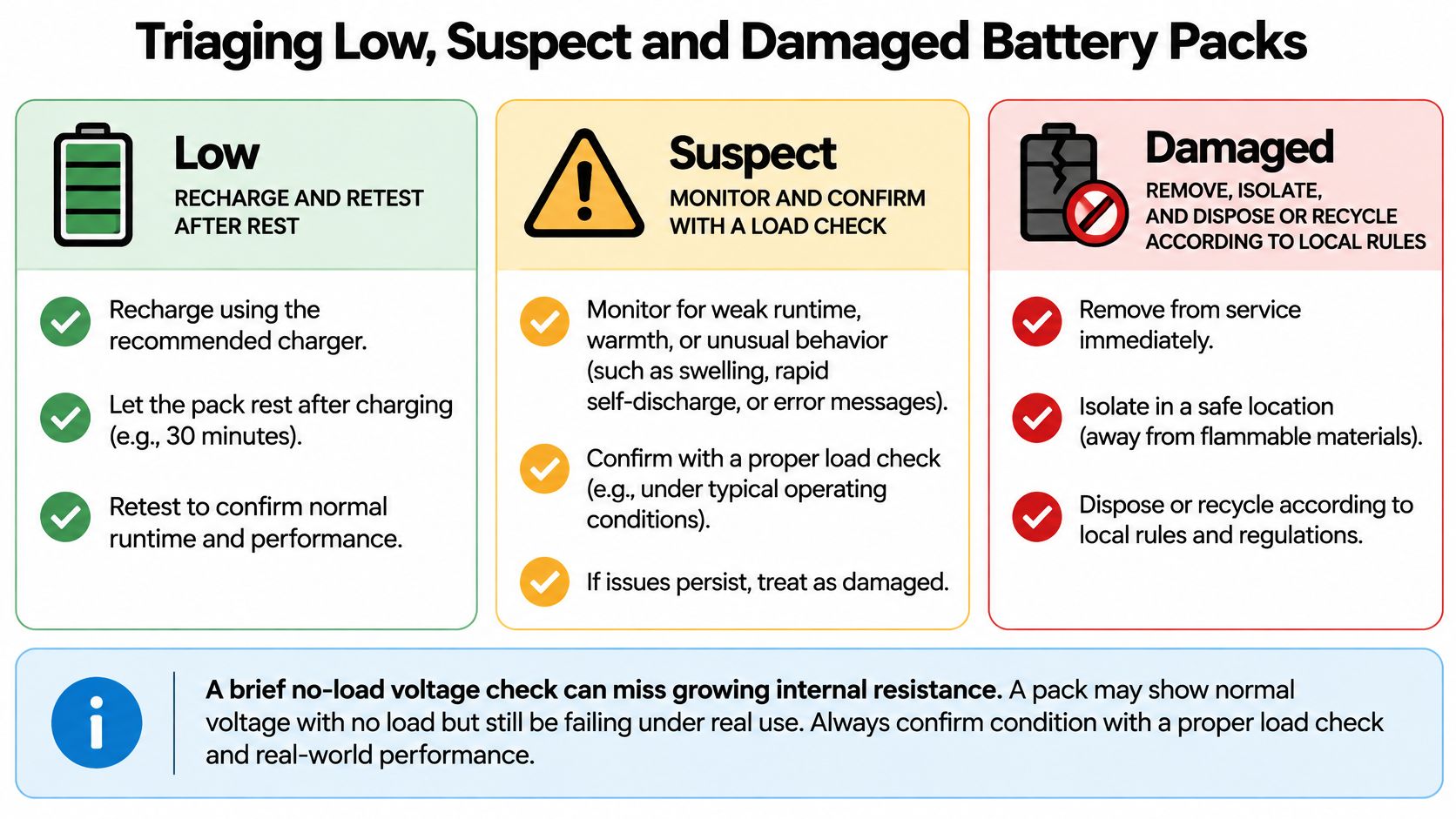
| Condition | Signs | Action |
|---|---|---|
| Usable but low | Holds charge, stays at a normal temperature, and shows no swelling | Store at 30% to 50% and check every 2 to 3 months |
| Suspect | Heats while idle, self-discharges, or voltage collapses under load | Isolate, then evaluate or retire according to manufacturer limits |
| Actively damaged | Swelling, cracks, leakage, hissing, smoke, or odd odor | Remove from service, tape terminals, bag it, and take it to hazardous-waste collection |
A no-load voltage check can miss growing internal resistance and self-discharge. If a battery loses charge while sitting, heats up while idle, or sags sharply under load, isolate it for a proper evaluation or retirement rather than returning it to the shelf.
For a swollen, cracked, leaking, hissing, smoking, or unusual-smelling pack, stop using it. Tape the terminals, bag the pack individually, and keep it in a nonflammable container away from people, vehicles, and combustibles while arranging disposal. Don't store a damaged battery in a home or truck cab, and don't put it in household recycling. Take it to a retailer that accepts batteries or a local hazardous-waste collection site; North Carolina's lithium-ion battery safety guidance explains terminal taping and collection options.
The risk is broader than cordless tools. UL Solutions' incident compilation includes more than 7,741 reported worldwide incidents involving lithium-ion batteries and battery-powered products from 2010 through 2023. That total isn't a cordless-tool fire rate, because it covers battery-powered products broadly, but it reinforces why damaged packs need a separate handling route.
Dropped, wet, or recalled packs should also be isolated and assessed rather than returned to saleable inventory. Sort the batteries in your shop this week and quarantine anything that shows signs of damage.
Battery Storage Questions People Also Ask
What charge level should I store cordless tool batteries at?
For a pack that'll sit for a month or longer, target 30% to 50% charge. Follow the battery maker's specific storage guidance if it differs.
How often should I check stored packs?
Check them every two to three months for heat, odor, swelling, corrosion, and unexpected voltage loss. If the pack needs more charge, bring it back to the storage target rather than leaving it fully charged.
Can I leave a battery in a truck during summer?
Don't leave it in a closed cab or gang box where it can overheat. Temperatures above 130°F can damage lithium batteries.
Can I store packs in a freezer?
No. Don't use a freezer or other sub-freezing place for storage, and don't charge a pack below 32°F.
What do I do with a swollen or cracked pack?
Remove it from service, tape the terminals, bag it individually, and take it to a battery-accepting retailer or hazardous-waste collection site. Never put it in household recycling.
Is it safe to leave a pack on the charger overnight?
Avoid unattended overnight charging on a jobsite. Disconnect the charger once the pack is full, and use the manufacturer-approved charger for that battery system.
If you're choosing a charger for your setup, check battery and charger compatibility before buying. Value Tools Co also has a practical guide to a 20-amp battery charger.
Choose a Storage Setup and Who It Fits
The right storage setup depends on how often packs move between the shelf and the tool. A framing crew rotating batteries daily needs a closed, shaded cabinet plus a separate quarantine bin for anything suspect. A homeowner storing a cordless mower needs a labeled bin and a calendar reminder. I'd rather see one plain shelf with a written charge target than an expensive cabinet nobody audits.
| Setup | Best for | Storage rule | Check |
|---|---|---|---|
| Crew cabinet with quarantine bin | Framing crews and remodelers on daily rotation | Closed, shaded cabinet inside the shop; packs near 30% to 50% | Inspect at every charge |
| Seasonal labeled bin | Homeowners and property managers | One bin on a shelf at 30% to 50%, away from metal | Every 2 to 3 months |
| Single pack on a shelf | Hobbyists using one tool monthly | Follow charge and temperature rules; no cabinet needed | Every 2 to 3 months |
Who This Is For
A crew cabinet works for contractors who want saleable packs, chargers, and questionable batteries kept separate. The quarantine bin handles the important task: it provides a place for hot, swollen, or voltage-sagging packs to sit away from good stock instead of going back into the rotation. Homeowners and property managers can use a labeled bin on a shelf for seasonal tools, while a hobbyist with one pack generally needs a safe shelf and a regular check, not a dedicated cabinet.
Who Should Avoid This
Don't pair an unknown charger with a discounted battery, and don't store packs in a hot truck bed. Before buying a bare tool or replacement pack, confirm the brand, voltage, and charger match using this power tool battery compatibility guide.
Value Tools Co, based in Elk Grove, California, sells power tools from DeWalt, Husky, Milwaukee, Makita, Ridgid, and Ryobi, including open-box and bare-tool options at up to 55% off retail price, with free U.S. shipping on qualifying orders and a 2-day return window.
Before the first charge, inspect every pack on arrival, confirm the charger match, and set up the storage bin. That small setup keeps usable batteries ready and questionable ones out of circulation.
Browse tested and inspected open-box tools, bare tools, accessories, and hardware at Value Tools Co, with savings of up to 55% off retail price. Choose a battery-compatible setup for your tools, then inspect each pack and prepare its storage spot before charging.


