

A drill that runs out halfway through a cabinet install, or cuts out while boring into framing, may not need a new tool. The battery may be too small for the job, too cold, worn out, or incompatible with the drill's charger and electronics.
The right lithium battery for a drill matches the tool's voltage platform and current demand, not just the amp-hour number on the label. For homeowners, a compact pack is easier to handle for quick repairs; for crews drilling continuously, a higher-capacity pack and a safe charging routine matter more. In Sacramento and the Central Valley, hot vehicle interiors add another consideration: let a hot battery cool before charging, and store packs out of direct sun.
What Lithium Drill Batteries Are and How They Differ
A lithium drill battery is a rechargeable pack made from lithium-ion cells, usually rated 18V or 20V for cordless drills, with electronics that manage charging, discharge, and temperature. Cells wired in series raise voltage; cells wired in parallel increase capacity. An 18V pack typically links five cells in series.
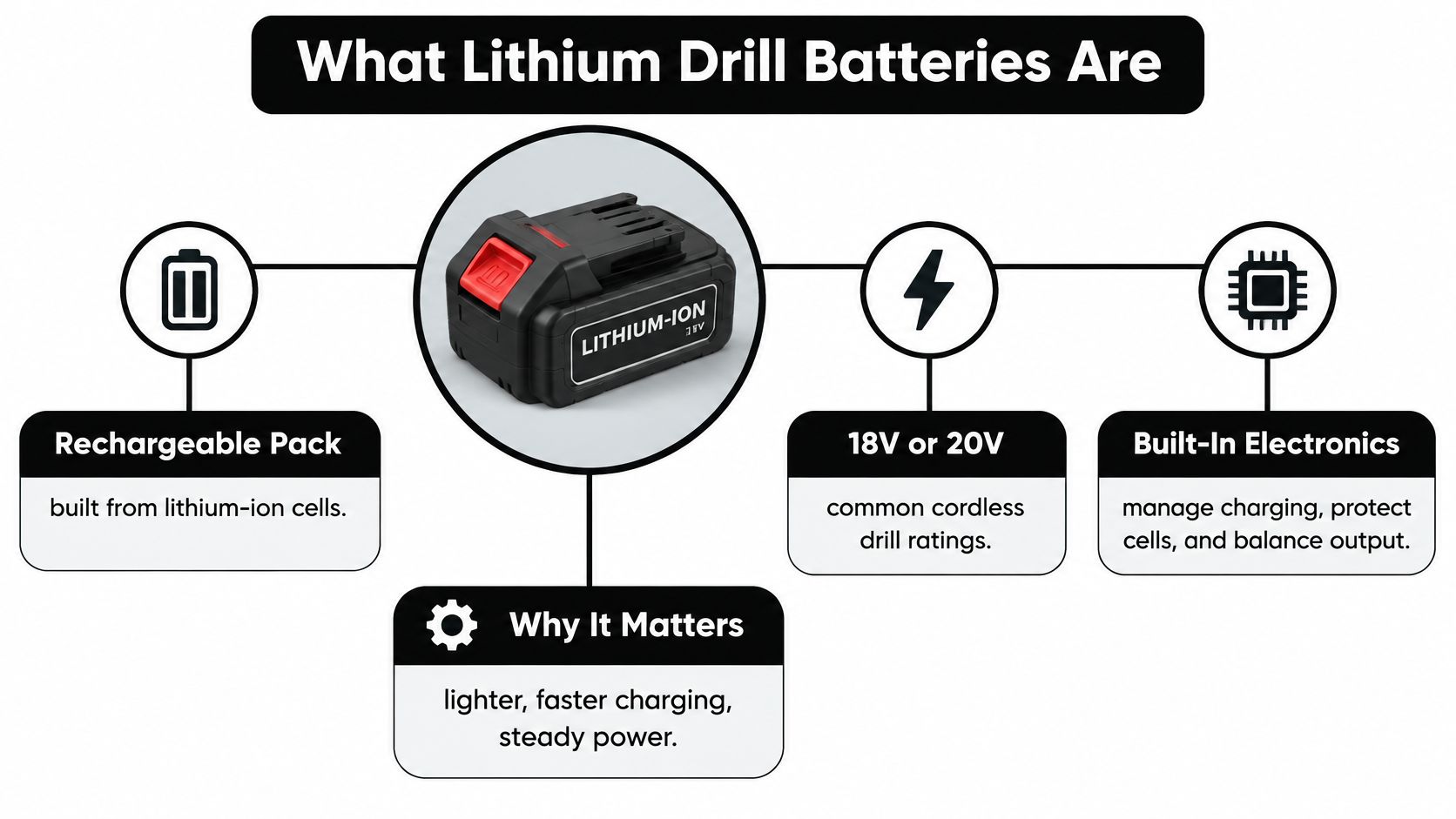
Lithium-ion cells became commercially available in 1991, when Sony introduced the technology. Their higher operating voltage and energy density helped make cordless tools practical, while their lower weight made a portable drill easier to use than one relying on heavier battery systems. The University of Oxford's account of lithium-ion battery development describes the commercialization milestone and the cell improvements behind it.
Battery chemistries compared for cordless drills
| Chemistry | Energy density | Memory effect | Weight for same runtime | Where it still appears |
|---|---|---|---|---|
| Nickel-cadmium (NiCd) | About 40–60 Wh/kg | Yes, capacity loss with repeated partial charging | Heaviest | Older tools and legacy packs |
| Nickel-metal hydride (NiMH) | Higher than NiCd, lower than lithium-ion | Minor | Heavy | Some older 12V tools and garden equipment |
| Lithium-ion | Higher than many earlier rechargeable chemistries | No meaningful memory effect | Lightest | Current 12V, 18V, and 20V platforms |
Older NiCd packs could lose usable capacity with repeated partial charging, the memory-effect problem associated with that chemistry. Lithium-ion packs don't have the same meaningful memory effect, so you can generally top up a partly used battery instead of waiting for it to run completely flat.
Think of amp-hours (Ah) as the size of the fuel tank and voltage as the pressure pushing power to the motor. A larger tank can extend runtime, but it doesn't automatically make the drill stronger under load.
Before buying, read the pack label and note four things: voltage, amp-hours, exact model number, and the charger paired with that battery series. Check all four against your drill and charger, especially when buying a used battery or a bare tool.
Matching Amp-Hours to Your Drill Work
A homeowner driving cabinet screws on Saturday needs a different pack than a crew drilling ledger holes all afternoon. Pick the pack for the longest continuous task on your list, then check that it can feed the motor without sagging.
| Pack size | Typical job | Runtime behavior | Weight | Best routine |
|---|---|---|---|---|
| 2.0Ah | Light drilling, fastening, and quick fixes | Drops out under sustained heavy load | Lightest | Short bursts, cabinets, and fixtures |
| 3.0–4.0Ah | Most homeowner drilling and repair work | A useful balance of runtime and manageable weight | Moderate | General household projects |
| 5.0Ah or larger | Repetitive drilling and longer work sessions | More capacity for sustained work; cell design and discharge rating still matter | Heavier | Longer shifts and repeated high-load tasks |
| 8.0Ah | Heavy production work and high-draw tools | Longest runtime per charge in the same platform | Heaviest | Crews running continuous high-torque tasks |
Amp-hours set runtime. Holding torque under load comes from cells, parallel-cell count, protection electronics, and maximum discharge rating. A larger pack spreads current draw across more cells. That lowers stress during repetitive heavy drilling and delays the voltage sag that trips low-voltage cutoff.
Heat raises the stakes here. In Central Valley summer heat, a small pack worked hard runs hotter and hits cutoff sooner. A larger pack stays cooler per cell for the same work, which protects both runtime and service life. I recommend sizing up one step if your main job is overhead drilling, long spade-bit runs, or back-to-back fastening in a hot garage.
Before choosing a battery, make three checks. Match the longest task and pick a pack that covers it without a mid-job swap. Check discharge capability against the drill's load and the manufacturer's guidance for that platform. Pair the pack with the motor, since a brushless drill can demand substantial current and needs a battery built for that workload.
Buying rule: Match the pack to the drill's current demand, not only the highest Ah rating you can afford.
On the first day, run the drill on the exact task you bought it for. Short runtime is normal. Early cutoff under load points to the wrong pack size. Step up one size before buying a second small battery. Cold also cuts usable capacity, and Battery University's explanation of battery discharge notes usable capacity falls to roughly 83% at 0°C and 66% at −10°C compared with 25°C.
Compatibility Beyond Matching Voltage
Matching voltage is only the starting point. A battery can physically click into a drill and still be a poor or unsafe match if its platform, connector, current limits, battery-management system, or charger aren't suited to the tool.
Government safety guidance warns that generic and third-party chargers may lack overcurrent and thermal protection. Use the manufacturer's charger or one explicitly approved for that battery system. A bargain replacement pack with uncertain protection electronics can cost more in downtime, tool damage, or fire exposure than a properly matched battery. The PRISM guidance on lithium-ion hand-tool risks also advises letting cold batteries warm and hot batteries cool before charging.
The voltage number on the pack doesn't prove cross-brand compatibility. Start with the drill's exact brand and battery series, then check the manufacturer's compatibility list. A voltage match within an 18V or 20V product line is a starting point, not proof of safe electrical fit.
Check what comes with a bare tool
A bare tool, or herramienta sola, typically comes without a battery or charger. Add the cost and compatibility of both before comparing the listing with a complete kit. If you already own compatible batteries, a bare tool can reduce redundant purchases; if you don't, the kit price may be the more accurate comparison.
A brushless drill, or sin escobillas, can draw substantial current when the bit binds or the work is demanding. Choose a pack rated for the drill rather than assuming any battery that fits will maintain performance.
For open-box purchases, write down the battery series and charger model before ordering. Use the checklist in “Confirm Battery Fit Before You Buy Open-Box,” and check the power-tool battery compatibility guide if you're comparing packs across tools.
Charging and Storing Packs in Central Valley Heat
Charge a battery only inside the manufacturer's stated temperature window. Bosch lists 0°C to 45°C (32°F to 113°F) for charging and 0°C to 20°C (32°F to 68°F) for storage. Its packs are listed for use between −20°C and 70°C (−4°F to 158°F), but that operating range isn't a charging range. Bosch's lithium-ion battery guidance explains the temperature limits and how chargers monitor pack temperature.
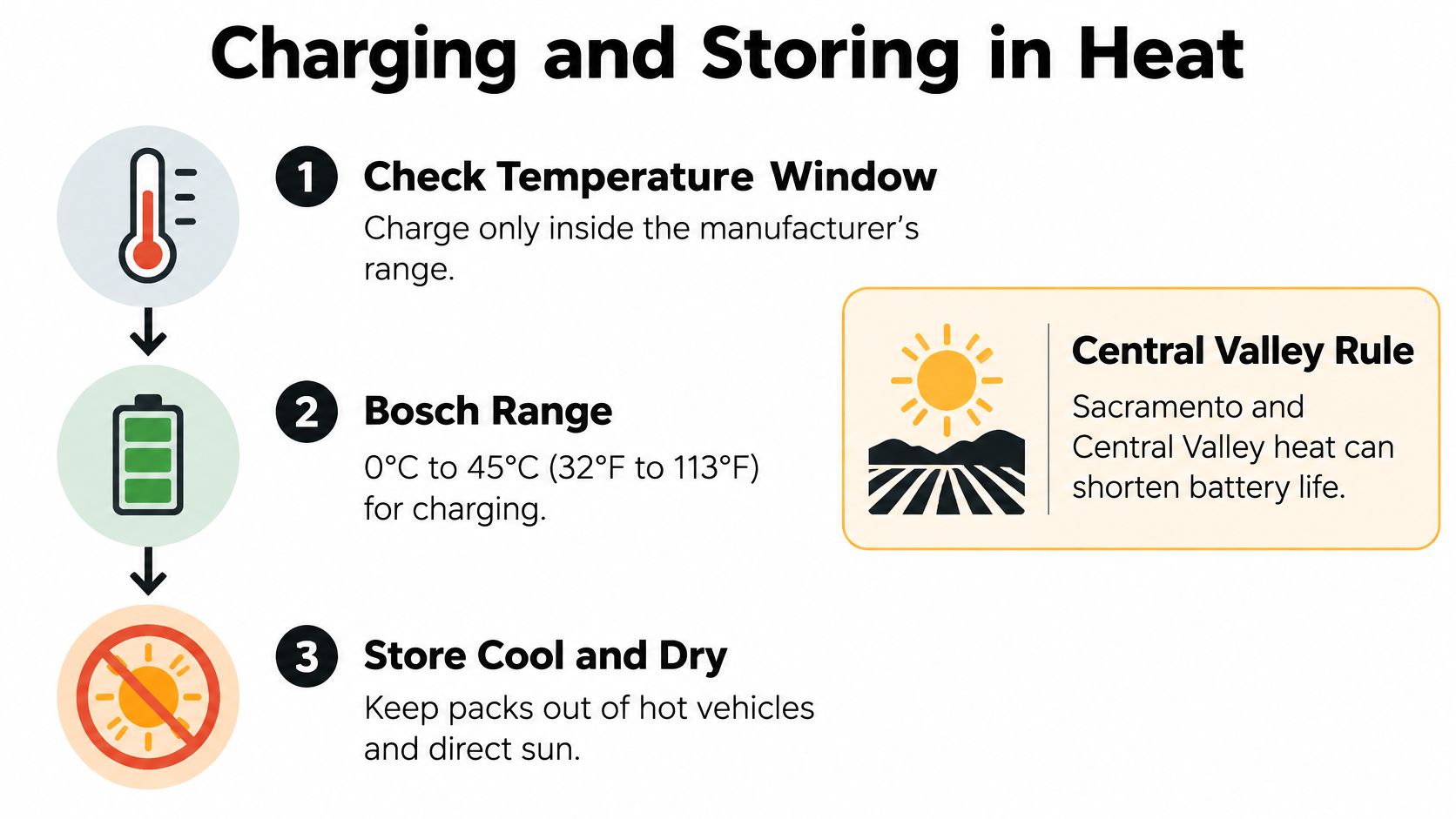
Sacramento and Central Valley summer work areas and truck interiors can exceed 100°F. A hot pack may need time to cool before charging; forcing it onto a charger can shorten service life or trigger a protective shutdown. Bosch chargers monitor battery temperature and adjust charging current, and some systems activate cooling above 45°C (113°F).
Use this routine between jobs:
- Move it into shade: Pull the pack from the drill and keep it out of direct sun.
- Let it cool: Wait until it no longer feels hot to the touch before charging.
- Use the right charger: Charge only with the manufacturer's charger or one explicitly approved for that battery.
- Remove it when full: Don't leave it on the charger for days.
- Warm cold packs: If a battery came from a cold truck, bring it to room temperature before charging.
- Store it indoors: Keep it dry and away from direct sun, in a moderate-temperature place.
Charging time depends on the battery and charger. STIHL reports approximately 30 minutes to 4.5 hours to reach 80%–100%, so check the pack and charger combination rather than relying on a generic fast-charge claim. For production work, rotate packs between the tool and charger, so a hot battery can cool instead of holding up the job.
For longer pack life, follow the additional storage and care advice in this guide to extending power-tool battery life.
Troubleshooting Weak Runtime and Retiring Failing Packs
| Symptom | Likely cause | Fix |
|---|---|---|
| Drill cuts out early under load | Voltage sag on a small pack or low-voltage cutoff | Step up to a larger amp-hour pack and avoid forcing the tool |
| Short runtime only in cold weather | Reduced power availability at low temperature | Warm the pack to room temperature before use |
| Charger light blinks or pack won't charge | Dirty terminals, temperature lockout, or charger fault | Clean contacts, let the pack cool, and test with a known-good charger |
| Pack feels hot after charging | Charging a hot pack or a failing cell | Stop using it, let it cool, and replace it if the problem repeats |
| Swelling, cracks, or electrolyte smell | Damaged cell and thermal risk | Stop using it, protect the terminals, and use hazardous-waste recycling |
Isolate the fault before replacing parts. Swap in a known-good battery, then try the suspect pack on a second compatible charger. This helps distinguish a failing battery from a charger problem or a drill fault. Inspect the contacts for dirt or damage before testing, and don't keep forcing a drill that repeatedly shuts off under load.
A small pack that cuts out only during heavy drilling may be sagging under load rather than completely dead. A pack that runs short only in cold conditions may recover usable performance after warming. If the charger light blinks, check for dirty contacts and a hot or cold pack before concluding the battery has failed.
Stop using a pack that's swollen, cracked, leaking, hot without a clear reason, or giving off an electrolyte smell. Don't open or attempt to rebuild a damaged lithium pack. Separate it from other batteries, protect its terminals against short circuits, and use a hazardous-waste facility or a retail battery-recycling channel.
Disposal matters even when the battery has been removed from service. The EPA's analysis of lithium-ion battery fires at waste facilities identified 245 related fires at 64 U.S. waste-management facilities during 2013–2020. The agency also reported that more than 50% of surveyed materials-recovery facilities attributed fires to batteries improperly placed in curbside recycling bins. These figures describe waste-handling risks, not the risk of a correctly used drill battery catching fire during normal operation. Never put drill batteries in household trash or curbside recycling.
Who This Is For and Who Should Avoid This
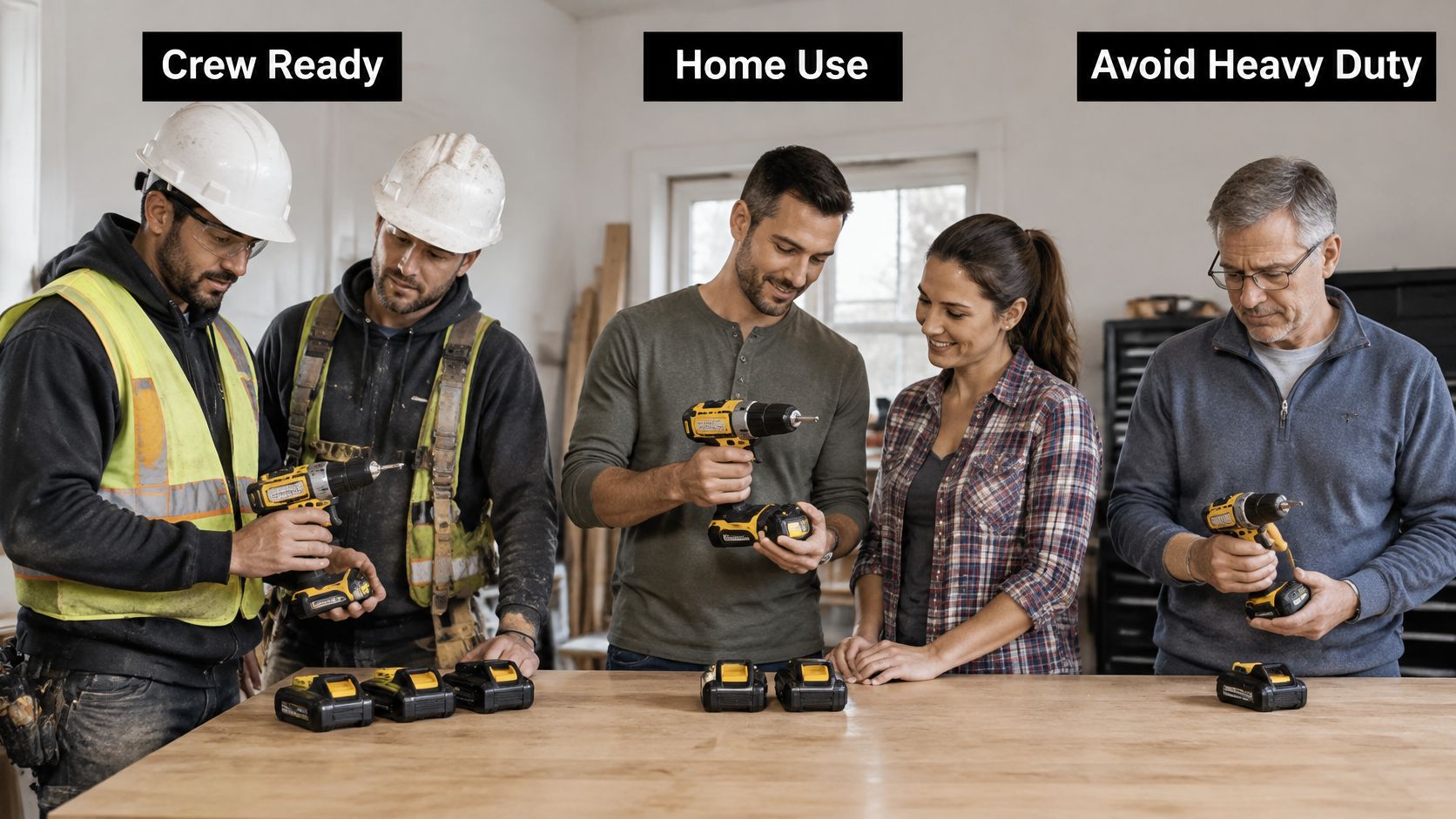
A Sacramento framing crew running drills all day has different battery needs than a homeowner hanging curtain rods once a month. Match the pack to the work pattern, the platform, and the heat it will face in a truck or garage.
| User | Good fit | Advantages | Trade-offs |
|---|---|---|---|
| Professional contractors and crews | 5.0Ah or larger, with at least two packs per person | Shared batteries can simplify rotation across drills, impact drivers, and other compatible tools | Platform lock-in and costly replacement packs |
| Remodelers and serious DIY users | 3.0–4.0Ah | Balances cost, weight, and runtime for most projects | May need swapping during a long workday |
| Budget and open-box buyers | A tested, undamaged compatible pack | Lower entry cost when the condition and runtime are verified | Unknown cycle history or uncertain protection electronics |
Standardizing on one battery platform keeps packs and chargers interchangeable across compatible tools on the same crew. That fit is electrical and mechanical, not just voltage. Use only packs the drill maker lists for that model, with the correct slide, contacts, and protection circuit.
Framing nailers follow separate rules. They need fasteners that match the project specifications and local building code. That fastener requirement applies to framing nailers, not drills, and project specifications can impose additional requirements.
Avoid the wrong shortcut: Skip generic chargers, cross-brand batteries on high-draw tools unless the manufacturer lists them as compatible, and budget packs with no runtime test or visible damage.
A bare tool is a poor purchase when you need a full shift and own no compatible batteries. Buy the packs and charger first, then add the bare tool. A manager handling repairs across rental units might buy two mid-size packs and a single compatible charger, provided both packs are approved for the drill. In Central Valley summer heat, that also means a shaded storage plan, since a hot truck bed shortens pack life fast.
This side-by-side overview can help you weigh the trade-offs:
Frequently Asked Questions About Lithium Drill Batteries
Can I charge a drill battery right after heavy drilling?
Let the pack cool to room temperature first, then charge it inside the charger's allowed temperature range. In Central Valley summer heat, a pack left in a truck or garage can stay hot enough to make a good charger pause the cycle. Cool storage extends service life.
Are generic chargers safe for lithium drill batteries?
I recommend the charger built for that battery system, or one the manufacturer names as compatible. The right charger manages current, voltage cutoff, and temperature monitoring as a system. A generic unit can miss those protections and shorten pack life or create a safety risk.
Can a 20V battery run an 18V drill?
Only when the manufacturer lists that exact battery and drill combination as compatible. Voltage printed on the label is not enough. Fit also means the rail, terminals, communication, and current rating match the tool.
How long does a lithium drill battery last?
Life depends on heat exposure, charge habits, and load. Keep packs cool and dry, avoid deep discharges on high-draw work, and recharge before long storage. Retire a pack that swells, runs hot, or drops fast under a normal load.
Where should a failing drill battery be recycled?
Take it to a household hazardous waste site or a retailer that accepts lithium batteries for recycling. Tape the terminals, keep the pack dry and separate, and keep it out of household trash and curbside bins.
Confirm Battery Fit Before You Buy Open-Box
A drill that spins in the store can still stall on site if the pack, charger, and tool sit on different systems. Check the series, the kit contents, and the pack condition before money changes hands.
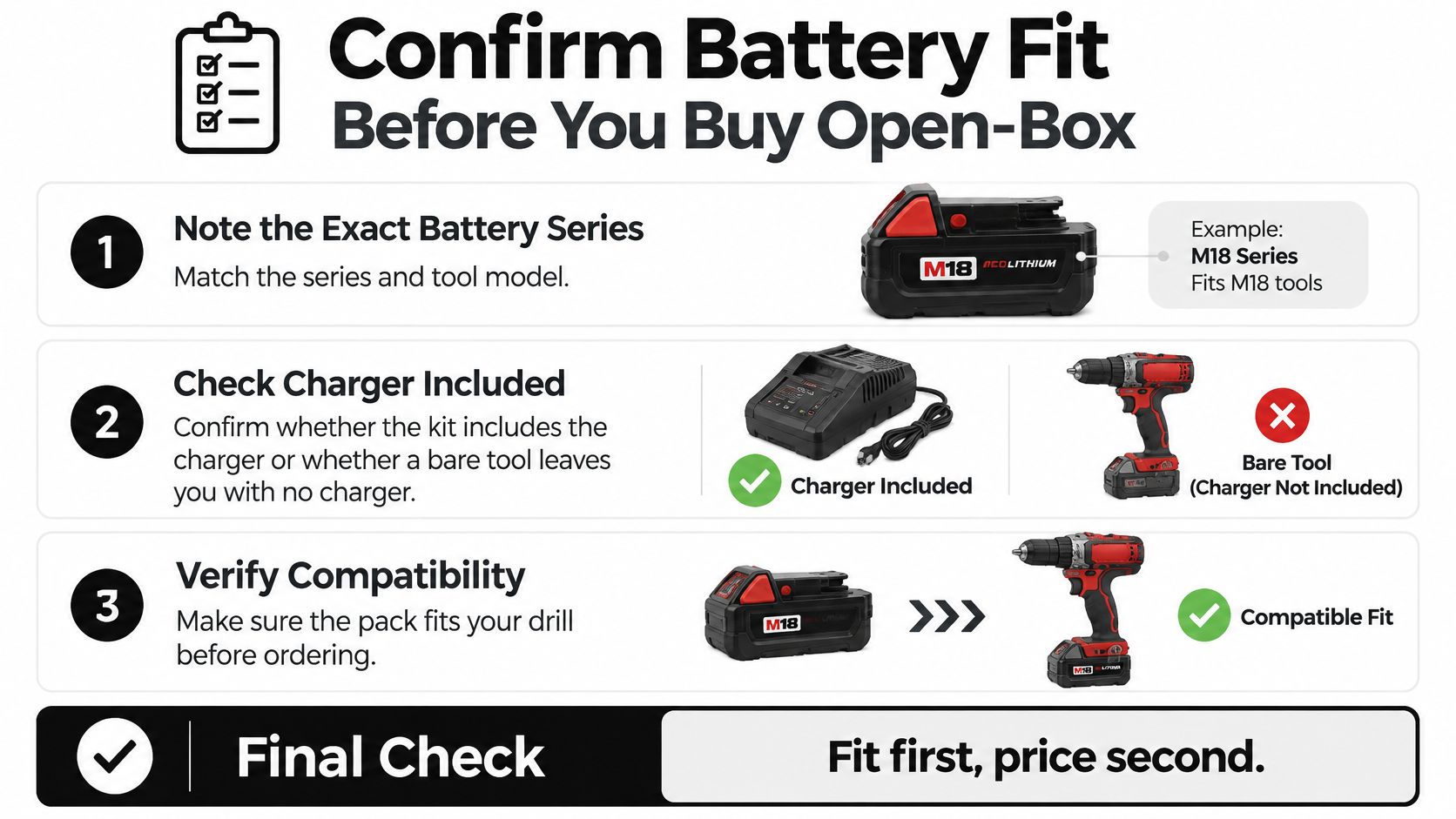
- Note the battery series: Match the exact series and tool model, not only the voltage printed on the pack.
- Check the charger: Confirm whether the kit includes one. A bare tool leaves you buying the battery and charger separately.
- Inspect the condition: Read the open-box description and check photos for swelling, cracks, or terminal damage.
- Check the test and markings: Look for certification marks and a clear condition grade in the listing photos and text.
- Verify the platform: Confirm the listed battery is approved for your drill before checkout.
Value Tools Co sells DeWalt, Husky, Milwaukee, Makita, Ridgid, and Ryobi tools, including open-box and bare-tool options at up to 55% off retail price. The store works on a concise 2-day return window. Confirm the current return terms on the product page before ordering. For a closer look at condition and terminology, see the guide to what an open-box item is.
Order the battery whose amp-hours fit the workload and whose charger matches the drill battery system. Run it through a full shift on day one. Heat, heavy pull, and a weak cell show up fast under real load.
For an open-box drill, bare tool, or replacement battery, Value Tools Co offers options from established tool brands, with savings of up to 55% off retail price. Compare the battery series, charger, and return terms before buying, then visit Value Tools Co to find a drill setup that fits your work and your budget.


