

A 20V 5.0Ah pack stores about 100 Wh, roughly 2.5 times the roughly 40 Wh in a 20V 2.0Ah pack before losses, temperature and age, a comparison based on nominal energy in Consumer Reports cordless drill testing. That math sets the ceiling for cordless drill battery life. Your hole size, material, trigger time and jobsite heat decide how much of that energy you get as finished work.
Runtime by Pack Size at a Glance
Runtime per charge depends on stored energy and workload, so compare packs in watt-hours, not amp-hours alone. Multiply volts by amp-hours to get a useful nominal estimate. A 20V 2.0Ah battery holds about 40 Wh. A 20V 5.0Ah battery holds about 100 Wh. The 3.0Ah, 4.0Ah and 6.0Ah values below are calculated the same way, 20V multiplied by amp-hours.
Don't confuse that one-charge runtime with cycle life. Runtime tells you how much work one full pack finishes today. Cycle life tells you how many full equivalents you can draw and recharge over the pack's working life. A big pack can win on runtime and still wear out early if it's stored hot or charged while heat-soaked.
Approximate energy and best-fit work by 20V pack size
| Pack (20V) | Stored energy (approx. Wh) | Capacity vs 2.0Ah | Best-fit work |
|---|---|---|---|
| 2.0Ah | about 40 | 1.0x | Overhead fastening and short punch-list work |
| 3.0Ah | about 60 | 1.5x | Light remodeling and mixed trim work |
| 4.0Ah | about 80 | 2.0x | General construction and framing screws |
| 5.0Ah | about 100 | 2.5x | Remodeling and repeated drilling in framing lumber |
| 6.0Ah | about 120 | 3.0x | Extended drilling and mixed-tool days |
How to Read the Table on a Real Job
Pick the smallest pack that finishes a normal work block without a swap. A 2.0Ah pack keeps a drill light overhead for cabinet hardware, fixtures and punch-list items. A 3.0Ah pack adds breathing room for light remodeling without the bulk of a large case. A 4.0Ah pack suits general construction and framing screws where you alternate drilling and layout.
Use a 5.0Ah pack for repeated holes in framing lumber, deck work and longer remodeling runs. Choose a 6.0Ah pack when one battery also feeds a saw or impact driver across a mixed-tool day. The trade-off is weight, balance and recharge time, so bigger isn't automatically better.
Why Stop-and-Go Testing Matters
Consumer Reports cycles drill batteries on and off instead of running them continuously with no load. That matches deck building and remodel work better because you drill, stop, reposition, change bits and start again. A no-load runtime claim can look strong and still disappoint once dense material and larger fasteners raise current draw.
Run your own check before a big job. Drill the same number of holes, with the same bit, in the same material, and time each pack.
That simple test beats comparing voltage labels. It also exposes an older pack whose capacity has faded, even if its case looks clean and its gauge lights up normally.
What Shortens Runtime on the Same Pack
The same battery can look generous on trim work and weak on framing. Current draw drives that difference. Short pilot holes and quick fastening bursts sip energy. Dense stock, wide bits and long fasteners pull harder for longer, so fewer holes fit inside the same watt-hours.
The Main Drains
- Large-diameter holes: Repeated holes in framing lumber or masonry keep the motor loaded and hot.
- Long screws at high torque: Structural screws and lags demand sustained current near the end of each drive.
- High clutch with repeated stalls: Every stall wastes energy as heat instead of turning the fastener.
- Continuous trigger time: Back-to-back drilling gives the pack little rest between high-current pulses.
- Dull bits and forced feed: A dull bit extends each hole, so you spend more trigger minutes for the same result.
A brushless, sin escobillas, drill generally uses each charge more efficiently because electronic controls can reduce wasted energy. I would favor brushless for daily work, but I wouldn't expect motor type to erase workload. Our guide to brushless versus brushed motors covers that trade-off in detail.
Estimate the Day Before You Leave
Count expected holes by diameter and material. Then estimate trigger minutes, giving large holes and long screws more weight than pilot holes. Match that total to a pack size and carry one spare, rather than planning to empty a single battery exactly at quitting time. On a hot afternoon, plan from the low end of your estimate.
Weight belongs in that decision too. A 6.0Ah pack hurts less on a bench or low framing than it does during overhead installation. If fatigue slows your feed or makes you brace awkwardly, the smaller 2.0Ah or 3.0Ah pack can produce cleaner, faster work even with a mid-morning swap.
Practical rule: Buy runtime for the heaviest repeated task in your week, not for the easiest task you did last month.
How Many Charge Cycles a Pack Lasts
A cycle is the equivalent of using 100% of capacity, even if you spread that use across several partial discharges. Two half discharges followed by recharges add up to roughly one full cycle. Keep a simple tally if you want to track a hard-working pack instead of guessing from its purchase date.
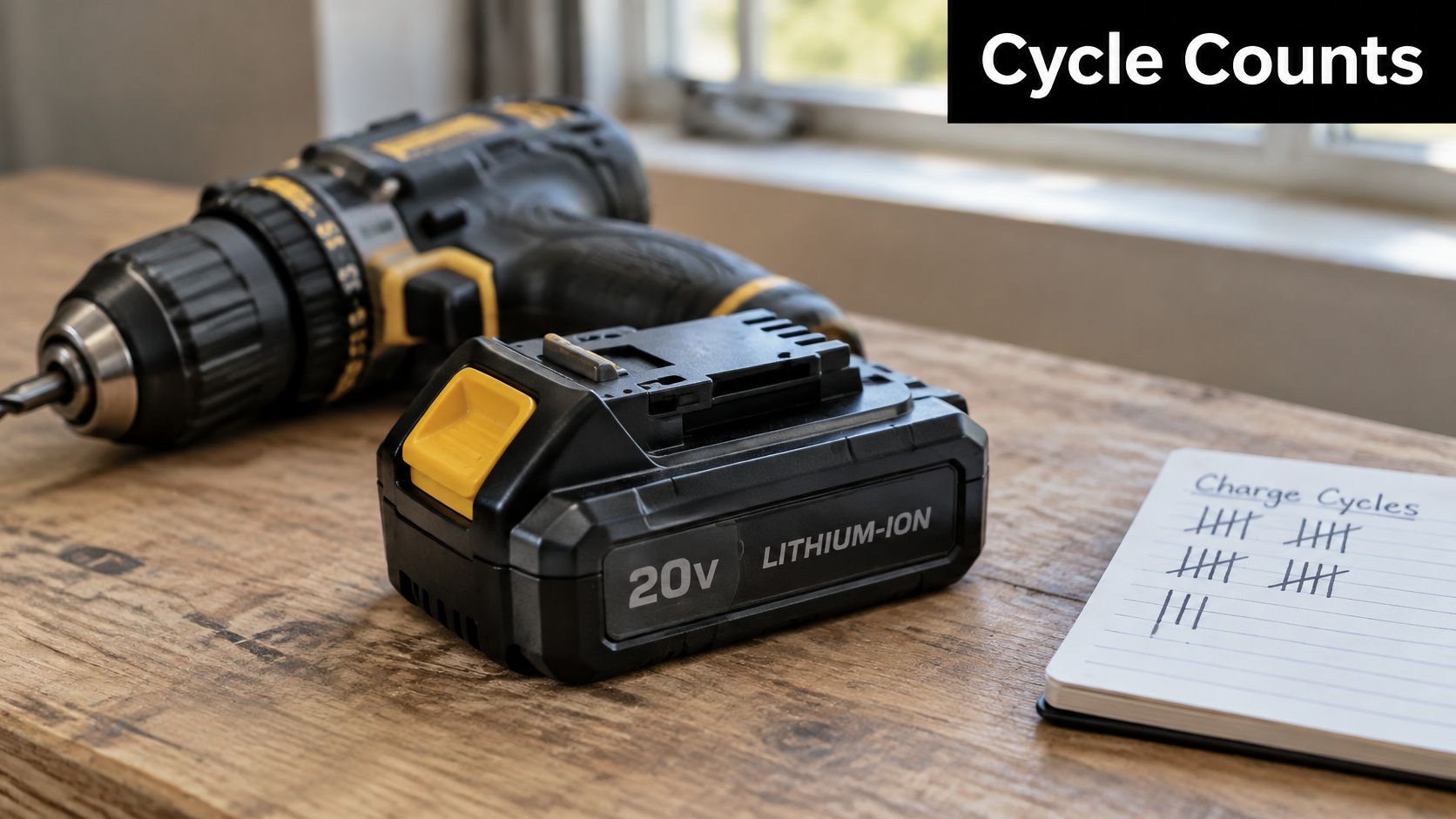
The Pacific Northwest National Laboratory review reports that lithium-ion batteries commonly withstand approximately 500 to 1,000 full charge-discharge cycles, depending on chemistry and operating conditions. It also reports an LFP battery string operating through more than 700 complete cycles with stable performance, while NMC and NCA systems showed measurable degradation under comparable testing.
Reported lithium-ion cycle performance by chemistry
| Chemistry | Reported equivalent full cycles | Testing note |
|---|---|---|
| Lithium-ion (general) | roughly 500 to 1,000 | Depends on chemistry and operating conditions |
| LFP | more than 700 complete cycles | Stable performance in PNNL testing |
| NMC | Not reported as a numeric range | Measurable degradation under comparable testing |
| NCA | Not reported as a numeric range | Measurable degradation under comparable testing |
Treat those figures as laboratory context, not a promise for a specific drill pack. Tool batteries face high-power pulses, heat, vibration and irregular storage, and each of those pulls real-world cycle counts below the controlled-test number. A pack that lives in a hot truck ages faster than the same pack kept cool, so where the battery rests between tasks matters as much as how hard it works. Many tool batteries also don't print their cell chemistry, so don't assign an LFP range to an unlabeled pack. Our overview of lithium-ion battery advantages explains why chemistry and care need to be judged together.
This short video adds a useful visual check on how a pack behaves as it ages.
Capacity loss feels ordinary at first. A pack retaining 80% of original capacity may still run normally but provide shorter runtime and need more frequent charging. The drill doesn't suddenly become useless. Your crew just swaps batteries more often and loses productive minutes on demanding work.
Judge retirement by output. When a standard task that used to finish on one charge no longer finishes, that pack has reached the end of its useful productive life for that job. Demote it to light fastening or replace it. Keep a sound spare so one aging battery doesn't stop the day.
Heat, Storage and Charging Habits in Northern California
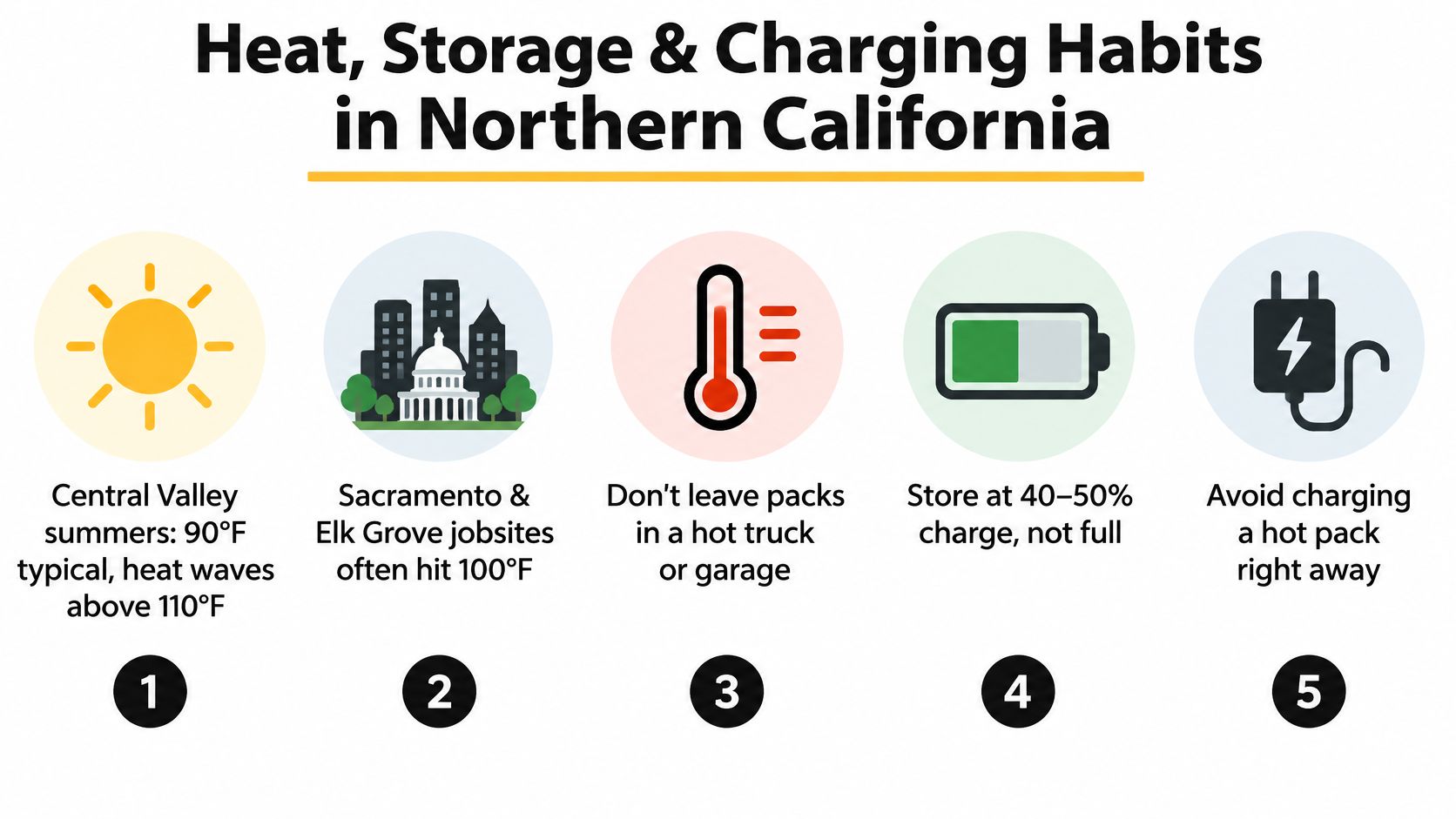
Heat changes the runtime math across Sacramento and the Central Valley. NOAA's Central Valley climate summary describes summers as hot and dry, with normal daytime temperatures around 90°F and occasional heat waves above 110°F. Sustained high temperature ages lithium-ion cells faster: capacity falls sooner, and a pack can feel strong at idle yet sag earlier once a large bit or long screw raises current.
Runtime is never just an amp-hour number. A 2.0Ah or 3.0Ah compact pack reaches working temperature faster under high current because each cell carries a larger share of the load. A 5.0Ah or 6.0Ah pack spreads that demand across more cells and usually holds voltage better, but shade and airflow still decide whether it stays productive through the afternoon.
Jobsite Heat Checklist
- Shade every spare: Keep packs in a ventilated case, out of direct sun and off hot asphalt.
- Skip the truck cab: Don't leave batteries in a parked cab or closed tool box during heat-wave afternoons.
- Cool before charging: Let a hot pack lose heat before it goes on the charger.
- Rotate under continuous load: Swap in a cooler pack instead of immediately recharging the hottest one.
- Give the charger airflow: Set it in a shaded, dry, ventilated spot away from generators and compressors.
Our guide to cordless tool battery storage fits the same routine between jobs. Avoid storing packs at full charge in a hot vehicle. Keep contacts clean and dry because poor terminal contact adds resistance and heat under load. Remove a finished pack from the charger unless the manufacturer explicitly supports leaving it there.
Cold Mornings and Hot Afternoons
Temperature cuts both ways. Bring a pack from a cold truck to a stable indoor temperature before charging or hard use. A cold battery can feel weak early, then perform normally after it warms gradually. Don't force that warmup with a heater or cover a charger with clothing, insulation or sawdust.
If a pack is too hot to keep in service, resting it is productive. Forcing it through another charge-discharge round spends future runtime to save a few minutes now.
For Sacramento and Elk Grove crews, rotation works only when the second pack is already on site before the first one heat-soaks. Keep the spare charged, shaded and dry, then swap before the hot pack stalls the drill.
Diagnosing a Battery That Runs Short
Start with the gauge problem. A fuel gauge indicates stored charge, not the power a pack can deliver under load. A battery can show full, start strongly, then sag and shut the drill down early when a large bit or long screw raises demand. Loaded performance is the evidence that matters.
Drill battery symptoms, causes and fixes
| Symptom | Likely cause | Fix |
|---|---|---|
| Runtime drops sharply after weeks of heavy use | Capacity or resistance loss from age or heat | Run a load test and retire the pack from heavy work if it cannot finish a standard task |
| Pack heats fast and cuts out under load | High current, a hot pack or poor terminal contact | Rest the pack, clean and dry the contacts, then rotate batteries |
| Gauge shows full but drill dies early | Fuel gauge reports charge, not power under load | Judge the pack by loaded runtime instead of the gauge |
| Charger runs hot or charging is slow | Warm pack or hot charging area | Let the pack cool and move the charger into shade and airflow |
| Weak only on cold mornings | Higher internal resistance at low temperature | Bring the pack to stable indoor temperature before use |
| Swelling, cracking or terminal corrosion | Damaged cell or terminals | Stop using the pack and dispose of it under local rules |
Run a Controlled Load Test
Pick one standard task, such as a set number of holes in the same framing material with the same bit. Run the suspect pack, then repeat with a known-good pack in the same drill. A difference of a few holes can be normal variation from feed pressure or wood density. A suspect pack that can't finish a job it previously handled points to capacity loss or rising resistance.
Fix the environment first. Cool the pack, clean the terminals, move the charger and retest under the same conditions. If performance returns, you found an operating problem rather than a dead battery. If it still heats quickly and sags under the same load, retire it from demanding drilling.
Safety overrides troubleshooting. Stop using a pack with a swollen case, cracked housing or corroded terminals. Don't pry it open or keep testing it to squeeze out another day. Dispose of it under local rules and replace it with a tested pack.
Inspecting Used and Open-Box Batteries Before You Buy
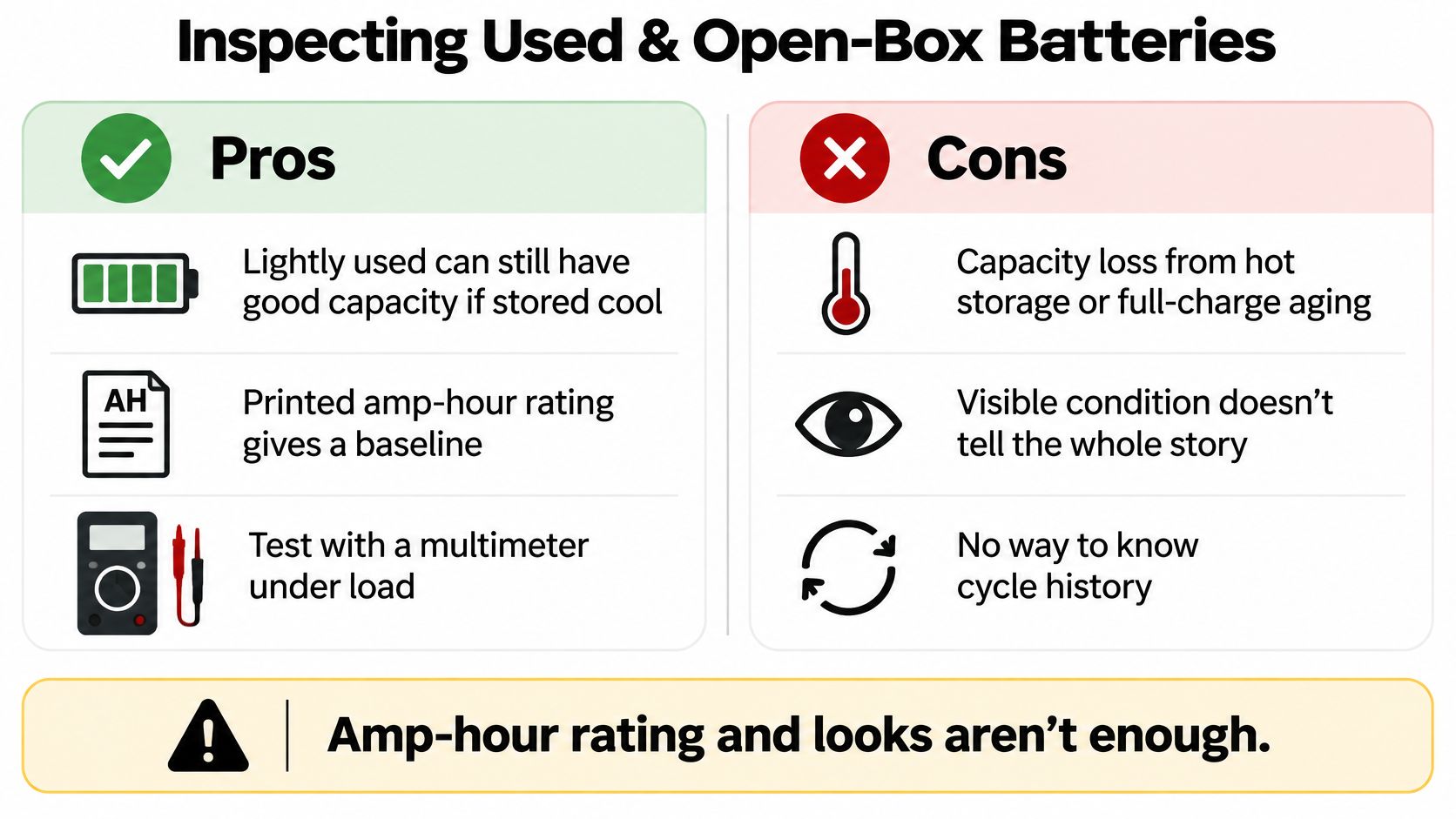
A clean case doesn't prove a healthy battery. Aging continues during storage, and heat plus high state of charge can reduce capacity before a pack does much drilling. A study of commercial lithium-ion cells in harsh Saudi Arabian summer conditions found that direct sunlight, glass-covered storage and 100% charge produced up to a 6% decline in state of health and a 6.5% increase in internal resistance over only two months.
That's the trap with an apparently unused bargain. The printed amp-hour rating tells you the original class. It doesn't tell you whether the pack spent a summer in a hot vehicle. A lightly used pack stored hot and fully charged may be less dependable than a heavily used pack stored under moderate conditions.
Buyer Inspection Checklist
- Ask about storage: Avoid packs kept in direct sun, under glass or in a hot vehicle.
- Inspect the shell: Reject swelling, cracks, loose latches and damaged rails.
- Check terminals: Look for corrosion, bent contacts and debris.
- Test under load: Measure runtime or loaded behavior, not just gauge lights.
- Watch heat and sag: Rapid heating or a sharp drop under load suggests resistance growth.
Pros and cons of used and open-box drill packs
| Pros | Cons |
|---|---|
| Lower price on tested and inspected open-box packs | Unknown cycle history and possible capacity loss |
| Tested inspection and returns reduce purchase risk | A bare tool is only a deal with a compatible pack and charger already owned |
| Visible condition can confirm no physical damage | Hot or full-charge storage can cut capacity even when the pack looks unused |
A bare tool, herramienta sola, makes sense only when you already own a compatible, tested pack and charger. Otherwise, price the full system before calling it a bargain. I would pay for inspection and a clear return path before I paid extra for a spotless label.
Who This Is For and Who Should Avoid It
Who This Is For
This planning fits professional contractors and remodeling crews running a drill, impact driver (atornillador de impacto) and saw on one platform. It also fits property managers and on-site handymen in Sacramento and Elk Grove who need a dependable spare during tenant turns. DIY homeowners upgrading a toolkit on a budget benefit when they match pack size to repeated work instead of buying the largest battery by default.
These readers gain from carrying one spare, rotating packs during heat and judging an aging battery by a standard task. Platform compatibility matters because one sound battery system can cover drilling, fastening and cutting without duplicate chargers.
Who Should Avoid This
Homeowners who drill a few holes a year don't need an elaborate rotation plan. Any healthy pack covers picture hanging and occasional assembly, and a second battery may age unused. Anyone doing sustained high-torque masonry drilling all day may need a larger platform or a corded tool rather than more compact packs.
Skip a bare-tool purchase if you haven't chosen a platform or don't own the right charger. Also avoid buying from a printed runtime figure alone if your work mixes masonry, framing lumber and long structural screws. No single number covers those loads.
Pick a Pack Size and Rotation Plan Before Your Next Job
A pack sized for your heaviest work block, plus one spare, beats a single large battery run flat twice a day. For remodeling and framing crews, I recommend two 4.0Ah or 5.0Ah packs on one platform plus one charger. Rotate them on heavy days. High-temperature aging research hosted by OSTI found lithium-ion cells exposed to 40 to 70°C for weeks experienced reduced power capability and marked capacity loss, so on a Central Valley jobsite the charging station needs shade, dry air and ventilation.
A pack that felt adequate in April can run short in August. Heat speeds the aging that steals runtime, which is why cooling and rotation belong in the plan from the start rather than as a fix after a battery quits mid-task.
- Count the work: List holes by diameter and material, weighting large holes and long screws most heavily.
- Choose with a spare: Select the pack size that covers a work block without depending on one battery.
- Rotate and cool: Keep the spare shaded and let a hot pack cool before charging.
- Retest before retiring: Fix heat or contact problems, then replace a pack that still can't finish a standard task.
- Buy bare carefully: Choose a herramienta sola only when a compatible tested pack and charger are already in hand.
Value Tools Co sells DeWalt, Husky, Milwaukee, Makita, Ridgid and Ryobi across Hand tools, Power tools and Drills & Drivers, with top-brand power tools, accessories and hardware at up to 55% off retail price. Browse the Drills & Drivers and Power tools categories to compare packs, chargers and bare tools on one platform before your next job.
Cordless Drill Battery Life FAQ
How long does a 20V cordless drill battery last on one charge
A 2.0Ah pack stores about 40 Wh and a 5.0Ah pack about 100 Wh, but hole size, material and trigger time set real runtime. Run a timed test on your own task.
How many charges does a cordless drill battery last
Lithium-ion cells are commonly rated for roughly 500 to 1,000 full cycles in laboratory testing. Judge a tool pack by whether it still finishes a standard job.
Why does my drill shut off when the battery shows full
The gauge reports stored charge, not power under load. A high-resistance pack can show full and still cut out early.
Does heat shorten cordless drill battery life
Yes. Cells aged at 40 to 70°C can lose 20 to 30% of power capability, so shade spare packs and cool hot packs before charging.
Is a bare tool a good deal
Only when you already own a compatible, tested pack and charger.
Stop guessing from the amp-hour label and build your next drill setup around tested runtime, a shaded rotation plan and a spare pack that fits your platform. Visit Value Tools Co to compare open-box drills, drivers and accessories, then choose the pack size that finishes your work without forcing a hot battery back onto the charger.


