

Buying the cordless demolition hammer with the highest voltage or biggest joule rating isn't a reliable way to buy the right breaker. Choose by the material you need to remove, the time the trigger stays down, and the dust, heat and vibration controls the job requires. For scattered remodel work, cordless can save setup time; for continuous slab demolition, reliable power delivery matters more than freedom from a cord.
Cordless vs Corded Demolition Hammers Side by Side
A cordless demolition hammer suits punch-list demolition, remodel work and occupied buildings where outlets and trailing cords slow the crew. A corded hammer remains the more straightforward choice when the same tool will break slab most of the shift.
Cordless vs corded demolition hammers by job factor
| Factor | Cordless | Corded |
|---|---|---|
| Power supply | Battery pack, no cord or generator | Outlet or extension cord |
| Runtime | Limited by pack count and charge | Continuous while power is on |
| Setup time | Charge and swap packs, minimal setup | Cord routing and outlet access |
| Sustained output | Can drop as packs heat or deplete | Steady with adequate power and required tool breaks |
| Access in occupied spaces | Strong, no trailing cord | Cord management needed |
| Best-fit work | Punch-list, remodel, intermittent chipping | Slab and foundation breaking all day |
Both types deliver repeated impacts through a bit. The meaningful difference isn't whether a battery-powered hammer can hit hard, but whether its power system can support the amount of breaking you've priced.
In 2026, Makita reported that its GMH02PM cordless demolition hammer delivers up to 15% faster breaking than its corded HM1213C, according to the White Cap product listing. That's a model-specific comparison, not proof that every cordless breaker beats a corded alternative or maintains that advantage across a full shift.
The practical trade-offs by power type
- Cordless advantages: Mobility, quick deployment and no generator or trailing supply cord. It's easier to move between occupied rooms without routing electrical leads through doorways.
- Cordless disadvantages: Battery cost, charging downtime and limited runtime. Hot packs can interrupt production even when charged spares are available.
- Ideal cordless user: A remodeler, utility technician or maintenance crew doing intermittent work.
- Corded advantages: Steady power without a battery-change schedule. The purchase doesn't require a separate stock of large packs.
- Corded disadvantages: Outlet dependence, extension-cord management and trip hazards. Poor power access can erase its setup advantage.
- Ideal corded user: A crew assigned to sustained slab or foundation breaking.
Compare the complete setup, not just the bare-tool price. A cordless bargain stops being cheap if the crew needs additional batteries and a charger before it can finish the first job.
Selection rule: Choose cordless for intermittent, mobile work, including controlled indoor demolition. Choose corded when a hammer must run through most of the working day.
Impact Energy Ratings That Predict Real Breaking Output
Impact energy in joules is a manufacturer test value, not a removal rate. Read it alongside the bit interface, operating weight, battery platform and declared vibration value.
The reference classes are 7.1 J SDS-Max, associated with anchor and through-hole work around 12–40 mm, and 27.5 J (20.2 ft-lb) SDS-Max, associated with heavier breaking; the DeWalt demolition-hammer reference provides the impact-energy comparison. These are selection classes, not specifications to transfer to an unrelated model.
| Reference specification | Lighter SDS-Max class | Higher-output SDS-Max class |
|---|---|---|
| Best application | Controlled chipping, tile and lighter concrete | Slab, foundation and heavy masonry |
| Buying priority | Control and manageable operating weight | Breaking capability and sustained power support |
| Main trade-off | Slower on substantial concrete | More tool to carry, position and control |
| Ideal buyer | Remodeler doing selective removal | Contractor handling localized heavy breakout |
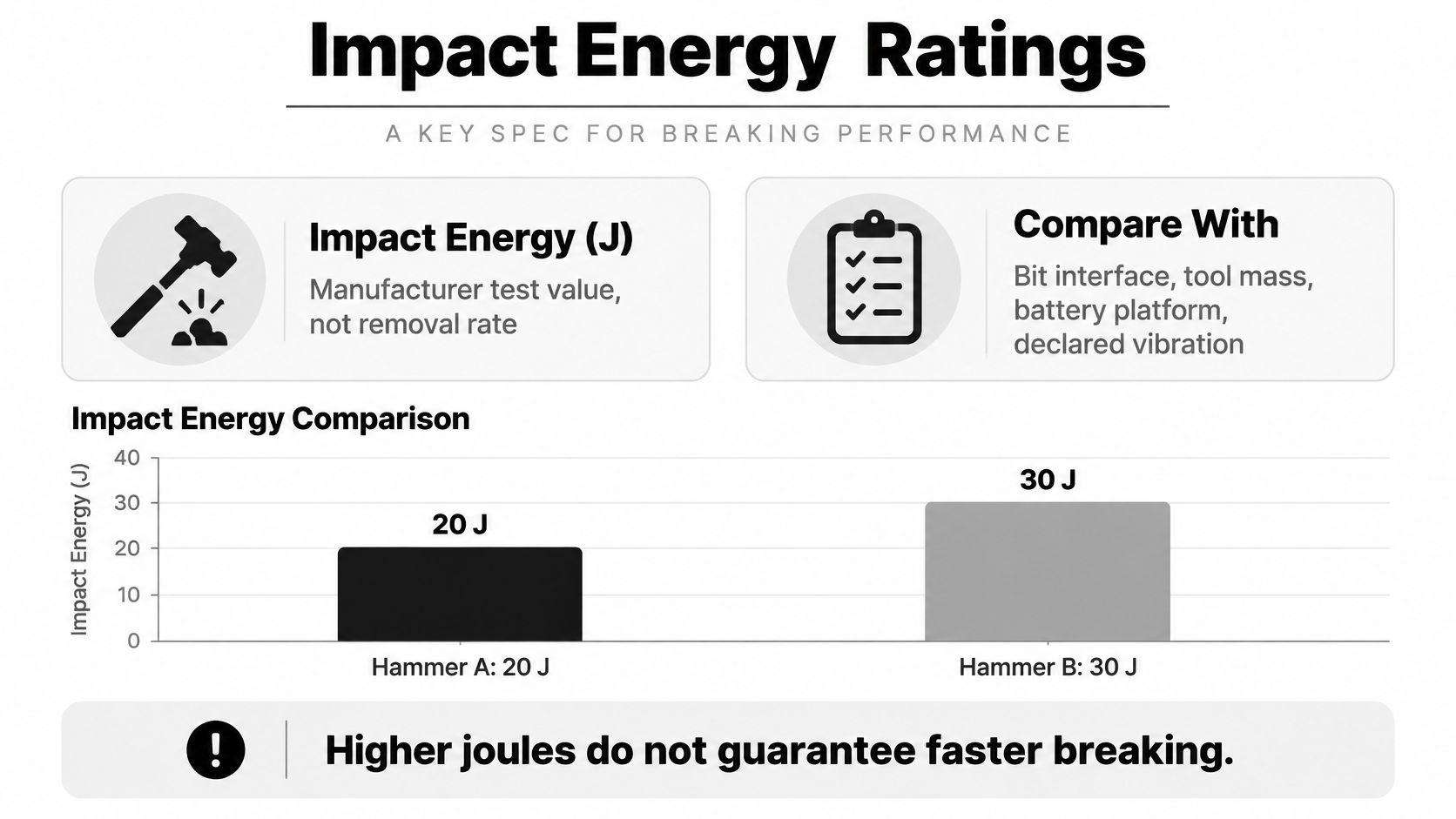
Treat illustrative chart bars as an explanation of the relationship, not as additional product specifications. A larger impact-energy number doesn't establish how quickly a particular hammer will remove your concrete.
Run a material-removal test before standardizing
A sharp chisel working near a free edge can outperform a dull point driven into the middle of confined concrete. Concrete strength, aggregate, operator pressure, battery output, thermal management and duty cycle all affect the result.
Use a repeatable field comparison:
- Select representative material. Test the substrate the crew encounters, with comparable thickness and access.
- Log trigger time. Record breaking minutes per fully charged battery, separately from positioning and cleanup.
- Count battery changes. Include cooling and charging delays in the production record.
- Measure completed removal. Record area at a consistent depth or volume removed per pack.
- Compare another candidate. Use equivalent bit condition and the same removal objective before committing to a fleet purchase.
Don't lean harder just because progress slows. Excess feed pressure can make the tool harder to control without producing useful fracture.
Handle isolation and balance deserve the same attention as impact energy. A powerful hammer that leaves the operator fighting its weight or vibration can be a poor buy for wall work, even if it breaks a floor test patch quickly.
Completed work per charged battery is the useful purchasing benchmark. Peak joules help establish the class; the field test should decide the purchase.
Battery Platforms, Runtime and Heat Limits
Sacramento and Central Valley summers can exceed 100°F, making battery cooling part of the production plan rather than an afterthought, as described in PRISM's lithium-ion hand-tool guidance. Heavy use, dust, vibration and high ambient temperatures increase the risk of overheating and battery damage.
Keep spare packs shaded and ventilated. Don't charge a hot pack or place the charger in an overheated enclosure, and allow a discharged pack to cool before charging.
Use a cooling rotation, not a battery race
For a three-pack working routine:
- Keep a suitable pack in the hammer. Follow the tool's approved battery requirements.
- Set the discharged pack aside to cool. Keep it away from direct sun and combustible debris.
- Charge a cooled pack. Rotate only when the battery and charger permit it.
This routine isn't a promise of uninterrupted operation. If the tool consumes energy faster than the charger can replace it, or the packs remain hot, the crew still needs downtime or another power source.
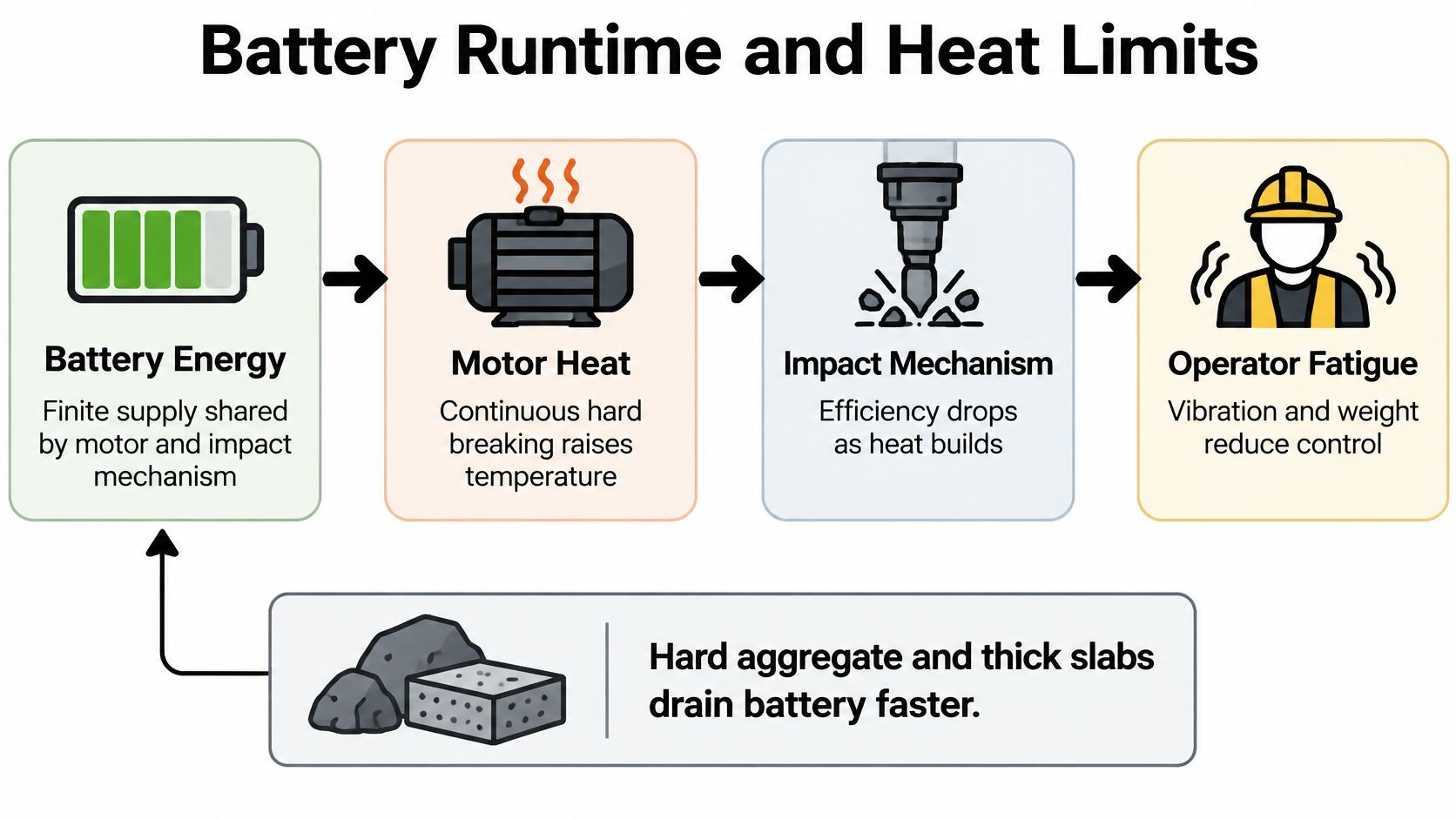
Stop using any pack showing swelling, leakage or unusual odor. Smoke is an emergency warning, not a cue to try another charger; keep people clear and follow the site emergency procedure.
Buy usable energy, not just a voltage label
The battery supplies the motor and impact mechanism, while the operator manages the resulting weight and vibration. Hard aggregate, thick concrete and unproductive downward pressure can consume charge without delivering proportional removal.
Higher-output platforms can support heavier breaking, but voltage alone doesn't establish capability. Amp-hours must be considered with voltage, approved pack compatibility and the manufacturer's specified battery configuration.
Milwaukee's 2005 V28 lithium-ion platform was an early full-size professional system that helped make demanding cordless applications practical, as described by Electrical Contractor's lithium-ion history. Modern battery breakers grew from that shift, but they still operate within a finite energy budget.
A bare tool makes sense when suitable batteries and chargers already belong to the crew. A kit may offer better overall value when the hammer needs larger packs than the drills and drivers already on the truck.
A brushless motor is worth considering, but it doesn't override battery compatibility, cooling requirements or service support. The best fit remains a remodeler, utility worker or maintenance team doing intermittent chipping away from reliable power.
Battery Platforms Compared by Brand
Major battery platforms for cordless demolition hammers
| Platform | Voltage families | What to verify before buying |
|---|---|---|
| DeWalt | 20V MAX and 60V FLEXVOLT | Exact pack fit, approved capacity, pack count and model-specific runtime |
| Makita | 18V LXT and 40V max XGT | Platform fit, required battery configuration and runtime with the specified packs |
| Milwaukee | M18 and MX FUEL | Exact platform compatibility, charger requirements and tested runtime |
These are platform families, not a promise that every battery fits every hammer carrying the same brand. Our power-tool battery compatibility guide helps separate brand recognition from actual electrical and mechanical compatibility.
Check three things before buying: whether your packs fit the exact model, whether they're approved for its required output, and whether the listed package includes the necessary charger and batteries. Read the manufacturer's runtime claim against the specific pack used in testing.
Match the existing fleet without forcing the fit
A bathroom remodeler with compatible packs may save money by purchasing a platform-matched chipping tool. That doesn't mean the crew's compact drill batteries are a sensible power supply for heavier demolition.
A foundation crew should compare the complete high-output cordless setup against a corded breaker before buying another battery ecosystem.
Stay with the platform already earning its place on the truck, unless its approved packs and charging capacity can't support the breaking work.
SDS-Max vs Hex Shank Bit Systems
Shank systems and their typical demolition use
| Shank system | Typical tool class | Typical job | Main limit |
|---|---|---|---|
| SDS-Max | Heavy rotary and demolition hammers | Slab, foundation and heavy masonry breaking | Heavier bits and higher cost |
| SDS-Plus | Compact rotary hammers | Anchor holes and light chipping | Too small for heavy breaking |
| 1-1/8 in. hex | Heavy demolition hammers | Moil points and chisels for heavy breaking | Confirm the exact chuck before buying |
| 3/4 in. hex | Light chipping and demolition hammers | Tile removal and small chisels | Not a substitute for a slab breaker |
A demolition hammer transfers impact through its piston mechanism and tool shank rather than relying on drilling rotation. The shank determines what fits; the complete hammer determines how much useful breaking that bit can deliver.
Don't buy a chisel because its working end looks right. Confirm the interface, retention arrangement and approved accessory dimensions against the exact tool model.
Keep the bit working in line
A point concentrates force to start cracks. A flat chisel directs or spreads impact for scaling, trenching and lifting tile; a broad tile chisel can improve control when the objective is to separate finishes without excavating the substrate.
Keep the bit aligned with the cut and let the hammer strike. Don't use the tool as a long pry bar or twist it sideways to release a trapped chisel, because those loads work against the shank, chuck and internal components.
For clean anchor holes, choose a rotary hammer in hammer-drill mode. A dedicated demolition hammer isn't a drilling substitute.
Check accessories before paying
- Confirm the shank: Match the tool's specified interface, not merely the brand.
- Choose useful length: Allow enough reach without carrying unnecessary weight.
- Carry a sharp spare: A dull chisel wastes battery time and encourages excessive feed pressure.
- Test retention: With the battery removed, check that the chuck locks and retains the accessory as the manual describes.
- Inspect wear surfaces: Look for damaged shanks, cracked boots and contamination around the holder.
SDS-Max accessories generally impose more weight and cost than compact SDS-Plus equivalents. That matters when lifting the hammer onto a wall or controlling it above waist height.
For open-box equipment, inspect the holder and seals as carefully as the housing. A clean exterior doesn't establish the condition of the impact mechanism or vibration-control system.
Which Cordless Demolition Hammer Fits Each Task
Choose the hammer class by the task, not the brand or voltage. Selective removal rewards control, while substantial concrete breakout requires enough impact capability to fracture the material without prolonged unproductive hammering.
Task-to-hammer matrix for cordless demolition work
| Task | Typical material | Hammer class and bit | Dust control |
|---|---|---|---|
| Tile and thinset removal | Ceramic tile on mortar bed | Light chipping class with flat chisel | Compatible shroud and extraction, or an appropriate wet method |
| Mortar raking | Brick and block joints | Light class with narrow chisel | Task-compatible capture or wet control; respiratory protection where required |
| Electrical or plumbing chases | Block and concrete walls | Light chipping class with flat chisel | Controlled cutting and tool-compatible extraction or wet methods |
| Concrete patch chipping | Slab edges and curbs | Heavy class with point or flat chisel | Appropriate extraction or wet control; isolate the work area |
| Slab and foundation breaking | Structural concrete | Heavy class with moil point | Task-specific wet control or extraction and exposure assessment |
| Enclosed-room demolition | Mixed interior finishes | Controlled light class with flat chisel | Tool-mounted extraction, containment and ventilation; stop if controls fail |
The matrix is a planning aid, not a silica-compliance determination. Choose the applicable control method for the actual tool, task, location and duration before work starts.
Bathroom removal versus driveway repair
Consider a remodeler replacing a bathroom floor in an occupied Elk Grove home. A manageable cordless chipping tool lets the operator move between the bathroom and kitchen without running a supply cord through the living space.
The purchase should favor a controllable flat chisel, comfortable working angle and a compatible dust shroud. A large floor breaker is the wrong bargain if it damages the substrate the crew intended to preserve.
Now consider a driveway-edge repair involving continuous breakout through a substantial slab. A corded or pneumatic hammer provides a more practical route to sustained production, while a cordless unit can handle isolated corners or cleanup.
Decide whether you need drilling or demolition
Before cutting electrical or plumbing chases, locate services and establish the authorized removal limits. Don't turn a narrow chase into uncontrolled structural demolition because a larger hammer makes removal easier.
Our hammer-drill and demolition-tool guide helps distinguish drilling, combination-hammer work and dedicated breaking.
For enclosed-room work, the dust-control requirements under Silica, Noise and Vibration Rules Before You Start Breaking must be resolved before the first impact. Cordless access doesn't make an occupied room an acceptable uncontrolled work zone.
Silica, Noise and Vibration Rules Before You Start Breaking
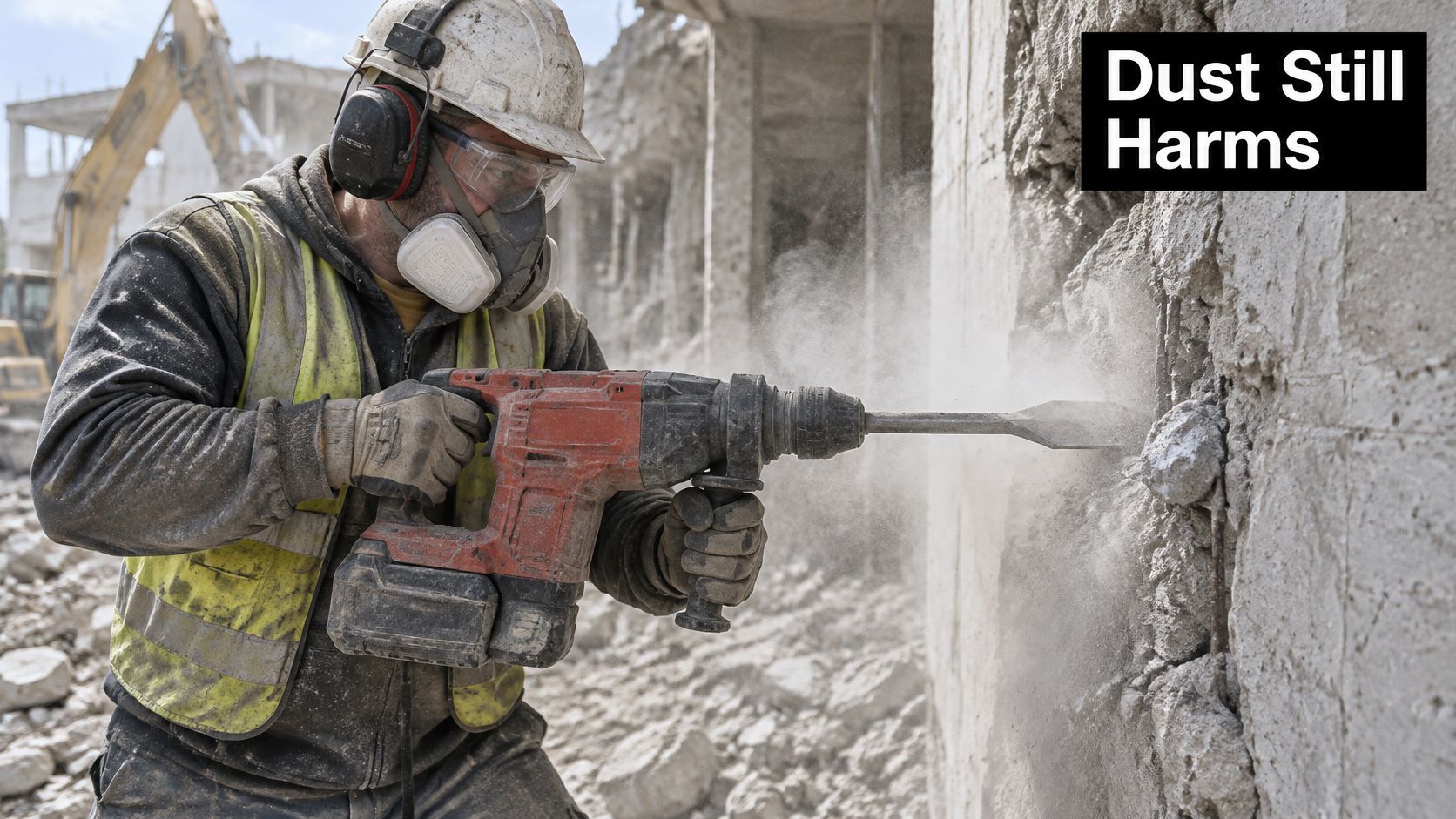
Cordless removes the cord, not the silica, noise or vibration hazard. Dust collection and exposure planning belong in the buying decision, alongside the hammer and batteries.
OSHA treats handheld powered demolition hammers with bushing tools as handheld powered chipping tools, and its construction silica FAQs identify an action level of 25 micrograms per cubic meter and a permissible exposure limit of 50 micrograms per cubic meter, each measured as an 8-hour time-weighted average. Don't substitute a general impression of cleanliness for an applicable control method or exposure assessment.
Protective equipment and capture at the work surface both matter.
Capture dust before it enters the room
A compatible tool-mounted shroud captures dust where the chisel strikes. A general shop vacuum sitting nearby doesn't provide equivalent capture, and a HEPA label alone doesn't establish that the complete setup meets the applicable requirements.
Use task-appropriate wet methods or commercially available extraction systems, maintain filters and airflow, and select respiratory protection according to the applicable requirements. Ventilation supports control but doesn't replace source capture.
For practical background on prevention and worker protection, consult the TP Training silica safety guide. Our dust-extractor selection guide can help identify equipment features to check against the hammer's extraction requirements.
Plan exposure, not just battery changes
OSHA's noise guidance identifies 85 dBA as a hearing-conservation concern and the construction permissible exposure limit as 90 dBA over 8 hours. The construction exposure table allows only 1 hour at 105 dBA and 30 minutes at 110 dBA, as reproduced in eLCOSH's construction-noise guidance.
European vibration guidance sets the hand-arm action value at 2.5 m/s² A(8) and limit value at 5.0 m/s² A(8), according to EU-OSHA's construction vibration guidance. Those are European benchmarks, not California legal limits; use them to understand why declared acceleration and actual trigger time both matter.
Cordless freedom can encourage longer sessions and more room-to-room work. Battery swaps aren't an exposure-control program.
- Stop for failed capture: Don't continue when required extraction or wet controls fail.
- Stop for migration: Visible dust entering adjacent rooms requires isolation and correction.
- Stop for unprotected people: Keep occupants clear and don't operate without required hearing protection.
- Control cleanup: Use appropriate vacuuming or wet cleanup rather than redistributing dust through dry sweeping.
Cordless Demolition Hammer Questions Answered
Can a cordless demolition hammer replace a corded one for every job?
No. A cordless hammer suits selective removal where moving freely matters. Sustained production can outpace battery capacity and charging, making a corded tool the more practical choice.
Can I use a cordless demolition hammer indoors without a vacuum?
Use the applicable silica-control method. Depending on the work, that may require tool-mounted extraction or an appropriate wet system, along with other specified protections.
How many batteries will a half-day slab session need?
There's no reliable universal pack count. Don't plan sustained slab breaking around one battery. Removal per charge, charging time and battery cooling all affect how much work you can complete.
Can it do the framing or fastening after demolition?
No. Use a framing nailer for framing and fastening, with fasteners specified by approved plans and local code. The nailer's magazine angle alone does not establish whether a fastener is suitable.
Is an open-box demolition hammer worth buying?
It can be, if the tool's operating condition and return protection are clear. Appearance alone won't tell you whether the vibration controls work. Check handle isolation, chuck retention and service availability before buying.
Who This Is For and Who Should Avoid It
Who This Is For
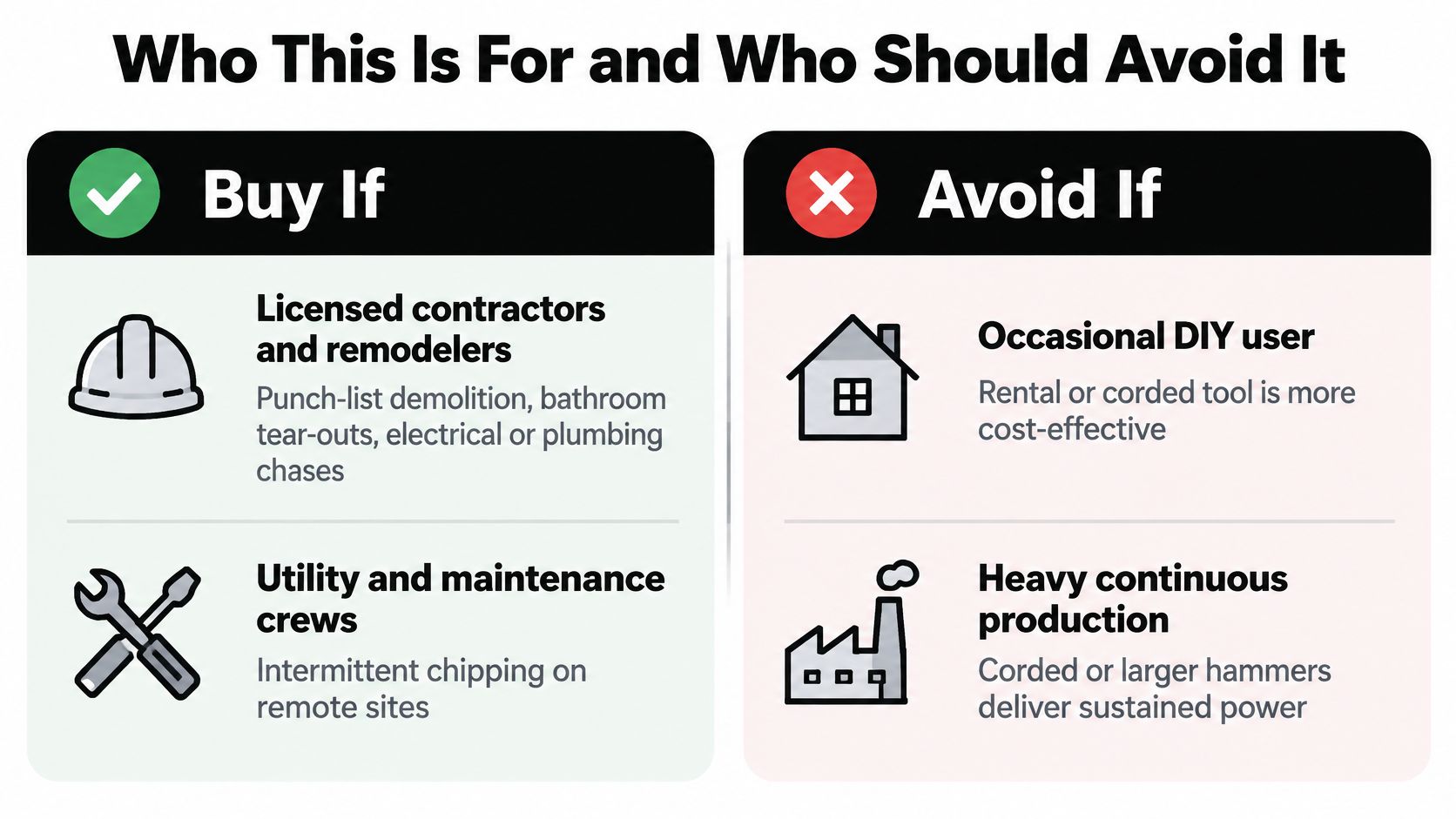
Cordless demolition hammers suit contractors and remodelers handling localized bathroom tear-outs, punch-list demolition, and service chases where a cord would restrict access. Utility crews, maintenance teams, and property managers may also value portability for isolated removal work.
A cordless hammer can make a small job easier to reach, but mobility can also make it easier to keep working. Weigh that against battery heat, vibration, dust exposure, and the need to pace the work.
Who Should Avoid This
Crews breaking slab continuously should favor corded or pneumatic equipment. A homeowner who only needs occasional anchor holes is usually better served by a rotary hammer or a rental.
Indoor masonry removal still requires appropriate silica controls. Structural and shear-wall alterations need approved details and qualified people; a more powerful hammer does not make an unsafe removal plan acceptable.
Make the complete purchase comparison
- Tool fit: Match the shank system, impact class, and operating weight to the work.
- Power support: Include approved batteries and a charger in the budget. Allow for pack cooling and charging delays.
- Operator protection: Compare declared vibration and sound values, and inspect the handle isolation components.
- Ownership cost: Check service-part availability, manufacturer warranty eligibility, and the seller's return terms separately.
Value Tools Co sells power tools from DeWalt, Husky, Milwaukee, Makita, Ridgid, and Ryobi, along with hand tools, appliances, and accessories. Its Power tools and Drills & Drivers categories include open-box and lightly used, fully functional items, with savings up to 55% off retail. Compare a tool-only price with the cost of a complete working setup before deciding which offer fits.
Value Tools Co offers free U.S. shipping on qualifying orders, a 2-day return window, and 24/7 support by email and a Sacramento-area phone line. Check the return terms before buying, particularly for an item whose battery, chuck, or vibration isolation may need close inspection.
For companion-tool selection, browse the angle grinder and cordless router buying guides. Abrasive cutting, routing, fastening, and concrete breaking call for separate tool choices.
The following video provides another visual reference for evaluating the tool category.
Buy cordless for controlled, intermittent removal where mobility saves setup time. Choose or rent a sustained-duty alternative when continuous breaking is the assignment.
Value Tools Co is an online and local retailer based in Elk Grove, California. Visit Value Tools Co to compare available tools and choose a setup suited to the material, workload, and dust-control plan.


