

There's a piece of advice that gets repeated in every tool aisle and every comment thread: buy the biggest bit set you can afford, because one day you'll need that odd size. That advice sells cases. It doesn't drive screws.
A set that earns its place in a pouch is a 1/4-inch hex group of impact-rated Phillips, square and Torx tips in the sizes your work calls for, plus spares of the two you burn through. Everything else in the box is either a backup or filler.
I judge a set on two things: whether the tip fills the recess completely, and what it costs per screw that seats clean. Piece count doesn't appear in either number.
Drive Styles That Belong in the Set
A useful impact driver bits set is a 1/4-inch hex group of impact-rated Phillips, square and Torx tips in the sizes this job drives, not the fattest case on the shelf. Sort the drives by how much torque they put into the screw, because that's the number that decides whether a bit lasts a season or a morning.
The hex shank is the interface, not the feature. Standardized drive-end dimensions for machine-operated bits came with ISO 1173 in 1975, as the published history of the screwdriver bit records, and that's why a bit from one brand drops into another brand's holder. Interchangeable is not the same as correct, which is where the profiles below matter.
| Drive | Torque transfer | Typical fasteners | Cam-out risk |
|---|---|---|---|
| Torx | 95–98% | Structural screws, OEM and exterior fasteners | Very low when the size matches |
| Square (Robertson) | 90–95% | Deck, cabinet and electrical-box screws | Low if fully seated |
| Phillips (PH) | 60–75% | Drywall and general construction screws | High if worn or mixed with Pozidriv |
| Pozidriv (PZ) | Comparable to Phillips, drops sharply with a PH bit | Some cabinet and imported hardware | High if a Phillips bit is used |
| Hex | High with deep engagement, poor when shallow | Furniture, set screws, some lag work via adapter | Moderate if engagement is shallow |
| Slotted | 40–60% | Legacy hardware only | Very high |
Torx and square carry the structural and deck work
Torx moves about 95 to 98 percent of the driver's torque into the screw, so structural screws, exterior fasteners and manufacturer-specific assemblies ride on T20, T25 and T30 tips. Square, or Robertson, sits near 90 to 95 percent and owns deck screws, cabinet screws and electrical-box screws, where the bit holds the screw without a second hand.
Phillips covers general work, with a catch
Phillips delivers roughly 60 to 75 percent before its cam-out geometry starts pushing the bit out of the recess. That's acceptable on drywall and general construction screws when the tip is the right PH size and stays seated. It's a poor choice for a long structural screw, where the cam-out that protects a screw head from over-torque wastes pulses and rounds the tip.
Pozidriv looks like Phillips and isn't. The recess carries extra marks between the arms, and a PH bit in a PZ recess contacts less area and rounds the head. Hex covers furniture and set screws. Slotted, near 40 to 60 percent, belongs in the drawer for old hardware and nothing else.
Name the tool both ways on the crew list. The impact driver, or atornillador de impacto, is the tool; bits are the consumable, and a tray labeled in both languages keeps a mixed crew moving.
Practical rule: if the tray doesn't clearly show PH2, SQ2, T20, T25 and T30, the set isn't versatile, it's padded.
Length matters as much as profile. A short bit bottoms out the holder on deck boards and cabinet frames, so a second length of each hot size earns its slot, and these 2-inch wood screws show the head styles you'll be matching against. Before you look at steel or price, mark the two drives on this week's fastener list. Those two, plus spares, are your set.
Steel Hardness and Expected Fastener Life
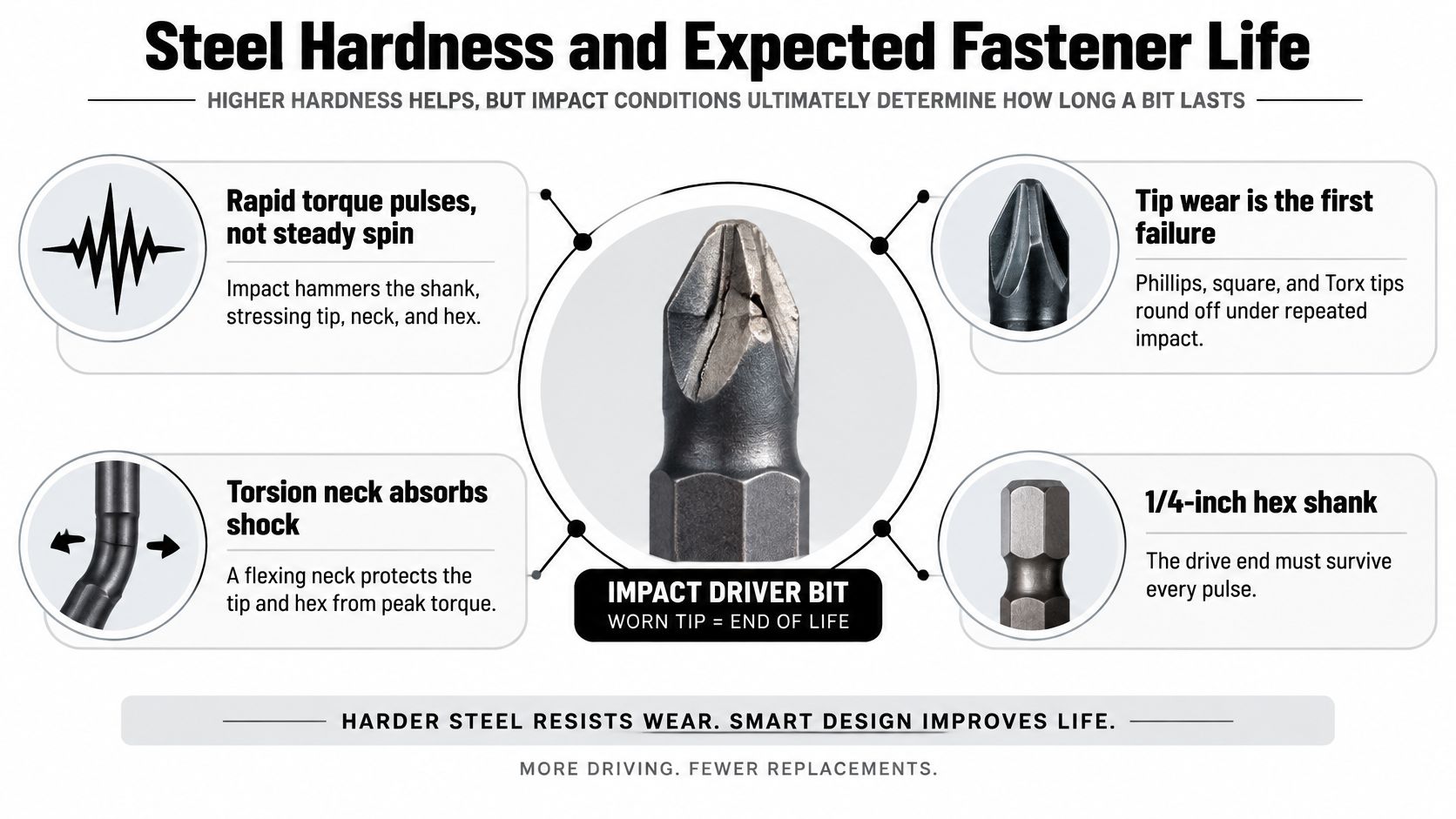
Buy the bit that finishes fasteners with the tip fully seated. Piece count in the case does not change the cost of a rounded head. An impact driver hits the shank with torque pulses instead of a steady spin, so the tip, the neck, and the hex accumulate fatigue rather than simple wear.
The failure pattern follows from that loading.
| Class | Hardness | Typical service | Best user |
|---|---|---|---|
| Premium impact alloy (S2 or comparable) | 58–62 HRC | Long service under repeated high-torque pulses | Daily structural and lag work |
| Mid-range impact with torsion zone | Within the 58–62 HRC band, tempered for toughness | Reliable remodel life if hot sizes are replaced before they round | Remodel crews replacing #2 and T25 bits often |
| Carbon steel | 52–56 HRC | Short once impact pulses start | Light, non-impact work and occasional homeowner jobs |
Hardness is not toughness
A technical comparison of impact-rated bits puts typical hardness at 58 to 62 HRC for S2 or comparable alloy steel, against 52 to 56 HRC for carbon steel, which is generally intended for lighter, non-impact applications (the bit specification comparison). Hardness fights tip wear. Too much of it without toughness chips the tip or snaps the shank.
Impact-rated designs get a ductile heat treatment instead of a harder tip. The torsion zone is the narrowed neck behind the tip. It twists slightly during a torque spike, trading some stiffness for fewer brittle breaks. That neck is the feature that separates a real impact bit from a relabeled general-purpose one.
What the classes mean at the till
Screw type, substrate, driving angle, and alignment move service life by a wide margin. A sound bit dies early when it is driven at an angle into a hard subfloor, because the tip is only partly engaged and the corners take the whole pulse.
Premium S2 alloy holds hardness with enough toughness for daily structural and lag work. You pay more per bit, and even a good torsion bit eventually rounds. I would skip that premium on cabinet screws and light trim. The extra cost per successful fastener only pays when the same sizes run all day under real torque.
Mid-range impact with a torsion zone suits remodel crews who replace #2 and T25 tips often. It gives up life under sustained high torque, so buy those two sizes in pairs and retire a tip as soon as it stops filling the recess.
Carbon steel stays cheap and sharp for hanging a few cabinets with a regular driver. It is brittle under impact pulses, so keep it out of the 18V tool on anything long.
The fastener decides as much as the bit does. A seized connector stalls the driver mid-run, and a stalled impact driver is where tips die, so the galvanized versus stainless steel comparison is worth reading before you fight a corroded joist hanger connection with a T25 bit.
Stock impact-rated alloy only in the drives you run, then keep spares of the two sizes that wear first. That shorter list beats a 100-piece case full of tips you will never seat fully.
Check Fit, Seat, and Condition Before You Pay
A crowded case is often the worse buy. Six bits that fill the recess finish more fasteners per dollar than forty tips that rock, walk, or round on the first pulse. Compatibility is the 1/4-inch hex shank (about 6.3 mm) plus the screw recess, never the shank alone. ISO 1173 sets drive-end dimensions and torque-test provisions for machine-operated bits, while ISO 8764-1 separates PH from PZ cross-recess tips, with the technical requirements and torque-test methods laid out in the ISO 8764-1 standard.
Run the checks below before money changes hands.
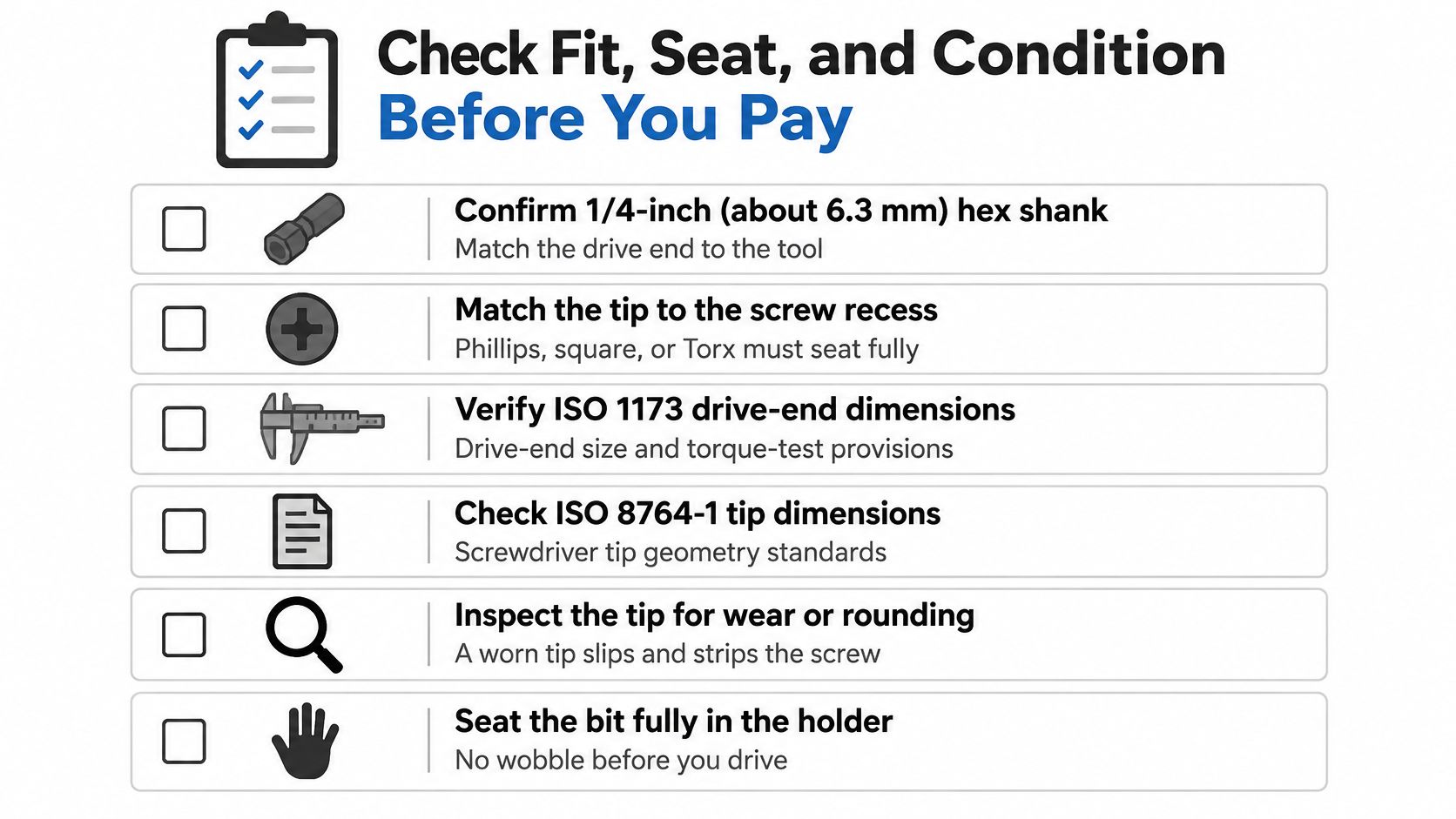
A bit can carry a universal label and still cam out. Insertion depth, straight alignment, holder quality, and the recess decide whether the tip stays buried or climbs out of the head. The Makita instructional manual warns that a bit must be inserted straight, since misalignment damages the screw or the bit, and that a bent bit can break or cost you control of the tool. Shallow insertion lowers the torque a bit can handle before it fails. Full seat is the difference between a clean drive and a chewed head.
Three visible signs of bad engagement
- The tip rocks in the recess. Contact is partial, so local stress climbs at the corners and the head deforms.
- The screw walks. A bit that won't hold the fastener on contact will wander on the first pulse.
- A shiny rounded corner on the bit. Plating wear at the flutes means the tip has already lost the geometry that filled the recess.
The eight-point check before you pay
- Confirm an impact rating printed on the case or bit, not just a hex shank.
- Seat each high-use tip in a known screw and reject rounding, mushrooming, cracks, or flaking plating.
- Sight the torsion zone for a kink or crack at the neck.
- Insert every bit in the holder and reject rattle, wobble, or a magnet that won't hold a screw.
- Confirm #2 Phillips, #2 square, T20, T25, and T30 sit in the tray with a second length of each.
- Confirm PH and PZ are marked separately and not dumped into one slot.
- If lags are on the list, confirm the nutsetter or socket adapter is present and not egg-shaped.
- Replace any bit that no longer fills the recess, because reduced engagement accelerates cam-out and chews the screw head.
Open-box stock with a correct label on a loose holder, or a missing adapter, is a false saving. I leave a premium impact bit in the tray when a sharp matching tip already seats fully on light hardware. Pay for the harder bit only where that full engagement has to survive repeated high-torque pulses.
Here's the same fit and seat logic in motion.
Three checks cover most of it: straight insert, full seat, matching recess. Miss any one and the extra pieces in the case never earn their price.
When Impact Rated Bits Earn the Upgrade
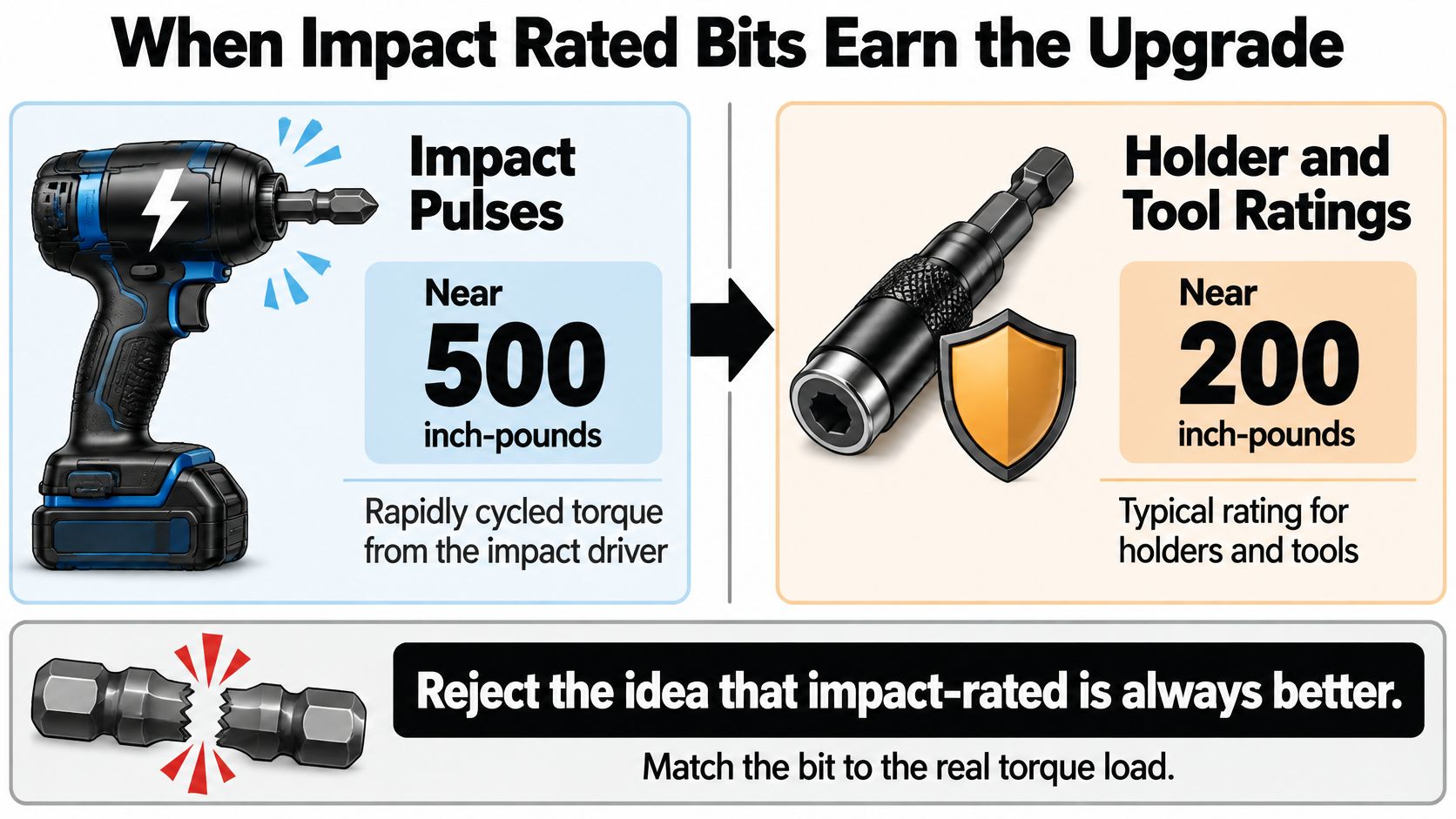
A premium impact bit earns its price only when the job hammers the tip. The label means the steel and heat treatment were chosen for shock. It says nothing about whether your fasteners produce that shock.
On structural screws and lags the loading is real. One engineering description in the patent record for an impact bit design puts impact pulses near 500 inch-pounds of rapidly cycled torque against tool and holder ratings near 200 inch-pounds. Field failure still shows up as tip rounding and repeated cam-out, not a clean snap. Impact bits die of metal fatigue in the end.
| Job | Bit class that pays | Why the cheaper bit fails |
|---|---|---|
| Cabinet hardware, a few screws | Small standard or light set | Duty cycle too low to wear a tip |
| Deck and fence screws, repeated | Mid-range impact with torsion zone | Tip rounding and cam-out after hundreds of drives |
| Structural screws and lags | Premium impact-rated alloy | Fatigue from high torque pulses |
| Overhead or angled driving | Impact bit with full straight seat | Shallow seating sharply reduces the torque a bit can handle before it fails |
| One-day punch list | Spares of the two hot sizes | A dead #2 or T25 bit stops the task |
The duty cycle decides, not the label
A homeowner hanging cabinet hardware gains almost nothing from a large premium set. The tips will not wear out before the project ends. I would skip the alloy upgrade there and spend the money on a second length of the two sizes that get used.
A contractor driving long fasteners all day is a different case. Premium alloy pays when it keeps more screws seated clean, so the cost per successful fastener drops even if the sticker is higher. Piece count does not enter that math. A 40-bit case full of sizes you never drive is often the worse buy.
Technique moves those numbers as much as steel does. How you run the tool changes tip life more than most buyers expect, which is why the fundamentals of impact driver usage belong next to any bit purchase.
Overhead and tight-angle work fails from shallow seating far more often than from steel grade. A straight, full seat fills the recess and lets the tip take the pulse. Buy the upgrade for duty cycle, not for the word on the package.
Cost per successful fastener beats sticker price every time, and the cheapest bit is the one that never cams out.
Who This Is For and Who Should Avoid This
The work this set is built for is repetitive driving with one hand on the tool and the other on the material.
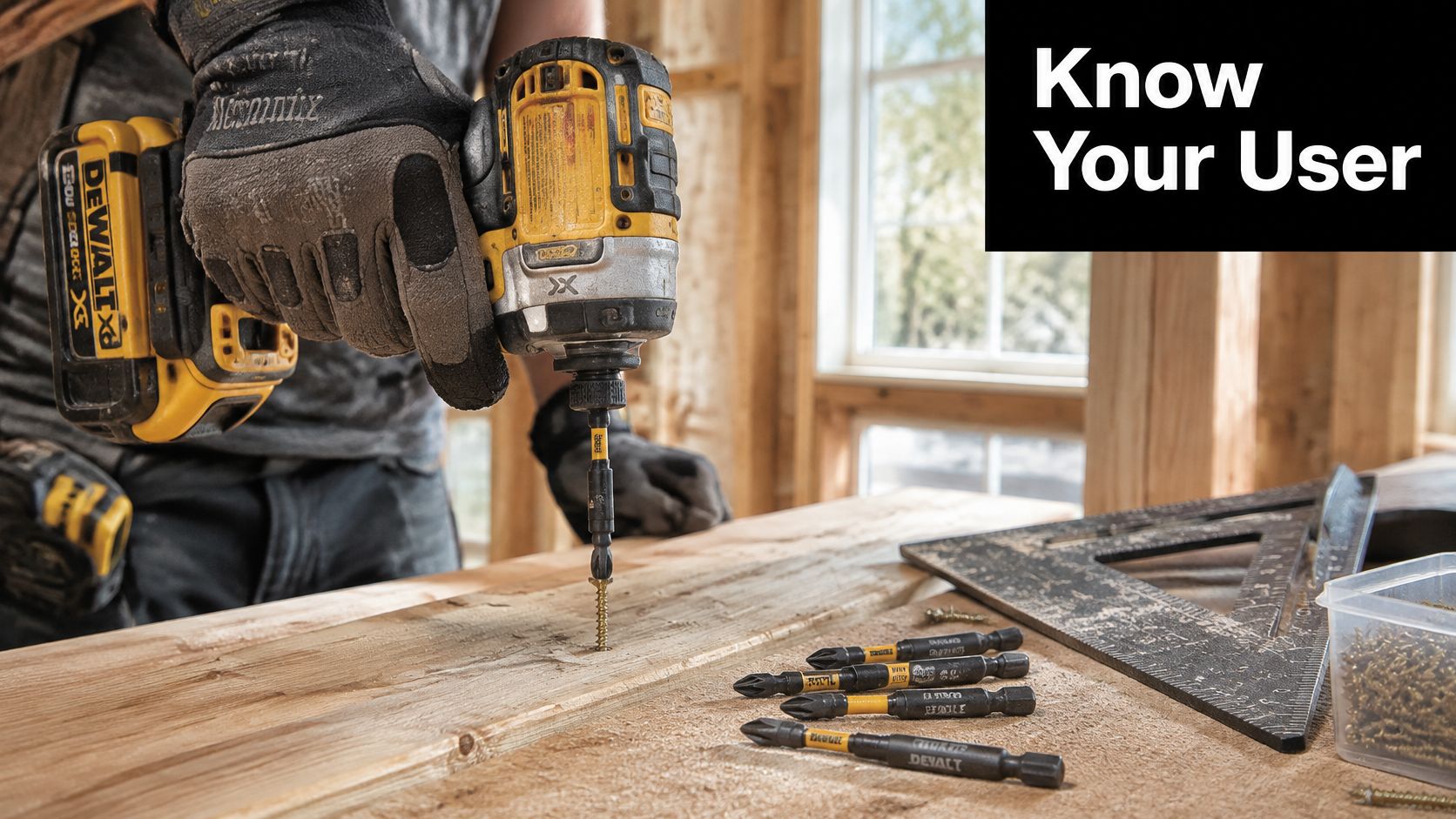
Who this is for
Framing and remodel crews, maintenance techs and serious DIY users get the most from a proper impact set. They turn the same Phillips, square or Torx size for hours, they keep spares and a torsion neck within reach, and they can tell a worn tip from a mismatched one at a glance. The payoff is fewer wrecked screw heads and fewer walks back to the truck.
Contractors on a full set. Pros are straightforward: faster seating, cleaner heads, and bits you can buy one at a time rather than as a sealed assortment. Cons are a higher price per piece and torsion necks that still round over time.
Homeowners on a small set. Pros: low cost, less clutter, and a tray that matches shelving, deck boards and furniture. Cons: fewer lengths, and no spare when the one PH2 goes dull mid-project.
Who should avoid a large premium set
A homeowner doing one cabinet or furniture job should skip it, and so should anyone whose fasteners are mostly slotted leftovers from an older house. Buyers who read piece count as a quality signal should walk past the big case entirely, because most of those sizes never leave the lid.
One regional caution for the pros in this group: carry a spare cooled pack. The New York State consumer battery safety guide warns against charging lithium-ion batteries above 105°F, and a truck cab in Sacramento in July passes that well before lunch.
Pair any set with a short safety routine. Release the trigger on a stall instead of holding it, retire a rounded tip instead of pulsing it through one more screw, and wear eye protection, because a bit under load can shatter.
Keeping Bits and Batteries Working in Valley Heat
On a Central Valley day at 100°F or more, the bit is only as steady as the pack behind it. Milwaukee's safety instructions note that under extreme high-torque, binding or stalling conditions the pack can shut the tool off when current draw becomes excessive, and they direct the user to release the trigger and let the battery cool before restarting (Milwaukee safety instructions).
The routine is short:
- Park the pack in shade or a ventilated area until it's near ambient temperature.
- Charge only on the charger approved for that platform, in a dry, ventilated spot.
- Pull the battery once charging finishes instead of leaving it on the charger overnight.
- Rotate a cooled spare rather than forcing a hot pack back into service.
The Canadian Centre for Occupational Health and Safety warns that lithium-ion packs are damaged by physical impact, improper charging and high or freezing temperatures, and that a defective battery or mismatched charger can overheat or catch fire (CCOHS lithium-ion charging guidance).
High-torque lag and structural fastening heats both the tool and the pack, and a cammed-out bit adds stalls that waste charge on top of it. Brushless, or sin escobillas, drivers still need the same cool-down. The habits that extend battery life on a cordless drill apply here without modification.
Frequently Asked Questions About Impact Driver Bit Sets
Can drill bits be used in an impact driver?
Drill bits are not driver bits. Their tips and shanks aren't built for shock torque, and the fit and seat are wrong for the chuck and the fastener.
Is a 1/4-inch hex shank a durability promise?
No. The 1/4-inch hex is the common interface, and it guarantees neither a correct recess fit nor long tip life.
Can regular screwdriver bits replace impact-rated bits?
A regular bit is a poor match for repeated impact pulses. It wears faster and cams out sooner under the same load.
What's the difference between PH and PZ?
They look alike, but a PH tip in a PZ recess has reduced contact area and rounds the screw head.
Match the Set to Your Fasteners and Buy Locally
A 40-piece case is often the worse buy. Judge the set by cost per fastener that seats with the tip fully in the recess, not by how many bits rattle in the tray. A premium impact bit is unnecessary when the work is a handful of cabinet screws and the driver barely pulses.
Three buy paths cover nearly every reader.
Daily structural or deck work. Take a short impact-rated alloy set with Phillips, square and Torx, a torsion zone on each bit, and two spares of the size you burn through. Fence and deck runs live and die on the SQU2. Check the Connecticut Fence Works installation guide for the fastener patterns a fence job demands before you stock the tray. Full engagement on those square heads is what keeps the bit from camming out halfway down a run.
Mixed remodel work. Mid-range impact bits in 1-inch and 2-inch lengths across PH, SQ and Torx, plus one nutsetter if lags come up. Add a second T25 before you need it. Here the premium bit earns its price only on the sizes that see repeated shock. The rest of a big assortment just sits in the case.
Light DIY work. A small set in the recesses you already own. Skip the piece-count case and the sockets you will never chuck. A standard bit is enough if the driver is only snugging a few screws.
Reject any set whose tips are already round, whose holder rattles, or whose label never says impact. Those three tells turn a bargain into a stripped head and a wasted fastener.
Value Tools Co is an online and local retailer based in Elk Grove, California. It sells DeWalt, Milwaukee, Makita, Ridgid, Ryobi and Husky power tools and accessories, including open-box and bare tools, at up to 55% off retail, with a 2-day return window. Compare Power tools, Drills & Drivers and Hand tools before you commit. On a bare-tool listing the battery is separate, so check the pack on its own.
Value Tools Co stocks the impact-rated tips, bit holders and spare bits that match the drives in this guide. If you are outfitting a crew or replacing the two bits that wear out first, browse the Value Tools Co power tools and accessories selection and compare open-box savings against new retail.
Buy the drives you will use this week, in the steel the job needs, and leave the rest.


