

A 12V 6Ah battery stores about 72 watt-hours of nominal energy: 12 V × 6 Ah = 72 Wh. That is a stored-energy figure, not a runtime promise, because usable energy and runtime fall once load, chemistry and temperature enter the picture.
The gap between nominal and delivered energy is where most buying mistakes start. A pack can carry the same 6Ah label as another and still refuse a load the other runs without complaint, so the label is a starting point for comparison, not a compatibility guarantee.
What 12V 6Ah Means in Real Energy Terms
A 12V 6Ah battery is rated to store approximately 72 watt-hours of nominal energy, calculated as voltage multiplied by amp-hour capacity, as the lithium-ion battery overview explains. That is the number to use when you compare packs on a shelf. It is not the number of hours you get from a device.
The amp-hour rating describes electrical charge capacity. Under specified test conditions, a 6 Ah pack could supply 6 A for one hour, 3 A for two hours, or 1 A for six hours. Change the load, and the clock changes with it. Change the chemistry, temperature or cutoff voltage, and the usable portion of those 72 Wh changes again.
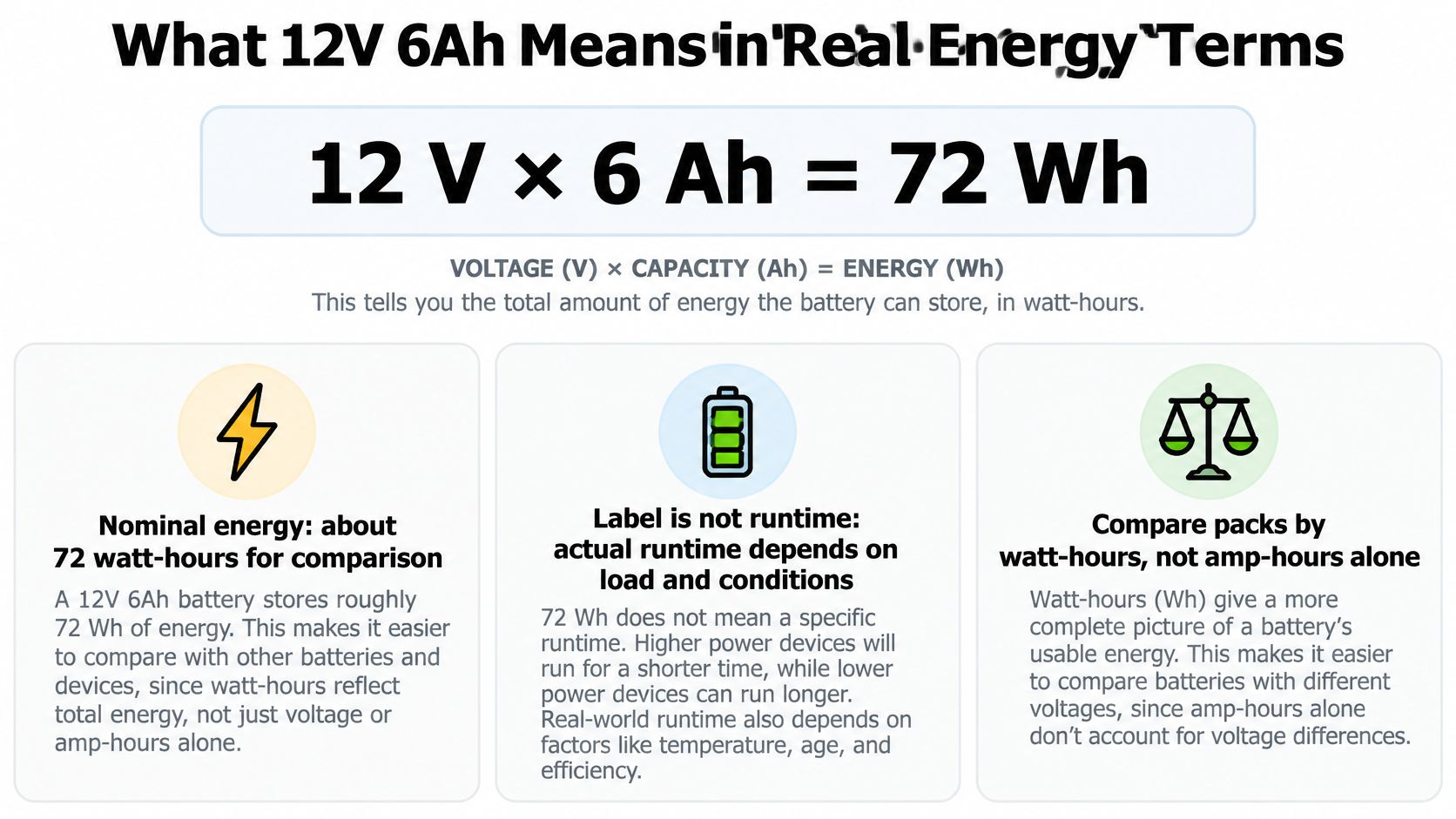
Why nominal energy is not delivered energy
A 10 W work light draws about 0.83 A at 12 V. Divide 72 Wh by 10 W and the arithmetic points to roughly 7 hours before losses. Voltage sag under load, the low-voltage cutoff and a cold pack all push the runtime lower. That is why a pack that looks adequate on paper can quit an hour into a shift.
A lithium pack labeled 12 V usually runs three cells in series at 3.6 to 3.7 V each, so its exact voltage range and battery-management limits depend on the design. The label gives you a nominal figure. The BMS decides how much of it reaches the tool.
Three numbers to check on any listing: watt-hours, maximum continuous current and connector type. Voltage and amp-hours alone won't tell you whether the pack fits the job.
Sealed Lead-Acid vs Lithium for a 12V 6Ah Battery
A 12V 6Ah label describes stored charge, not how much energy a device can draw before the battery cuts out. Chemistry affects usable output, weight, storage loss and charging requirements. A sealed lead-acid (AGM) pack suits equipment designed around lead-acid charging; lithium, often LiFePO4, is lighter but requires a compatible charger and battery-management system (BMS).
| Attribute | Sealed lead-acid (AGM) | Lithium (LiFePO4) |
|---|---|---|
| Nominal energy | About 72 Wh (12 V × 6 Ah) | About 76.8 Wh (12.8 V × 6 Ah) |
| Weight and size | Heavier for the same Ah | Lighter and more compact |
| Self-discharge | About 3% per month (datasheet example) | Typically about 1% to 3% per month |
| Discharge limits | Usable energy falls at high discharge rates | Set by the BMS; check maximum continuous current before buying |
| Cold-weather capacity | Capacity falls at low temperature | Capacity drops; the BMS may block charging below freezing |
Where the chemistries diverge
Lead-acid batteries have a much longer history than lithium-ion batteries. The RSC review of lithium-ion history describes lithium-ion's development from early commercialization to higher specific energy and lower cell costs.
That progress helps explain why a modern 12V 6Ah lithium pack can be much lighter than a lead-acid pack. The energy figures still need context: a 12.8 V, 6 Ah LiFePO4 pack calculates to about 76.8 Wh, only slightly above the 72 Wh nominal figure for a 12 V, 6 Ah pack. In practice, load, cutoff settings and battery condition determine how much energy the device can use.
How to choose between them
Choose AGM when the device is designed for lead-acid and will sit on a compatible float charger, such as a UPS, emergency light or gate opener. Choose lithium when lower weight or frequent cycling matters, provided the device and charger support that pack's voltage range and BMS limits. For a closer look at the trade-offs, see this guide to lithium-ion battery advantages.
Before buying, confirm the device's chemistry requirements and the charger's profile. If either specifies lead-acid, use AGM. If both support LiFePO4 and the device's current demand stays within the BMS rating, lithium is the lighter choice.
Matching Voltage, Terminals, Size and Discharge Rate
Fit comes down to five checks, and voltage is only the first. Work through them in order before you buy, because a pack that fails any one of them is the wrong pack no matter how good the price is.
The five fit checks
- Voltage and charger profile. Confirm the device accepts a nominal 12 V pack, then confirm the charger is built for that chemistry. A 12 V label on both items does not make the charger compatible.
- Terminal type and polarity. Match the connector, verify the adapter, and check that the red and black leads are not reversed. Reversed polarity can kill a device before the first charge.
- Physical size. Measure the battery bay, height clearance and mounting points. A sealed lead-acid pack is usually bulkier than a lithium pack of equal amp-hours, so a lithium replacement may need a spacer or a different bracket.
- Discharge rate. Compare the device's continuous and peak current draw with the pack's maximum continuous current. A pack can have enough watt-hours and still choke on a high-starting-current load.
- Charger compatibility. Use a charger that matches the chemistry. A lithium charger on a lead-acid pack is not a "close enough" pairing.
Small cordless tools, including impact drivers (atornillador de impacto) and brushless (sin escobillas) platforms, draw short high-current bursts. That pattern rewards a pack with a BMS rated for peak draw, not just a large amp-hour number. Bare tool (herramienta sola) listings matter here because you're buying the pack separately from the charger and case.
What changes by use case
| Use | Load pattern | Usually better chemistry | Check first |
|---|---|---|---|
| UPS and backup power | Long standby, occasional deep draw | Sealed lead-acid with matched charger | Charger voltage and float setting |
| Emergency lighting | Low steady current over long standby | Lead-acid or lithium with suitable charger | Standby drain and battery age |
| Small power tools | Short high-current bursts | Lithium with a BMS rated for peak draw | Peak current on datasheet |
| Scooters and mobility devices | Moderate sustained current, frequent cycling | Lithium when weight matters | Connector, polarity and BMS cutoff |
| Cordless bare tools | Brief high-current pulses | Lithium matched to the tool | Tool voltage and pack type |
Fit rule: if the device's peak current exceeds the pack's documented continuous rating, move up to a larger pack or a different platform. Do not assume the BMS will forgive the overload.
Charging and Maintenance Without Damaging the Battery
The 6Ah label describes stored capacity, not how quickly a pack will recharge or how long it will last. Charging depends on the battery's chemistry, the charger's profile and current, and the pack's temperature.
| Charging case | Voltage | Current | Time |
|---|---|---|---|
| Sealed lead-acid, constant voltage | 14.40 to 15.00 V at 25 °C | Initial below 1.8 A | 15 to 18 hours |
| Sealed lead-acid, constant current | 14.40 V end point | 0.60 A until 14.40 V | About 4 hours of continued charging |
| LiFePO4 12.8 V pack | About 14.6 V (four-cell pack) | 1.2 A standard, 6 A maximum | Follow the charger's termination signal |
The two rules that prevent most failures
For a representative 12V 6Ah sealed lead-acid battery, the specified constant-voltage charge is 14.40 to 15.00 V at 25 °C, with initial current below 1.8 A and an estimated recharge time of 15 to 18 hours, according to the sealed lead-acid datasheet. A constant-current option uses 0.60 A until the battery reaches 14.40 V, then continues charging for about four hours.
Avoid leaving a lead-acid battery partly charged between uses. Chronic undercharging promotes sulfation and reduces capacity. The same datasheet gives a self-discharge rate of about 3% monthly, so check and top up a battery that sits unused rather than leaving it discharged.
A 12.8 V LiFePO4 battery needs a lithium charging profile. One published specification gives about 14.6 V for a four-cell pack, with 1.2 A standard charge current and 6 A maximum, as listed in the 12V 6Ah LiFePO4 specification. A lead-acid float regimen is not a substitute.
Charger mismatch and heat
Match the charger's chemistry setting and output voltage to the battery. A charger designed for lithium may use the wrong profile for lead-acid, and a lead-acid charger may not suit lithium. Label chargers to prevent mix-ups. When choosing a bench charger, this guide to a 10 amp battery charger explains why current headroom matters more than the highest setting.
Central Valley summers are very hot, and a battery left in a garage or truck bed can age faster. Let a hot pack cool before charging, and charge it in the shade.
How to Test a 12V 6Ah Battery and Fix Common Faults
A resting voltage check is a start, not a diagnosis. A pack that reads near 12 V can still have very little load capacity, so the test that matters is the one with a real load attached.
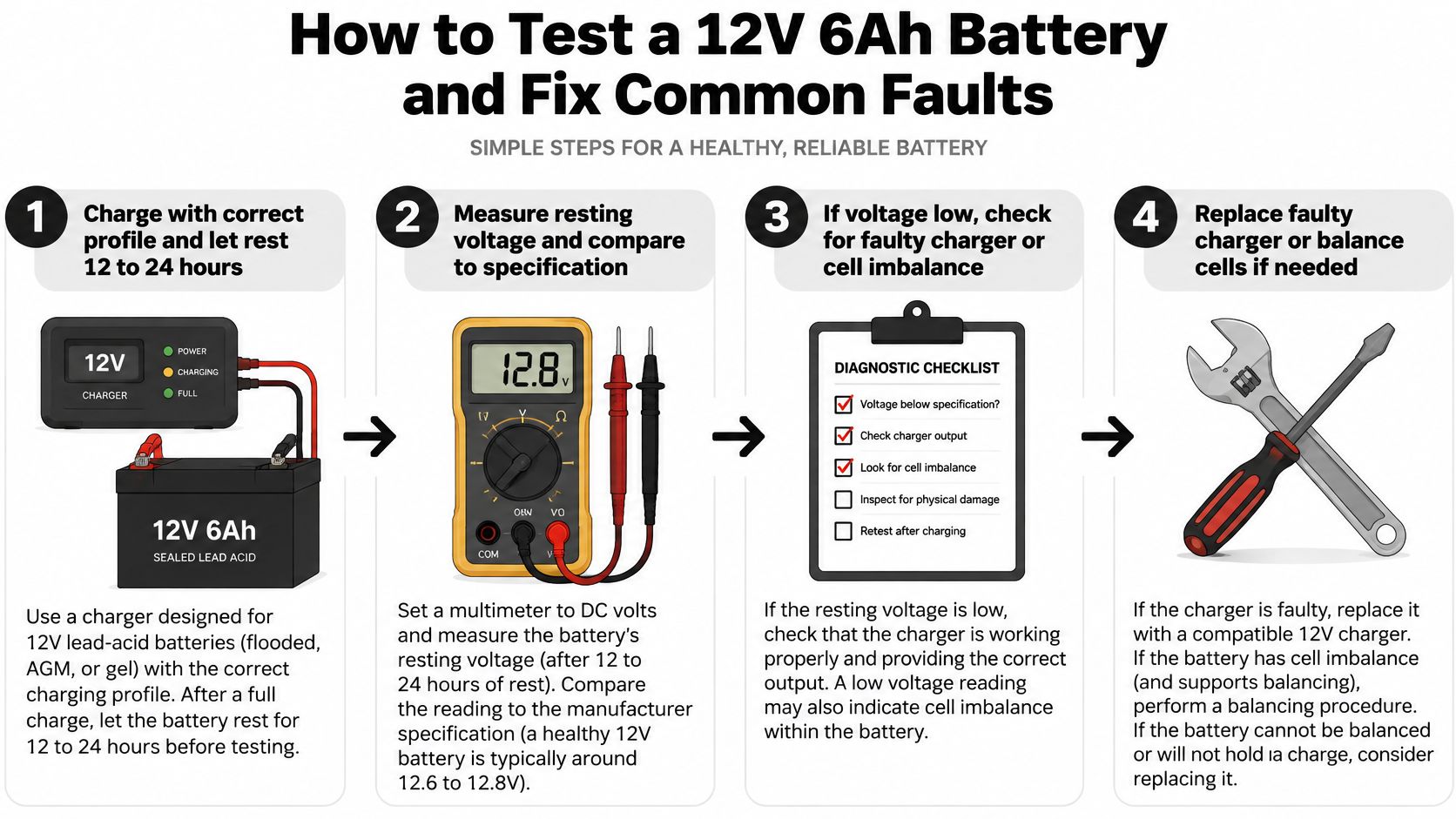
The load test that tells the truth
- Charge with the correct profile. Use the lead-acid or lithium setting that matches the pack, then let it rest for 12 to 24 hours.
- Measure resting voltage. Compare the reading with the manufacturer's figure for that chemistry, not with a generic 12 V target.
- Apply a real load. Use a load tester or a known-good device and watch the voltage under load. A pack that holds at rest and collapses under load has a capacity problem.
- Compare runtime with expected energy. Use the watt-hour figure as the baseline, then note how far the observed runtime falls below it.
- Inspect the case and terminals. Look for heat, swelling, corrosion or loose contacts before you recharge.
- Recharge and retest. If capacity stays low after a full charge, retire the pack instead of sending it back into a critical job.
Match the symptom to the fix
| Symptom | Likely cause | Fix |
|---|---|---|
| Reads 12 V at rest but collapses under load | Low load capacity, often sulfation or aged cells | Recharge with the correct profile, retest under load, replace if capacity stays low |
| Lithium pack will not charge | BMS cutoff or wrong charger profile | Confirm charger chemistry and voltage; check the datasheet for BMS reset steps |
| Short runtime after a full charge | Capacity loss from age or heat | Compare to rated energy under load; replace if well below expectation |
| Pack gets hot during charging | Faulty pack or wrong charger | Stop charging, let it cool, verify charger settings |
| Crusty or loose terminals | Electrolyte leakage or poor contact | Clean terminals, tighten connections, check polarity before reconnecting |
| Swollen or bulging case | Gas buildup or internal damage | Do not charge; isolate and dispose of it as described in the next section |
Retire the pack when the load test says so. A pack that has lost a large share of its rated energy will keep failing at the worst moment, and no charger setting fixes worn-out cells.
Safe Disposal and Handling Damaged Packs
A swollen, leaking, cracked, hot or mechanically damaged battery must not be charged. Stop using it and keep it away from combustible materials.
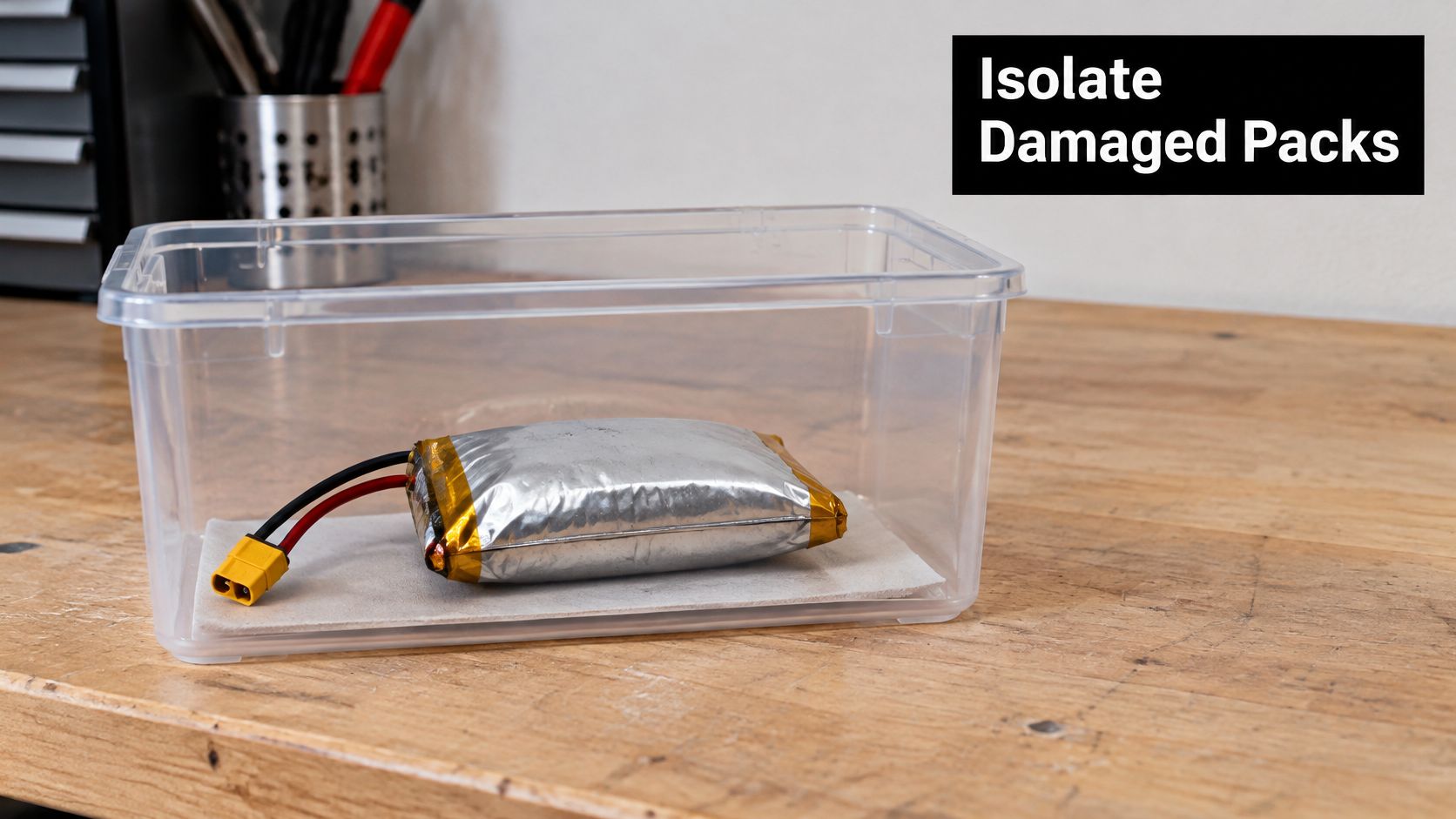
For a damaged lithium pack, use a non-flammable container and keep it away from heat. Tape the terminals of any pack you set aside to prevent a loose tool or other metal object from shorting them. Never put rechargeable batteries in ordinary trash. Take them to a retailer battery-collection point or your county household hazardous waste program.
The decision order after a failure
If a recently purchased pack is defective, contacting the seller about a return may be faster than finding a recycling drop-off. If a return is not available, use an appropriate collection point.
Battery recycling rules and collection programs vary by location. The EU battery rules summary describes reporting requirements for battery recycling operations and recovery targets for lithium.
For a pack that is still safe to keep, follow this cordless tool battery storage guide to reduce the risk of damage during storage. The video below covers safe battery handling.
Frequently Asked Questions About 12V 6Ah Batteries
What does 12V 6Ah mean in watt-hours?
It means about 72 watt-hours of nominal energy, calculated as 12 V × 6 Ah. That figure lets you compare packs by stored energy, but it is not a guaranteed runtime because load, temperature, chemistry and cutoff voltage all reduce what reaches the device.
Can a lithium charger charge a sealed lead-acid 12V 6Ah battery?
No. A lithium charger uses a different voltage profile and can overcharge or undercharge a sealed lead-acid pack. Charge lead-acid at 14.40 to 15.00 V at 25 °C with an initial current below 1.8 A, and use a lithium profile only on a lithium pack with a matching BMS.
How long will a 12V 6Ah battery run a 10 W work light?
At 12 V, a 10 W light draws about 0.83 A. The theoretical runtime from 72 Wh is roughly 7 hours, but losses, voltage sag and the low-voltage cutoff usually cut that shorter, so plan on less than the arithmetic suggests.
Why does a 12V 6Ah battery read 12 V but die under load?
A rested voltage near 12 V shows the pack has some charge, not that it can deliver current. Sulfation, aged cells or a BMS current limit can make voltage collapse under load. A controlled load test tells you more than a multimeter reading alone.
Can I charge a swollen or leaking battery?
Do not charge a swollen, leaking, cracked, hot or mechanically damaged battery. Isolate it from combustible materials, tape the terminals, and take it to a household hazardous waste site or retailer take-back point. If it is under warranty, contact the seller before disposal.
Who This Is For and How to Buy With Confidence
A 12V 6Ah battery suits a device designed for that voltage, chemistry, connector and current draw. Its 72 Wh nominal energy can cover modest backup or short-duty use, but it does not guarantee a fixed runtime. Load, temperature and battery chemistry all affect how much energy the device can use.
Who This Is For
DIY owners replacing a sealed pack in a UPS, emergency light, gate opener or workshop device should match the original chemistry, terminal size and charger. Property managers may find the format practical for modest backup needs. Contractors considering a spare for jobsite lighting should confirm the light's battery platform and current requirements first.
The trade-off is straightforward: lead-acid packs are heavier, while lithium packs can offer more usable energy in a smaller case. Either way, a 6Ah label describes capacity under specified conditions, not how long every device will run.
Who Should Avoid This
- Users whose motor or tool exceeds the pack's continuous-current rating. A pack can start the load yet overheat, lose capacity early or trigger its battery management system.
- Owners unable to match the charger to the battery chemistry. If the charger profile is unknown, resolve that before buying.
- Anyone who needs long runtime from one pack. Choose a higher-capacity battery or plan to swap packs.
- Crews expecting a framing nailer battery. A 12V 6Ah pack is intended for compatible devices, not a framing nailer that requires a different battery platform.
Check the pack's voltage, chemistry, connector, dimensions and discharge rating against the device requirements. A mismatch in current rating or charging profile is reason to choose another battery, regardless of the amp-hour label.
How to Buy With Confidence
Before checkout, confirm the battery fits the device and that its charger supports the correct chemistry and voltage. Once it arrives, charge it with the matched charger and assess its performance under an appropriate load. A printed capacity rating alone does not establish runtime.
For cordless jobsite lighting, the Milwaukee 2367-20 uses the 12V M12 battery system. It carries a 5 Year Tool Warranty and an LED Limited Lifetime Warranty. Value Tools Co sells open-box and lightly used, fully functional items, with savings of up to 55% off typical retail pricing. Qualifying orders receive free U.S. shipping, and the store has a 2-day return window.
A 12V 6Ah pack is a practical choice when its chemistry, current rating and charger match the device. Compare those specifications before buying, then use the return window to address a fit issue promptly. Visit Value Tools Co to browse its tool and appliance selection.


