

A random orbital sander is the better general-purpose choice for finish work, while a standard orbital, or sheet sander, wins for corners, edges, and quick paint prep. Random orbitals typically use 125 mm or 150 mm discs and run at roughly 4,000–12,000 orbits per minute, according to woodworking sander guidance.
The choice usually comes up halfway through a job: cabinet doors are ready for stain, or a bedroom wall needs a quick scuff before paint. Grab the wrong tool and you can add cleanup, scratch removal, or hand-sanding to the punch list. The practical difference isn't just pad shape. It's how the tool handles visible finishes, corners, dust, and long stretches of sanding.
| Criterion | Random Orbital Sander | Standard Orbital (Sheet) Sander |
|---|---|---|
| Pad | Round, commonly 125 mm or 150 mm | Usually rectangular, often quarter-sheet |
| Motion | Orbit plus free rotation | Fixed, repeating orbit |
| Typical speed | Roughly 4,000–12,000 orbits per minute | Varies by model |
| Best fit | Cabinets, doors, furniture, countertops | Edges, corners, light paint prep |
| Finish | Less likely to leave recognizable swirl marks | Repeating scratches can show through stain |
| Dust collection | Can connect to extraction, if the tool and pad are compatible | Can collect dust, depending on the model and setup |
| Corner access | Round pad can't reach a sharp inside corner | Rectangular pad reaches closer to square corners |
| Price | Varies by model and features | Often a simpler, lower-cost option |
What the Two Sanders Do on a Jobsite
On a cabinet install, the choice shows up as soon as the doors come off for sanding. Broad faces headed for stain or clear coat call for a random orbital; square recesses and painted edges give the sheet sander a job. Set both beside the bench when the punch list includes both kinds of work.
Consider oak cabinet doors alongside bedroom trim and a drywall patch. The doors need consistent scratch removal before finishing. The painted surfaces need a light scuff without cutting through sound paint or rounding edges. Trying to cover everything with one machine can leave you correcting cabinet faces or hand-sanding corners longer than expected.

The sheet sander's rectangular pad takes sheet-style abrasive and reaches closer to square corners. The random orbital's round disc suits open cabinet panels, doors, and tabletops. Neither replaces a hand-sanding block where the pad cannot sit flat. Keep the machine supported, especially along narrow edges.
Choose by the surface you'll see
Match the grit to the coating and the scratches you need to remove. A high OPM setting cannot make an overly coarse abrasive suitable for a light paint scuff. On visible wood, check the surface before advancing to finer grit rather than relying on sanding time alone.
Treat finish quality, dust, and control as a connected jobsite system.
Check extraction compatibility before buying, and judge vibration over sustained work rather than a showroom pass. Compare abrasive cost per square foot of acceptable finish, including sheets or discs spent correcting scratches. For cordless work in Central Valley summer heat, account for battery changes and cooling interruptions. Budget-conscious pros and DIYers shopping Value Tools Co should weigh that complete setup against the bare-tool price: the cheaper machine may leave more work on the punch list.
How Each Sander Moves and Why That Matters
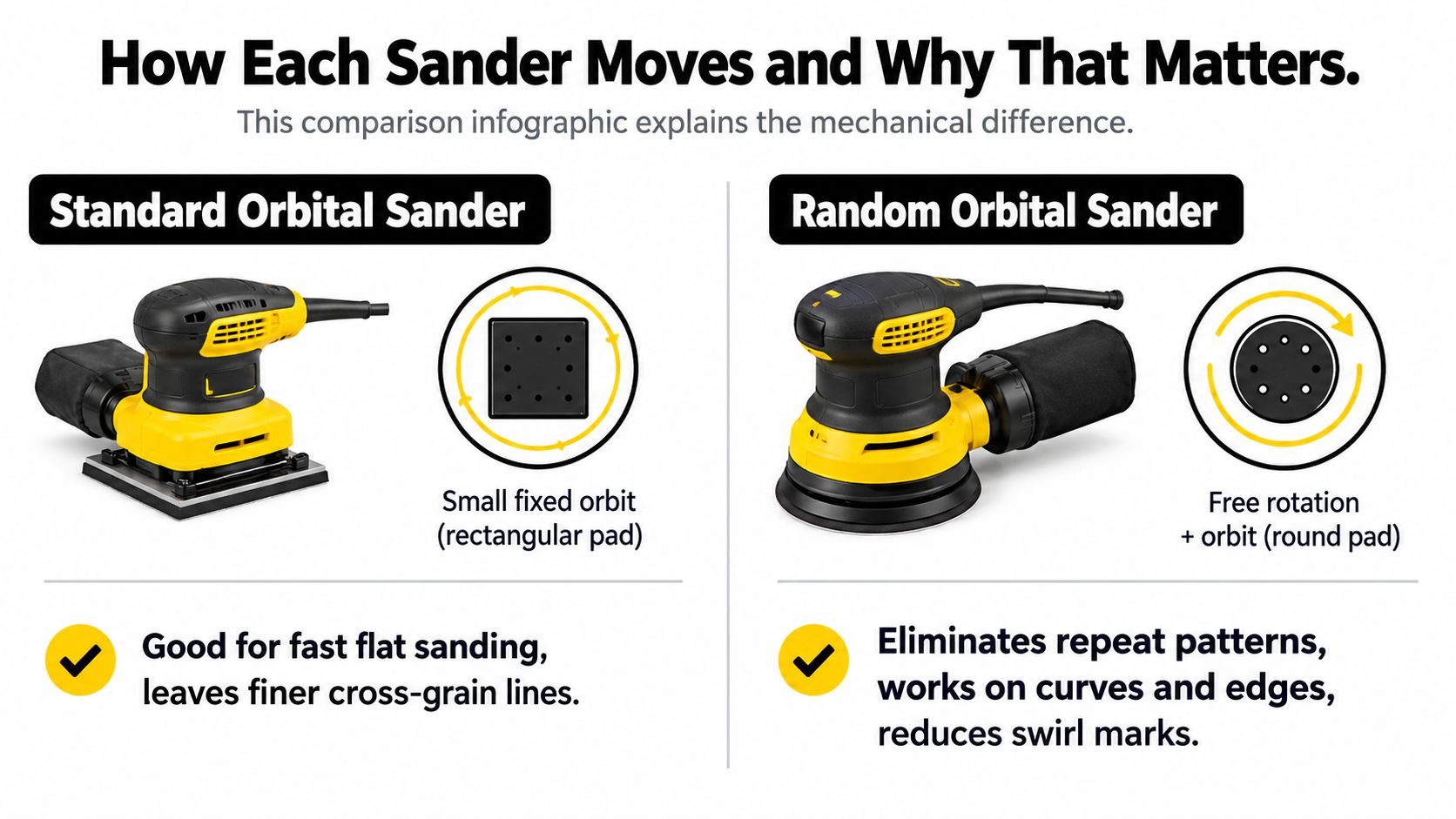
A standard orbital sander moves its rectangular pad in a small, fixed, repeating orbit. A random orbital sander combines that orbit with free rotation around an offset bearing, so the abrasive follows a changing path rather than repeating the same motion. That mechanical difference drives the most important finish-quality distinction.
Follow the pad's motion
On a sheet sander, the pad's fixed orbital pattern creates a consistent scratch path. That predictable action can work well for light preparation and close-to-corner sanding, but it can also leave repetitive marks if the operator pauses or sands across the grain. Those marks are more likely to show after stain or a clear finish.
The random orbital adds a second motion: the pad orbits eccentrically while rotating freely. Since its rotation isn't mechanically synchronized to one fixed path, the abrasive continually changes direction. That substantially reduces visible swirl patterns compared with a conventional orbital sander, though it doesn't make poor technique harmless.
The random-orbit mechanism has a documented commercial patent milestone in U.S. Patent US4854085A, filed on September 24, 1987 and issued on August 8, 1989. Later patent records show development of ergonomic housings, dust collection, and palm-grip designs through the 1990s and early 2000s.
A random orbital helps prevent a repeating scratch pattern. It can't compensate for a clogged disc, a skipped grit, or a pad held at an angle.
Watch the tool in motion to see how these different pad actions relate to sanding control.
Side-by-Side Comparison at a Glance
A cabinet refinish with stained doors, painted jambs, and tight built-in corners can justify both sanders. Buying for that job means deciding where finish quality matters, where the pad fits, and what equipment you can keep running through the workday.
Use these questions to narrow the choice:
- Will the surface take stain or a clear finish? Favor the random orbital for visible finish quality and general versatility. Compare results at the grit you intend to use, rather than judging a showroom sample sanded with an unknown abrasive. A high OPM rating alone doesn't establish finish quality.
- Are there square inside corners? A sheet sander reaches closer with its rectangular pad. Check that reach against the actual cabinet opening or jamb. Budget for hand finishing wherever the pad cannot work flat, rather than tipping the tool to chase an edge.
- Can you run extraction where you're sanding? On an occupied remodel, include the extractor and hose in the buying decision. Try the connected tool against a vertical door: hose drag and restricted movement can make a comfortable bench demonstration misleading.
- What will a full work session cost? Compare abrasive use per square foot, grip comfort, vibration, and battery changes alongside the purchase price. For cordless work in Central Valley summer heat, check the manufacturer's operating limits and plan charging access rather than assuming uninterrupted runtime.
For budget-conscious pros and DIYers shopping Value Tools Co, price the usable setup, including abrasives and any batteries or extraction accessories you still need.
Before choosing a pad size, check local stock for matching discs in your working grit sequence. Compare disc availability with rectangular sheets, including how much usable abrasive each format leaves after cutting or replacement. A cheaper tool loses its appeal when replenishing abrasives interrupts the job.
Dust Control, Vibration, and Long-Term Cost
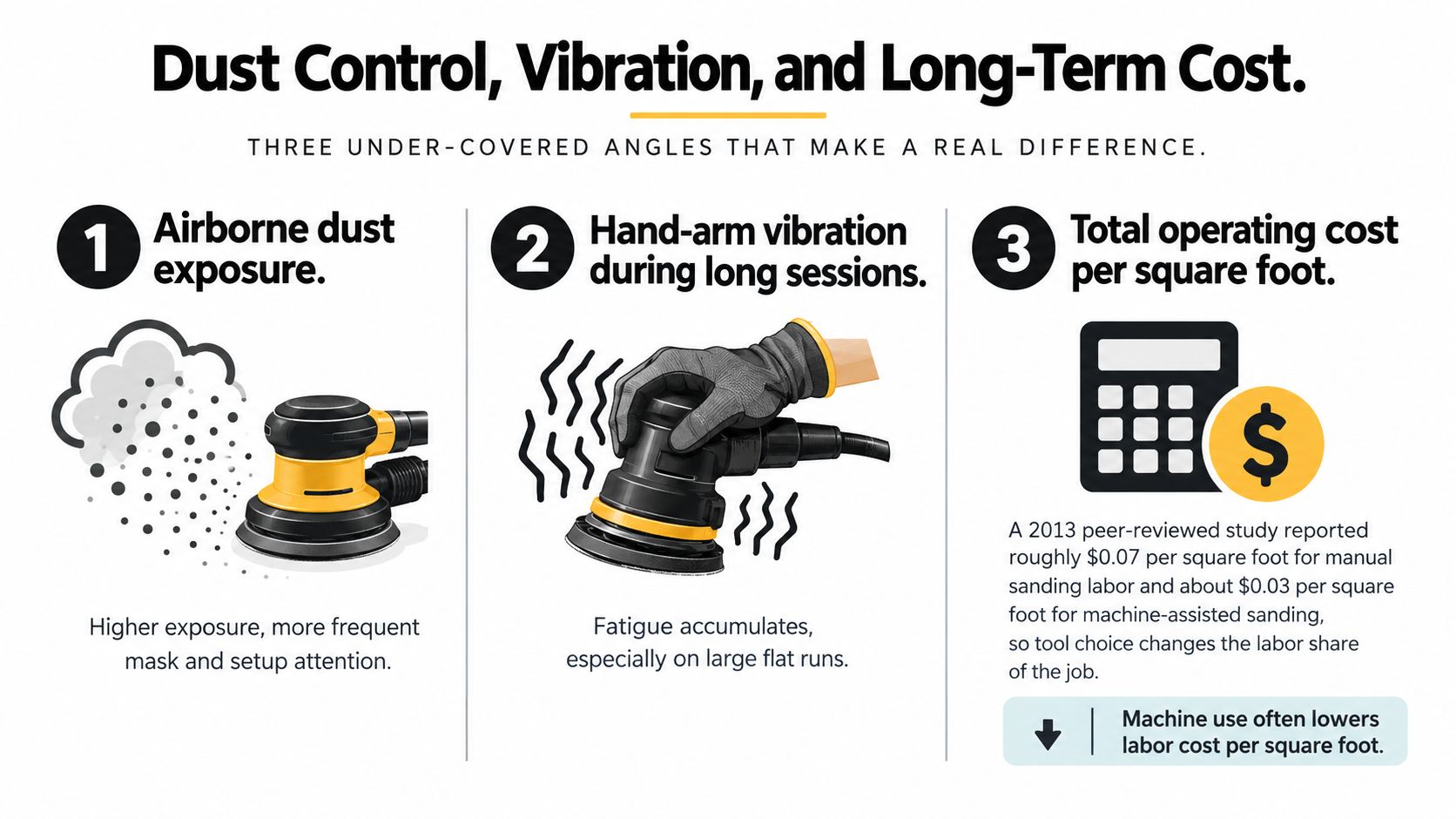
Dust collection is a performance and safety issue, not just a way to reduce cleanup. A peer-reviewed 2013 study comparing conventional sanding with self-generated-vacuum sanding on three industrial substrates found particle concentrations 320 to 4,640 times higher with the conventional system; the differences were statistically significant for all three tested substances (study record). The result applies to the tested systems, not to every random orbital sander: capture depends on the vacuum design, filter bag, abrasive, substrate, and how well the parts fit together.
NIOSH notes that random-orbital sanding can generate significant wood dust, which is associated with eye and skin irritation, allergy, reduced lung function, asthma, and nasal cancer. In its engineering-control example, additional exhaust and a slotted sanding pad reduced dust emissions by approximately 90% compared with an aspirator-controlled sander (NIOSH guidance). That's a reminder to compare the whole extraction setup, including the pad holes, disc alignment, seals, and extractor.
Price the whole sanding setup
Independent occupational-health documentation cited in the verified data reports that industrial sanding emission controls reduced particle counts by 56% to 83% and particle mass by 13% to 35% in a controlled process. Those results reinforce the value of extraction, but they don't establish what any particular job will cost. For the contractor, the practical comparison is disc price, how quickly abrasives clog or wear, filter replacement, cleanup, and labor spent correcting scratches.
Vibration also belongs in the buying decision, especially for long sessions. A 3M abrasive-safety guide warns that random-orbit sanding vibration can pose a greater risk to employees and employers than use of a right-angle grinder (3M abrasive-safety guide). If a tool feels tiring during a realistic continuous sanding session, a fast cutting rate may not offset fatigue or reduced control.
Practical rule: Buy dust extraction as part of the sanding system. Don't assume a dust bag alone is enough for indoor work.
For a closer look at what affects capture on the tool itself, see this guide to random orbital sander dust collection. Wear suitable respiratory and eye protection, and ventilate the work area even when the sander connects to a vacuum.
Best Use Cases for Each Sander
Cabinet doors, furniture, countertops, and other broad surfaces that will show stain or clear coat generally favor a random orbital. Its changing abrasive path makes it a good general-purpose sander for removing mill marks, old finish, and surface defects before coating. For practical comparisons between sheet and random-orbit tools, see this guide to random orbital sander vs sheet sander.
A standard orbital is a useful pick for inexpensive paint prep, edge work, and occasional DIY sanding. Reach for it when you need to get close to a square inside corner or scuff a painted surface rather than prepare a broad hardwood panel for a transparent finish. The rectangular pad is an advantage on those details, but it doesn't eliminate the need to watch for visible marks.
Match the tool to the crew and the site
A finish carpenter fitting cabinets benefits from a random orbital for door and panel faces, with hand sanding or a sheet sander for corners. A remodeling GC doing punch-out may want both: a sheet sander for local paint prep, and a random orbital for damaged trim or doors that need broader surface correction. A property manager turning units may find a sheet sander handy for routine scuffing, while a DIYer refinishing a dining table is usually better served by a random orbital.
In Sacramento and the Central Valley, cordless tools can face a separate jobsite challenge during 100°F+ summer heat. Battery cooling and runtime are worth checking when sanding outdoors or moving between work areas; don't leave batteries baking in a vehicle or charge them while they're hot. Older trim in California homes can also mean extra repair and finish work during remodels, so choose based on the actual surface and detail rather than assuming one sander handles every condition.
Availability matters when a tool or replacement part holds up a job. Value Tools Co lists fast one-day delivery in Northern California and same-day warehouse pickup in Elk Grove, which can be useful when a Sacramento-area crew needs to keep a repair moving. Confirm current stock and delivery timing before scheduling work around it.
Grit Sequence, Speed, and Technique for a Clean Finish
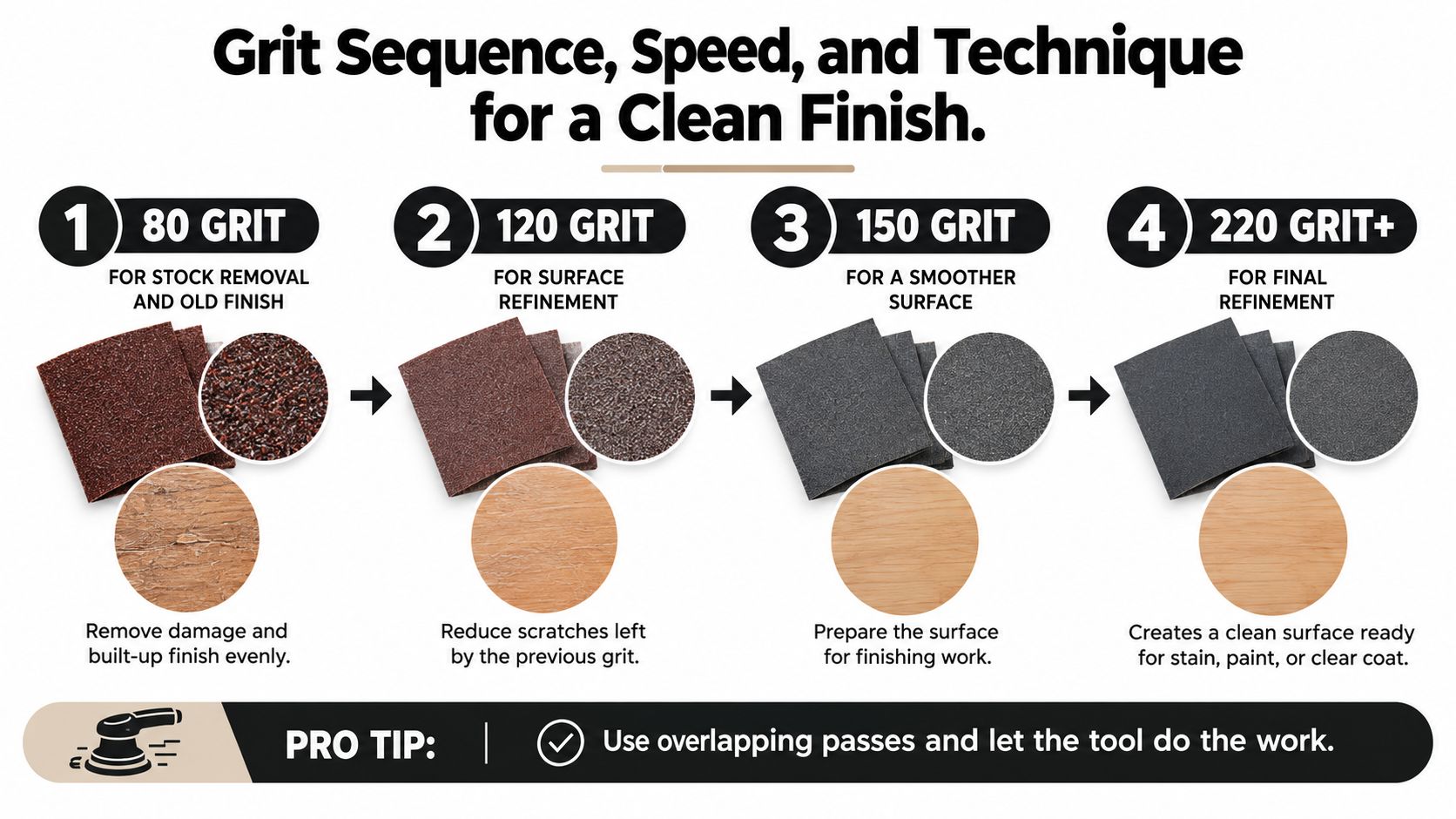
On a cabinet door headed for stain, scratches left behind at the first grit can survive every finer pass. A practical wood sequence is 80 grit for stock removal or old finish, then 120, 150, and 220 or higher. Start only as coarse as the surface needs, and match the final grit to the coating requirements. Move up after the previous abrasive's scratches are gone.
Work through the surface in order
Keep the pad flat and overlap steady passes, moving with the grain where practical. Tipping onto an edge concentrates the cut and can leave a hollow. On hardwood or MDF, inspect between grits and clear loose dust before continuing. Align abrasive holes with the pad so extraction can carry dust away.
Lower OPM settings favor finish-sanding control; higher settings speed stock removal. Use woodworking sander guidance alongside the tool's instructions when selecting settings. Let the tool's weight work: extra pressure can stall random-orbital pad rotation, add heat, and leave uneven scratches.
Replace a clogged or dull disc instead of leaning harder.
Judge abrasive cost by the area finished cleanly, not how long a worn disc stays attached. Poor cutting means longer trigger time on cordless work and more hand fatigue from vibration. Check dust flow before blaming the abrasive.
The round pad still leaves true inside corners for a sheet sander or hand block. For coating preparation, consult sanding kitchen cabinets before spray painting. Value Tools Co's random orbital sander sandpaper guide helps budget-conscious buyers choose compatible discs before stocking up.
Who Should Buy Which Sander and What to Spend
Your best buy depends on how often you sand, what finish you're preparing, and what the complete setup costs. Compare the tool price with abrasive consumption, extractor and filter needs, battery runtime, and the time you might spend correcting marks. A lower purchase price isn't a bargain if the wrong pad shape or poor dust capture slows the work.
| Buyer | Practical choice | Why it fits |
|---|---|---|
| DIYer refinishing furniture occasionally | Entry-level 5-inch random orbital | Versatile for broad surfaces that will show the finish |
| Trim carpenter or remodeler | Brushless 5-inch or 6-inch random orbital with a vacuum-ready pad | Better suited to repeated finish work and extractor use |
| Painter or property manager doing regular paint prep | Keep a sheet sander on the truck | Rectangular pad helps with edges and square corners |
| Garage-shop woodworker | Consider a 6-inch random orbital | Useful for larger tabletops and doors |
Buy for the work you actually do
A cordless tool can make a punch-list repair easier, but include battery runtime and cooling in the decision if you work in Central Valley summer heat. A corded model avoids battery changes during a long session, while a cordless setup may be more convenient on a ladder or in a finished room. For either format, check replacement-disc availability and the dust port before committing.
Value Tools Co's open-box and bare-tool options may suit a budget-conscious buyer who already owns compatible batteries. The store describes savings of up to 55% on Open-Box or Bare Tools and offers a 30-Day Peace of Mind Guarantee covering tested and inspected tools, 30-day returns by mail or in-store, and free return shipping on defective items. Ask for the current terms on the specific listing before you buy.
California crews commonly call a random orbital a lijadora orbital aleatoria and a sheet sander a lijadora de acabado. A bare tool is herramienta sola; other common jobsite terms include framing nailer / clavadora de marcos, impact driver / atornillador de impacto, and brushless / sin escobillas. Regardless of which sander you choose, use respiratory and eye protection, and connect suitable extraction whenever the setup allows.
Buying recommendation: Choose a random orbital as your primary sander for cabinets, doors, furniture, and visible finish work. Add a sheet sander when corner access, light paint prep, or rectangular abrasives are part of your regular work.
Value Tools Co offers tested and inspected open-box and bare tools, local Elk Grove pickup, and its 30-Day Peace of Mind Guarantee for eligible purchases. Compare the sanders and extraction-ready options for your next cabinet, door, or remodel job, then visit Value Tools Co to find a setup that fits your work and budget.


