

You're standing in the Elk Grove aisle with a shelf to install today and a larger remodel waiting tomorrow. A compact drill may handle cabinet screws comfortably, while a higher-torque model can bore larger holes but leave your wrist tired overhead. The right Ryobi cordless drill kit depends less on the biggest torque number and more on whether you need a charger, how much runtime your work consumes, and whether you're building around the ONE+ battery platform.
For a Northern California homeowner, that decision might mean one 18V drill, a battery for weekend repairs, and a charger in the garage. For a Central Valley handyman, it can mean rotating packs through work in 100°F-plus summer heat, carrying a second drill, or choosing a bare tool because the batteries are already on the truck. This guide matches Ryobi drill configurations to real tasks, compares standard brushed and brushless options, and explains when buying an open-box or bare tool makes more financial sense than another complete kit.
Introduction to Ryobi Cordless Drill Kits and Why They Matter
A drill kit decision starts before the first screw. In a Northern California garage or truck, the question is whether you need a ready-to-work package or are adding a drill to batteries and chargers already on hand. That choice affects upfront cost, runtime, tool weight, and how easily you can replace a pack through local pickup when a job cannot wait.
Ryobi's modern cordless drill lineup traces to 1996, when the company introduced an 18V cordless drill using a nickel-cadmium battery and a connector designed to remain compatible with later generations. That interface became the basis of the ONE+ system, which Ryobi says now covers over 300 compatible products, including drills, saws, outdoor equipment, and accessories. The platform history is documented in Ryobi's battery compatibility history.
That history has a practical cost impact. Buying a kit gives you the charger and battery needed to start, while a bare tool can cost less if your garage or work truck already has compatible packs. Once the platform is established, adding an impact driver / atornillador de impacto, reciprocating saw, fan, or light avoids buying another charger and battery family. Ryobi's move to lithium-ion in 2007 retained compatibility while improving runtime, charging speed, and pack size, according to that historical account.
The job determines the kit
Shelf installation, furniture assembly, pilot holes, and light hardware usually favor a smaller standard drill. Framing repairs, structural screws, hole saws, and larger bits place greater demands on clutch control, chuck capacity, sustained torque, and motor efficiency. A heavier brushless HP model can handle harder work, but its extra weight becomes tiring during overhead cabinet installation.
Northern California conditions add more decisions. Central Valley heat can shorten working time and punish batteries left in a hot truck, so rotating packs matters on longer jobs. Seismic repair work may involve blocking, backing, pilot holes, and hardware, but a drill does not replace a framing nailer / clavadora de marcos when plans or local practice require 21° full round-head framing nails. Local pickup also has value when a failed charger or battery can stop the day.
For broader homeowner planning, the essential tools for homeowners guide provides a useful reference. The right kit is the one whose battery investment matches the work ahead.
What Is Inside a Ryobi Cordless Drill Kit and How the ONE+ System Works
A complete Ryobi cordless drill kit usually includes the drill, batteries, charger, and a bag or basic accessories. A bare tool / herramienta sola includes only the drill. For a first purchase, the kit may cost less than assembling those parts separately. If you already own ONE+ batteries and a charger, the bare tool usually produces the lower total cost.
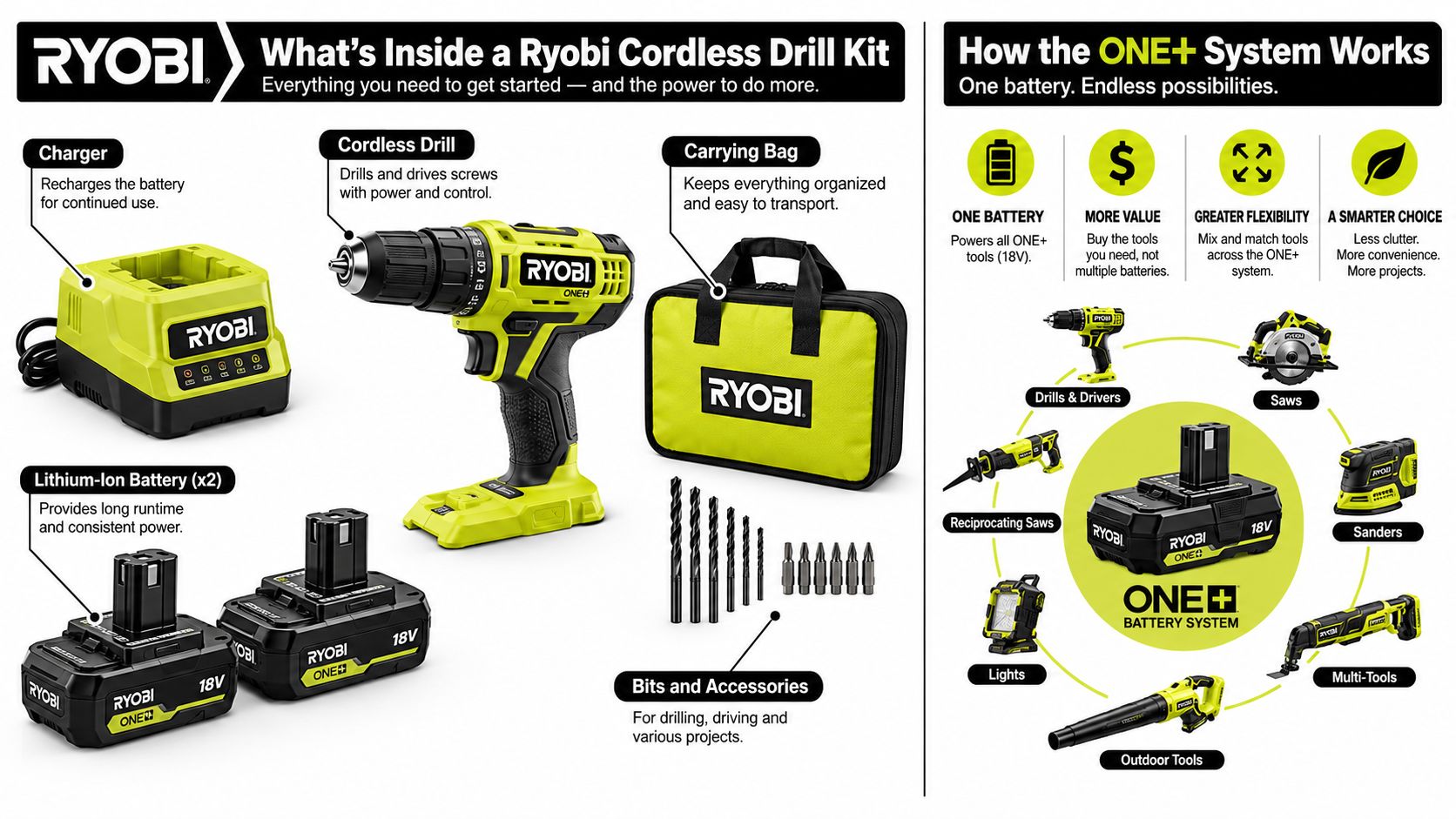
The 18V ONE+ system uses one battery family across compatible tools. Buy the first charger and pack, then add other ONE+ equipment without building a second charging setup. Ryobi lists over 300 products in the platform, and the connector has remained compatible across roughly three decades, as noted in Ryobi's platform history. That makes the first battery purchase a platform decision, not just a drill purchase.
Read the kit contents carefully
The listed RYOBI 18V ONE+ 1/2 in. drill/driver kit includes two 1.5 Ah lithium-ion batteries, a charger, a double-ended bit, and a bag. It is rated at 500 in-lbs of torque, up to 1,750 RPM, and uses a 1/2 in. keyless chuck, according to the manufacturer product listing at Home Depot.
The 1.5 Ah packs keep the drill compact and the handle lighter. They also provide less working reserve than higher-capacity batteries. That balance suits short fastening jobs and overhead work. Repetitive drilling through framing lumber, thick stock, or material requiring accessory bits calls for spare packs, breaks, and sensible battery cooling.
18V is the drill platform choice
The 18V ONE+ range is the battery family used by these drill and driver kits. A rechargeable battery does not make separate Ryobi platforms interchangeable. Check the voltage family, connector, and exact contents before ordering, especially when a listing says “tool only.”
Price the complete working setup rather than the drill body. Include the charger, batteries, and any bits you still need. That comparison helps expose the difference between a kit and a bare tool, while this guide to power tool battery compatibility helps verify whether existing packs fit the tools you plan to add. In Northern California, a kit with a second battery can also reduce downtime when heat, long drilling cycles, or a local pickup delay affects the workday.
Brushed vs Brushless Motors and Key Specs That Affect Real Performance
A brushed Ryobi drill-driver kit delivers about 515 in-lbs of torque, with a two-speed gearbox covering 0 to 450 RPM in low gear and 0 to 1,750 RPM in high gear. Its 24-position clutch is documented in the Ryobi ONE+ drill specifications from Home Depot Canada.
Low gear gives better control and mechanical advantage for driving screws. High gear works for smaller holes and faster light-duty drilling. The clutch limits overdriving and stripped heads when installing cabinet hardware, hinges, electrical boxes, and finish trim. For Northern California repair work, that level is usually enough unless the job regularly involves large holes or long runs of fasteners.
Brushless HP models raise output to roughly 750 to 850 in-lbs of peak torque and about 2,100 to 2,150 RPM, based on TechGearLab's Ryobi brushless drill testing. That reserve helps with hole saws, larger bits, and demanding fastening. It also draws more current, so battery capacity and spare packs matter more during extended work, particularly in hot Central Valley conditions.
Ryobi drill kit specs compared by motor type
| Feature | Standard Brushed Kit | Brushless HP Kit |
|---|---|---|
| Motor | Brushed | Brushless |
| Torque | About 515 in-lbs | Roughly 750 to 850 in-lbs peak |
| Maximum speed | About 1,750 RPM | About 2,100 to 2,150 RPM |
| Gearbox | Two speed, about 0 to 450 and 0 to 1,750 RPM | High-output two-speed design varies by model |
| Clutch | 24 positions on the standard class | Model-dependent |
| Best fit | General DIY, repairs, light remodeling | Larger bits, hole saws, repeated demanding work |
| Main trade-off | Less reserve under heavy load | More weight, current demand, and cost |
Brushed motors remain practical for intermittent work when the lower purchase price matters. They suit household repairs and occasional shop use. Brushless models earn their higher cost through stronger output and better reserve when the drill repeatedly approaches its limits. The trade-off is extra weight, battery demand, and greater kit cost, so compare the complete platform investment rather than the bare tool alone.
Torque is not the whole ergonomic story
A newer Ryobi hammer drill reaches 2,150 RPM and 850 in-lbs of torque, yet Popular Mechanics lists it at 3.1 lb with a 7.5 in. head length, as reported in Popular Mechanics' cordless drill coverage. That size can work against you inside cabinets, in crawlspaces, and during overhead fastening. Extra torque does not compensate for a drill that strains your wrist or will not fit the access point.
Practical rule: Choose enough torque to complete the work without stalling, then choose the smallest balanced drill that can do it repeatedly.
Popular Ryobi Cordless Drill Kit Configurations and Model Recommendations
The most useful Ryobi kit comparison starts with the job, not the product color. A 1/2 in. chuck accepts larger accessories than a 3/8 in. chuck, while a smaller drill can be easier to control during light fastening. A two-battery kit costs more upfront than a single-battery package, but it removes charging interruptions on larger projects.
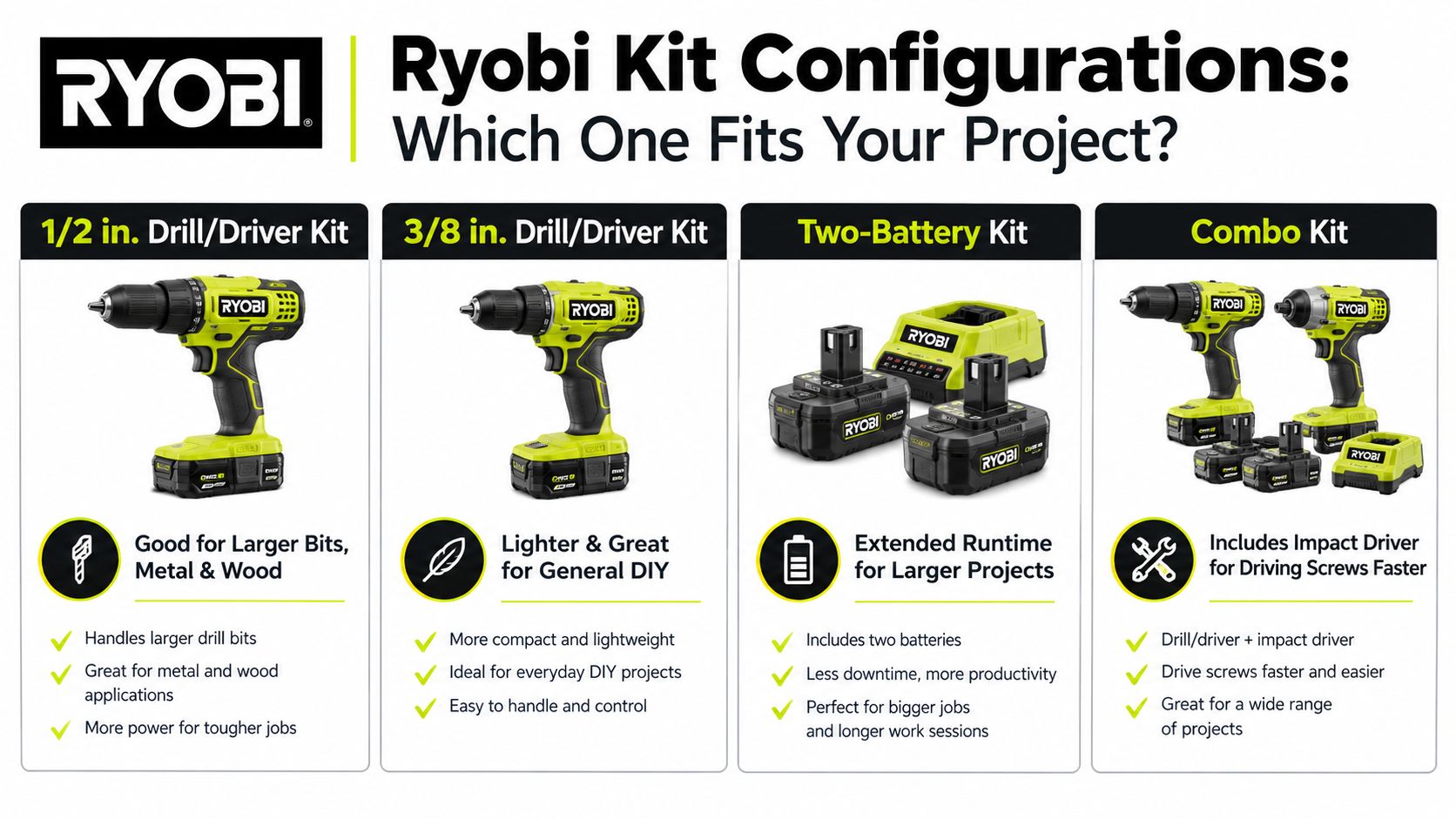
Match the configuration to the work
| Configuration | Known specifications or format | Pros | Cons | Ideal user |
|---|---|---|---|---|
| 1/2 in. standard drill/driver kit | 500 in-lbs, 1,750 RPM, two 1.5 Ah batteries, charger, bit, and bag | Ready to work, larger chuck, practical general-purpose output | More bulk than a compact drill, small batteries may need rotation | Homeowners, maintenance workers, light remodelers |
| 3/8 in. drill/driver kit | Listed up to 600 RPM on a separate Ryobi kit | Lighter-duty handling and simpler control | Less speed and muscle for demanding drilling | Furniture assembly, small repairs, light DIY |
| Brushless HP drill/driver | Roughly 750 to 850 in-lbs and 2,100 to 2,150 RPM | Stronger drilling reserve and faster high-speed work | Higher current demand, added size and fatigue | Remodelers, serious DIYers, frequent drilling |
| Combo kit | Drill/driver plus impact driver / atornillador de impacto format | Separates drilling from screw driving, efficient for repetitive fastening | More tools and batteries to store, higher purchase cost | Small crews, deck work, renovation projects |
The standard 1/2 in. kit is the safest general recommendation when you need a complete package. The 3/8 in. option, listed at up to 600 RPM in Ryobi's product information, is better when the work is light and compact handling matters more than drilling speed.
A brushless HP kit is the stronger alternative for hole saws, larger wood bits, and repeated fastening. It isn't automatically the better cabinet-installation tool. For overhead work, balance and wrist position can matter more than peak torque.
If you already own ONE+ batteries, compare a bare tool against a complete kit before buying. A kit with another charger and small battery can be wasteful if your existing packs are healthy and you need only the drill body. If your batteries are old, limited in capacity, or assigned to other tools, a two-battery kit can still be the better total-cost decision.
A combo kit earns its space when you drive many screws. The drill handles drilling and controlled fastening, while the impact driver takes repetitive screw driving away from the drill clutch. For occasional household use, the extra tool may sit unused, so a single drill kit is usually the cleaner purchase.
Watch this hands-on comparison before choosing between drill and driver roles:
Durability depends on workload, storage, chuck care, and battery handling as much as motor type. Ryobi's platform is useful because one battery family can support gradual expansion, but no drill should be run continuously in heat without pauses. Warranty terms also vary by model and seller, so check the listing rather than assuming every kit has identical coverage.
Who This Ryobi Kit Is For and Who Should Avoid This Platform
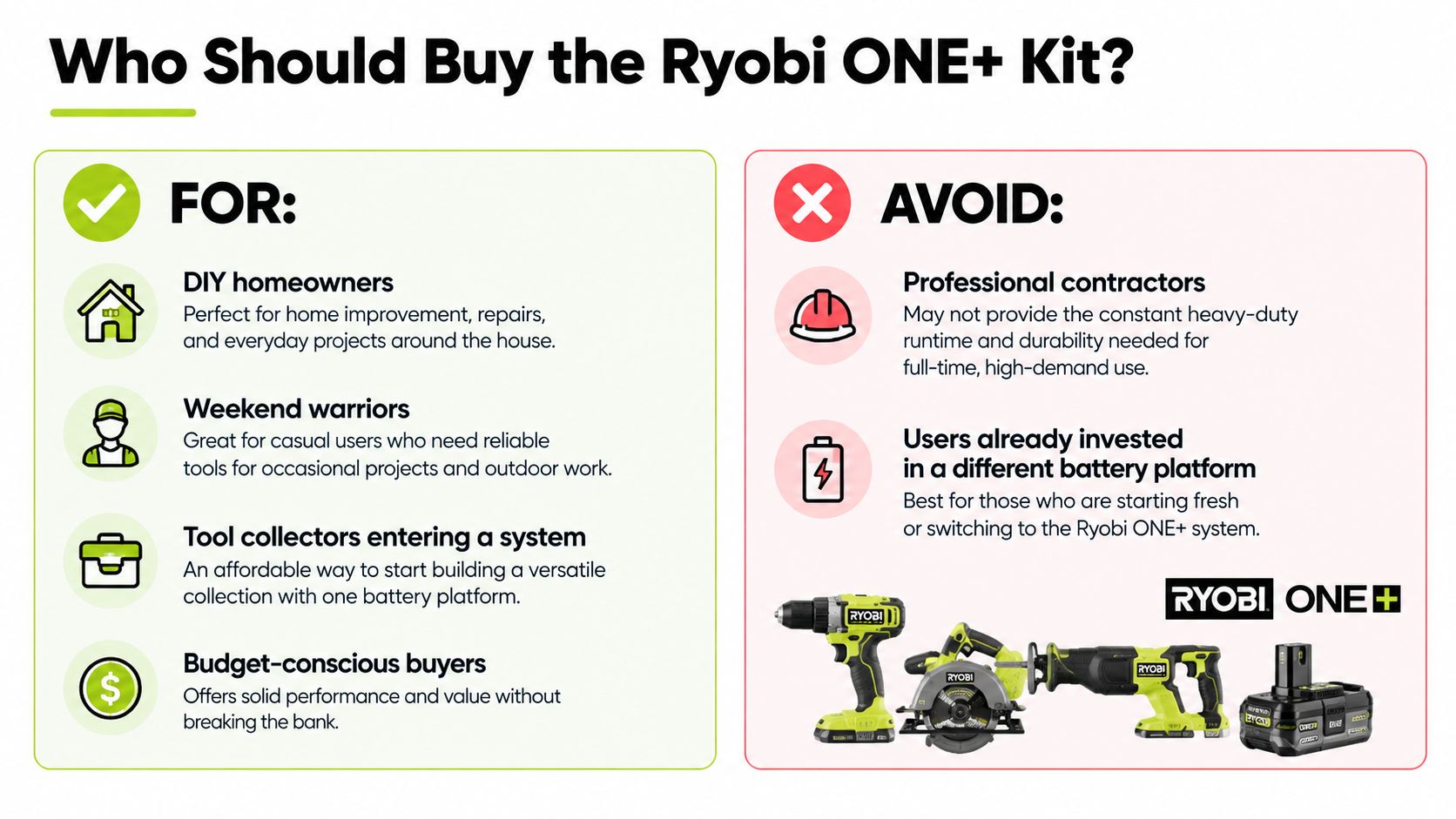
A Ryobi ONE+ kit makes sense when the battery platform matters as much as the drill. Homeowners, property managers, maintenance workers, and small remodeling crews can start with one useful tool and add compatible equipment as work demands change. A contractor may also keep ONE+ as a secondary system for punch-list work, lights, fans, and outdoor equipment.
Who this is for
DIY homeowners should start with a standard 1/2 in. kit when they need a ready-to-use package. It handles shelving, hardware, pilot holes, light framing repairs, and routine maintenance without requiring separate battery purchases. The kit also makes sense when nearby retailers offer local pickup, since a replacement battery or bit can be sourced quickly instead of waiting for delivery.
Weekend remodelers and Central Valley handymen can justify a two-battery or brushless package when drilling and fastening continue through a full workday. Northern California heat changes the practical calculation. A pack that performs well in a cool garage may lose runtime during repeated Sacramento-area work, so carry a charged spare and keep batteries shaded.
Budget-conscious professionals can use ONE+ selectively for punch lists and moderate-duty work. The platform's broad tool range can reduce the cost of adding equipment, but compare the complete kit price with the bare-tool price and the batteries you would otherwise need. That total-cost comparison matters more than the drill's shelf price.
For structural fastening, use the specified tool and fastener system. In regions where seismic requirements affect anchors and connections, a cordless drill cannot substitute for following the project's code and fastening details.
Who should avoid this platform
Avoid starting ONE+ when your truck and shop already depend on another battery family and you have no clear need for additional Ryobi tools. A new charger and battery line adds storage, charging time, and ownership cost. The platform investment only pays back when you will use more than the first drill.
A heavy daily production framer should also examine sustained output, service life, and ergonomics before choosing a standard drill platform. Even the newer HP hammer drill's 3.1 lb weight and 7.5 in. head length can tire the wrist in tight spaces or overhead, despite its 850 in-lb torque and 2,150 RPM, as reported by Popular Mechanics.
A powerful drill is useful only while you can hold it accurately and safely.
Choose a standard kit for household work, a compact 3/8 in. configuration for lighter handling, brushless HP for repeated demanding drilling, and another established platform when your professional operation already supports one.
Maintenance Battery Care and How to Evaluate Open Box Kits Smartly
Heat is hard on cordless tools. In Sacramento and the Central Valley, don't leave a charged battery on a truck dashboard or in direct afternoon sun. Bring packs into shade, allow a hot battery to cool before charging, and rotate batteries rather than forcing one pack through continuous heavy drilling.
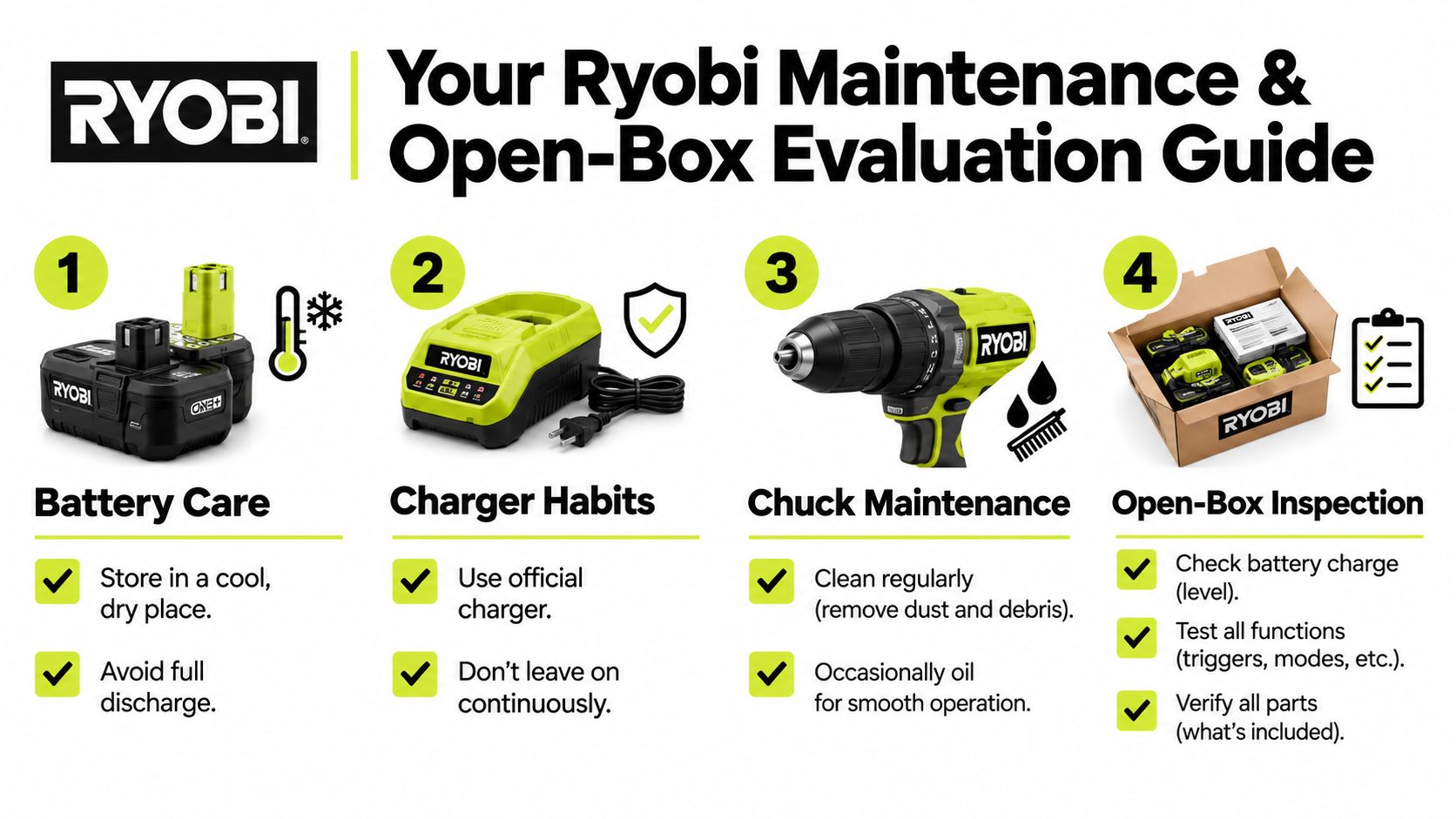
Field battery and drill care
Use the official charger supplied for the battery family, keep charger vents clear, and don't charge packs where moisture or loose metal can reach the contacts. Stop using a battery if its case is damaged, swollen, unusually hot, or producing an odor. Remove the pack before clearing a jam, changing a bit, or servicing the chuck.
A basic routine prevents most avoidable problems:
- Cool storage: Keep batteries dry and shaded, especially after heavy drilling.
- Charge deliberately: Let hot packs cool before charging and avoid treating the charger as permanent storage.
- Clean the chuck: Brush out dust and debris, then use only appropriate light lubrication where needed.
- Inspect the tool: Check the trigger, forward and reverse selector, clutch ring, chuck grip, LED, and battery contacts.
When evaluating an open-box kit, verify every listed component. Test the charger, install each battery, run the drill in both directions, shift through the gearbox, and check that the chuck closes evenly. Inspect the bit holder, bag, battery housing, and charger cord for damage.
The open-box item guide explains why condition and inspection matter. A cosmetic mark is different from a cracked housing, intermittent trigger, loose chuck, or battery that won't accept a charge.
A basic Ryobi kit can sell for about $49.97 with a drill, a 1.5 Ah battery, and a charger, placing it in the budget-to-value segment according to Home Depot's Ryobi cordless tool listings. That price only helps if the included parts are functional and suited to your runtime needs.
Pricing Savings and Where to Buy Your Ryobi Kit in Northern California
The lowest sticker price isn't always the lowest ownership cost. If you already have working ONE+ batteries and a charger, a bare tool may be the logical purchase. If you're entering the platform, a complete kit avoids separate battery and charger costs. If you need continuous runtime, two smaller packs can be more practical than one drill with no backup.
Independent review pages place the cheapest current Ryobi 18V drill kit around $54 with two 1.5 Ah batteries and a charger, while newer kits and combo bundles remain part of the same 300-plus-product ONE+ ecosystem, as reported by Front Desk Review's cordless drill coverage. Retail prices change, so compare the exact model, battery count, charger, and return terms before treating a deal as a bargain.
For Sacramento-area buyers, local availability can change the calculation. Fast one-day Northern California delivery helps when a project is scheduled, while same-day Elk Grove warehouse pickup can eliminate a jobsite delay. Confirm current stock and pickup eligibility before driving over.
Value Tools Co offers tested and inspected Ryobi open-box and bare tools, with up to 55% savings on those categories. Its 30-Day Peace of Mind Guarantee includes 30-day returns by mail or in-store and free return shipping on defective items. Those terms matter when you're comparing a lightly used kit with a new retail package, particularly if you can inspect the tool or arrange quick local support.
For internal shopping guidance, connect this article to the site's drills and drivers collection and the relevant Ryobi product listings. The buying decision should come down to three checks: battery ownership, required runtime, and the physical size you can comfortably use all day.
For most homeowners, the standard 1/2 in. Ryobi cordless drill kit is the sensible starting point. Existing ONE+ owners should price a bare tool first, while serious remodelers should spend more on brushless HP only when the added output justifies the weight and battery demand.
Value Tools Co carries tested and inspected Ryobi open-box and bare tools, including ONE+ drill options, with up to 55% savings and a 30-Day Peace of Mind Guarantee. Compare kit contents, battery needs, and local availability, then visit Value Tools Co for delivery or same-day Elk Grove pickup options.


