

You're on a Sacramento framing job, the afternoon temperature is pushing past 100°F, and two cordless nailers look nearly identical on the supplier's page. One is labeled factory reconditioned. The other is refurbished. The cheaper tool may save money today, but the questions are who repaired it, what parts went into it, how it was tested, and whether you can return it when the work matters.
The practical answer is straightforward. Factory reconditioned tools usually offer stronger consistency because the manufacturer or an authorized partner controls the repair process. Refurbished tools can be excellent value, but quality depends more heavily on the seller's standards, parts, testing, warranty, and return policy. That distinction matters for a framing nailer, impact driver, compressor, or rotary hammer that has to perform repeatedly under job-site pressure.
Introduction to Tool Condition Choices
A reconditioned Milwaukee rotary hammer restored through a manufacturer-controlled process is a different purchase from a lightly used tool that a reseller wiped down, tested briefly, and listed as refurbished. Both may run when you pull the trigger. Only one may have documented component replacement, validated testing, and support that resembles the original product channel.
That difference becomes more important in Northern California. A cordless framing nailer left in a hot truck can experience conditions that expose weak batteries, tired contacts, and marginal electronics. A tool that works acceptably in a cool shop may lose consistency when the crew is driving structural fasteners all day in Sacramento or the Central Valley.
The label alone doesn't settle the decision. You need to evaluate repair authority, parts sourcing, test depth, visible condition, warranty coverage, return terms, included accessories, and delivery timing. For a local contractor, same-day availability can also matter more than a small price difference if a replacement tool is needed before the next shift.
A useful starting point is the used tools buying guide from Value Tools Co, which treats condition as a purchasing decision rather than a cosmetic label. The same approach works here. A factory reconditioned tool generally suits demanding daily use when reliability and specification control come first. A carefully vetted refurbished tool can make more sense for a homeowner, occasional remodeler, or small crew that needs a dependable tool without paying new-tool pricing.
Understanding the Key Concepts
Factory reconditioned generally means the original manufacturer or an authorized partner recovered a returned, worn, or defective tool and restored it through an approved process. That process can include replacing worn components, correcting defects, inspecting assemblies, and completing factory-authorized tests. The important point is control. The manufacturer knows the design tolerances, approved parts, firmware requirements, and intended operating behavior.
Refurbished is a broader category. A retailer, independent repair shop, or third-party refurbisher may inspect, clean, repair, test, cosmetically touch up, and repackage the tool before resale. Some refurbishers operate disciplined workflows and produce dependable equipment. Others perform only enough checking to confirm that the motor starts or the charger powers on.
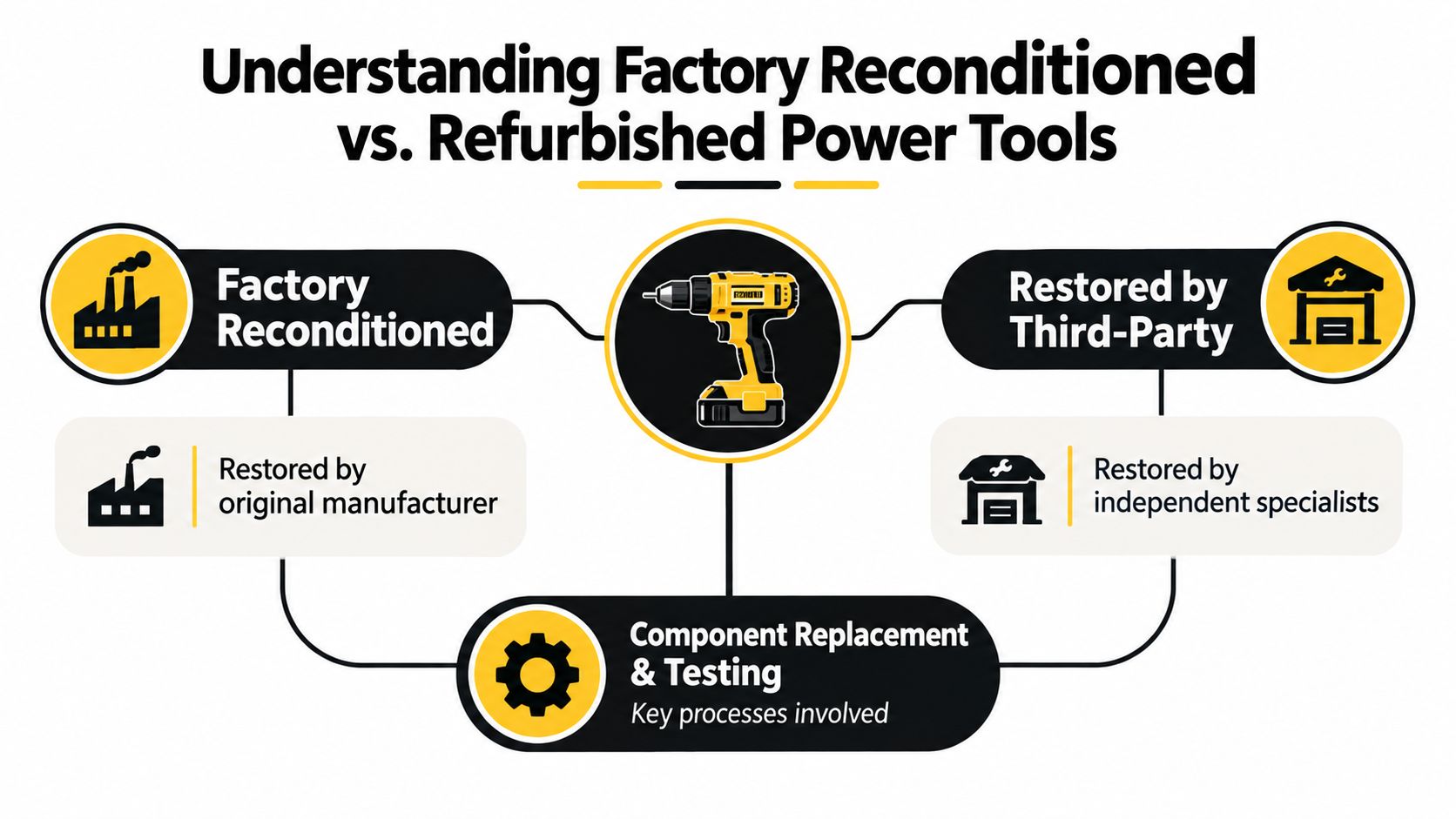
The historical distinction is useful, although the market doesn't apply it consistently. Factory reconditioning emphasizes manufacturer-controlled recovery, replacement of worn components, and authorized testing. Refurbishment more often describes repairing defects and restoring appearance and functionality after a return or damage event, as described in this comparison of reconditioned and refurbished products.
What the label means at the workbench
A factory reconditioned impact driver may receive an approved trigger assembly, genuine internal parts, and a test sequence designed for that model. A third-party refurbished impact driver may receive a replacement component that fits and works, but the seller's inspection process determines whether the tool is ready for heavy use.
“Used” is different again. A used tool may have been operated and resold without a meaningful recovery process. Open-box usually describes an opened or returned item, but the condition and inspection depth still need confirmation. The open-box item guide from Value Tools Co helps separate a packaging status from a true repair or testing status.
The same distinction appears beyond tools. Buyers researching Amazon refurbished products for brands in 2026 will encounter manufacturer programs, seller programs, and platform grading systems that don't always mean the same thing. Read the actual listing details instead of treating “renewed,” “refurbished,” and “reconditioned” as interchangeable.
Comparing Repair Standards and Quality
The main difference in factory reconditioned vs refurbished power tools is the chain of responsibility. A manufacturer or authorized partner typically has access to validated repair procedures, genuine parts, model-specific test equipment, and the original engineering requirements. A third-party refurbisher may be highly capable, but its results depend on its own inspection rules, supplier relationships, technicians, and documentation.
That doesn't make every refurbished tool unreliable. It means the buyer has more work to do before assuming consistent quality. The relevant question isn't “Does it look new?” It's “What was checked, what was replaced, and who stands behind the result?”
Tool standards comparison
| Criteria | Factory Reconditioned | Refurbished |
|---|---|---|
| Repair authority | Original manufacturer or authorized partner | Retailer, independent specialist, or third-party seller |
| Part sourcing | More likely to use genuine or manufacturer-approved components | May use mixed, compatible, or seller-sourced components |
| Testing depth | Validated, model-specific factory or authorized testing | Depends on the seller's inspection and test procedure |
| Specification control | Generally closer to original design requirements | Can range from basic functional checks to comprehensive testing |
| Cosmetic condition | Commonly presented as like new, although packaging may vary | May show wear, scratches, touch-ups, or repackaging |
| Documentation | Often includes clearer condition and warranty information | May be limited unless the seller publishes a test report |
| Best fit | Daily professional use and low tolerance for downtime | Budget-conscious buyers who can verify the seller and return terms |
The manufacturer-versus-third-party repair comparison supports the practical distinction: factory reconditioned products are typically restored with validated processes, genuine parts, and factory-level quality assurance, while third-party refurbishment can vary in component sourcing and test depth.
Practical rule: A clean housing doesn't prove a healthy gearbox, battery interface, trigger, or electronic brake. Ask what the seller tested internally.
What works and what doesn't
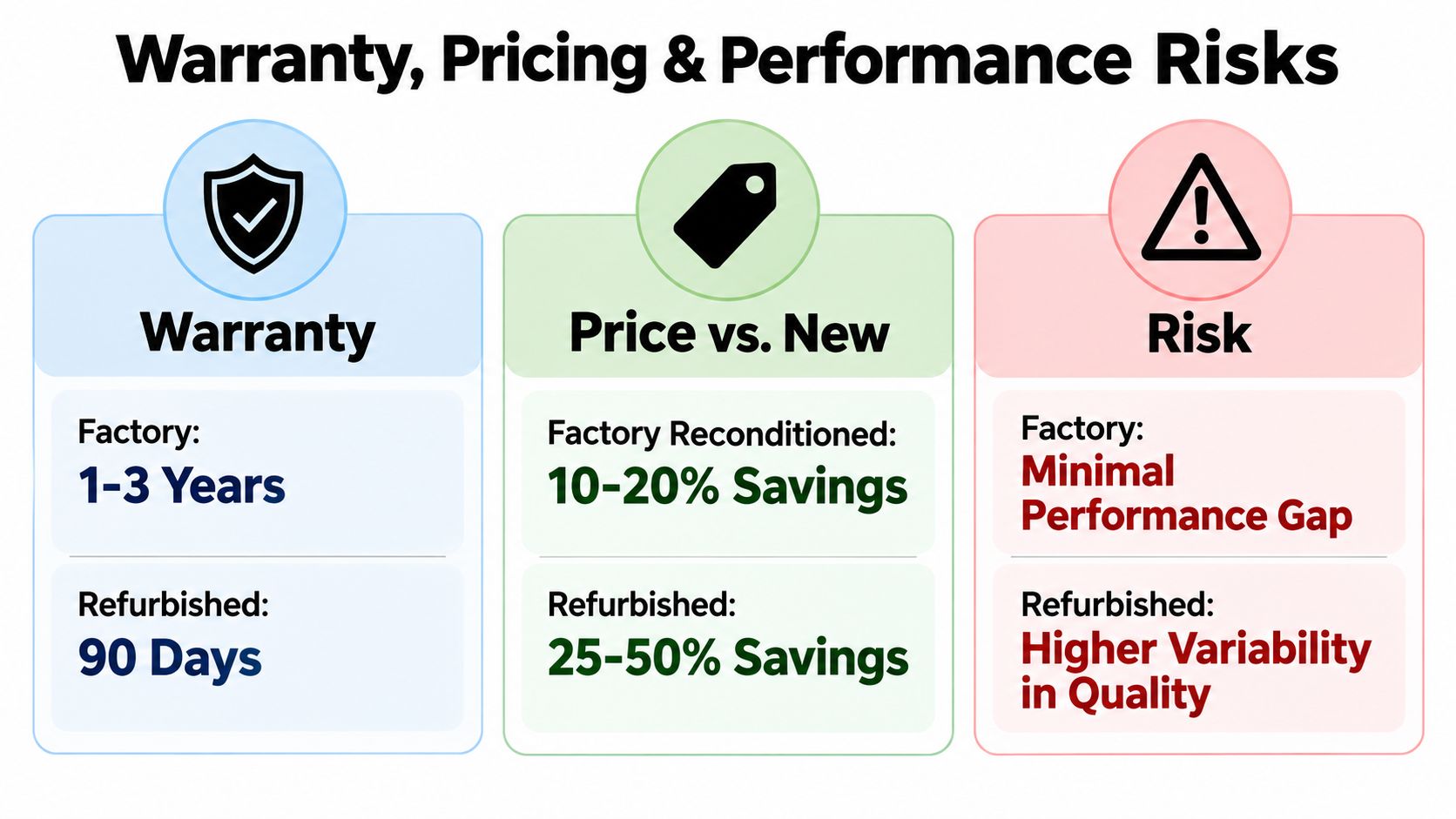
For a high-use framing nailer, factory reconditioning is usually the safer choice when the price difference is reasonable and the warranty is clear. The tool is exposed to repetitive cycling, dust, impact, vibration, and temperature swings. Consistent fastener depth and reliable firing matter more than a few cosmetic marks.
A refurbished tool can work well for trim installation, punch-list work, occasional deck repairs, or a homeowner's renovation kit. It becomes a poor choice when the listing provides no test details, excludes the battery without saying so, uses vague “powers on” language, or offers no practical return route. A tool that merely starts isn't necessarily ready for production work.
Warranty Pricing and Performance Risks
Price comparisons often fail because buyers compare the sticker price rather than the ownership risk. A factory reconditioned tool may carry manufacturer-backed coverage or equivalent protection. Refurbished products commonly have warranties ranging from 90 days to 1 year, according to this refurbished product standards guide. The actual term matters less than the exclusions, claim process, battery coverage, and return window.
A seller may cover the tool body but exclude the battery, charger, or consumable parts. Another may require the buyer to pay shipping for a defect. Before ordering a cordless tool, confirm whether the listing includes the battery and charger, whether they carry the same condition grade, and whether the warranty begins on delivery.
The broader ownership issue includes software and support. A 2025 consumer study found that only 24% of respondents expected warranties longer than two years, while fewer than 10% expected software or OS updates beyond five years, according to the Vodafone Institute refurbished-versus-new study. Power tools aren't phones, but the lesson applies. Buyers often focus on the purchase price and overlook the support period, replacement battery ecosystem, and future serviceability.
Calculate the real value
Use this decision test before buying:
- Downtime exposure: If the tool fails during a scheduled pour, framing inspection, or tenant repair, the cheaper purchase may cost more in lost time.
- Replacement availability: Confirm that batteries, chargers, and wear components remain available for the platform.
- Return friction: A clear return policy has practical value, especially when the listing doesn't disclose internal repair work.
- Warranty scope: Verify whether coverage applies to the tool, battery pack, charger, and labor.
- Job intensity: Occasional use tolerates more uncertainty than daily production work.
The extended warranty options from Value Tools Co can be part of that comparison, but don't buy extra coverage without reading the exclusions. A strong warranty cannot compensate for a seller that won't explain what was tested.
How to Evaluate Listings Safely
Start with the listing title, then read every condition note. “Manufacturer reconditioned,” “seller refurbished,” “open box,” “used,” and “bare tool” describe different buying situations. If the title says bare tool / herramienta sola, assume the battery and charger aren't included unless the description says otherwise.
A practical inspection checklist
- Identify the restorer. Look for the manufacturer's name, an authorized service reference, or a clearly named independent refurbisher. If the listing only says “refurbished” without identifying who performed the work, treat the condition as unverified.
- Ask what was tested. For a framing nailer / clavadora de marcos, ask whether the seller checked firing consistency, depth adjustment, trigger operation, magazine alignment, and battery contacts. For an impact driver / atornillador de impacto, ask about the chuck or hex collet, forward and reverse controls, brake response, and load testing.
- Check the accessories. A tool body, battery, charger, belt hook, side handle, case, and manuals may have separate condition histories. Confirm the exact contents before comparing prices.
- Inspect photographs carefully. Look for damaged vents, melted plastic, bent magazines, missing labels, cracked housings, worn battery rails, and evidence of water or concrete dust. Cosmetic wear isn't automatically a problem, but structural damage is.
- Read the return language. Find out whether returns are accepted by mail or in-store, who pays return shipping for defects, and whether the seller requires a diagnostic process before approving a return.
- Match the tool to the work. A refurbished drill may be sensible for cabinet installation. A heavily used compressor or nailer deserves more scrutiny because seals, valves, switches, and impact components carry mechanical wear.
Questions worth asking the seller
Ask whether worn components were replaced or merely found functional. Ask whether the tool was tested under load, not just powered on. Ask whether batteries were capacity-tested, whether the charger is genuine or compatible, and whether firmware or configuration checks apply to that model.
A professional listing should make those answers easy to find. If you have to chase basic information, the uncertainty is part of the price.
Regional Conditions and Tool Longevity
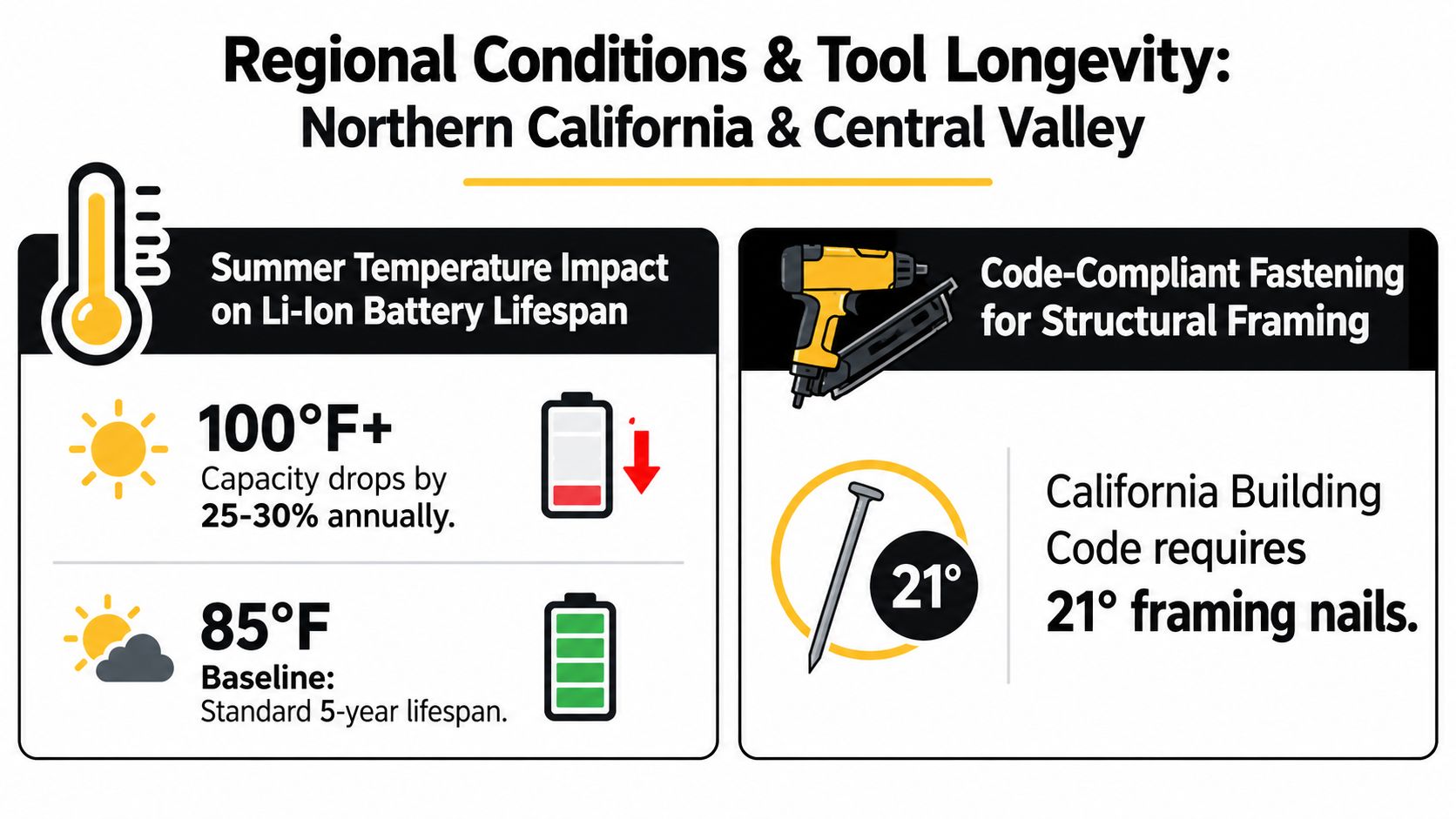
Central Valley heat changes the battery decision. An industry guide reports lithium-ion battery aging at about 4% per year at 77°F, increasing to roughly 8% per year at 104°F, with permanent capacity loss accelerating above 105°F. The power-tool battery storage guidance for hot conditions makes the practical point clear: don't leave battery packs, chargers, or cordless tools in direct sun or inside a hot vehicle between jobs.
For Sacramento and Elk Grove crews, store spare packs in a shaded, ventilated area and let a hot battery cool before charging. Don't charge a visibly damaged, swollen, wet, or overheated pack. Keep the charger out of direct sunlight, and inspect contacts for corrosion or debris before connecting it.
Fastener selection also affects the purchase. Structural framing work may require 21° full round-head framing nails under applicable California building requirements, so confirm that a framing nailer accepts the collation and nail specification your project calls for. A tool can be mechanically sound and still be wrong for the inspection if it doesn't support the required fastener system.
Local supply has operational value. A contractor near Sacramento may prefer fast 1-day Northern California delivery or same-day Elk Grove warehouse pickup when a failed tool threatens the schedule. Those options don't replace inspection, but they reduce the time between identifying a problem and getting a workable replacement.
Buying Recommendations and Next Steps
Choose factory reconditioned for daily production work, structural framing, repetitive fastening, concrete drilling, or any job where a tool failure can stop a crew. The manufacturer or authorized repair channel generally gives you better confidence in parts compatibility, original tolerances, and test procedures. Confirm the warranty before ordering, especially for batteries and chargers.
Choose refurbished when the seller documents the work, the tool has a meaningful return window, and the use case doesn't justify paying the premium for manufacturer-controlled recovery. A homeowner installing cabinets, a property manager handling repairs, or a small maintenance business may get strong value from a tested refurbished drill, grinder, or impact driver. The saving only works if the tool arrives ready for the actual task.
Match condition to the job
| Buyer or use case | More suitable choice | Reason |
|---|---|---|
| Full-time framing crew | Factory reconditioned | Lower tolerance for inconsistent firing and downtime |
| Remodeler with mixed weekly work | Either, with documented testing | Balance reliability, platform compatibility, and price |
| Homeowner completing occasional projects | Carefully vetted refurbished | Lower purchase cost can matter more than factory-channel assurance |
| Property manager needing a backup tool | Refurbished with easy returns | Availability and replacement speed may outweigh cosmetic condition |
| High-wear rotary hammer user | Factory reconditioned | Internal wear and load performance deserve closer control |
Value Tools Co sells tested and inspected open-box or bare tools, including manufacturer-reconditioned listings such as a used, manufacturer-reconditioned Milwaukee rotary hammer. Its 30-Day Peace of Mind Guarantee includes returns by mail or in-store, free return shipping on defective items, and savings of up to 55% on Open-Box or Bare Tools. Those terms are useful when comparing a local purchase against a listing that has a lower price but unclear testing or difficult returns.
Before checkout, verify five details:
- Condition authority: Who restored the tool?
- Included equipment: Is it a bare tool, and are the battery and charger included?
- Functional testing: What specific operations were checked?
- Protection: What does the warranty cover, and for how long?
- Logistics: Can you use fast Northern California delivery or same-day Elk Grove pickup if timing matters?
My recommendation is simple. Buy factory reconditioned for tools that earn money every day. Buy refurbished when the seller proves the testing, the return process is practical, and the job can tolerate some uncertainty.
FAQ
How can I tell if a tool is seller-refurbished?
Look for the name of the refurbisher, a condition report, testing details, and warranty terms. If the listing only uses “refurbished” and doesn't identify a manufacturer or authorized partner, treat it as seller-refurbished until the seller provides better documentation.
Are battery packs covered under factory reconditioned warranties?
Not automatically. Check the warranty exclusions and confirm coverage for the tool body, battery pack, and charger separately. Battery condition can materially affect cordless-tool value, particularly in hot Central Valley work conditions.
Can refurbished tools receive firmware updates?
It depends on the tool platform, software requirements, and the seller's testing process. Ask whether the tool was checked for configuration or firmware compatibility, then verify support through the manufacturer before relying on connected features.
How long should I wait for delivery in Elk Grove?
Delivery depends on the seller, stock location, and shipping service. If the tool is available locally, ask about same-day Elk Grove warehouse pickup. For a scheduled job, confirm the delivery commitment before ordering rather than assuming a refurbished listing will arrive quickly.
Compare manufacturer-reconditioned, refurbished, open-box, and bare-tool listings at Value Tools Co, where tested and inspected tools come with a 30-Day Peace of Mind Guarantee, in-store or mail returns, free return shipping on defective items, and savings of up to 55% on qualifying Open-Box or Bare Tools. Choose the condition that matches your workload, then order for Northern California delivery or arrange same-day Elk Grove warehouse pickup.


