

A bare tool is a cordless power tool sold without its battery and charger, called herramienta sola on bilingual crews, and the buyer supplies a compatible battery to make it run. It's one part of a three-part system, with the tool body, the battery platform and the charger treated as separate pieces of equipment.
You've seen the listing. The price on a Milwaukee impact wrench or a RIDGID nailer looks like a typing error, then the fine print says Tool Only, and the pack and charger aren't in the box. That gap is the entire decision. Buying bare is smart money for someone already carrying packs on that platform, and a fast way to overspend for anyone who isn't. What follows is the math, the compatibility checks and the safety rules I'd run before hitting checkout on any tool-only listing.
What a Bare Tool Includes and What It Leaves Out
The battery works like a fuel tank and the tool body is the engine. A bare tool ships assuming you already own a tank that fits, which is why the box is lighter and the price is lower. The word bare describes package contents, not an inferior or incomplete tool. The motor, chuck, electronics and housing are the same parts that go into a full kit.
Assembly Magazine's review of cordless tool development puts it plainly: a bare tool is a cordless power tool sold without the rechargeable battery and charger, so the buyer purchases the tool body separately and supplies compatible power-system components.
What Ships in the Box
| Item | Bare tool | Full kit |
|---|---|---|
| Tool body (motor, chuck, housing) | Included | Included |
| Battery pack | Not included | Included |
| Charger | Not included | Included |
| Blades, bits or nails | Not included; consumables are bought separately | Sometimes a starter blade or bit |
| Carrying case | Usually not included | Often included |
| Accessories such as guards | Included when they mount on the tool body | Included |
Live listings make this concrete. The RIDGID 18V Cordless 23-Gauge 1-3/8 in. Headless Pin Nailer is listed as Tool Only at a $132.00 sale price in Open Box condition, so the pack and charger stay off the order and you finish the tool with batteries already on your rack. The Milwaukee 0820-20 M12 12V Cordless Jobsite Fan carries the same Tool Only flag, and the Milwaukee 2367-20 package shows what that flag means in practice: one M12 ROVER Service and Repair Flood Light, nothing else. On open-box tool-only items, the Value Tools Certified Inspection spells out package contents and included accessories in the inspector notes, which is the field to read before assuming anything ships with the body.
Read the Listing Wording Before You Compare Prices
Separating the power source from the tool didn't happen by accident. Assembly Magazine traces the architecture to Makita's 1978 6010D, a 7.2-volt drill built for general consumers with a removable battery pack and its own charger. Once a body, a platform and a charger could be sold as separate components, the tool-only package became a legitimate purchase rather than a stripped-down compromise.
That history matters less at checkout than three words. Look for Tool Only, bare tool or herramienta sola before you compare a price against anything else, because a $132 bare pin nailer and a boxed kit with a pack and charger aren't the same product. Set the tool-only price next to a kit only after adding what a compatible battery and charger cost you. That total is the actual price of entry on a new platform, and it's where a cheap listing stops being cheap.
Practical rule: if the listing doesn't state clearly which items are excluded, you can't compare it fairly against a kit. Move on or ask before ordering.
How Battery Platforms and Amp-Hours Shape Your Purchase
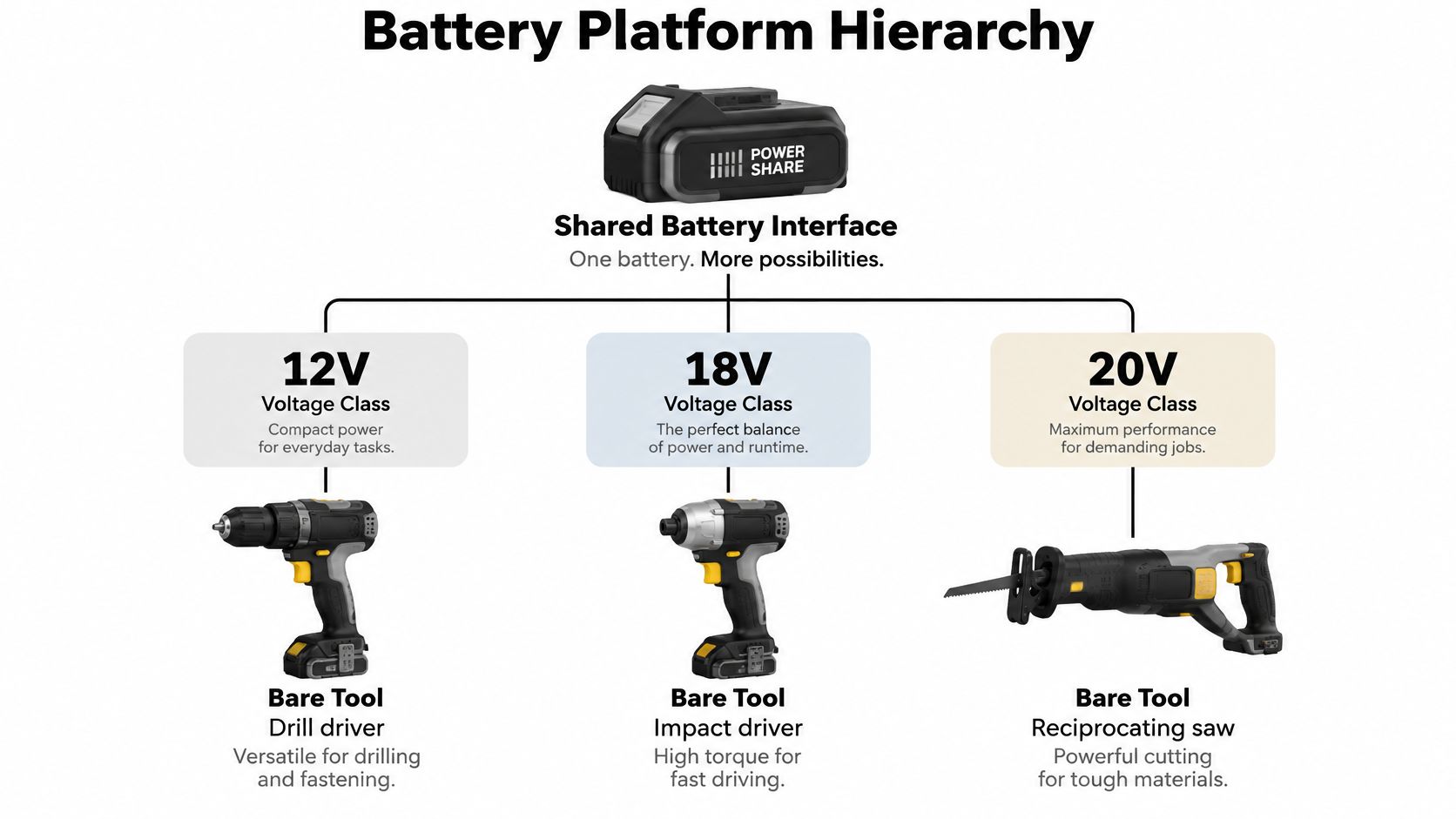
The purchase is the platform, not the tool. A platform is a family of tools sharing one battery interface and voltage class, which is why the packs already in your truck decide which bare tools are worth buying and which ones start a second collection you didn't plan for.
The scale of that reuse is the whole argument. A Yahoo Shopping retrospective on cordless tool history reports, citing semiconductor manufacturer onsemi, that modern ecosystems can include hundreds of tool types powered by only two to four battery systems. One pack, many tools, one charger on the wall.
Amp-Hours Are Stored Charge, Not Runtime
Amps-hours (Ah) get sold as hours of work. They aren't. Makita's lithium-ion battery safety document defines Ah as stored charge rather than guaranteed runtime, because actual runtime shifts with motor load, material, operating technique, temperature and the tool's control electronics. A 5.0Ah pack in a drill driver and the same pack in a grinder are two different workdays.
Higher-Ah packs generally carry more stored energy and more mass, and that trade-off lands on your wrist. Overhead drilling, sanding and long fastening runs punish a heavy pack far more than a bench cut does.
| Battery size | Best for | Trade-off |
|---|---|---|
| Compact pack | Light work, trim and overhead fastening | Less runtime per charge |
| Mid-size pack | General drilling and driving | Balanced runtime and weight |
| High-capacity pack | Grinders, saws and continuous site work | Heavier and bulkier for overhead use |
Heat Changes the Math in the Central Valley
Sacramento and Central Valley summers are hard on packs. On an afternoon when the forecast runs past 100°F, a battery left in a truck bed or on a dashboard gets hot enough that it shouldn't go straight onto a charger. Let it cool in shade first, charge in the morning before the day peaks, and expect shorter runtime as the heat builds. Rotating two packs beats pushing one until it cuts out.
If you're unsure whether a pack fits a specific body, start with this guide to power tool battery compatibility before you order anything.
When a Bare Tool Saves Money and When a Kit Costs Less
The tool-only price is the smallest number on the page. Add a pack and a charger and the total can climb past a complete kit, which is why the Canadian Centre for Occupational Health and Safety frames the decision around ownership: a bare tool is most economical when the buyer already has working batteries and a charger on that platform, and otherwise the initial system cost can exceed the apparent tool-only price.
| Buyer situation | Owns batteries and charger | Better choice | Reason |
|---|---|---|---|
| Contractor adding a tool to one platform | Yes | Bare tool | Reuses existing packs and charger |
| First cordless purchase | No | Full kit | Battery and charger can exceed the bare price |
| Hobbyist expanding a toolkit slowly | Yes | Bare tool | Lower cost per added tool |
| Crews mixing battery generations | Partly | Compare full ownership cost | Extra packs add up quickly |
| Bargain buyer on a known platform | Yes | Open-box bare tool | Discounts up to 55% with inspection details |
Run the arithmetic on a real listing and it stops being abstract. The RIDGID 18V Cordless 23-Gauge 1-3/8 in. Headless Pin Nailer Tool Only is listed at $132.00 in Open Box condition, inside a catalog where top-brand power tools, accessories and hardware run up to 55% off retail. If your trailer already carries RIDGID 18V packs, that's your entire cost. If it doesn't, price the pack and charger first and watch how quickly the gap closes.
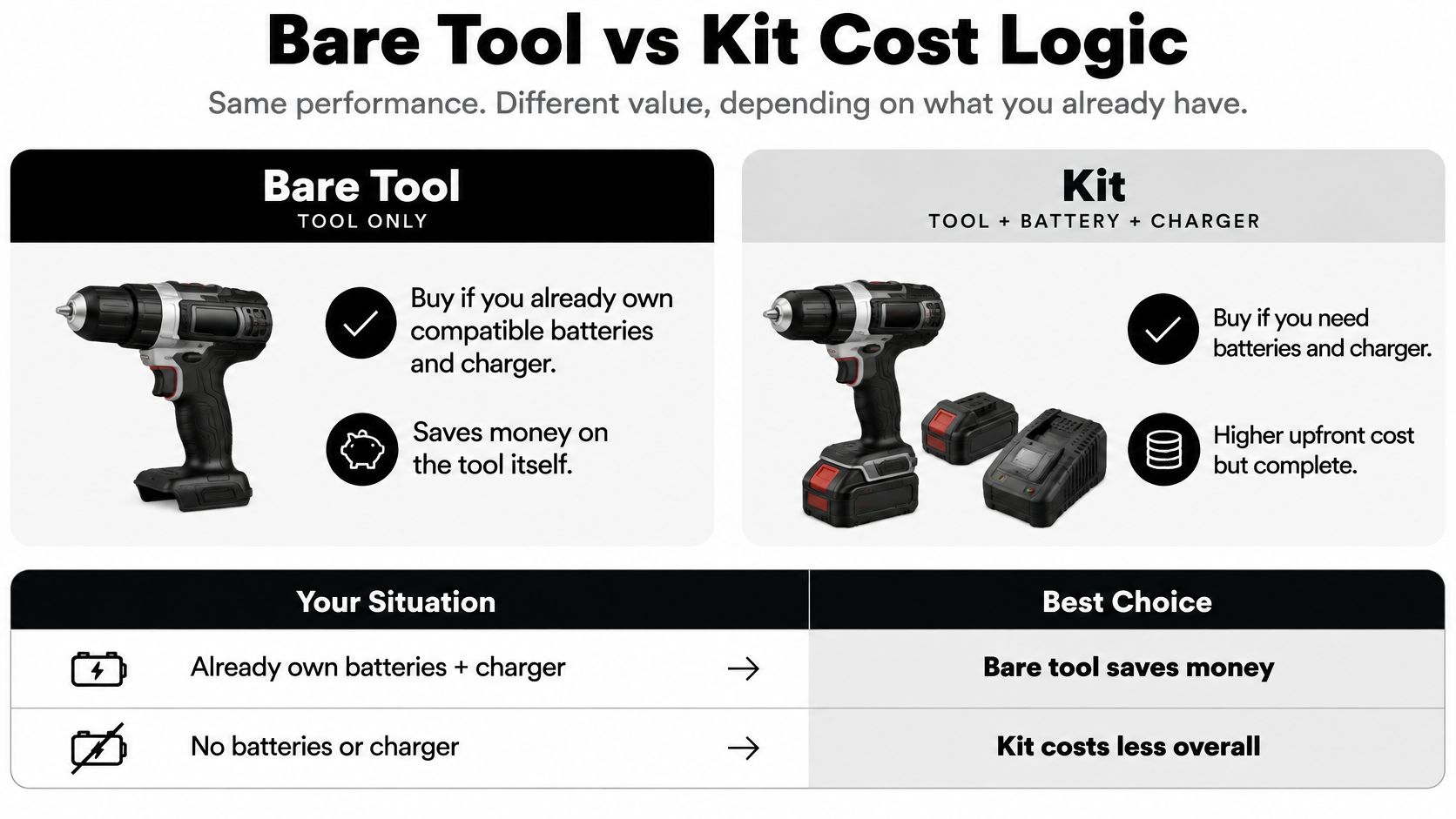
Here's the same logic walked through on video, including how the kit premium is really a battery and charger purchase.
Fleets and Small Crews
Mixed battery generations are the expensive part of a fleet. Two trucks running three platform generations means duplicate chargers, duplicate spare packs and a crew member who can't borrow a battery from the truck next to him. Standardize on one platform first, then buy bare tools into it for years. This comparison of combo kit buying decisions helps when you're building that standard from scratch.
Open-box changes the math again for bargain shoppers. An inspected open-box bare tool can land under a new tool-only package while carrying a written condition report, which is the closest thing to buying new with the discount already applied.
Run These Checks Before You Order a Bare Tool
Start with the battery platform. Milwaukee's battery documentation states that its lithium-ion packs should be used only with compatible Milwaukee lithium-ion tools and charged only in the specified Milwaukee charger, and it also warns that those packs are not compatible with V-technology or NiCd systems. Same brand does not mean same interface across generations.
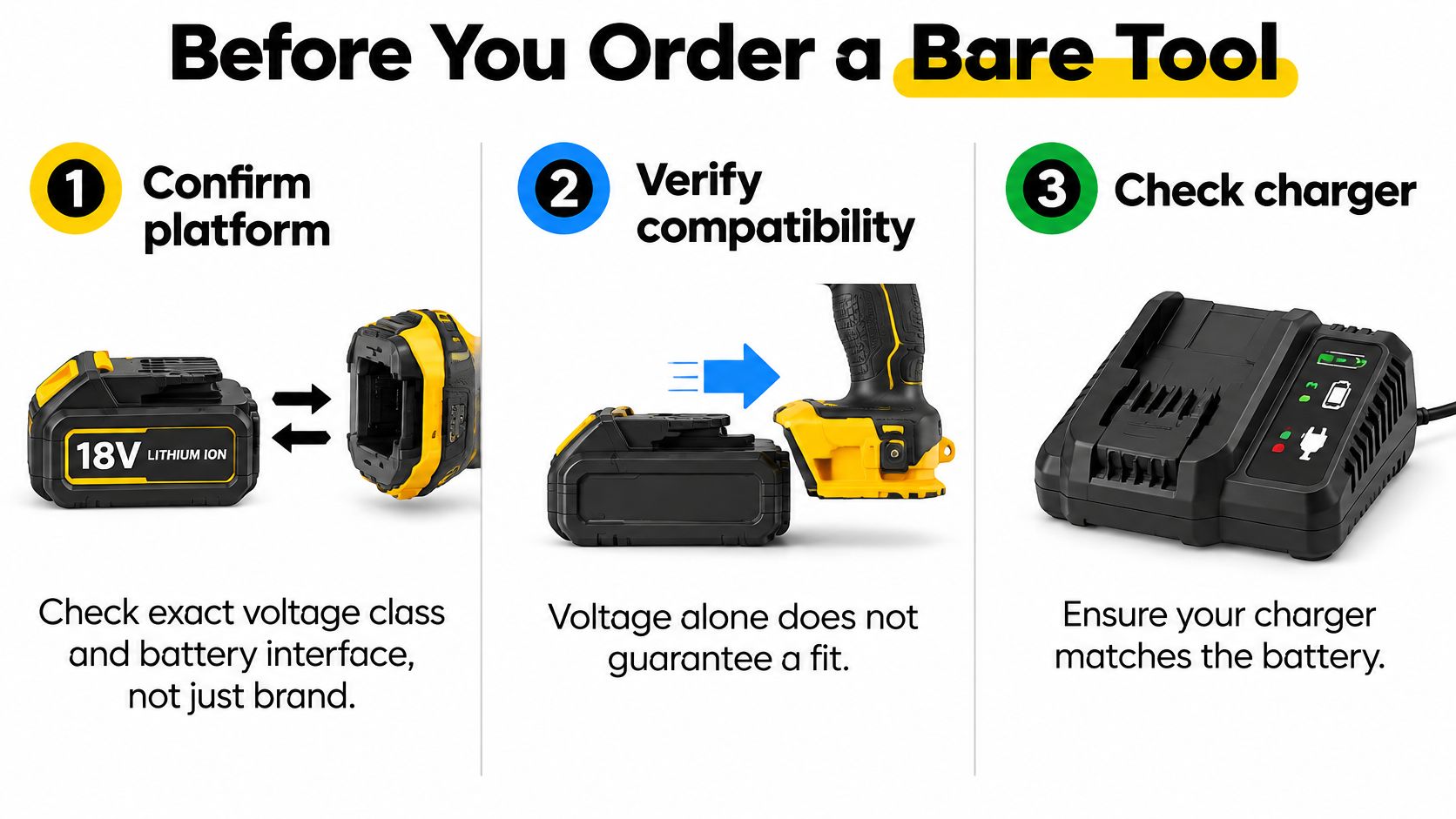
Run four checks in order; interface and cost errors show up first.
- Confirm the platform and battery interface. Match the exact voltage family plus the connector geometry listed for the model. Voltage alone does not guarantee a fit, and neither does a familiar housing color.
- Total the ownership cost against a kit. Add the tool price, any pack and charger you still need, plus blades or nails and warranty coverage. If that total lands within a few dollars of a kit, buy the kit.
- Check the condition and inspection notes. Open-box items carry a Value Tools Certified Inspection covering bench verification, functionality, cosmetic condition, package and included accessories, and inspector notes. Read it before assuming a case or guard is included, even on small listings such as the Milwaukee 0820-20 M12 12V Cordless Jobsite Fan marked Tool Only.
- Confirm the return terms. The 30-day guarantee applies to tested and inspected products, and every item is inspected and tested before listing.
Call before you commit to a big order. A two-minute compatibility check on 916 201 4365 beats a return.
If the schedule is tight, order early and verify fit before checkout; a fast shipment of the wrong bare tool is still the wrong tool.
Battery and Charger Safety for Bare Tool Buyers
Charging compatibility is a safety requirement, not an accessory detail. The Canadian Centre for Occupational Health and Safety advises using only the manufacturer-approved battery and charging device, avoiding uncertified chargers, charging at room temperature, keeping batteries off soft surfaces that trap heat, and never charging a damaged or defective pack. It also recommends removing the battery or unplugging the charger once charging finishes and working in a well-ventilated area.
Those rules matter most with open-box and used bare tools, because the body can be perfectly functional while the pack is the weak link.
- Use the approved charger only. A mismatched aftermarket unit can create electrical, fire or explosion hazards even when the connector clicks in nicely.
- Charge cool and in open air. Room temperature, good ventilation, no soft upholstery under the pack.
- Pull the battery when it's full. Unplug the charger and store the pack off the tool for transport.
- Retire damaged packs. Swelling, cracks, leaking, impact marks or abnormal heat mean replacement, not recovery of the savings.
In Central Valley heat, that order of operations is not optional. A pack that came off a saw at 2pm is too hot to charge, and a truck bed in July is a storage failure waiting to happen. Good cordless tool battery storage habits cover shade, ventilation and terminal protection; keep metal objects away from the contacts so nothing bridges them.
At end of life, plan a drop-off. The US Environmental Protection Agency confirms that rechargeable batteries used in handheld power tools require separate handling and shouldn't enter household trash or curbside recycling bins.
A bare tool avoids duplicate packs. In exchange, battery health becomes your responsibility, and nobody checks it but you.
Who a Bare Tool Suits and Who Should Avoid It
The split is clean. If you own packs on a platform and buy tools into it, bare is the cheaper path almost every time. If you own nothing, a kit is the honest purchase.
Who This Is For
Professional contractors already standardized on one battery platform, who add a body when a job needs a grinder or a second driver without another charger on the truck. Remodelers and builders replacing a single failed tool in a working fleet. Serious DIY users building a kit over a few seasons, one bare tool at a time. And bargain shoppers who want inspected open-box tools from known brands, since many Value Tools Co products are inspected open-box and overstock items.
The pros are real: lower upfront cost, less duplicated charging equipment, and easy one-for-one replacement of a tool that died mid-project. The cons are just as real: new buyers must purchase batteries immediately, an incompatible pack is a wasted order, and battery maintenance lands on you.
Who Should Avoid This
First-time cordless buyers, homeowners who can't identify their battery platform, and anyone who needs the tool running the day it arrives without owning a compatible pack. Buy the kit.
The framing trade shows why compatibility outranks price. In California residential wood-framing work, the state's residential code references for wood framing specify a full round-head nail with a minimum head diameter of 0.281 inch, or 7 mm. A clavadora de marcos that only accepts clipped-head or incompatible collation fails the job no matter how good the discount was. Confirm nail type, length, diameter and magazine angle before you mobilize.
Bare Tool FAQ
What is a bare tool
A cordless power tool sold without its battery and charger. The tool body is fully functional and new unless the listing says otherwise, but it needs a separately purchased compatible pack before it will run. On product listings the same item may carry the label Tool Only, as with the RIDGID 18V Cordless 23-Gauge 1-3/8 in. Headless Pin Nailer and the Milwaukee 0820-20 M12 12V Cordless Jobsite Fan.
Does a bare tool include a battery
No. The buyer supplies a compatible pack and charger, which is why the price sits below a kit and why platform compatibility decides whether the deal holds up.
Are bare tools cheaper than kits
Only when you already own compatible batteries and a charger. The RIDGID pin nailer lists at $132.00 tool only in Open Box condition, but a first-time buyer still has to add an 18V pack and a charger on top of that figure. Price the whole platform, not the tool body.
Can I use any battery in a bare tool
No. Match the exact voltage platform, the battery interface and the approved charger for that model. Same brand does not mean same generation.
What does herramienta sola mean
The Spanish term for a bare tool, meaning the tool body without battery or charger. On listings it functions exactly like Tool Only.
Is an open-box bare tool a good buy
It can be, when it carries an inspection report and you verify the battery and charger condition yourself. Inspected open-box bare tools often land below new tool-only pricing.
Value Tools Co stocks tool-only and open-box cordless tools from DeWalt, Makita, Milwaukee, Ridgid and Ryobi, with savings up to 55% off retail. Every item is inspected and tested before listing, and tested and inspected products carry a 30-day guarantee. If you're adding a bare tool to a platform you already run, check the listing's inspection notes and battery interface, or call 916 201 4365 with compatibility questions before you order. Browse the full catalog at Value Tools Co and see what your existing batteries can power next.


