

Buying the biggest kit for the money is usually the wrong way to choose the best budget tool set. Start with the tools that finish your work, then judge the purchase by battery serviceability, replacement availability, and what happens when something fails. For most homeowners, a drill/driver, impact driver, compact saw, and compatible spare batteries make a more useful starting point than a case filled with duplicate bits.
Who Each Budget Tool Set Is For
Quick-pick budget tool sets by buyer
| Buyer | Core tools | Battery rule | Set size |
|---|---|---|---|
| Homeowner, weekend repairs | Drill/driver, impact driver, compact circular saw | One 18V or 20V platform, two batteries | 3-4 tools |
| Remodel DIY, interior work | Drill/driver, impact driver, oscillating multi-tool, level | One platform, two batteries, one charger | 4-5 tools |
| Framing or carpentry crew | Impact driver, framing nailer, circular saw, tape and square | Two or more batteries per tool | 4 tools plus spare packs |
| Electrician or maintenance tech | Drill/driver, impact driver, reciprocating saw, hand tools | One platform shared across cordless tools | 5-6 tools |
| Property manager or handyman | Drill/driver, impact driver, blower, pump | One platform, two batteries | 4-6 tools |
These are starting configurations, not manufacturer package specifications. Count working tools separately from layout accessories, batteries, and consumables. Prices move, so compare the useful contents and battery platform rather than treating a sale price as a permanent ranking.
Who This Is For
Homeowners handling weekend repairs need controlled drilling, screwdriving, and occasional cutting. This setup suits shelf installation, gate repairs, and basic lumber cuts; its advantage is manageable weight and limited duplication. It's too small for extended demolition or daily production work.
Interior remodel DIYers benefit from an oscillating multi-tool for trim cuts, jamb undercuts, and awkward access. The level is more valuable than another assortment of screwdriver bits. This package doesn't replace dust extraction, demolition equipment, or a dedicated finish-cutting setup.
Framing and carpentry crews need fastening and cutting tools that match the work schedule. Match the framing nailer to the specified fasteners, including 21° full round-head nails where the project calls for them; the magazine angle alone doesn't establish compliance with California structural requirements. Confirm nail diameter, length, head style, connector requirements, and approved plans before buying.
Buying priority: A framing package is only economical if its tools and battery inventory can support the crew using it.
Electricians and maintenance technicians gain from a drill, impact driver, reciprocating saw, and task-specific hand tools. Shared batteries simplify service calls, but the cordless kit doesn't supply every tester, insulated tool, or specialty accessory the work requires. Choose compact tools when cabinet access and overhead work matter more than maximum output.
Property managers and on-site handymen around Elk Grove and Sacramento benefit from a repair-and-cleanup combination. A blower clears work areas, while a suitable pump handles its intended fluid or inflation task. Don't assume every pump uses the same battery system as the drivers.
At Value Tools Co, we carry DeWalt, Husky, Makita, Milwaukee, Ridgid, and Ryobi, with categories including Hand tools, Power tools, and Drills & Drivers. Choose the platform and task list first, then compare available stock.
Essential Tools Each Trade Needs in a Budget Set
The U.S. Bureau of Labor Statistics construction industry figures list 570,980 carpenters, 599,700 electricians, and 929,760 construction laborers among the largest trades it tracks. Those workers don't need identical kits, and the piece count on the box is a weak way to choose one. A set earns its price by finishing the task without stopping; one missing driver or a single battery on the charger costs more in downtime than the discount ever saved. Buy around the operations you perform, not a manufacturer's definition of a complete set.
Must-have tools by trade for a budget set
| Trade | Must-have tools | Add later | Skip at budget level |
|---|---|---|---|
| Framing and carpentry | Impact driver, framing nailer, circular saw, speed square, tape measure | Miter saw, second drill | Table saw |
| Electrical | Drill/driver, impact driver, cable stripper, lineman pliers, voltage tester | Conduit bender, fish tape | Heavy bench-mounted tools |
| Plumbing and maintenance | Adjustable wrench, pipe wrench, drain snake, cordless drill | Press tools, basin wrench | Specialty pipe threaders |
| General DIY and remodeling | Drill/driver, impact driver, socket set, driver bit set, level | Oscillating multi-tool, stud finder | Cabinet-grade table saw |
Buy for the Operation, Not the Trade Label
For carpentry, the drill/driver controls drilling and clutch-limited fastening, while the impact driver handles suitable screws without constant bit changes. Add the tape measure even when a bundle includes a square. A cutting tool without reliable layout equipment creates expensive mistakes.
For electrical work, select stripping tools for the actual conductor sizes and cable types. A non-contact voltage tester is useful for preliminary checks, but it isn't a substitute for the appropriate instrument and procedure to establish a safe working condition. De-energize, secure the circuit, and verify with equipment suited to the system.
When conduit work enters the schedule, ATEK Distribution's conduit cutting guide for electrical contractors is a useful resource for matching the cutting method to flexible metal conduit. Don't treat a general reciprocating-saw blade as the right solution for every cable or raceway task.
Plumbing buyers should move the basin wrench into the immediate purchase when faucet work is already booked. Rent or defer press tools and threading equipment until the job mix justifies ownership. General DIY buyers can use our essential tools for homeowners guide to separate household necessities from specialty purchases.
Check the Missing Working Parts
A drill bundled with a large bit assortment can still be incomplete. Without an impact driver, you'll keep switching between drilling and fastening; without a spare pack, charging can interrupt the task. On a service call, that pause is billable time gone.
Before comparing cordless combo kits, record:
- Exact model numbers: A familiar brand name doesn't identify motor type, output, or included features.
- Accessory types: Match driver bits, sockets, drill bits, and blades to the actual fasteners and materials.
- Power components: Establish whether batteries and a compatible charger are included or sold separately. Bare-tool listings look cheaper until you price the packs needed to run them.
- Handling: Check grip size, balance with the intended battery, belt-clip placement, and access to controls.
Spend on missing capability before adding duplicates. A second battery usually outperforms a second drill for keeping a job moving. A modest kit that completes the whole task offers better value than an impressive case that sends you back to the store.
How to Inspect a Budget Tool Before You Pay
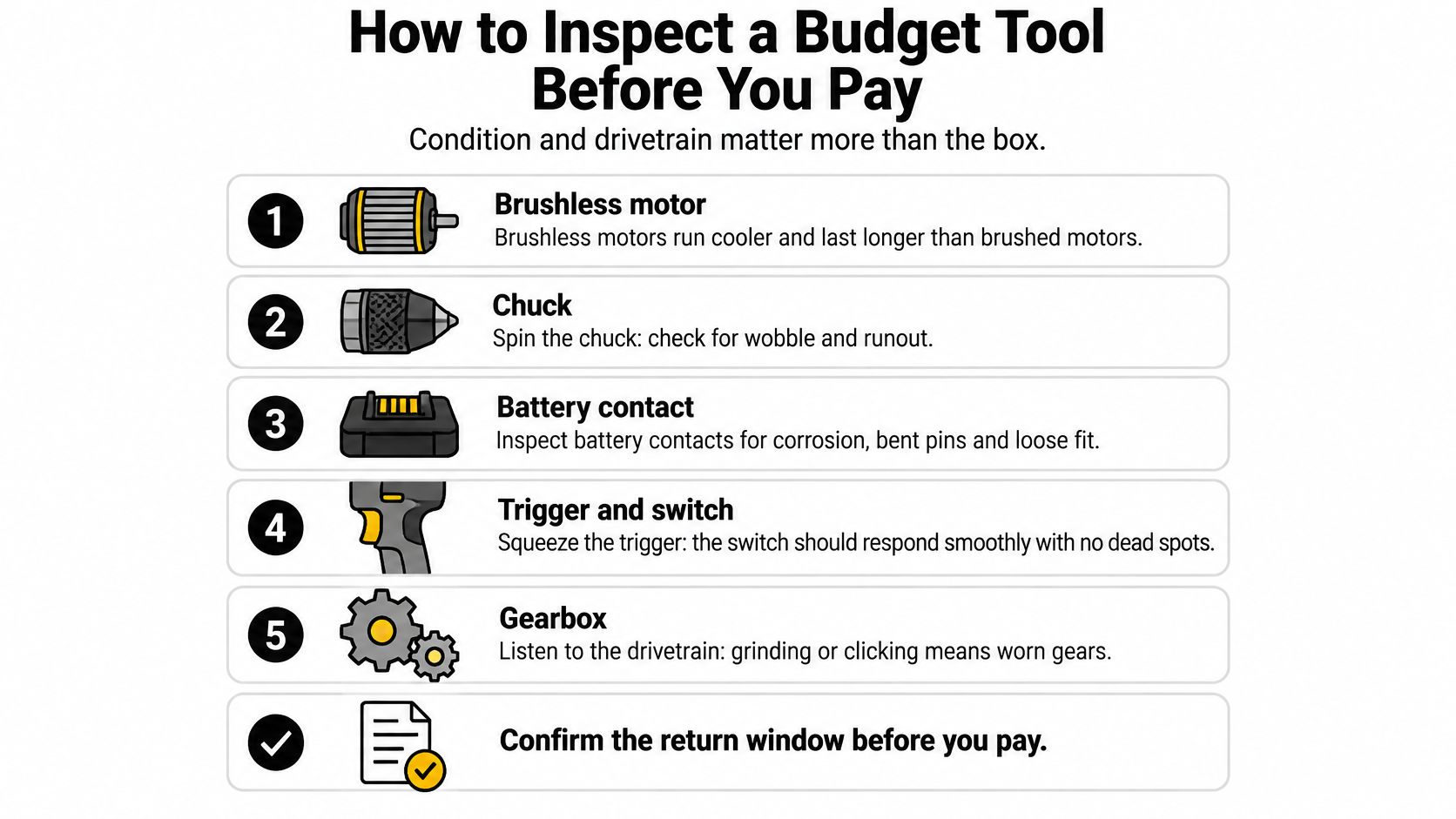
Judge a budget tool by its condition, controls, and drivetrain, not its packaging. A brushless motor can be an advantage for frequent use, but motor type alone doesn't prove durability; gearing, cooling, bearings, and previous treatment matter too. Inspect the gearbox construction where documented, and check the keyless chuck for secure gripping and visible wobble.
OSHA's hand and power tool guidance calls for tools to be maintained in safe condition and examined for damage before use. Apply that standard to new, open-box, and used equipment.
A Practical Pre-Purchase Inspection
- Start with the housing. Look for cracks around the handle, battery rail, gearbox mount, and screw bosses, plus loose screws or burn marks. Buyers often dismiss impact damage as cosmetic without checking whether the housing still supports the mechanism.
- Inspect the power connection. On corded tools, examine the plug, insulation, and strain relief; on cordless tools, inspect the battery housing and contacts. Swelling, cracks, corrosion, or bent terminals aren't acceptable trade-offs for a discount.
- Test the charger and battery together. Confirm that the charger recognizes the pack and displays the normal charging indication described in its manual. A working tool motor doesn't establish that the included battery will accept a charge.
- Run the tool unloaded. Where the manufacturer permits, run it briefly, listening for grinding and watching for unusual vibration, smell, or rapid heating. Don't assume a successful trigger squeeze proves that the drivetrain is healthy.
- Exercise the controls. Test forward and reverse, variable-speed response, and the drill's clutch settings. Sticky selectors and trigger dead spots are easy to overlook when the buyer focuses only on maximum speed.
- Check the safety equipment. Disconnect power before inspecting saw guards and confirm that the relevant movable guard operates and returns correctly. Never accept a tied-back guard or missing safety component as normal used-tool condition.
- Check mechanical movement with power disconnected. Inspect chuck operation and hand-tool ratchets for smooth engagement, following the manual rather than forcing a locked spindle. Fit a suitable bit and check retention, because smooth rotation alone won't reveal poor gripping.
Match Inspection to the Return Terms
Many of our products are inspected open-box and overstock items. That inspection should support, not replace, your own arrival checks, especially for accessories, battery fit, and application-specific operation.
Check replaceable wear items and legible model identification before accepting the purchase. A tool with readily available brushes, chucks, blades, or service parts is easier to keep working than an unidentified bargain.
A defective tool belongs out of service until it's properly repaired. A low purchase price doesn't compensate for injury risk or an interrupted job.
Battery Platform and Heat Limits in the Central Valley
Price the spare battery before deciding that a cordless set is cheap. The tool body may be discounted while the battery and charger needed to operate it make the complete purchase less attractive. Battery serviceability means you can obtain a suitable replacement pack and charger without replacing the whole working setup.
Start with the tools you use most often. Confirm that the chosen package includes your planned batteries and charger, then check whether later additions are available as bare tools, meaning tool bodies sold without those power components.
Compatibility Is More Than a Brand Name
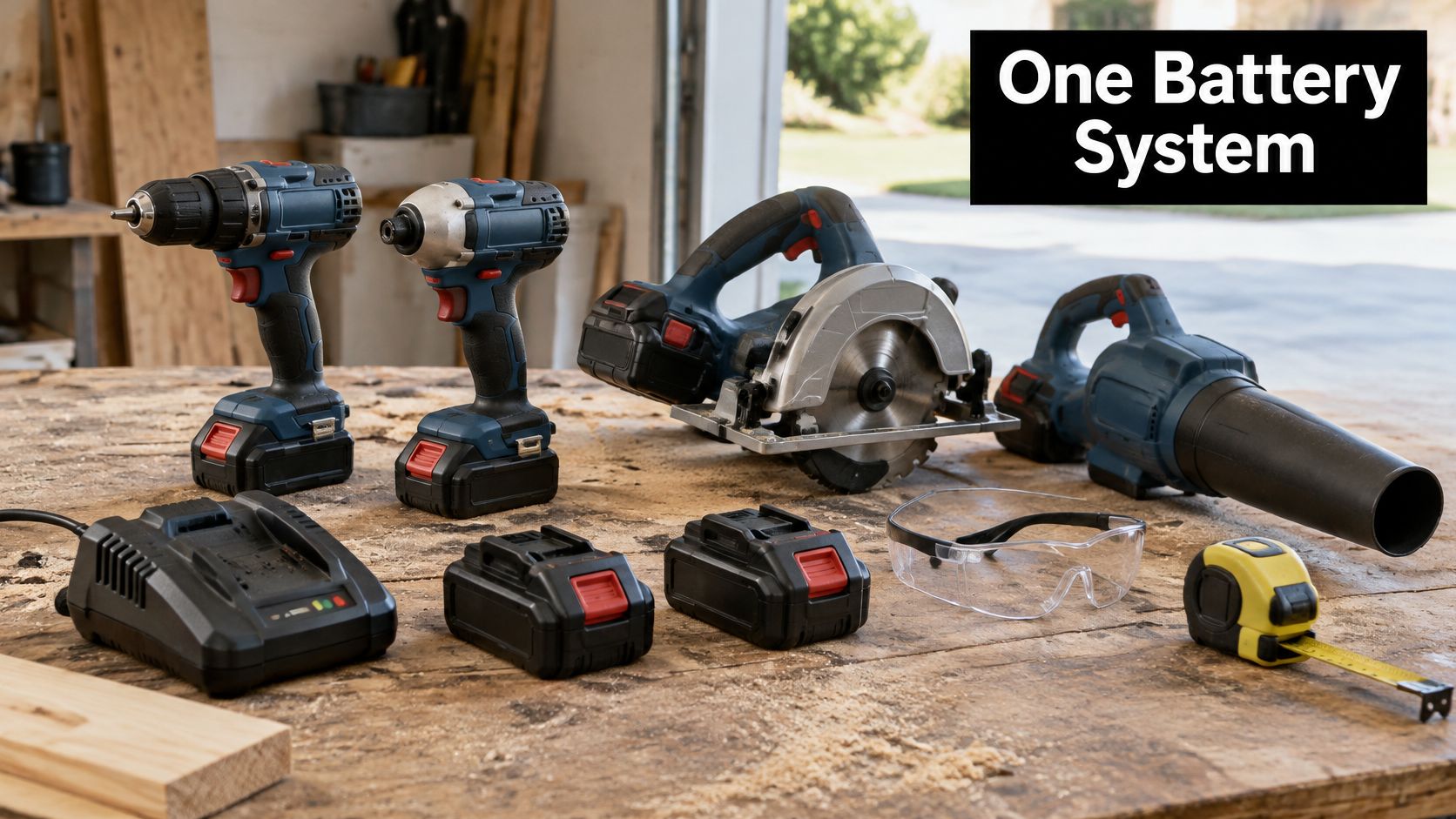
A drill, impact driver, saw, and blower can share power only when the manufacturer documents compatibility. The same brand can sell separate battery families, and a pack that physically fits through an adapter isn't automatically an approved combination.
Use our power tool battery compatibility guide when checking platform choices. Also check the battery capacity and type recommended for demanding tools; the smallest pack may improve handling on a driver without being the sensible choice for sustained saw work.
Avoid a mixed assortment that requires separate chargers for tools doing closely related jobs. For a new platform, I'd favor a useful spare pack over a low-priority extra tool.
Treat Heat as a Scheduling Constraint
Cal/OSHA's outdoor heat guidance requires shade when temperatures exceed 80°F, allows requested cool-down rest, and identifies 95°F as the start of stricter high-heat requirements for covered industries including construction. Worker protection and battery management are separate responsibilities. Neither a spare battery nor a brushless motor replaces water, shade, and rest.
For Sacramento and Central Valley summer work, build cooling time into the equipment plan:
- Rotate packs: Let a recently worked battery cool rather than immediately asking it to charge.
- Follow temperature limits: Use the battery and charger manufacturer's permitted charging and operating ranges.
- Store out of direct sun: Choose a shaded, dry location rather than a sun-heated truck bed or closed toolbox.
- Keep cooling equipment dry: If using an insulated container, keep batteries away from ice, condensation, and pooled water.
- Stop at warning signs: Don't bypass a charger's temperature delay or continue using a damaged pack.
For crews working above the high-heat threshold, my purchasing rule is to carry a spare pack for each heavy-use tool. That's an equipment recommendation, not a Cal/OSHA battery requirement. Full-time cutting crews should also assess charger capacity and available electrical supply.
New, Open-Box and Used Tools Compared on Real Cost
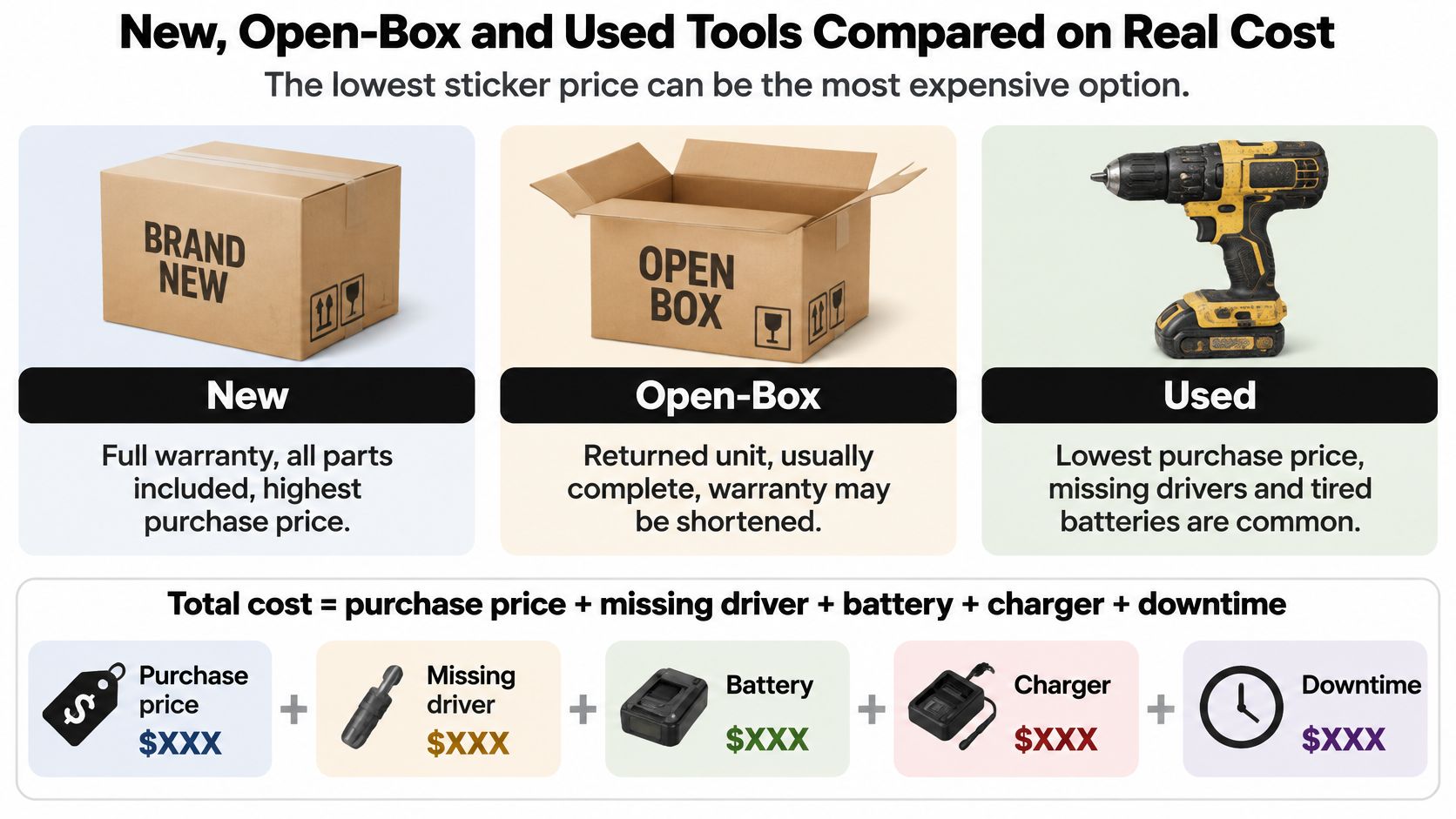
The lowest sticker price can become the most expensive choice when a missing driver or failed battery stops paid work. Compare purchase price, missing components, spare power, replacement access, secure storage, and downtime. An inexpensive tool is useful only if you can put it to work.
New, open-box and used tools compared
| Condition | Warranty coverage | Price position | Best use |
|---|---|---|---|
| New, full retail box | Manufacturer warranty as printed | Full retail | Crew tools and batteries used daily |
| Open-box, inspected and tested | 30-day guarantee on tested and inspected products; check manufacturer terms | Up to 55% off retail on eligible items | Drivers, saws and nailers you can test on arrival |
| Gently used or bare tool | Confirm seller coverage and manufacturer eligibility; bare describes contents, not condition | Compare the complete operating cost | Spare tools when you already own compatible batteries |
Bare tool and used tool aren't interchangeable descriptions. A bare tool can be new, open-box, or used. Its value depends heavily on whether you already own the power components it needs.
Where an Inspected Open-Box Tool Makes Sense
Value Tools Co sells top-brand power tools, accessories, and hardware at up to 55% off retail price. Every item is inspected and tested before listing, and our guarantee applies to tested and inspected products. Manufacturer warranty eligibility still needs checking on the individual listing.
For example, our RIDGID 18V Cordless 23-Gauge 1-3/8 in. Headless Pin Nailer Tool Only is listed at $132.00 in Open Box condition. It suits delicate trim positioning and small molding work where the specified pin is appropriate. It isn't a framing nailer, finish-nailer substitute, or structural fastening tool.
Its advantage is a lower-cost addition for someone already using compatible batteries. Its limitation is that tool-only pricing excludes the power supply. Check balance with your pack, nose access, firing operation, and fastener availability rather than assuming the small pin size guarantees easy handling.
Our buying used tools guide provides another checklist for evaluating condition and completeness.
Compare the Cost of Staying Operational
Say a crew already owns compatible packs and chargers and needs a backup impact driver. An inspected open-box body can fill that gap without duplicating equipment. Compare it with a new bare driver and a complete starter kit, not just whichever listing has the lowest headline price.
If the crew instead needs its primary driver and has no healthy batteries, a new kit may be the stronger purchase. It establishes a complete operating package rather than requiring separate purchases before work starts.
Total-cost test: Buy the option that leaves you able to finish the job if the most heavily used component becomes unavailable.
Buy open-box where you can test promptly and arrange replacement without derailing work. I'd favor new, supported batteries and a dependable charger for the power supply used every working day.
Where a Budget Set Falls Short and Where to Spend More
A general-purpose combo kit isn't a production system. Full-time framers need nailers rated for their workload, suitable fasteners, and enough available power to keep the crew working. Commercial electricians need properly rated test equipment and task-appropriate insulated tools that an ordinary household kit doesn't provide.
Who Should Avoid This
Avoid a starter bundle when your income depends on sustained cutting, repetitive fastening, specialized accessories, or a specific inspection requirement. Buy the required capability directly instead of paying for unrelated tools.
Our DEWALT 20V MAX XR 15-Gauge Finish Nailer Kit, listed at $269.00, illustrates a dedicated-tool purchase. It's a candidate for finish carpenters, not a replacement for a framing nailer or a delicate pin nailer. Confirm kit contents, weight, fastener specifications, condition, and warranty treatment before ordering.
Specifications and buying roles
| Product | Listed specifications | Practical role | Main limitation |
|---|---|---|---|
| DEWALT finish nailer kit | 20V MAX XR, 15-gauge, $269.00 | Dedicated finish fastening | Not structural framing or fine pinning |
| RYOBI compact drill/driver with bag | Corded, 5.5 Amp, 3/8 in., variable speed, $33.00 | Homeowner backup drill or shop drilling | Cord access and no cordless mobility |
The RYOBI 5.5 Amp Corded 3/8 in. Variable Speed Compact Drill/Driver with Bag is a reasonable low-cost candidate for occasional drilling near an outlet. Compared with a cordless drill, it avoids battery management but adds a cord; compared with an impact driver, it provides a different fastening mechanism. Don't select it as a crew's primary screw-driving tool because it costs less.
Put the Budget Into the Workload
Prioritize spending in this order:
- Power supply: Supported batteries and the appropriate charger.
- Primary driver: Comfortable handling, useful control, and suitable fastening capability.
- Cutting or fastening specialist: The saw or nailer that matches booked work.
- Supporting equipment: Accurate layout tools, serviceable hand tools, storage, and consumables.
Save on unnecessary duplication, not inaccurate levels or poorly fitting bits. Clean vents after work using the manufacturer's recommended method, store equipment dry, and keep model and serial numbers with purchase records for warranty and loss documentation.
Choose Your Set and Check Its Terms Before Ordering
The cheapest kit is the one that never stops a job. Pick the set that matches your work, choose a platform where batteries and chargers are easy to replace, and buy inspected open-box tools only when the listing states the condition and contents plainly. A RIDGID 18V pin nailer at $132.00 or a Milwaukee M12 jobsite fan at $78.00 is a fair price for the body alone, but a Tool Only listing sits idle until you already own the right battery and charger. Settle the exact models and power components before you approve a crew purchase.
Before Checkout
- Match the models: each tool should perform an operation already on your job list.
- Read the contents: establish whether the battery, charger, case and accessories are included, especially on anything marked Tool Only.
- Check condition: read the open-box notes rather than relying on the product photograph.
- Confirm protection: read the product-page guarantee terms and the manufacturer warranty before paying.
Our 30-day guarantee covers tested and inspected products, and every item is inspected and tested before it is listed. Qualifying orders ship free within the U.S., so confirm the shipping terms and stock status before scheduling work around a delivery date.
We commit to fair pricing, secure checkout, careful packaging and responsive support from order to delivery. Prices are shown in US dollars, and newsletter subscribers receive 5% off their first purchase. For later expansion, consult our cordless router and angle grinder buying guides before adding specialty equipment.
Frequently Asked Questions
What is the best budget tool set for homeowners?
A compact drill/driver, an impact driver and a saw matched to your cutting, all on one supported battery platform. Add hand tools and layout gear for the repairs you do.
Are open-box tools worth buying?
Yes, when the inspection notes, included parts, guarantee coverage and battery availability make the full purchase sound. Tool condition matters more than box condition.
Is a bare tool a better deal than a kit?
Usually only when you already own compatible, healthy batteries and a suitable charger. Compare the operating package, not the body price alone.
Value Tools Co sells inspected tools from established brands for buyers building a practical kit without paying for extras they will not use. Visit Value Tools Co, confirm your battery platform, and read the open-box notes before choosing. If the purchase is for a crew, call the team first so the order matches the work and the required power setup.


