

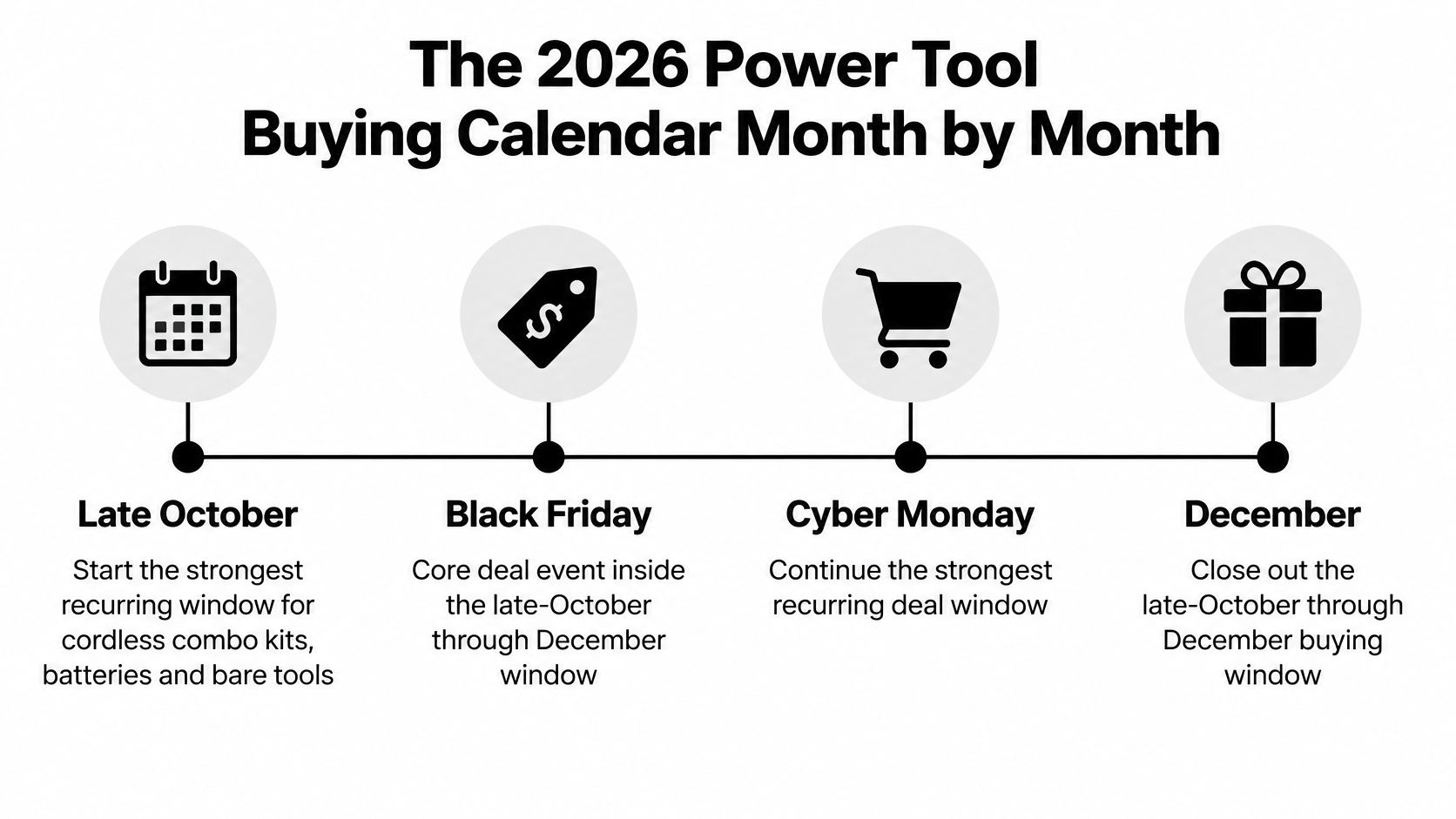
Late October through December, centered on Black Friday and Cyber Monday, is the strongest recurring buying window for cordless kits and batteries, while outdoor equipment bottoms out in late-summer and fall clearance instead. But the best time to buy power tools isn't always the next holiday, especially when a failed tool is holding up paid work.
A cheap kit can become an expensive purchase once you replace undersized batteries. A tested open-box tool can be the better buy today if it fits your existing platform and comes with a usable return policy. Buy around the job, the battery system, and the tool's condition, not just the sale banner.
The 2026 Power Tool Buying Calendar Month by Month
Treat this calendar as a working schedule. Retailers control individual offers, and the exact kit configuration you want can disappear before the window you circled arrives.
Best months to buy power tools in 2026
| Window | 2026 timing | Typical discount | Best categories to buy | Trade-off |
|---|---|---|---|---|
| Early Black Friday events | Late October to early November | Typically 15–25% on featured kits | Cordless combo kits, drills, impact drivers | Popular configurations can sell out |
| Black Friday and Cyber Monday | November holiday weekend | Roughly 20–35% on kits, batteries and bundles | Combo kits, batteries, chargers, bare tools | Oversized kits encourage unnecessary spending |
| December tool-only offers | December holiday shopping period | Commonly 10–25% on bare tools | Bare tools for existing battery owners | Fewer complete-platform bundles |
| January clearance and restock | After holiday inventory sells through | Roughly 20–40% on leftover and discontinued stock | Discontinued models, single tools | Limited platform selection |
| Spring promotion ramp | April to May | Typically 10–20% on featured tools | Saws, grinders, sanders | Don't assume the annual kit low |
| Memorial Day | Late May | Commonly 15–30% on single tools and kits | Replacement tools, corded tools | Compare kit contents carefully |
| Father's Day | June | Roughly 15–30% on kits and battery bundles | Kits, batteries, chargers | Included accessories may add little value |
| Late-summer outdoor clearance | Late summer | Roughly 10–20% on blowers and hedge trimmers* | Blowers, trimmers, hedge trimmers | Check battery inclusion and remaining stock |
| Labor Day | Early September | Commonly 15–30% on single tools and kits | Replacement tools, shop tools | Less emphasis on complete platform refreshes |
| Fall outdoor clearance | Fall assortment changeover | Approximately 30–50% on gas outdoor equipment* | Gas mowers, gas trimmers, outgoing outdoor equipment | Check parts and warranty |
| Holiday battery bundles | Holiday promotion period | Commonly around 20–35%* | Battery kits and combo bundles | Count only packs you'll actually use |
The calendar's rhythm tracks the ClarkDeals power-tool buying guide, which flags recurring deal surges around Labor Day and Black Friday, a pickup in activity during April and May, and Father's Day promotions in June. The starred ranges come from Tool Buyer Hub's seasonal equipment guide: roughly 10–20% on blowers and hedge trimmers in late summer, approximately 30–50% on gas outdoor equipment at fall clearance, and commonly 20–35% on holiday battery kits and bundles.
Check the assortment before you circle a date
Early holiday events are a price-check window. Watch how featured kits are configured before the busiest weekend. November rewards platform buyers; December favors shoppers who already own batteries and need another bare tool.
January clearance rewards flexibility and punishes specificity. A crew that needs one exact saw or nailer cannot plan around leftovers. In quiet months, keep a replacement list and buy from it, never from the markdown banner alone. A Milwaukee M12 jobsite fan listed at $78.00, or a RIDGID 18V headless pin nailer at $132.00 in open-box condition at Value Tools Co, can beat a hypothetical November price on a tool your crew needs this week.
For a small construction business, sort every purchase into urgent replacements, planned platform upgrades, and discretionary additions. Procright's explanation of how to segment procurement spend is a workable framework for that sorting.
Practical rule: Record the actual selling price of the exact model. A large advertised percentage means little when the reference price is above what buyers normally pay.
How Tool Category and Battery Ownership Change the Best Buying Window
A circular saw needed for tomorrow's subfloor isn't the same purchase as a mower you won't use until next season. Urgency, seasonality, and battery ownership decide whether waiting makes sense.
Year-round trade tools deserve opportunistic buying. Seasonal equipment deserves more patience, provided you can accept reduced selection and have somewhere suitable to store it.
Best buying window by power tool category
| Tool category | Strongest window | Discount pattern | Stock risk | Ideal buyer |
|---|---|---|---|---|
| Cordless combo kits | Black Friday, Father's Day | Platform-building bundles | Popular configurations may disappear | First-time platform buyers |
| Bare tools / herramienta sola | December, credible clearance | Tool-only markdowns | Exact model may be limited | Existing battery owners |
| Batteries and chargers | Holiday bundles | Savings tied to bundle contents | Desired capacities may sell out | Crews expanding a platform |
| Drills and impact drivers | Memorial Day, Labor Day, Black Friday | Single-tool and kit offers | Check local availability | Contractors replacing a tool |
| Saws and grinders | Spring promotions, Labor Day | Individual-tool offers | Model-specific | Remodelers and fabricators |
| Framing and finish nailers | Holiday offers, end-of-line clearance | Kit and tool-only opportunities | Specific configurations need checking | Finish and framing crews |
| Cordless blowers and trimmers | Late summer, early fall | Seasonal clearance | Declining selection | Property managers |
| Gas outdoor equipment | Fall clearance | Outgoing inventory reductions | Limited model-year leftovers | Buyers comfortable checking parts support |
| Corded tools and air tools | Any credible clearance | Evaluate the individual offer | Confirm specification and stock | Continuous-duty users |
These are buying priorities, not guaranteed stock forecasts. The Home Coupon Codes buying-window guide distinguishes gift-oriented platform bundles from the broader single-tool and kit promotions associated with Memorial Day and Labor Day.
Compare the system you'll actually use
A bare tool normally excludes the battery and charger. Our guide to what a bare tool includes helps identify the components you must already own or purchase separately.
Say a hypothetical kit includes two compact 2.0Ah packs, but your cutting work requires higher-capacity batteries. The kit's discount isn't your saving if those compact packs will stay in the case while you buy different batteries.
Compare these shopping baskets instead:
- Complete kit: Tool, usable batteries, compatible charger, and useful accessories.
- Bare-tool route: Tool plus any additional packs or charger the job requires.
- Existing-platform route: Tool only, provided your batteries are compatible, healthy, and sufficient for the workload.
An impact driver, or atornillador de impacto, may suit compact batteries for overhead fastening. A demanding saw can justify a different battery choice even within the same platform.
Don't pay for a generation change you don't need
An outgoing brushless, or sin escobillas, model can be sensible value. Compare torque, controls, weight, battery compatibility, and replacement-parts support rather than assuming the newest housing delivers a meaningful improvement.
Waiting also carries price risk. Contractor Supply's cordless-tool industry coverage identifies upward cost pressure involving tariffs and imported lithium-ion cells, motors, steel, and aluminum.
That doesn't justify panic buying. It does mean a needed tool at a defensible current price can beat a speculative holiday bargain.
Deal Tactics That Beat Waiting for the Next Sale
The useful discount is the difference between what you'll pay and the lowest credible alternative for the same working setup. Start with the model number, then investigate condition and package contents.
A buying procedure that keeps comparisons honest
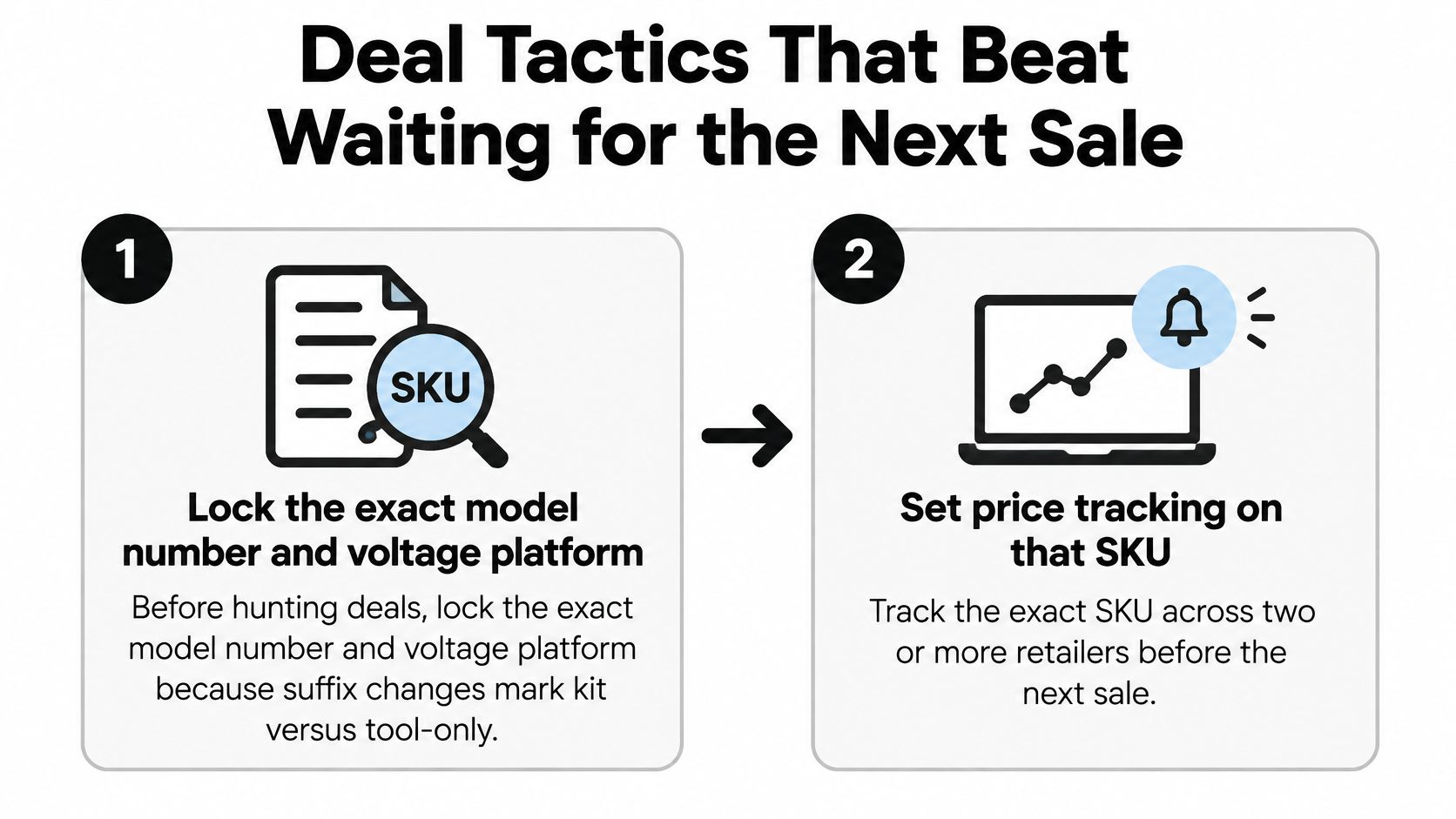
- Lock the model and platform. Record the full model number, voltage system, and package suffix. Similar-looking listings can contain different batteries or no batteries at all.
- Set price alerts for that exact configuration across competing retailers. Save the actual checkout price, including shipping, rather than the crossed-out reference price.
- Check tested open-box inventory before waiting. Value Tools Co sells top-brand power tools, accessories, and hardware at up to 55% off retail price. Compare condition and included components before treating that maximum saving as your expected result.
- Ask local stores about floor models and outgoing inventory. Inspect the chuck, shoe, adjustment locks, and contact surfaces because cosmetic wear and mechanical wear aren't interchangeable.
- Confirm stock before driving. Weekday mornings or month-end can be convenient times to speak with staff, but neither guarantees a markdown. A phone confirmation is more useful than guessing when a store might reduce prices.
- Negotiate with evidence. An in-stock competitor offer, missing accessory, or worn display case gives the seller something concrete to evaluate; if the price is fixed, ask whether a necessary blade or accessory can be included.
- Calculate the final delivered cost. Our newsletter gives 5% off the first purchase; check eligibility before completing checkout. Compare qualifying free shipping with pickup, particularly for bulky tools.
For local shopping options, our discount tool store guide helps frame the comparison around condition, availability, and return access rather than distance alone.
Use real prices as reference points
Our listed RIDGID 18V Cordless 23-Gauge 1-3/8 in. Headless Pin Nailer Tool Only is $132.00 in Open Box condition. That's a useful comparison for an existing compatible-platform owner, not a complete startup cost for someone without batteries.
Other listed reference points are the RYOBI 5.5 Amp Corded 3/8 in. Variable Speed Compact Drill/Driver with Bag at $33.00, and the DEWALT 20V MAX XR 15-Gauge Finish Nailer Kit at $269.00. Check current availability and contents before ordering.
| Buying channel | Advantage | Limitation | Best fit |
|---|---|---|---|
| Tested open-box retailer | Lower price with disclosed condition and a return route | Individual configurations may be scarce | Platform owners and budget-conscious professionals |
| Big-box holiday kit | Broad assortment and complete packages | Unneeded packs can inflate spending | Buyers establishing a platform |
| Private-party used tool | Potentially negotiable purchase price | Condition and return protection may be uncertain | Buyers capable of inspecting and repairing tools |
A low private-party price isn't automatically the cheapest working tool. Add missing batteries, consumables, repair risk, and your time before deciding.
Inspecting Open-Box and Bare Tool Deals Before the Return Window Closes
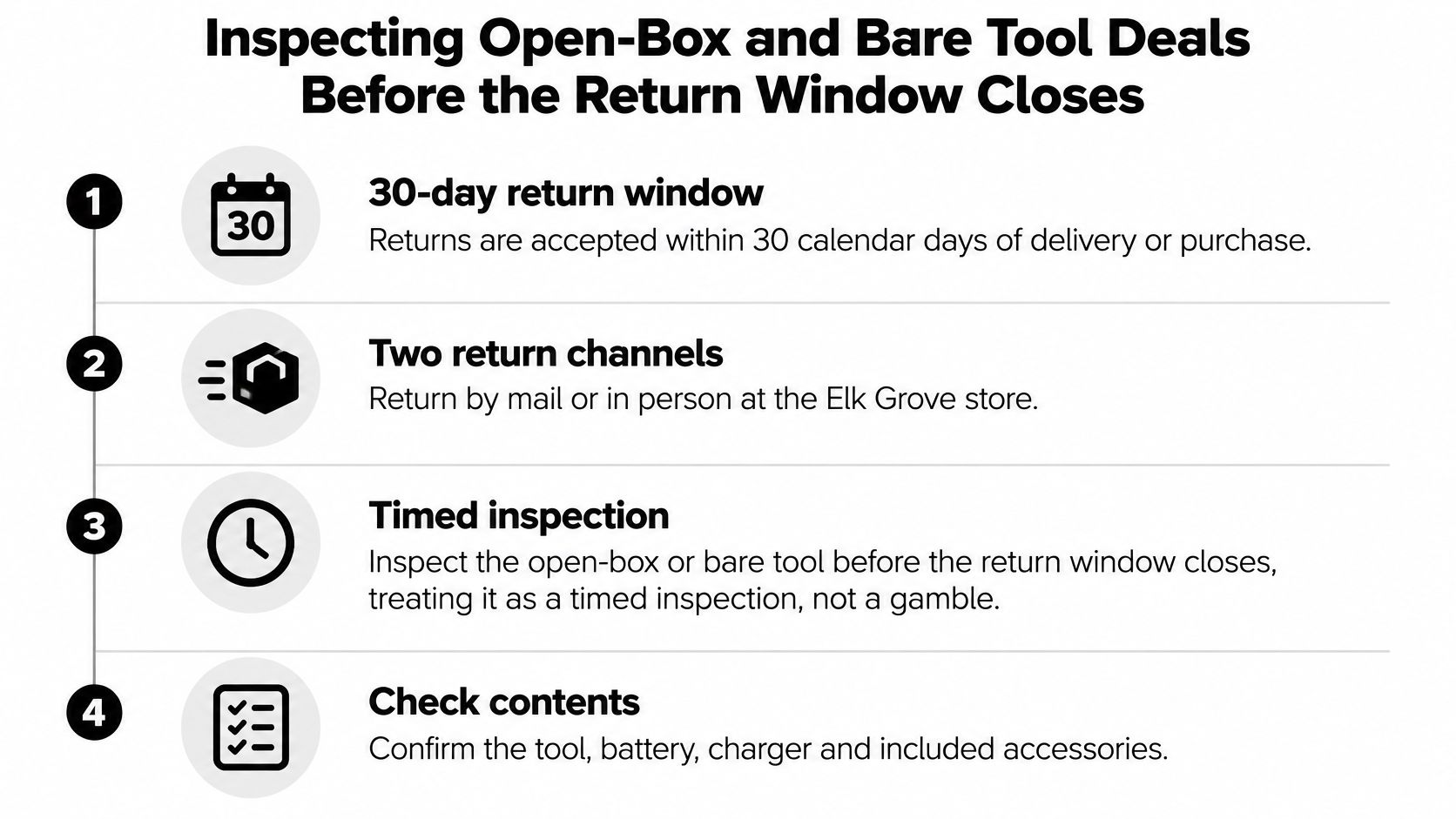
An open-box price only beats a holiday kit if the tool works. Treat delivery day as the start of a timed inspection, because the return window is the only real advantage you have on condition. Our open-box item guide explains what the condition label means, but the individual listing still determines what should arrive in the box.
Our 30-Day Peace of Mind Guarantee sets the clock on that inspection. Thirty days is enough time to run a pack through several charge cycles and put the tool under real load, so don't let the box sit unopened while the calendar runs. Keep packaging and accessories together, document arrival condition, and contact support through the store's FAQ page before attempting any repairs or modifications, since user-caused damage can make a return ineligible.
Run an arrival-day inspection
- Inventory the contents. Match the tool, battery, charger, case, guides, and accessories to the listing. Photograph discrepancies before using anything.
- Test under an appropriate working load. Drill representative material, make a controlled cut, or drive the approved fastener into scrap suitable for that tool.
- Check charging communication. Confirm that a compatible charger recognizes the pack and completes its normal charging sequence. Stop if the battery is swollen, cracked, leaking, or behaving abnormally.
- Work every control. Operate the trigger, brake, guard, lock-off, and adjustment mechanisms as applicable. Disconnect power before inspecting blades, bits, guards, or fastener channels.
- Record useful runtime. Note the battery condition, material, accessory, and workload. Amp-hour capacity alone doesn't establish a universal runtime, so avoid judging a pack against an unrelated task.
Battery history matters more than clean packaging
The Atlas Copco lithium-ion battery management guide identifies best performance around 20–25°C, generally recommends storage below 80% charge, and describes approximately 30–40% state of charge, 10–20°C storage, and humidity below 50% as useful storage targets. Follow the specific battery manufacturer's instructions where they differ.
A clean case tells you nothing about how the pack was stored. Ask about battery age and storage history, and skip listings that won't confirm whether a pack or charger is included, because a bare tool priced like a kit is where open-box deals go wrong.
The trade-off is straightforward: you get a lower purchase price and a defined window to run an operational test, in exchange for uncertain prior battery history, limited replacement inventory, and the possibility of missing original components. For a buyer already holding compatible batteries, a tested open-box tool inside a 30-day return window beats sitting out the season waiting for November. The calculation reverses for anyone who would need to buy packs and a charger just to complete the test.
This route suits contractors evaluating another platform before committing and homeowners controlling upgrade costs. One distinction matters before you rely on it: a retailer's return guarantee and the manufacturer's warranty are separate protections, and only one of them expires in 30 days.
Buying Around Sacramento Heat and California Jobsite Requirements
A summer promotion can put a cordless kit into a hot truck before it reaches its first job. For Sacramento and Elk Grove crews, the buying decision includes transport, storage, and charging arrangements during severe Central Valley heat.
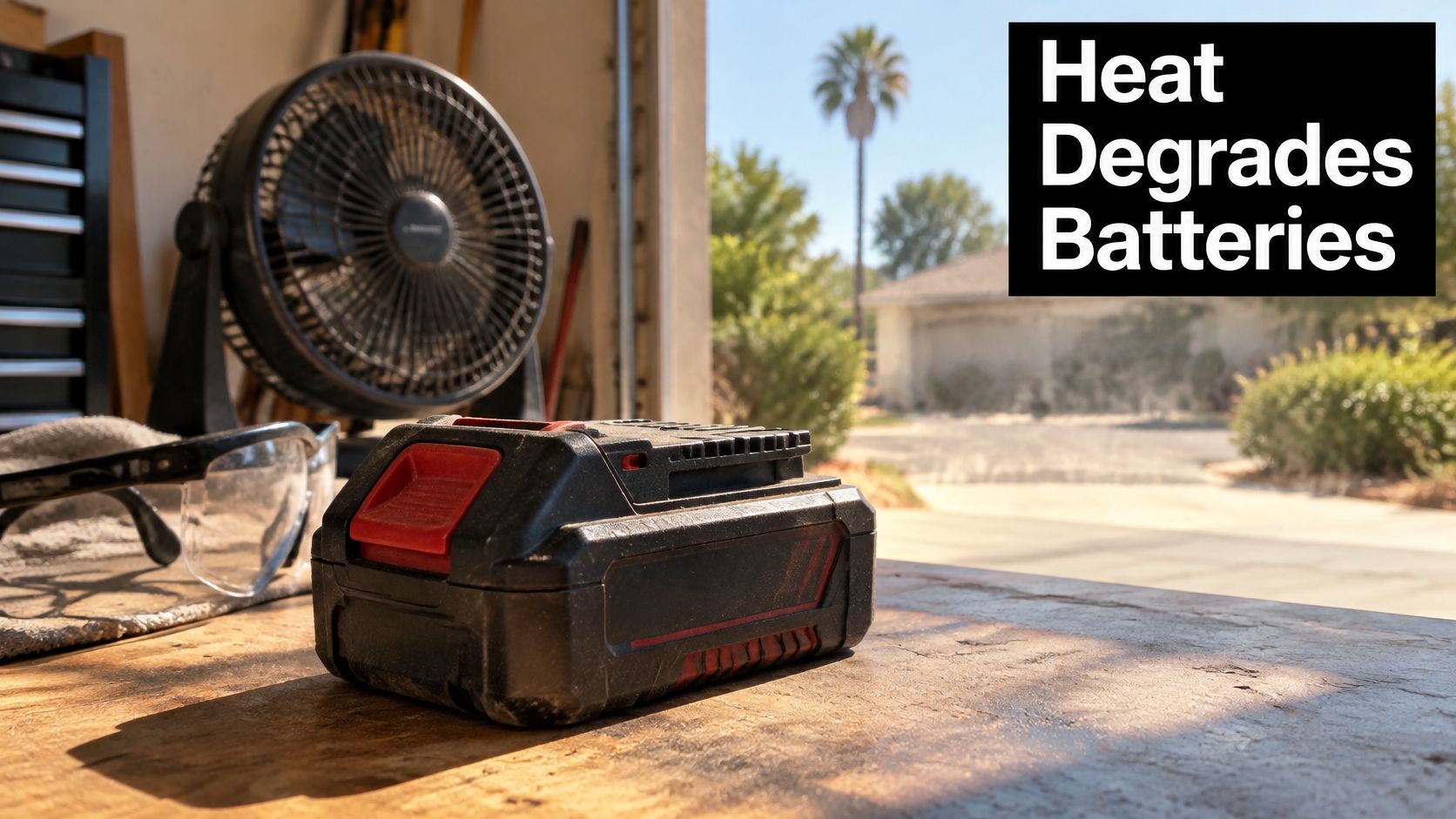
Justrite's lithium-ion storage guidance identifies temperatures above 149°F (65°C) as capable of degrading performance, damaging batteries, and increasing failure risk. Outdoor air temperature is not battery temperature, so a shaded forecast reading does not prove a pack left on a dashboard or trailer shelf is safe to charge.
Make battery cooling part of the purchase plan
Let a hot pack cool in a shaded, ventilated location before charging. Keep batteries out of parked vehicles, enclosed trailers, and direct sunlight, and do not force cooling with water or a refrigerator.
For summer purchases, prioritize disclosed testing and a clear return route. Check for abnormal heat and charging faults before putting the tool into production, rather than discovering a weak pack halfway through a roof repair.
A corded saw or grinder can be the better choice for continuous work near suitable power. Its advantages are uninterrupted supply and fewer battery-management demands; its disadvantages are cord handling, outlet access, and trip hazards.
Buy enough usable runtime for the workday, not merely enough batteries to make the kit look complete.
Buy the nailer that accepts the specified fastener
California framing purchases need a specification check, not a blanket assumption about nail-head rules. Where the approved plans call for full-round-head fasteners compatible with a 21-degree full-round-head framing nailer, that configuration is the relevant purchase.
Verify nail diameter, length, head style, collation angle, and the manufacturer's approved fastener list. Project documents and the local building department control the job's requirements; a discounted nailer that accepts the wrong fastener can interrupt production.
Pros include suitability for framing applications that specify compatible full-round-head nails. Cons can include bulkier magazines, additional consumable costs, and incompatibility with other collation angles.
Framing crews, remodelers, and inspection-sensitive projects benefit from matching the nailer precisely. Occasional pallet repair and nonstructural DIY do not justify buying this configuration solely because it sounds more professional.
Match fulfillment to the work schedule
Value Tools Co is an online tool shop based in Elk Grove, California, carrying DeWalt, Husky, Milwaukee, Makita, Ridgid, and Ryobi, with free U.S. shipping on qualifying orders. Confirm stock condition, included batteries or charger, and the delivery window before scheduling work around an order.
Choose the option that gets the correct tool to the job reliably, not the one that merely produces the lowest cart subtotal.
Who This Timing Strategy Fits and Who Should Buy Now Instead
Who This Is For
- Contractors refreshing a battery platform: Stage discretionary purchases for the broad holiday-kit assortment, and standardize chargers and batteries before adding specialty tools.
- Property managers and maintenance leads: Target seasonal clearance when outdoor-equipment replacement isn't urgent, with room to reject unsuitable leftovers.
- DIY homeowners starting from zero: Compare complete working kits with documented batteries and chargers rather than the cheapest tool-only listing.
- Sacramento-area tradespeople: Use local pickup and in-person return access to evaluate suitable inventory whenever it appears.
Who Should Avoid This
Waiting is the wrong strategy for a crew with a failed tool and an approaching inspection. The same applies when your only compatible battery has failed, a required discontinued model is disappearing, or a current acceptable offer could be lost while you speculate about tariff-related pricing.
Calculate the cost of interruption before deciding to wait. Rental expense, additional travel, and rescheduled labor belong in the comparison even when they don't appear on the receipt.
Misconceptions that lead to poor purchases
- Black Friday is always cheapest: Seasonal outdoor equipment and individual clearance tools don't follow one universal low-price date.
- A struck-through price proves savings: Only a credible comparison for the same model and contents establishes value.
- Open-box means untested: Our open-box offering includes tested and inspected tools; condition and completeness still need checking.
In its published estimates, Freedonia Group placed global professional power-tool demand at $27.7 billion in 2024, growing 3.7% annually, with construction representing 60% of professional power-tool sales. That scale helps explain manufacturers' interest in repeatable promotional cycles, but it doesn't establish the lowest price for your particular tool.
Buy now when the tool is needed for paid work. Wait when the purchase is discretionary.
Set Your Price Target and Place the Order
- Write down the exact model and target price. Include the batteries, charger, and accessories required to work.
- Compare current tested open-box and bare-tool stock against that complete cost.
- Order when the price and condition make sense. Don't gamble a productive workday on an unconfirmed future discount.
Our inventory spans power tools, hand tools, appliances, and accessories, supported by secure checkout, careful packaging, and responsive support. For additional comparisons, browse our cordless router buying guide, angle grinder review, Drills & Drivers category, and Air Tools category.
Frequently Asked Questions
What day of the week do power tools go on sale?
There's no reliably established universal weekday for power-tool discounts. Track retailer alerts and the exact model rather than waiting for a particular morning.
Do Prime Day and seasonal Prime sales beat Black Friday on tools?
An individual offer can be competitive, but there's no supported blanket winner across tools. Compare the exact model, included battery capacities, condition, and delivered price.
How long does a Black Friday tool deal typically last?
There's no standard duration, and an advertised event doesn't guarantee inventory throughout it. Check the offer's expiration and stock status, then purchase when it meets your target.
Does buying a bare tool without a battery void the manufacturer warranty?
Tool-only packaging alone doesn't establish that a warranty is void. Coverage varies by brand, seller eligibility, condition, proof of purchase, and registration requirements, so verify the specific manufacturer's terms.
Track the SKU, buy the tested open-box unit when the discount covers battery-replacement risk, and use the return window as your test bench.
Visit Value Tools Co to compare tested and inspected open-box and bare tools against your target price, with savings up to 55% off retail. Use the 30-Day Peace of Mind Guarantee, mail or in-store returns, and free return shipping on defective items to evaluate your purchase, and choose same-day Elk Grove pickup when the job can't wait.


