

Buying the cordless platform with the longest tool catalog is often the wrong advice. There's no universal best cordless tool battery system. The right buy is the platform you'll still own in five years, with enough useful tools, affordable replacement packs, and a charging routine that doesn't cook batteries through Sacramento summers.
For production framing and demolition, I'd start with Milwaukee M18. For remodeling and nailers, DeWalt 20V MAX is a practical commitment; for home maintenance, Ryobi ONE+ 18V deserves a close look. But a sale-priced bare tool isn't a bargain until you count the battery, charger, and spare required to finish the job.
Best Cordless Tool Battery System by Trade
A platform that saves money on the tool but adds heat-stressed packs and costly replacements is a poor trade. Choose around the work that earns space on your truck: framing crews need capacity for high-draw tools, installers may prioritize balance, and homeowners need a useful range without excess chargers.
Which cordless battery system to buy by job
| Job | Platform to commit to | Why it fits | Main tradeoff |
|---|---|---|---|
| Production framing and demolition | Milwaukee M18, with M12 for lights and compact tools when justified | M18 suits high-draw saws; M12 offers a separate compact line | Two families to inventory; batteries don't swap |
| Remodel, finish, and nailers | DeWalt 20V MAX | Compatible impacts, saws, and nailers can share a platform | Check 20V MAX and FlexVolt labels on the tool |
| Home shop and light maintenance | Ryobi ONE+ 18V | A broad, value-focused selection on one interface | Less suited to continuous framing work |
| Service work with registered tools | Ridgid 18V | Bare-tool value may suit buyers who confirm the current service agreement | Check specialty-tool availability before committing |
| All-day installation where balance matters | Makita 18V LXT | A practical shortlist for comparing tool handling | 40V XGT is a separate family, not an LXT pack |
Match the platform to the bottleneck
Milwaukee M18 suits framing and demolition when saws drive the purchase. Add M12 only if compact drivers or lights justify carrying a second battery family. A discounted accessory alone rarely justifies another set of packs and a charger.
DeWalt 20V MAX fits remodelers who move between impact drivers, or atornilladores de impacto, and nailers. Ryobi ONE+ 18V is a better match for a home shop with a blower, drill, light, and occasional repair tools than for continuous structural work.
Ridgid 18V is worth considering if you're prepared to confirm eligibility and complete any required registration. Makita 18V LXT merits a handling comparison for installation work. Fit the intended battery before judging an impact driver or saw; bare-tool weight alone doesn't show how the tool carries.
Fastener requirements come first. For metal roofing, the DF-14-PH3 screw for metal roofing provides a product reference for checking the specified fastening system. Select the driver and bit to suit the approved assembly.
Northern California buyers can check Value Tools Co's free U.S. shipping on qualifying orders, or call the Sacramento-area phone line to confirm stock before ordering a missing charger or tool.
Buying test: Compare useful compatible tools, pack replacement costs, and how your charging routine handles Central Valley heat. Catalog size alone won't show the five-year cost.
Compatibility Rules Before You Buy a Pack
A cordless platform is a matched battery-and-tool system, including the charger, rails, latch, contacts, and protection electronics. It isn't just a voltage sticker, and two packs marked 20V MAX aren't automatically cross-brand compatible.
The Power Tool Cell battery compatibility guide explains that Milwaukee M12 and M18 use different battery sizes, voltages, and rails, so their packs don't interchange, although a compatible dual-family charger can serve both. A shared charger reduces charging clutter; it doesn't merge the tool families.
Check the actual tool, not just the listing title
Before buying an open-box bare tool, or herramienta sola, work through these checks:
- Read the model number. Match the exact tool to the manufacturer's battery compatibility documentation.
- Identify the voltage family. Brand name alone isn't enough when a manufacturer sells separate systems.
- Inspect the slide-on rails and latch. The battery must seat and lock without force or modification.
- Compare the contact pattern. Don't assume similar-looking housings use the same electrical connections.
- Confirm the approved charger. Check the battery model against the charger's supported-pack list.
- Check the package contents. Tool Only means you must account for the battery and charger separately.
A brushless, or sin escobillas, motor doesn't create cross-brand compatibility. It describes the motor design, not the battery interface.
Within an approved platform, a larger amp-hour pack generally adds runtime rather than raising the tool's rated voltage. For example, a compatible 6.0Ah pack can generally replace a 2.0Ah pack, but adds weight, as explained in the Tool Compatibility battery FAQ. Check clearance and any pack restrictions on the specific tool before treating a larger battery as an automatic upgrade.
Don't turn a cheap pack into a safety experiment
Unapproved adapters may interfere with battery-to-tool protection communication and can jeopardize warranty support. A battery that physically powers a tool hasn't necessarily preserved its temperature monitoring or discharge protection.
Our power tool battery compatibility guide helps narrow the pairing before checkout. Use it to organize your checks, then confirm the exact combination in manufacturer documentation.
Reject the wrong-platform bargain, even if the case looks familiar. Unless there's a clear work requirement your current platform can't meet, add tools to the battery family already on the truck.
Major Platforms Compared on Range and Value
A long tool catalog does not guarantee the lowest ownership cost. Choose by the tools you'll use, the battery families they require, and the cost of adding packs and chargers. For Sacramento and Central Valley crews, heat exposure also makes pack replacement and rotation part of the five-year calculation.
Use this comparison to narrow the shortlist. Check each model's compatibility and package contents before buying.
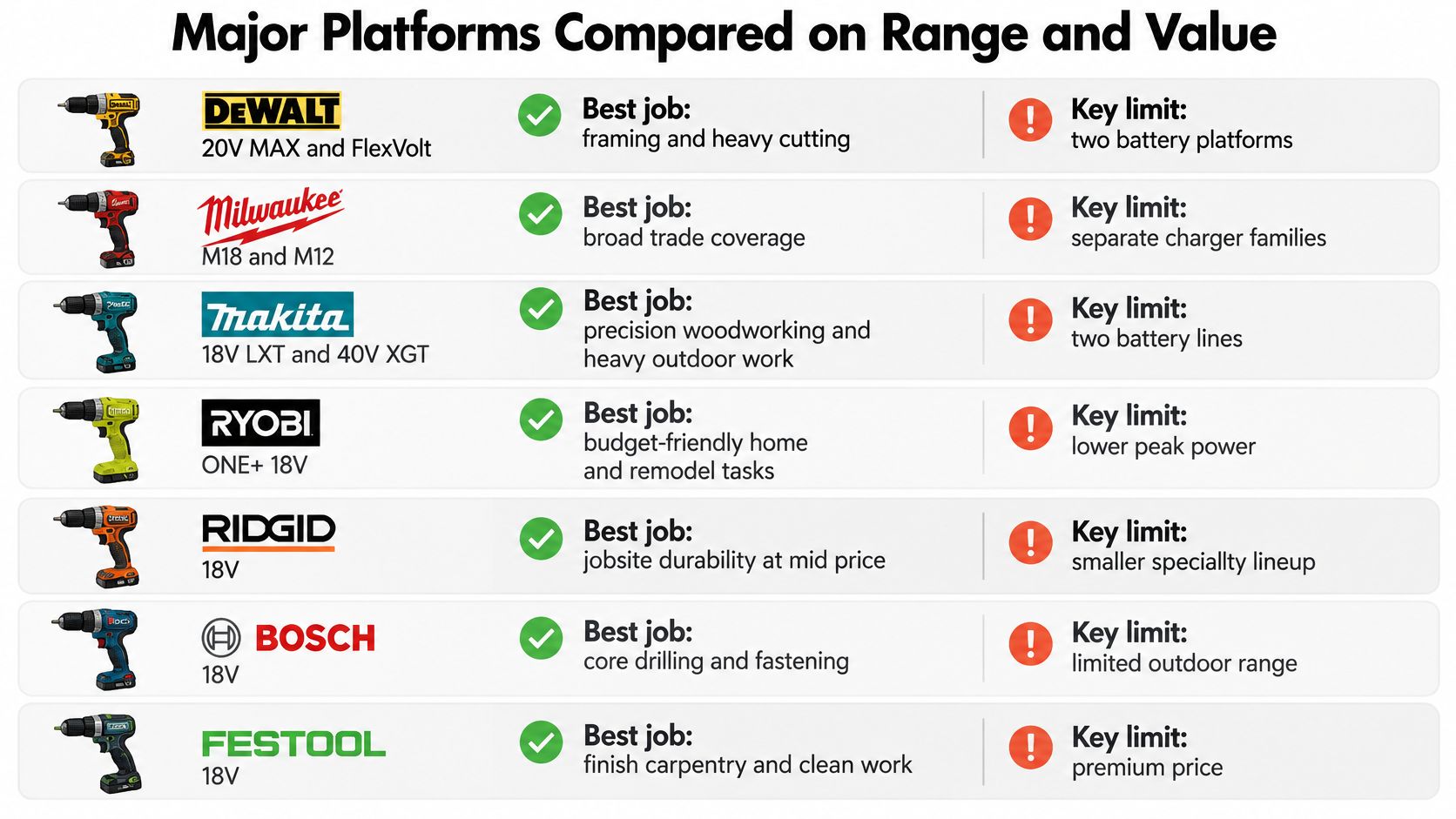
Cordless platforms by family, range, and limit
| Platform | Voltage families | Representative tool range | Where it earns its keep | Hard limit |
|---|---|---|---|---|
| DeWalt | 20V MAX and FlexVolt | Drills, impacts, saws, and nailers | Remodeling and framing work | Check each tool's FlexVolt compatibility |
| Milwaukee | M12 and M18 | Compact service tools and larger cutting tools | Crews covering mixed trades | M12 and M18 packs are separate families |
| Makita | 18V LXT and separate 40V XGT | Drills, impacts, and saws | Installation work where handling matters | XGT packs do not run LXT tools |
| Ryobi | ONE+ 18V | Home, punch-list, and light-maintenance tools | DIY and lighter maintenance | Compare specific tools for continuous production work |
| Ridgid | 18V | Drills, impacts, and service tools | Service work and value-focused additions | Confirm the product's service terms |
| Bosch | 18V | Drilling and fastening tools | Core drilling and fastening work | Check the specialty tools you need before expanding |
| Festool | 18V | Tools for finish carpentry | Finish work within an existing setup | A separate system adds cost |
Pros, cons, and the right owner
- DeWalt: A practical choice for remodeling and framing when the shortlist includes nailers, saws, and impact tools. FlexVolt compatibility varies by tool, so check the label before counting on a pack to work across the family.
- Milwaukee: M18 can cover larger cutting tasks while selected M12 tools suit compact service work. The trade-off is maintaining two battery families. It fits mixed-trade crews that need both.
- Makita: Compare LXT tools with batteries installed if balance is a priority. Adding XGT means supporting a separate family, so choose it for tools you expect to use, not catalog breadth alone.
- Ryobi: A sensible fit for serious DIY, punch-list work, and light maintenance. For continuous framing, compare the specific tool's capacity and handling with production-focused alternatives.
- Ridgid: Adding bare tools can make sense for a service kit. Confirm the exact product's service terms before treating them as part of the purchase value.
- Bosch: Existing Bosch packs are a good reason to keep the platform productive. Check that the specialty tools you need are available before committing to a wider setup.
- Festool: A strong candidate for finish carpentry when it fits the workflow already in place. Starting a separate battery system takes a clear job-based reason.
Check model-level performance before buying
Compare the actual saw or driver for vibration, loaded weight, and handling. A brand's reputation does not establish how a particular model will perform in your hands.
For framing, verify nail diameter, length, head style, collation, and the approved fastening schedule. A 21° full round-head nailer may suit a framing method, but its angle alone does not establish California seismic or building-code compliance.
Value Tools Co sells power tools from DeWalt, Husky, Milwaukee, Makita, Ridgid, and Ryobi, along with hand tools, appliances, accessories, and hardware. Check current product listings for the specific tool and package you need.
For another perspective on choosing a battery ecosystem, this video can supplement model-by-model comparisons.
Heat Runtime and Pack Rotation in the Central Valley
Heat can shorten battery life before the pack looks damaged. In a reported test described by GEB Power's temperature guide, a battery held at 113°F degraded approximately 6.7% after 200 cycles, compared with 3.3% at 77°F, more than twice the degradation under those test conditions.
That isn't a lifespan prediction for every tool battery. It is a strong reason to avoid leaving packs on roofs, in truck beds, or in direct sun during 100°F-plus Sacramento and Central Valley summers. Higher temperature can temporarily improve output while still accelerating permanent aging.
This rotation checklist belongs beside the charging station, not buried in the bottom of the tool bag.
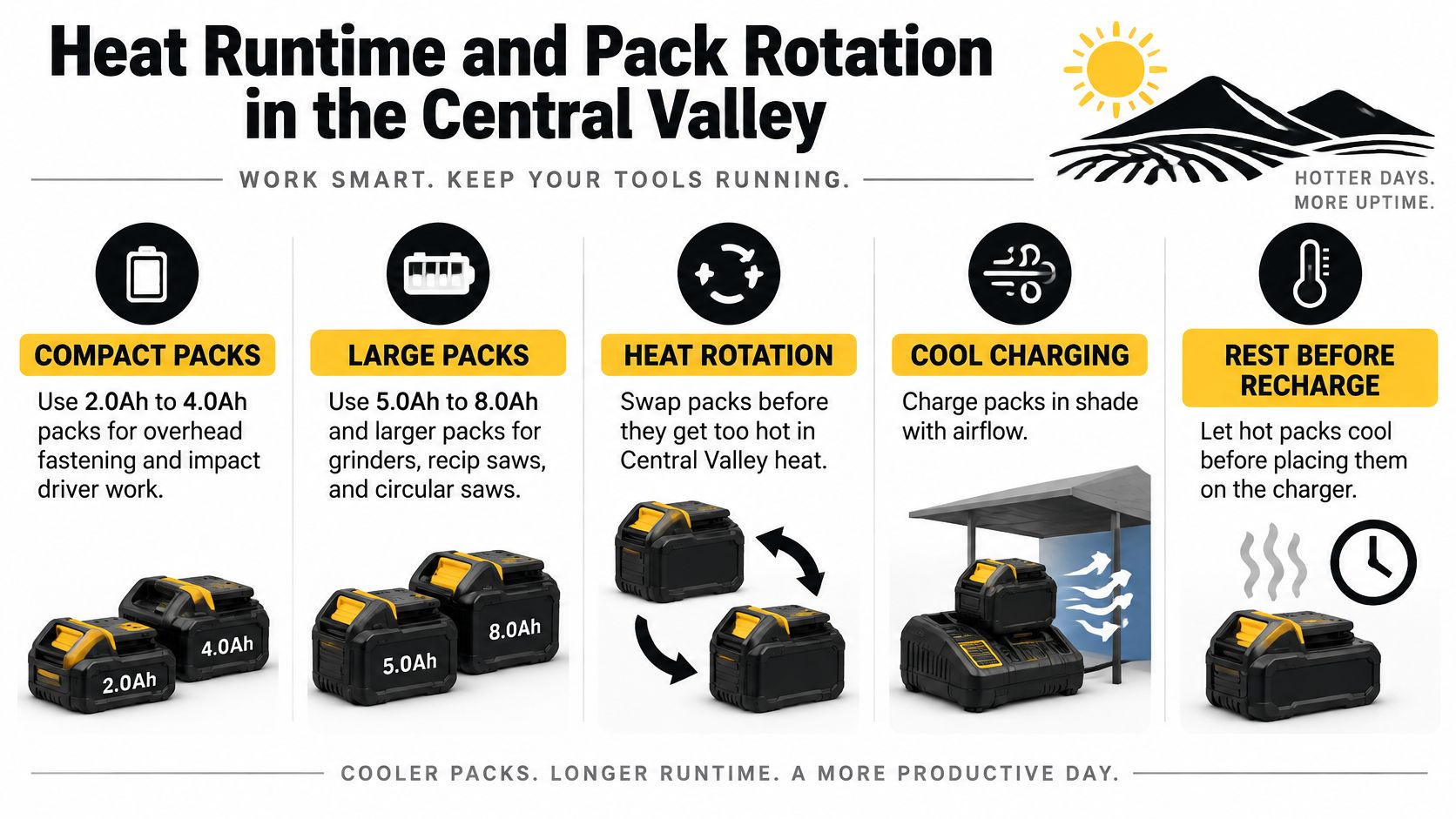
Size the pack for the task
As a starting setup, consider 2.0Ah to 4.0Ah compact packs for overhead fastening and impact-driver work. For grinders, reciprocating saws, circular saws, and extended nailer work, consider 5.0Ah to 8.0Ah or larger packs, subject to the tool's approved battery recommendations.
Those are shopping ranges, not promises of runtime or output. A compact pack keeps weight off your wrist during cabinet installation; a larger pack is more useful when repeated cuts would otherwise interrupt production.
The advantages of several packs are fewer forced stops and time for a hot battery to cool. The disadvantages are additional weight, purchasing cost, and the need to manage charging rather than dropping every exhausted pack straight onto a charger.
Use a repeatable cooling routine
- Remove the hot pack. Stop loading a battery that's overheating or repeatedly entering thermal protection.
- Set it in shade with airflow. Keep it off dashboards, hot pavement, and sun-heated metal.
- Let it cool before charging. Cool to the touch is a practical initial check, but follow the manufacturer's charging-temperature limits and charger indicators.
- Keep a compact punch-list spare. Leave the larger approved pack available for the saw instead of carrying it through every small fastening task.
A spare battery is useful only if you've kept it cooler than the one you just removed.
Outdoor contractors and maintenance crews benefit most from this discipline. A homeowner drilling occasional holes in a garage doesn't need a stack of large batteries to imitate a production setup.
Inspect open-box packs for correct platform markings, case damage, and normal charging behavior. Don't charge a swollen, cracked, or persistently hot pack, and don't interpret a charger accepting a battery as proof of full remaining capacity.
For sustained work beside reliable power, our cordless versus corded tools guide can help decide whether a corded grinder or saw would reduce battery demand altogether.
Five Year Ownership Cost Beyond the Tool Price
A bare tool's price is only one part of its five-year cost. Add the tools, batteries, approved charger, likely replacements, and charging-related downtime, then subtract a conservative resale estimate. Total ownership cost rises with the number of packs, charger capacity, and the workload the tools see.
A bare tool can be good value if you already own compatible packs. If you do not, include the cost of the batteries and charger before comparing it with a kit.
Ownership cost by usage profile
| Profile | Pack setup | Charger and spares | Replacement exposure |
|---|---|---|---|
| Daily remodeler | Two or three packs, including a mid-capacity pack | Fast charger and enough spare capacity to rotate packs | Highest pack churn and downtime risk |
| Property-maintenance worker | Compact and mid-capacity packs shared across a light, blower, and driver | Approved charger, with packs rotated across tools | Moderate exposure |
| Occasional homeowner | Kit battery suited to short projects | Kit charger, without an unnecessary duplicate | Lowest exposure |
These are suggested purchasing profiles, not fixed requirements. A remodeler running a saw continuously may need more charging capacity. A maintenance worker using a blower heavily should budget for it as a primary battery load, not an occasional accessory.
Include downtime and replacement uncertainty
For a working crew, compare the cost of a spare pack with the labor lost while people wait. A fast charger cannot eliminate every interruption. A hot pack may need to cool before charging begins.
A professional platform may cost less over time if it provides longer useful service, accessible support, and easier resale. Check those factors rather than assuming they come with the brand.
Common DeWalt, Milwaukee, Makita, and Ryobi packs are candidates for checking local resale demand. Compare completed sales for the exact model and condition, not optimistic asking prices. Discount packs with unknown histories.
Inspect used packs without guessing their capacity
Cosmetic scuffs don't automatically mean electrical damage, and a clean case doesn't prove the cells are healthy. Check more than appearance:
- Platform identity: Read the model and family markings, not just the color.
- Case condition: Reject swelling, cracks, separation, or signs of melting.
- Contacts: Look for burning, corrosion, deformation, and loose connections.
- Charging behavior: Confirm normal indicators on the approved charger, without repeated faults or unusual heat.
- Return protection: Prefer a purchase that gives you time to identify faults under normal use.
Use this battery-life maintenance guide to set storage and charging routines. Don't open a damaged pack or attempt cell replacement without an authorized service pathway.
Plan for end-of-life handling as well. A North Carolina lithium-ion battery recycling assessment projects approximately 3.45 million end-of-life lithium-ion batteries from outdoor equipment and power tools in the U.S. during 2025, rising to approximately 12.51 million by 2034. It identifies limited end-of-life information and unsafe packaging and shipping as challenges.
Use manufacturer take-back or an accepting household hazardous-waste facility, not household trash. Confirm handling instructions before transporting a damaged pack.
Who This Is For and Who Should Avoid It
A shared cordless platform makes sense when you'll keep adding compatible equipment and use the batteries often enough to justify them. It's less useful when a buyer collects unrelated sale tools and ends up maintaining several incomplete systems.
A coordinated kit also makes loading the van simpler: everyone knows which batteries belong with the saw, light, and driver.
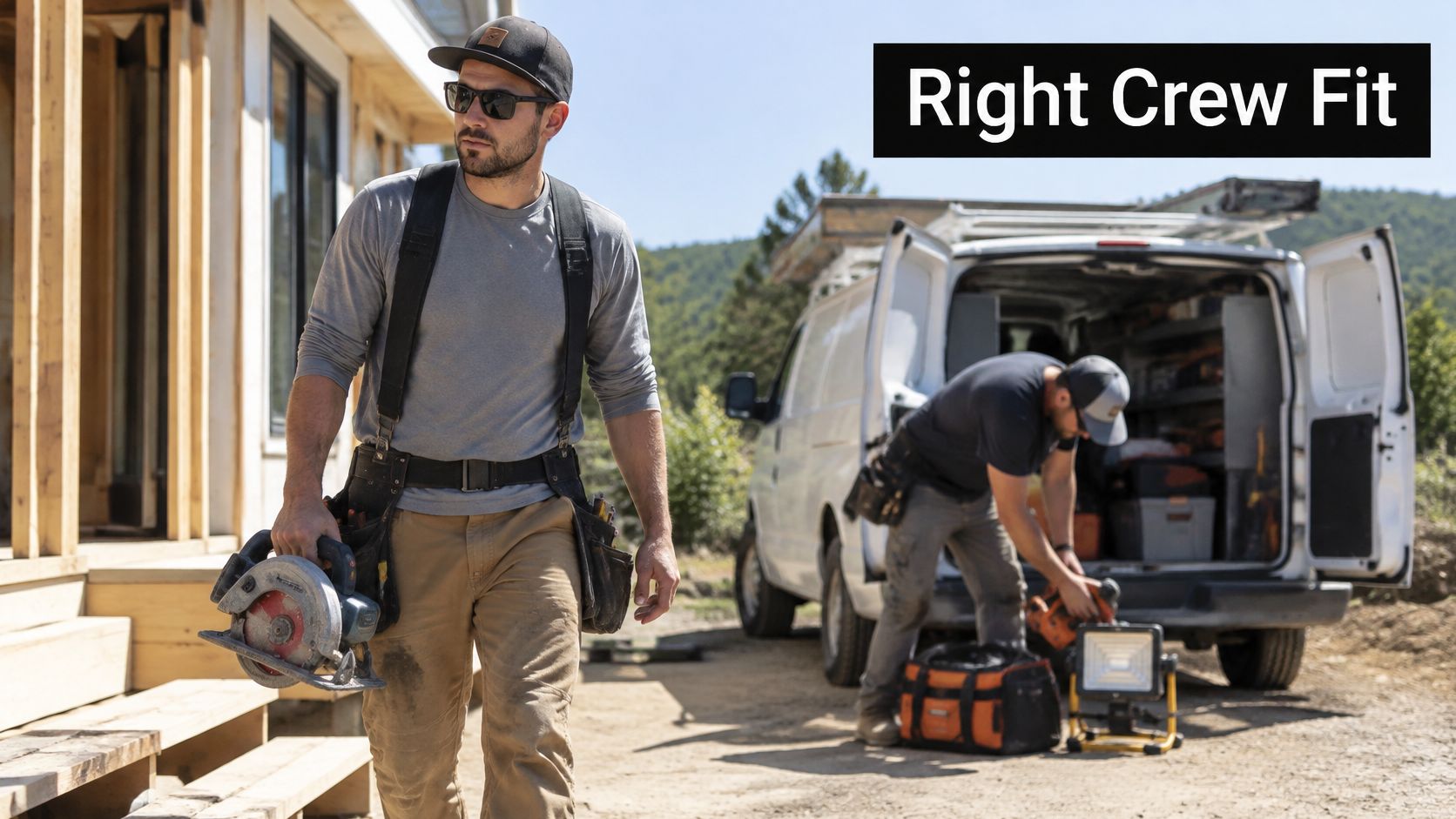
Who This Is For
- Framing and remodeling crews: Start with a saw, nailer, and driver family that supports the intended work, with a working pack and a spare as the minimum planning shape.
- Northern California maintenance businesses: Standardize the van around an approved charger and compact plus mid-capacity batteries, rather than a separate kit for every task.
- Property managers: A compatible drill and jobsite light make a useful starting combination when both are regularly needed.
- DIY buyers leaving corded tools: Choose Ryobi or a professional line you intend to keep, then start with a kit battery for short indoor projects.
For a maintenance business, equipment planning should follow the work you quote. AurenWell's handyman estimates and contracts can help organize job scope and documentation, making it easier to distinguish recurring tool needs from one-off requests.
Who Should Avoid This
- Adapter-dependent buyers: Don't build the plan around defeating battery communication or forcing unrelated systems together.
- Crews with a complete working platform: A discounted competing drill usually isn't a good reason to strand healthy M18 or 20V MAX equipment.
- Occasional users oversizing every pack: A large saw battery is unnecessary weight for a few cabinet holes.
- Registration-averse buyers: Don't choose Ridgid primarily for a service agreement you won't take the steps to qualify for.
- Anyone ignoring storage conditions: Standardization won't protect packs left in a closed truck through a Central Valley afternoon.
The best system is the one whose next three tools you'll actually buy, not the logo on today's drill.
Every group needs the same safety baseline. Remove swollen packs from service, preserve the tool's battery communication, and wear eye and hearing protection when operating nailers and grinders.
Choose by the next job sequence: cutting, fastening, cleanup, and lighting. If the proposed family doesn't cover those needs sensibly, a large catalog won't fix the mismatch.
Buy the Platform That Matches the Next Five Years
The lowest tool price can become the highest five-year cost if it leaves you with another charger, spare batteries, or a platform that doesn't suit your next jobs. Choose around the work ahead and the packs you can keep cool, charged, and in service.
- List your next three tools. Identify the likely sequence, such as fastening, cutting, and lighting. A platform's catalog matters only if it covers the tools you expect to use.
- Assess what's already on the truck. Keep using healthy, supported packs unless a specific job requirement justifies switching. Replacing working batteries and chargers adds cost without improving the tools you already own.
- Price the tool and pack together. Value Tools Co sells open-box and lightly used DeWalt, Milwaukee, Makita, Ridgid, and Ryobi tools, with savings of up to 55% off retail. Compare the bare-tool price with the cost of any batteries and charger you still need. Buy a bare tool when your existing packs can handle its workload; for outdoor production, budget for enough packs to rotate without recharging a hot battery.
- Check the listing before checkout. Confirm the model, battery interface, charger compatibility, and included accessories. Value Tools Co has a 2-day return window, so review the listing and order details promptly.
- Complete any required registration. Keep receipts, serial numbers, and service documents together. Registration requirements can affect the support available for some tools.
Future-proofing means choosing a system with replacement packs, chargers, and service you can access. The Power Tool Bench ecosystem guide covers proprietary interfaces, unofficial adapters, and repair pathways as factors in a long-term platform decision. A smaller supported system can make more financial sense than a larger catalog if it meets your work needs.
Do 18V and 20V MAX batteries interchange across brands?
No. Voltage labels don't establish compatibility. Use the manufacturer-approved battery family for the exact tool.
Can a bigger amp-hour battery replace a smaller one?
Usually, if both belong to the approved platform and the tool permits that pack. A larger pack adds runtime and weight; it doesn't automatically change the tool's rated voltage.
Do battery adapters turn two systems into one?
No. Unapproved adapters can compromise battery-protection communication and warranty support. Don't base a platform decision on using one.
How should I store tool batteries in hot weather?
Keep packs out of direct sun and closed vehicles, and store them in shade within the manufacturer's limits. Let a hot pack cool according to the manufacturer's guidance before recharging.
The best five-year choice is the platform that meets your upcoming tool needs without adding avoidable battery, charger, or heat-management costs. Visit Value Tools Co to compare open-box and lightly used tools from DeWalt, Milwaukee, Makita, Ridgid, and Ryobi, then weigh the tool price against the packs and charger your setup still requires.


