

Buying the fastest sander is often the wrong advice. For most cabinet, furniture and remodel work, the better purchase is a controllable variable-speed tool with effective dust extraction, available replacement pads and a power source that suits the job. Useful random orbit sander reviews should tell you what happens at the workpiece, not just repeat the speed printed on the box.
A slightly slower machine can cost less to run if it leaves a consistent surface and keeps dust out of the room. That matters when you're preparing cabinet doors in an occupied house or sanding through a Sacramento summer afternoon.
Which Random Orbit Sander Type Fits Your Work
A 5-inch variable-speed random orbit sander, or lijadora orbital aleatoria, covers most cabinet, trim, furniture and remodel work. Choose a 6-inch pad when broad, flat panels dominate your workload, then choose corded or cordless power according to how long you need to sand without stopping.
Random orbit motion combines an orbiting pad with rotation. That produces a less directional scratch pattern than a single-action orbital sander, but it doesn't guarantee a swirl-free finish. Keep the pad flat, move steadily and remove the previous grit's scratches before progressing.
Random orbit sander types and speed references
| Type | Pad Size | Power Source | Speed Reference |
|---|---|---|---|
| 5-inch corded, variable speed | 5 in. | Corded | Check model label |
| 5-inch cordless, 18V or 20V | 5 in. | Battery, matching M18 or 20V platform | Milwaukee test reference listed below |
| 6-inch corded | 6 in. | Corded | Check model label |
| 6-inch cordless | 6 in. | Battery | Confirm exact model and manufacturer speed rating before buying |
The Milwaukee M18 Fuel reference offers 6,000–12,000 OPM, according to the Pro Tool Reviews test. That test also reported resistance to bogging and low vibration, useful characteristics when you're controlling the tool across a wide cabinet panel.
The larger cordless category isn't a verified model recommendation here. Don't buy from a category description alone, especially when a listing photograph and its specification text disagree.
Choose control before maximum speed
Variable speed lets you adjust the same tool for removal and finishing. Lower settings help manage heat on painted surfaces and give you more control near veneer edges; higher settings suit open solid-wood surfaces when the abrasive and finish permit them.
A compact pad is easier to manage around cabinet components. A larger pad covers broad surfaces more efficiently, but it won't make a handheld tool a substitute for production floor-sanding equipment.
- Corded advantage: Continuous shop work without battery changes.
- Corded drawback: Cord routing around workpieces and finished surfaces.
- Cordless advantage: Easier movement between stairs, doors and scattered repairs.
- Cordless drawback: Battery weight, charging and replacement-pack costs.
Check whether the label specifies brushless, or sin escobillas. Motor design affects efficiency and heat behavior, but the brushless label doesn't establish usable runtime under load.
Buying rule: Settle the pad size and power source first. Then judge the extraction system before paying extra for a higher top speed.
How Dust Collection Changes the Real Cost of Sanding
A dust bag and a sealed extraction setup aren't equivalent. The bag provides collection at the tool; an effective vacuum-assisted system also depends on airflow through the abrasive, pad, hose connection and filter.
The difference is easier to understand visually.
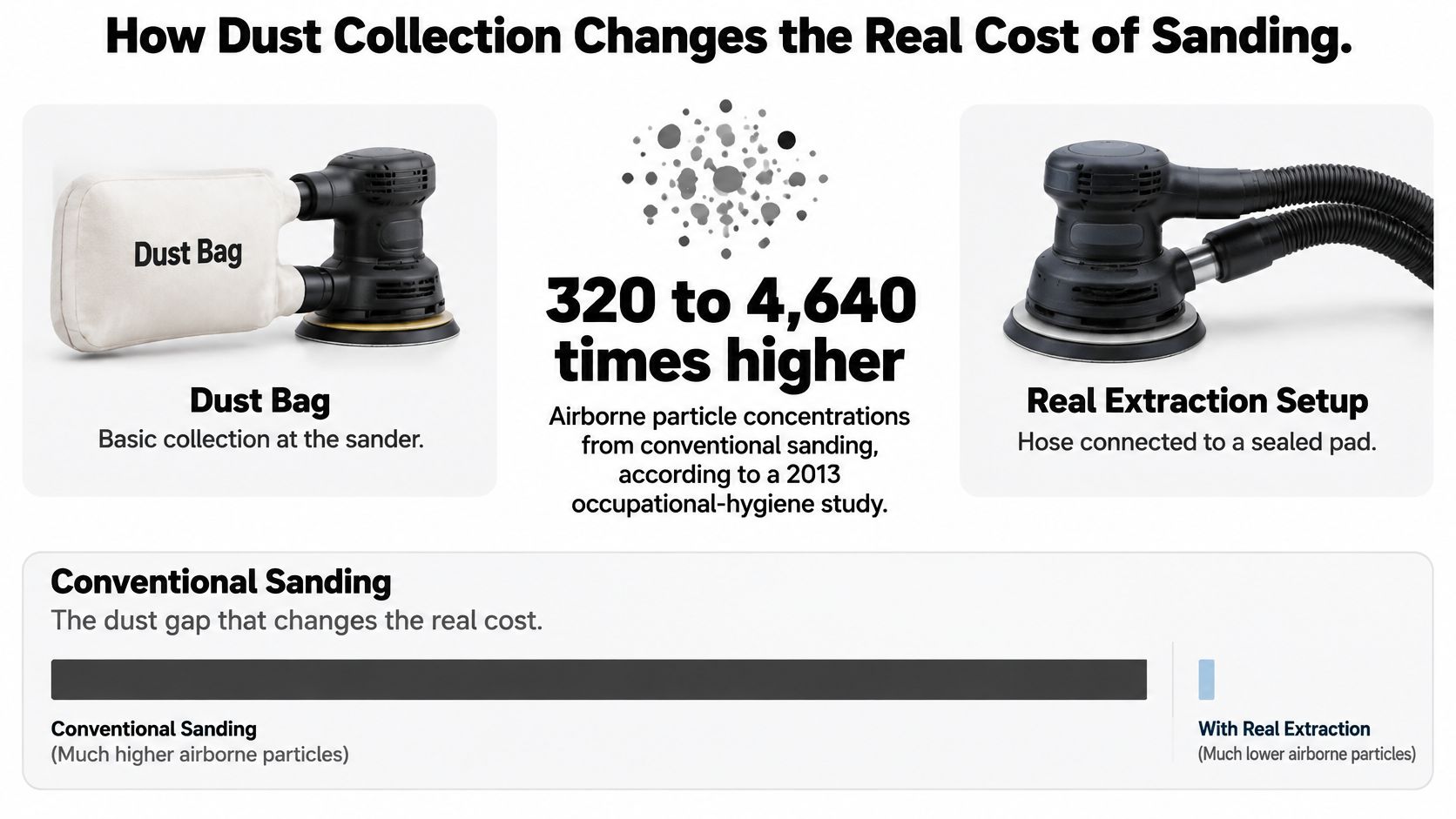
A 2013 occupational-hygiene study found that conventional sanding produced geometric-mean airborne-particle concentrations 320 to 4,640 times higher than a self-generated-vacuum system across wood, chromate paint and titanium dioxide. The vacuum system achieved 91–93% collection for wood and 96–98% for chromate paint.
Those results compare specific tested systems, not every bag-equipped sander against every shop vacuum. They also don't establish that collecting visible debris makes an unknown coating safe to sand. Before buying, check how the tool captures dust at its source.
Measured dust capture by collection method
| Dust Method | Reported Result | Context |
|---|---|---|
| Onboard dust bag | Up to 88% of sanding debris | Milwaukee M18 Fuel cordless test |
| Vacuum or dust extractor | 95% collection efficiency | Same Milwaukee test |
| Self-generated vacuum, wood | 91–93% collection | Occupational-hygiene study |
| Self-generated vacuum, chromate paint | 96–98% collection | Occupational-hygiene study |
| Conventional sanding without extraction | 320 to 4,640 times higher airborne-particle concentration | Study comparison with self-generated vacuum |
The Milwaukee figures describe collected sanding debris, while the occupational study also measured airborne concentrations. Those measurements aren't interchangeable, so don't use this table as a direct ranking of unrelated tools.
Inspect the complete airflow path
Attach the abrasive you intend to use. Its holes must align with the pad, the extraction port must hold the adapter securely, and the hose must stay connected while you move across the workpiece.
Inspect the filter and collection container rather than accepting a clean housing as proof of condition. A blocked filter or damaged seal can undermine an otherwise capable setup. Our random orbital sander dust-collection guide helps you evaluate those connections before purchasing.
For work extending from furniture into flooring, J.R. Hardwood Floor Refinishing & Cleaning's guide to mess-free floor restoration provides useful context for planning dust containment beyond the handheld tool.
This video offers an additional visual reference for sanding setup.
Count cleanup and workpiece visibility as operating costs. If you repeatedly stop to vacuum the surface or clean adjacent rooms, a cheaper tool can become the more expensive purchase. A slightly slower sander with effective extraction can be the better professional buy.
Speed, Finish and Checking a Used Sander Before You Pay
A low purchase price can disappear in the cost of a worn pad, missing adapter or battery that fails under load. Judge the complete working setup, not just the motor.
In its side-by-side test of variable-speed random-orbit sanders, JLC evaluated switch access, grip comfort, vibration, tracking, sanding consistency and dust collection. The tested Porter-Cable model delivered the fastest and most uniform finishing results among the group. That result applies to the specific model tested, not every Porter-Cable listing, so match the model before using the comparison to guide a purchase.
Judge the surface, not the unloaded sound
Test the sander on a secured scrap panel using representative material and abrasive. Check whether it tracks comfortably, the switch is reachable without shifting your grip, and overlapping passes leave an even scratch pattern.
Keep pressure light enough for the pad to rotate freely. Bearing down can interfere with rotation and make it harder to tell whether the abrasive is working properly. For coating work, sanding between coats for woodworkers offers useful context on light finish preparation versus aggressive material removal.
Run this used-sander inspection
- Check the controls and pad response. Operate the switch and try the available speed settings. A hesitant switch, intermittent operation or a setting with no noticeable response needs further inspection.
- Connect dust equipment with a disc attached. Check the airflow path under realistic conditions, not just whether an adapter fits an empty port. Look for obstructed holes, loose connections and escaping dust during an allowed test.
- Make a controlled pass under load. Listen for unusual changes in sound and feel for excessive vibration. Persistent rattling, erratic tracking or stalling under reasonable pressure are warning signs.
- Inspect the hook-and-loop pad. Attach a fresh disc and check that its edges hold securely. Worn hooks, torn foam, pad wobble or a replacement pad that is difficult to obtain can turn a discount into downtime.
- Verify cordless equipment. Confirm whether the listing includes a compatible battery and charger, then check operation under load. A charge indicator alone does not establish battery condition; unexpected shutdown calls for further investigation.
- Match the contents to the listing. Check the bag or canister, adapters, guards and other advertised accessories. Missing parts matter if they prevent connection to dust equipment you already own.
For a broader checklist on condition and package completeness, use this guide to buying used tools.
Understand inspection and warranty protection
Many Value Tools Co products are inspected open-box and overstock items. Open-box listings include a Value Tools Certified Inspection covering bench verification, functionality, cosmetic condition, package and included accessories, and inspector notes.
That inspection is not a long-term durability test or a manufacturer's warranty. Check the exact listing for item-condition details and warranty eligibility, particularly for open-box or lightly used equipment. Value Tools Co offers a concise 2-day return window, so review the applicable terms before buying.
Savings of up to 55% are most useful when the inspected setup is complete and ready to work. Factor in any missing accessories or parts you may need, and compare that total with the cost of a new tool.
Cordless or Corded in Central Valley Summer Heat
An unconditioned Sacramento garage changes the cordless buying decision. On a 100°F-plus workday, a battery may already be hot before sustained sanding adds more heat.
The Sacramento Metropolitan Air Quality Management District's extreme-heat battery document connects hotter summer conditions with higher battery temperatures and discusses cooling measures that support battery health. It isn't a handheld-sander runtime test, so it doesn't justify a specific runtime reduction for your tool.
Use a practical battery-cooling routine
Keep spare packs shaded and away from hot surfaces. Let a hot battery cool before charging, and follow the manufacturer's charging-temperature limits rather than trying to force a charge.
Don't store packs in a parked vehicle. Set up the charger in a cooler, ventilated location and keep its airflow clear of sanding dust.
- Continuous shop sanding: Choose corded power when an outlet is available and uninterrupted work matters.
- Stairs and punch lists: Cordless makes sense when relocating the cord would take more effort than the sanding.
- Remote repairs: Confirm you have enough charged capacity before leaving the shop.
- Repeated thermal shutdown: Stop and investigate the workload, pack temperature and tool condition rather than repeatedly restarting.
A cordless sander removes the extension cord, but adding extraction still means managing a hose. Don't pay a mobility premium expecting a completely untethered tool when your indoor work requires source capture.
Compare the complete battery purchase
A bare tool, or herramienta sola, is cheaper only when your existing batteries and charger make the package economical. Confirm platform compatibility, pack availability and overload behavior, not just the amp-hour rating.
A battery used in your impact driver may fit the sander yet change its balance enough to affect comfort on vertical surfaces. Handle the intended combination when possible.
Our corded-versus-cordless tool comparison helps separate mobility benefits from operating costs.
Add the cost of a spare pack and any required charger before comparing a bare cordless sander with a corded alternative.
Who This Is For and Who Should Avoid This
Finish carpenters and cabinetmakers need predictable scratch removal, comfortable handling and a reliable vacuum connection. Remodelers and maintenance crews benefit from a compact cordless tool for scattered repairs, while homeowners restoring furniture can cover substantial ground with a versatile variable-speed sander.
Match the setup to the work, not to the most expensive machine you can justify.
Sander choice by job and dust setup
| Your Work | Sander Pick | Dust Setup |
|---|---|---|
| Cabinet and furniture finishing | 5-inch variable speed, corded or compatible cordless platform | Shop vacuum with suitable filtration and sealed connection |
| Punch lists, stairs and remote repairs | 5-inch cordless with spare battery | Bag for light work, extraction for sustained sanding |
| Large panels and floor prep | 6-inch corded for appropriate localized preparation | Dust extractor required for this recommended setup |
| Occasional home touch-ups | Budget 5-inch, corded or cordless | Bag plus ventilation and appropriate protection |
| Heavy coating removal or narrow inside corners | Not the right random orbit sander application | Choose a belt sander, scraper or suitable hand tool |
Who This Is For
Production users should prioritize sealed extraction, replaceable wear parts and manageable vibration. The drawback is extra equipment, filter maintenance and a hose that can resist your movement.
This cabinet-door application illustrates where controlled handling matters more than aggressive removal.

OSHA's woodworking guidance lists an eight-hour permissible exposure limit of 15 mg/m³ for total nuisance dust and 5 mg/m³ for the respirable fraction. It also identifies respiratory symptoms and cancer among wood-dust hazards; those limits aren't proof that a particular sanding setup is safe.
Use eye protection and a properly fitted respirator when required by the material, exposure assessment and applicable workplace requirements. A dust bag doesn't replace ventilation or personal protection, and visible cleanliness doesn't establish airborne exposure.
Who Should Avoid This
Skip a general-purpose random orbit sander when the main job is rapid, heavy coating removal. A belt sander or an appropriate stripping method is the more direct choice, after identifying the coating and required controls.
The round pad also won't reach a narrow inside corner. Use a detail sander, scraper or sanding block instead of tipping the disc onto its edge and damaging adjacent surfaces.
Occasional outdoor users may not need the same extraction capacity as a cabinet shop. They still need to control dust and protect themselves. If corners or bulk stripping dominate your workload, buy the appropriate tool rather than forcing a finishing sander into that role.
Reviewed Models Milwaukee M18 Fuel and Porter-Cable 5-Inch Sanders
These two 5-inch sanders suit different priorities. The Milwaukee has reported cordless operating and dust-collection results; the Porter-Cable's cited strength is finish performance in JLC's comparison. For professional work, weigh those results alongside extraction needs, battery costs and the finish required.
Specifications and results for the reviewed 5-inch models
| Model | Pad | Power | Speed (OPM) | Dust Capture |
|---|---|---|---|---|
| Milwaukee M18 Fuel 5-inch cordless | 5 in. | M18 battery | 6,000–12,000 | Bag up to 88%, vacuum 95% |
| Porter-Cable 5-inch variable-speed | 5 in. | Corded, variable speed | Not reported | Not reported |
The Milwaukee's listed speed and dust-collection figures are reported test results. The cited Porter-Cable comparison supports a finish-performance assessment, but does not provide model-specific speed or dust-capture figures here. Treat its finish result as a reason to consider the tested sander, not as evidence that every Porter-Cable model performs the same way.
Milwaukee M18 Fuel for mobile finishing
The Milwaukee fits repair and finish work where moving freely matters and a battery platform is already part of the tool setup. Its reported low vibration and resistance to bogging support repeated sanding, while connected extraction remains an option when dust control matters more than mobility.
- Pros: Reported collection performance, controlled operation under pressure and low vibration.
- Cons: Battery costs, charging interruptions and battery heat during sustained work.
- Ideal user: A mobile contractor with compatible M18 batteries.
- Alternative: A corded variable-speed sander for continuous bench work.
Battery convenience has a cost beyond the tool. Include spare packs, charging time and extraction equipment when comparing total setup cost. Inspect the pad mount, housing, battery interface and dust-port connection before purchase. The cited test does not establish long-term durability or the condition of an individual open-box sander.
Porter-Cable for finish consistency
The tested Porter-Cable is worth considering for furniture and cabinet work where uniform scratch removal matters. Its cited comparative finish result is useful, but the available comparison does not establish a dust-capture percentage or exact listing specifications.
- Pros: Finish consistency and productive sanding in the cited comparison.
- Cons: Dust capture, listing details and warranty coverage are not established here.
- Ideal user: A finish-focused buyer who can confirm the listed sander matches the tested model.
- Alternative: Milwaukee when cordless mobility is the priority.
For either model, assess grip comfort with the intended hose or battery attached, and inspect the pad before use. Proper extraction can make a slower sanding setup the better professional choice when it captures dust more effectively and limits cleanup.
Recommendation: Choose the Milwaukee for mobile work where compatible batteries and extraction suit the job. Consider the tested Porter-Cable for finish consistency, but confirm the model identity, replacement-pad availability and warranty terms before buying.
Frequently Asked Questions About Random Orbit Sanders
What is a random orbit sander best for?
A random orbit sander suits cabinet parts, furniture, trim and broad wood surfaces that need smoothing before finishing. Use a compact pad for mixed repair work; choose a larger pad when wide panels make up most of the workload.
Is a dust bag enough?
A dust bag can manage light sanding, but it does not replace source extraction. For sustained work, connect suitable dust collection and use the respiratory protection required for the material and exposure. Poor capture adds cleanup and can leave dust in the work area.
Should I choose cordless or corded for Sacramento summer work?
Corded tools suit continuous shop sanding, while cordless models make mobile repairs easier when a cord would get in the way. Keep spare batteries shaded, let hot packs cool before charging, and avoid leaving them in a parked vehicle. Heat can interrupt work and affect battery charging.
What does OPM mean?
OPM means orbits per minute. It describes the pad's orbital speed, not its rotation. A higher OPM rating alone does not guarantee a better finish. Abrasive condition, pad tracking, pressure and dust removal all affect the result.
Is an open-box sander worth buying?
It can be, if the pad, dust port, controls and advertised accessories are in acceptable condition and the complete setup costs less than the alternative. Check the inspection notes for the item's functionality, cosmetic condition, packaging and included accessories. Treat visible appearance as only one part of the assessment, not proof that the sander is ready for work.
Choose Your Sander and Buy With Confidence
A good sander is the one that handles your regular work without adding avoidable cleanup, charging delays or finish repairs. Match the tool to the job, not just to a familiar brand. A larger pad may speed broad-panel work, but it can be awkward on narrow cabinet parts.
Match the purchase to the workload
- Continuous shop work: Choose a corded variable-speed sander with a sound pad and a secure extraction connection.
- Mobile trim and punch lists: A compact cordless platform suits work where moving a cord would slow you down. Include battery capacity in the cost.
- Broad panels and localized floor preparation: Consider a larger pad only when the tool fits the material and task.
- Corners or heavy stripping: Choose a tool designed for that work rather than pressing harder with a random orbit sander.
Compare the Milwaukee and Porter-Cable recommendations with the exact listing. Brand recognition cannot make up for a missing model number, worn pad or incomplete accessory package.
Price a ready-to-work setup
Compare the full cost: abrasive discs, a replacement pad if needed, an extraction adapter, suitable filtration and, for cordless tools, batteries and charging equipment. For repeat jobs, track abrasive and consumable use per completed door or panel. A lower bare-tool price can still lead to higher ongoing costs.
Read the listing's inspection details and check the manufacturer's warranty terms. Value Tools Co has a concise 2-day return window, so test the tool promptly after it arrives. Confirm the exact model, pad size, condition and included accessories on the listing before ordering.
Check current listings for DeWalt, Makita, Milwaukee, Ridgid, Ryobi and Husky rather than assuming a particular sander is available. Choose dust collection before prioritizing speed, then compare complete working setups instead of bare-tool prices.
Your next step is straightforward: pick a listing suited to your main job, review its inspection record and confirm the connections needed for your dust setup.
Value Tools Co sells inspected open-box and overstock tools, with condition and accessory details to help shoppers compare working value. Visit Value Tools Co to check available sanders against your dust setup and battery platform, then choose a package that fits your work.


